Foram encontradas 48 questões.
Disciplina: Inglês (Língua Inglesa)
Banca: DIRENS Aeronáutica
Orgão: EPCAR
TEXT
Your digital footprint
Every time you go online you leave a trail. This is just like a real footprint. It reveals where you’ve been, how long you stayed and what you’ve been doing there. Every time you register for an online service, send an email, download a video or upload a photo, the information can be accessed and your digital footprint can be revealed. This shouldn’t necessarily be worrying but it is advisable to be aware of your digital footprint and to be cautious and sensible when you are online. Six top tips for taking care of your digital footprint
Don’t forget to log off when you leave a website, especially if you are using a shared computer. If you don’t, someone can easily pretend to be you!
Don’t tell anyone your passwords and don’t write them down in an obvious place. Make them more complex by using a combination of letters, numbers and punctuation marks.
Tell an adult if you come across anything online that makes you upset, anxious or concerned. There are ways to report inappropriate or abusive content and in most cases web managers respond rapidly.
Remember your favourite websites by using the history button and the bookmark function on your computer or mobile device. This is a way that your digital footprint can work in your favour, but remember to clear your browser history regularly.
If you want to post comments online, you don’t have to use your own name. Invent a nickname to use instead. You can also use a picture instead of a real photo.
Protect your identity online. Be careful about who you share personal information with and always think twice before sharing details like your email, home address, school or phone number with someone. Think about the future
All kinds of people are interested in your digital footprint. It's now quite common for colleges, universities and employers to check out the online profiles of possible candidates as part of their application process. There are cases of people having missed out on jobs and places in college because their digital footprint didn’t impress the recruiters. So, remember: keep safe, don’t put too much personal information online and always think carefully before you post something. Ask yourself, ‘Would I be happy for absolutely everyone to see this?’
(Taken from http://learnenglishteens.britishcouncil.org/skills/ reading/upper-intermediate-b2-reading/your-digital-footprint Access on 28/08/20)
A digital footprint is
Provas

Disciplina: Inglês (Língua Inglesa)
Banca: DIRENS Aeronáutica
Orgão: EPCAR
TEXT
Your digital footprint
Every time you go online you leave a trail. This is just like a real footprint. It reveals where you’ve been, how long you stayed and what you’ve been doing there. Every time you register for an online service, send an email, download a video or upload a photo, the information can be accessed and your digital footprint can be revealed. This shouldn’t necessarily be worrying but it is advisable to be aware of your digital footprint and to be cautious and sensible when you are online. Six top tips for taking care of your digital footprint
Don’t forget to log off when you leave a website, especially if you are using a shared computer. If you don’t, someone can easily pretend to be you!
Don’t tell anyone your passwords and don’t write them down in an obvious place. Make them more complex by using a combination of letters, numbers and punctuation marks.
Tell an adult if you come across anything online that makes you upset, anxious or concerned. There are ways to report inappropriate or abusive content and in most cases web managers respond rapidly.
Remember your favourite websites by using the history button and the bookmark function on your computer or mobile device. This is a way that your digital footprint can work in your favour, but remember to clear your browser history regularly.
If you want to post comments online, you don’t have to use your own name. Invent a nickname to use instead. You can also use a picture instead of a real photo.
Protect your identity online. Be careful about who you share personal information with and always think twice before sharing details like your email, home address, school or phone number with someone. Think about the future
All kinds of people are interested in your digital footprint. It's now quite common for colleges, universities and employers to check out the online profiles of possible candidates as part of their application process. There are cases of people having missed out on jobs and places in college because their digital footprint didn’t impress the recruiters. So, remember: keep safe, don’t put too much personal information online and always think carefully before you post something. Ask yourself, ‘Would I be happy for absolutely everyone to see this?’
(Taken from http://learnenglishteens.britishcouncil.org/skills/ reading/upper-intermediate-b2-reading/your-digital-footprint Access on 28/08/20)
Considering paragraphs 1 and 4, mark the INCORRECT alternative.
Provas
Na EPCAR, durante o ano letivo, os alunos das três séries se enfrentam em uma competição esportiva denominada “Troféu Tenente Lima Mendes”.
Para o ano de 2021, o comandante ordenou que fosse construído um novo pódio no qual a posição mais alta tenha forma de um cubo e as posições inferiores tenham forma de paralelepípedos retos retângulos conforme figura abaixo, com dimensões indicadas numa mesma unidade de medida.
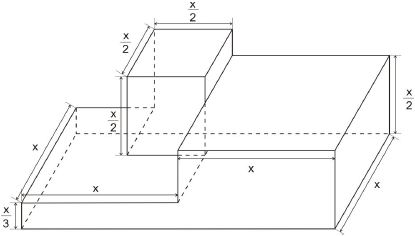
Depois de construído em sua totalidade, o pódio deverá ser pintado, com exceção da parte inferior que estará apoiada no solo.
A expressão que melhor representa a área a ser pintada, em função de x, em unidade de área, é
Provas
Disciplina: Inglês (Língua Inglesa)
Banca: DIRENS Aeronáutica
Orgão: EPCAR
TEXT
Your digital footprint
Every time you go online you leave a trail. This is just like a real footprint. It reveals where you’ve been, how long you stayed and what you’ve been doing there. Every time you register for an online service, send an email, download a video or upload a photo, the information can be accessed and your digital footprint can be revealed. This shouldn’t necessarily be worrying but it is advisable to be aware of your digital footprint and to be cautious and sensible when you are online. Six top tips for taking care of your digital footprint
Don’t forget to log off when you leave a website, especially if you are using a shared computer. If you don’t, someone can easily pretend to be you!
Don’t tell anyone your passwords and don’t write them down in an obvious place. Make them more complex by using a combination of letters, numbers and punctuation marks.
Tell an adult if you come across anything online that makes you upset, anxious or concerned. There are ways to report inappropriate or abusive content and in most cases web managers respond rapidly.
Remember your favourite websites by using the history button and the bookmark function on your computer or mobile device. This is a way that your digital footprint can work in your favour, but remember to clear your browser history regularly.
If you want to post comments online, you don’t have to use your own name. Invent a nickname to use instead. You can also use a picture instead of a real photo.
Protect your identity online. Be careful about who you share personal information with and always think twice before sharing details like your email, home address, school or phone number with someone. Think about the future
All kinds of people are interested in your digital footprint. It's now quite common for colleges, universities and employers to check out the online profiles of possible candidates as part of their application process. There are cases of people having missed out on jobs and places in college because their digital footprint didn’t impress the recruiters. So, remember: keep safe, don’t put too much personal information online and always think carefully before you post something. Ask yourself, ‘Would I be happy for absolutely everyone to see this?’
(Taken from http://learnenglishteens.britishcouncil.org/skills/ reading/upper-intermediate-b2-reading/your-digital-footprint Access on 28/08/20)
If a user reports inappropriate content,
Provas
No retângulo EPCR da figura a seguir, !$ \overline{PC}=6 \, cm !$, !$ \overline{RA}=3 \, cm !$ e !$ \overline{AC}=5 \, cm !$
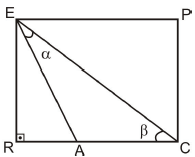
O valor de !$ \sin \, \alpha+ \cos \, \alpha !$ é
Provas
A tabela de preços para refeições em um restaurante indica quatro opções como descritas a seguir:
| Opção | Valor de acordo | |
| 1ª | Self service livre (por pessoa) | R$35,00 |
| 2ª | Self service com balança (por kg) | R$50,00 |
| 3ª | Prato feito pequeno (máximo de até 350 g) | R$15,00 |
| 4ª | Prato feito grande (máximo de até 700 g) | R$30,00 |
O cliente faz a escolha ao entrar no estabelecimento sem que possa alterá-la posteriormente e servindo-se uma única vez.
Naturalmente, os clientes desejam escolher a opção que lhes faça pagar um menor valor para uma refeição com quantidade x, em kg.
Assim, é correto afirmar que
Provas
Tem-se dúvida sobre a origem do baralho de cartas. Os pesquisadores do assunto afirmam que ocorreu uma fusão entre o que era usado na China, por volta do século X d.C., e aquele que os franceses conheceram no século XIV d.C. no contato com os árabes que chegaram à Europa.
Considere que um baralho seja constituído de 52 cartas com quatro naipes, nove cartas numeradas de 2 a 10 e quatro cartas nobres, conforme descrito a seguir nos quadros e nos desenhos:
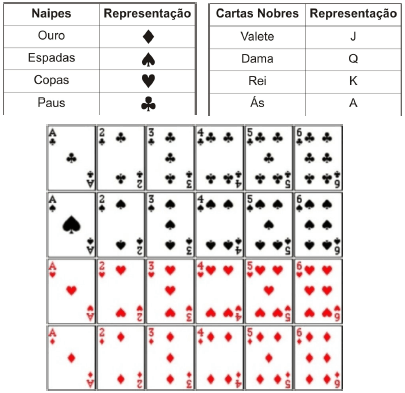

Existem inúmeras possibilidades de jogos com as cartas de um baralho. Dentre os mais conhecidos estão os jogos de “Truco”, “Buraco”, “Paciência” e “Poker”. Cada um desses tem suas regras específicas.
Considere um jogo cujo objetivo é somar 21 pontos com o menor número de cartas recebidas.
As regras são as seguintes:
• participam exatamente 4 jogadores;
• são usadas todas as 52 cartas acima descritas;
• a valorização das cartas é: Valete (J) = 8 pontos; Dama (Q) = 9 pontos; Rei (K) = 10 pontos; Ás (A) = 20 pontos e as demais, ou seja, cartas que estão numeradas de 2 a 10, 1 ponto cada uma;
• cada jogador recebe inicialmente 3 cartas, distribuídas aleatoriamente, sem que nenhum dos jogadores tenha conhecimento prévio;
• pode-se obter mais uma, duas ou três cartas além das três iniciais, assim que todos tenham suas três cartas; e
• o jogador não pode trocar as cartas que receber.
Analise as proposições a seguir e assinale a única alternativa correta para esse jogo descrito.
Provas
Disciplina: Inglês (Língua Inglesa)
Banca: DIRENS Aeronáutica
Orgão: EPCAR
TEXT
Your digital footprint
Every time you go online you leave a trail. This is just like a real footprint. It reveals where you’ve been, how long you stayed and what you’ve been doing there. Every time you register for an online service, send an email, download a video or upload a photo, the information can be accessed and your digital footprint can be revealed. This shouldn’t necessarily be worrying but it is advisable to be aware of your digital footprint and to be cautious and sensible when you are online. Six top tips for taking care of your digital footprint
Don’t forget to log off when you leave a website, especially if you are using a shared computer. If you don’t, someone can easily pretend to be you!
Don’t tell anyone your passwords and don’t write them down in an obvious place. Make them more complex by using a combination of letters, numbers and punctuation marks.
Tell an adult if you come across anything online that makes you upset, anxious or concerned. There are ways to report inappropriate or abusive content and in most cases web managers respond rapidly.
Remember your favourite websites by using the history button and the bookmark function on your computer or mobile device. This is a way that your digital footprint can work in your favour, but remember to clear your browser history regularly.
If you want to post comments online, you don’t have to use your own name. Invent a nickname to use instead. You can also use a picture instead of a real photo.
Protect your identity online. Be careful about who you share personal information with and always think twice before sharing details like your email, home address, school or phone number with someone. Think about the future
All kinds of people are interested in your digital footprint. It's now quite common for colleges, universities and employers to check out the online profiles of possible candidates as part of their application process. There are cases of people having missed out on jobs and places in college because their digital footprint didn’t impress the recruiters. So, remember: keep safe, don’t put too much personal information online and always think carefully before you post something. Ask yourself, ‘Would I be happy for absolutely everyone to see this?’
(Taken from http://learnenglishteens.britishcouncil.org/skills/ reading/upper-intermediate-b2-reading/your-digital-footprint Access on 28/08/20)
The main goal of the text is to
Provas
Considere todos os trapézios que podem ser formados com as medidas de base maior, base menor e altura iguais a 4c , 4 e (− 2c + 40) , respectivamente, em uma mesma unidade de medida, sendo c um número real, de modo que o trapézio exista.
As áreas dos trapézios estão em função de c. De todos os trapézios que podem ser formados, apenas um tem a maior área A.
O valor de A, em unidade de área, é igual a
Provas
TEXTO III
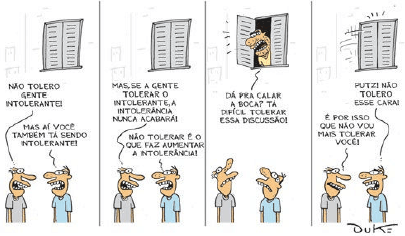
(Disponível em: https://www.seuguara.com.br/2013/03/intolerancia-chargedo- duke-270313.html - Acesso em 28/08/2020)
Após analisar a tirinha de Duke, assinale (V) para as afirmativas verdadeiras e (F) para as falsas.
( ) A excessiva repetição da palavra “tolerar” e seus cognatos tem como efeito de sentido realçar o sentimento provocado por essas mesmas palavras.
( ) A intolerância é um comportamento comum, aceitável e praticado, em todas as esferas da sociedade, por todos os cidadãos, tendo sua origem nas redes sociais.
( ) As três personagens são intolerantes, entretanto a segunda personagem que está embaixo da janela é a mais intolerante delas.
( ) A fala e as atitudes das três personagens são incoerentes, pois, ao mesmo tempo em que criticam a intolerância entre as pessoas, elas a praticam no seu cotidiano.
( ) Muitos comportamentos sociais são assimilados em função das circunstâncias, haja vista a segunda e a última fala da segunda personagem que está embaixo da janela.
( ) A primeira e a última falas da primeira personagem que está embaixo da janela demonstram conformidade entre seu pensamento e sua atitude.
Assinale a alternativa que apresenta a sequência correta.
Provas
Caderno Container