Foram encontradas 70 questões.
Provas

Provas
Observe a figura que representa o uso mundial de água por três setores entre 1940 a 2000.
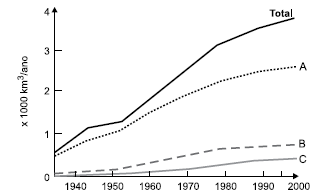
(Ricardo Hirata. Recursos Hídricos. In: W. Teixeira. et al. (org.). Decifrando a Terra. São Paulo: Companhia Editora Nacional, 2000. Adaptado)
Os totais indicados com as letras A, B e C representam, respectivamente, os consumos de água mundial pelos setores:
Provas
The disjunction between method as conceptualized by theorists and method as conducted by teachers is the direct consequence of the inherent limitations of the concept of method itself. First and foremost, methods are based on idealized concepts geared toward idealized contexts. Since language learning and teaching needs, wants, and situations are unpredictably numerous, no idealized method can visualize all the variables in advance in order to provide situation-specific suggestions that practicing teachers so clearly need in order to tackle the challenges they confront every day of their professional lives. As a predominantly topdown exercise, the conception and construction of methods have been largely guided by a one-size-fits-all (…) approach that assumes a common clientele with common goals.
(KUMARAVADIVELU, B. Beyond methods: macrostrategies for language teaching. Adapted )
Considering the excerpt above, it is fair to say that the writer argues for the
Provas
Provas
By the end of the twentieth century English was already well on its way to becoming a genuine lingua franca. Just as in the Middle Ages Latin became for a time a language of international communication, so English is now commonly used in exchanges between, say, Japanese and Argentinian business people or between Singaporeans and their Vietnamese counterparts.
A number of researchers have studied lingua franca conversations and have noted a number of somewhat surprising characteristics, including:
• Increasing of redundancy by adding prepositions (We have to study about... and Can we discuss about...?).
• Large use of certain verbs of high semantic generality, such as do, have, make, put, take.
• Pluralisation of nouns which are considered uncountable in native-speaker English (advices, staffs).
The evidence suggests that non-native speakers are not conforming to a native English standard. Indeed they seem to get along perfectly well despite the fact that they miss things out and put things in which they ‘should not do’. Not only this, but they are actually better at ‘accommodating’ than native speakers are when talking to second language speakers.
(Jeremy Harmer. The practice of English language teaching. Adaptado)
The expression lingua franca refers to
Provas
Provas
Provas
Provas
Provas
Caderno Container