Foram encontradas 40 questões.
O triângulo ABC é isósceles com AB = AC = 4 cm, e o triângulo DBC é isosceles com DB = DC = 2 cm, conforme a figura.
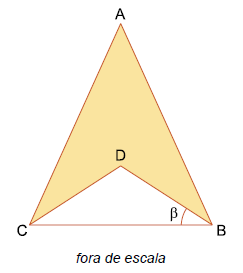
Seja a medida do ângulo interno !$ \hat{DBC} !$ do triângulo DBC.
Sabendo-se que !$ sen \,\, ( \beta \, = \, { \large \sqrt{6} \over 4} !$ ,a área, em cm2, do quadrilátero ABDC é
Provas
Questão presente nas seguintes provas

Sílvia e Márcio moram em cidades diferentes no interior. Sílvia vai à capital uma vez a cada 10 dias, e Márcio vai à capital uma vez a cada 12 dias. A última vez em que eles se encontraram na capital foi um sábado. O próximo encontro dos dois na capital ocorrerá em
Provas
Questão presente nas seguintes provas
A progressão geométrica (a1, a2, a3, ...) tem primeiro termo !$ a_1 = { \large 3 \over 8} !$ e razão 5. A progressão geométrica (b1, b2, b3, ...) tem razão !$ { \large 5 \over 2} !$ . Se a5 = b4, então b1 é igual a
Provas
Questão presente nas seguintes provas
- História do BrasilEra VargasO Estado Novo (1937-1945): a Guinada Autoritária e a Constituição de 1937
O período mais produtivo da Época de Ouro da MPB coincide, basicamente, com o Estado Novo (1937-1945), implantado por Getúlio Vargas. Não é uma simples coincidência. Em 1937, Vargas criou o Ince (Instituto Nacional de Cinema Educativo), o SNT (Serviço Nacional de Teatro) e o INL (Instituto Nacional do Livro). De outro lado, Vargas também operava, com mão de ferro, o famigerado DIP (Departamento de Imprensa e Propaganda.
(José Arbex Jr. e Maria Helena V. Senise. Cinco séculos de Brasil, 1998. Adaptado.)
Durante o Estado Novo,
Provas
Questão presente nas seguintes provas
(www.otempo.com.br)
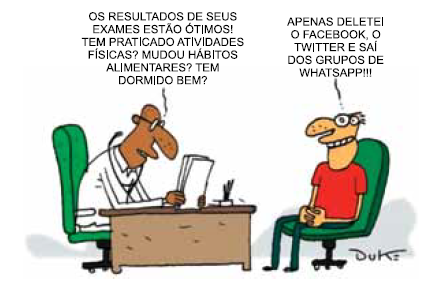
Depreende-se com a leitura da charge que as redes sociais
Provas
Questão presente nas seguintes provas
Para cumprir os objetivos ratificados pelo Acordo de Paris, o Brasil, entre outras medidas, deve
Provas
Questão presente nas seguintes provas
Sabendo-se que o número complexo 2 + i é raiz do polinômio !$ x^3+ax^2+bx-5 !$ , em que a e b são números reais, conclui-se que a + b é igual a
Provas
Questão presente nas seguintes provas
An increasing body of evidence suggests that the time we spend on our smartphones is interfering with our sleep, self-esteem, relationships, memory, attention spans, creativity, productivity and problem-solving and decision-making skills. But there is another reason for us to rethink our relationships with our devices. By chronically raising levels of cortisol, the body’s main stress hormone, our phones may be threatening our health and shortening our lives.
If they happened only occasionally, phone-induced cortisol spikes might not matter. But the average American spends four hours a day staring at their smartphone and keeps it within arm’s reach nearly all the time, according to a tracking app called Moment.
“Your cortisol levels are elevated when your phone is in sight or nearby, or when you hear it or even think you hear it,” says David Greenfield, professor of clinical psychiatry at the University of Connecticut School of Medicine and founder of the Center for Internet and Technology Addiction. “It’s a stress response, and it feels unpleasant, and the body’s natural response is to want to check the phone to make the stress go away.”
But while doing so might soothe you for a second, it probably will make things worse in the long run. Any time you check your phone, you’re likely to find something else stressful waiting for you, leading to another spike in cortisol and another craving to check your phone to make your anxiety go away. This cycle, when continuously reinforced, leads to chronically elevated cortisol levels. And chronically elevated cortisol levels have been tied to an increased risk of serious health problems, including depression, obesity, metabolic syndrome, Type 2 diabetes, fertility issues, high blood pressure, heart attack, dementia and stroke.
(Catherine Price. www.nytimes.com, 24.04.2019. Adaptado.)
No trecho do último parágrafo “while doing so might soothe you for a second”, o termo sublinhado equivale, em português, a
Provas
Questão presente nas seguintes provas
An increasing body of evidence suggests that the time we spend on our smartphones is interfering with our sleep, self-esteem, relationships, memory, attention spans, creativity, productivity and problem-solving and decision-making skills. But there is another reason for us to rethink our relationships with our devices. By chronically raising levels of cortisol, the body’s main stress hormone, our phones may be threatening our health and shortening our lives.
If they happened only occasionally, phone-induced cortisol spikes might not matter. But the average American spends four hours a day staring at their smartphone and keeps it within arm’s reach nearly all the time, according to a tracking app called Moment.
“Your cortisol levels are elevated when your phone is in sight or nearby, or when you hear it or even think you hear it,” says David Greenfield, professor of clinical psychiatry at the University of Connecticut School of Medicine and founder of the Center for Internet and Technology Addiction. “It’s a stress response, and it feels unpleasant, and the body’s natural response is to want to check the phone to make the stress go away.”
But while doing so might soothe you for a second, it probably will make things worse in the long run. Any time you check your phone, you’re likely to find something else stressful waiting for you, leading to another spike in cortisol and another craving to check your phone to make your anxiety go away. This cycle, when continuously reinforced, leads to chronically elevated cortisol levels. And chronically elevated cortisol levels have been tied to an increased risk of serious health problems, including depression, obesity, metabolic syndrome, Type 2 diabetes, fertility issues, high blood pressure, heart attack, dementia and stroke.
(Catherine Price. www.nytimes.com, 24.04.2019. Adaptado.)
No trecho do primeiro parágrafo “ But there is another reason for us to rethink our relationships with our devices”, o termo sublinhado introduz uma
Provas
Questão presente nas seguintes provas
Observe as obras que representaram, posteriormente aos fatos, os processos de independência da Venezuela e do Brasil.
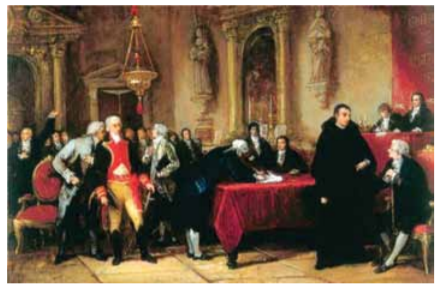
(Martin Tovar y Tovar. Assinatura da independência da Venezuela, 1876. www.cervantesvirtual.com)
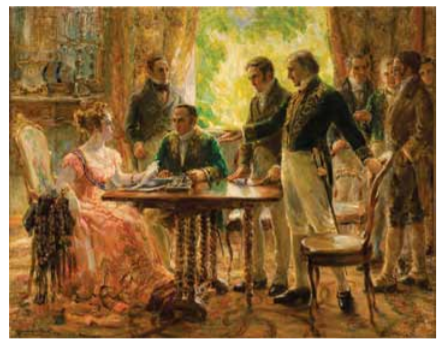
(Georgina de Albuquerque. Sessão do Conselho de Estado, 1922. www.museudeartedorio.org.br)
Nessas representações, pode-se observar
Provas
Questão presente nas seguintes provas
Cadernos
Caderno Container