Foram encontradas 80 questões.
Em uma circunferência trigonométrica de centro C e origem dos arcos em O, foram marcados os pontos P e Q, sendo que as medidas dos arcos  e
e  são iguais, respectivamente, a !$ \alpha !$ e !$ 2\alpha !$, conforme indica a figura.
e são iguais, respectivamente, a !$ \alpha !$ e !$ 2\alpha !$, conforme indica a figura.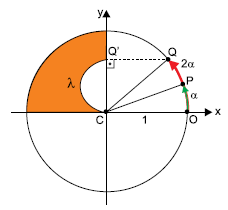
Sabendo-se que Q’ é a projeção ortogonal de Q sobre o eixo y, que !$ \lambda !$ é uma semicircunferência de diâmetro !$ \overline{CQ'} !$ e que sen !$ \alpha=\dfrac{1}{3} !$, a área da região colorida na figura é
Provas
Questão presente nas seguintes provas

Quatro cargas elétricas puntiformes, Q1, Q2, Q3 e Q4, estão fixas nos vértices de um quadrado, de modo que |Q1| = |Q2| = |Q3| = |Q4|. As posições das cargas e seus respectivos sinais estão indicados na figura
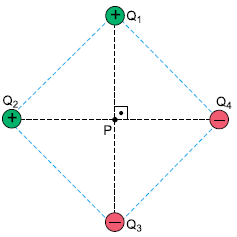
Se E for o módulo do campo elétrico no ponto P, centro do quadrado, devido à carga Q1, o campo elétrico resultante no ponto P, devido à presença das quatro cargas, terá módulo
Provas
Questão presente nas seguintes provas
O elemento estrôncio ocorre na natureza como componente de dois minerais: a estroncianita, SrCO3 (massa molar 147,6 g/mol), e a celestita, SrSO4 (massa molar 183,6 g/mol). A partir desses minerais são obtidos os sais de estrôncio, utilizados na pirotecnia para conferir a cor vermelho-carmim intensa a fogos de artifício.
Considere a relação:

O valor desse quociente é, aproximadamente,
Provas
Questão presente nas seguintes provas
A figura mostra, em perspectiva, as quatro primeiras pilhas de blocos de uma sequência.
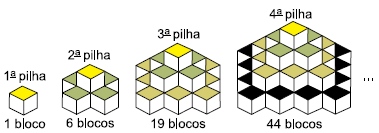
Mantida a mesma lógica de empilhamento dos blocos, a 6ª pilha da sequência terá um total de blocos igual a
Provas
Questão presente nas seguintes provas
Um indivíduo diploide possui o genótipo AaBbCc. Sabendo--se que esses alelos segregam-se independentemente durante a meiose sem mutação, assinale a alternativa que ilustra corretamente um possível espermatócito II, produzido por esse indivíduo, com os seus respectivos alelos.
Provas
Questão presente nas seguintes provas
The placebo effect: amazing and real
November 2, 2015
Robert H. Shmerling
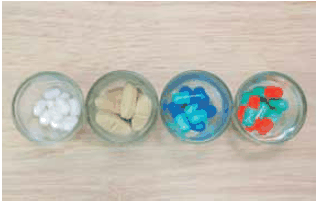
The placebo effect is a mysterious thing. I’ve long been fascinated by the idea that something as inert and harmless as a sugar pill could relieve a person’s pain or hasten their recovery just by the expectation that it would. Studies use placebos – an inactive treatment, such as a sugar pill – in an attempt to understand the true impact of the active drug. Comparing what happens to a group of patients taking the active drug with the results of those taking a placebo can help researchers understand just how good the active drug is.
The word “placebo” comes from Latin and means “I shall please.” And “please” it does. In study after study, many patients who take a placebo show improvement in their symptoms or condition.
The placebo effect is for real
Recent research on the placebo effect only confirms how powerful it can be – and that the benefits of a placebo treatment aren’t just “all in your head.” Measureable physiological changes can be observed in those taking a placebo, similar to those observed among people taking effective medications. In particular, blood pressure, heart rate, and blood test results have been shown to improve among subsets of research subjects who responded to a placebo.
Of course, not everyone has a therapeutic response to a placebo. If that were the case, we wouldn’t need medications at all. Instead, we could simply wield the power of suggestion. Understanding why certain people improve with placebo treatment and others do not is the “holy grail” of placebo research.
Nocebo: Placebo’s evil twin
The power of suggestion is a double-edged sword. If you expect a treatment to help you, it’s more likely to do so. And if you expect a treatment will be harmful, you are more likely to experience negative effects. That phenomenon is called the “nocebo effect” (from the Latin “I shall harm”). For example, if you tell a person that a headache is a common side effect of a particular medication, that person is more likely to report headaches even if they are actually taking a placebo. The power of expectation is formidable and probably plays a significant role in the benefits and the side effects of commonly prescribed medications.
(www.health.harvard.edu. Adaptado.)
De acordo com o texto, o efeito placebo
Provas
Questão presente nas seguintes provas
The placebo effect: amazing and real
November 2, 2015
Robert H. Shmerling
The placebo effect is a mysterious thing. I’ve long been fascinated by the idea that something as inert and harmless as a sugar pill could relieve a person’s pain or hasten their recovery just by the expectation that it would. Studies use placebos – an inactive treatment, such as a sugar pill – in an attempt to understand the true impact of the active drug. Comparing what happens to a group of patients taking the active drug with the results of those taking a placebo can help researchers understand just how good the active drug is.
The word “placebo” comes from Latin and means “I shall please.” And “please” it does. In study after study, many patients who take a placebo show improvement in their symptoms or condition.
The placebo effect is for real
Recent research on the placebo effect only confirms how powerful it can be – and that the benefits of a placebo treatment aren’t just “all in your head.” Measureable physiological changes can be observed in those taking a placebo, similar to those observed among people taking effective medications. In particular, blood pressure, heart rate, and blood test results have been shown to improve among subsets of research subjects who responded to a placebo.
Of course, not everyone has a therapeutic response to a placebo. If that were the case, we wouldn’t need medications at all. Instead, we could simply wield the power of suggestion. Understanding why certain people improve with placebo treatment and others do not is the “holy grail” of placebo research.
Nocebo: Placebo’s evil twin
The power of suggestion is a double-edged sword. If you expect a treatment to help you, it’s more likely to do so. And if you expect a treatment will be harmful, you are more likely to experience negative effects. That phenomenon is called the “nocebo effect” (from the Latin “I shall harm”). For example, if you tell a person that a headache is a common side effect of a particular medication, that person is more likely to report headaches even if they are actually taking a placebo. The power of expectation is formidable and probably plays a significant role in the benefits and the side effects of commonly prescribed medications.
(www.health.harvard.edu. Adaptado.)
According to the fifth paragraph, nocebo effect
Provas
Questão presente nas seguintes provas
As cartas topográficas oferecem aos seus leitores a localização precisa dos fenômenos geográficos, permitindo identificar, com grande nível de detalhamento, suas posições
Provas
Questão presente nas seguintes provas
The placebo effect: amazing and real
November 2, 2015
Robert H. Shmerling
The placebo effect is a mysterious thing. I’ve long been fascinated by the idea that something as inert and harmless as a sugar pill could relieve a person’s pain or hasten their recovery just by the expectation that it would. Studies use placebos – an inactive treatment, such as a sugar pill – in an attempt to understand the true impact of the active drug. Comparing what happens to a group of patients taking the active drug with the results of those taking a placebo can help researchers understand just how good the active drug is.
The word “placebo” comes from Latin and means “I shall please.” And “please” it does. In study after study, many patients who take a placebo show improvement in their symptoms or condition.
The placebo effect is for real
Recent research on the placebo effect only confirms how powerful it can be – and that the benefits of a placebo treatment aren’t just “all in your head.” Measureable physiological changes can be observed in those taking a placebo, similar to those observed among people taking effective medications. In particular, blood pressure, heart rate, and blood test results have been shown to improve among subsets of research subjects who responded to a placebo.
Of course, not everyone has a therapeutic response to a placebo. If that were the case, we wouldn’t need medications at all. Instead, we could simply wield the power of suggestion. Understanding why certain people improve with placebo treatment and others do not is the “holy grail” of placebo research.
Nocebo: Placebo’s evil twin
The power of suggestion is a double-edged sword. If you expect a treatment to help you, it’s more likely to do so. And if you expect a treatment will be harmful, you are more likely to experience negative effects. That phenomenon is called the “nocebo effect” (from the Latin “I shall harm”). For example, if you tell a person that a headache is a common side effect of a particular medication, that person is more likely to report headaches even if they are actually taking a placebo. The power of expectation is formidable and probably plays a significant role in the benefits and the side effects of commonly prescribed medications.
(www.health.harvard.edu. Adaptado.)
No trecho do quarto parágrafo “ Instead, we could simply wield the power of suggestion.”, o termo em destaque equivale, em português, a
Provas
Questão presente nas seguintes provas
A partir de conhecimentos acerca das formações vegetais no Brasil, é correto afirmar que a Mata dos Cocais caracteriza uma mata de transição entre
Provas
Questão presente nas seguintes provas
Cadernos
Caderno Container