Foram encontradas 90 questões.
A Secretaria Estadual de Saúde do Paraná divulgou, em 2023, a ocorrência de febre maculosa no estado. Essa é uma doença infecciosa, com sintomas como febre, vômitos, dores de cabeça e musculares e manchas vermelhas no corpo. Ela pode variar desde as formas clínicas leves e atípicas até formas graves, com elevada taxa de letalidade.
Assinale a opção que indica o agente etiológico da febre maculosa.
Provas

Analise a imagem a seguir.

O heredograma acima representa a herança de uma característica autossômica na espécie humana. Os indivíduos representados por quadrados ou círculos brancos apresentam lóbulos de orelha soltos e os quadrados e círculos sombreados representam os indivíduos com lóbulos de orelha presos.
A probabilidade do casal formado por 1 e 2 ter uma terceira criança do sexo feminino e com lóbulo de orelha preso é
Provas
A figura mostra uma célula humana produtora de anticorpos, proteínas que combatem invasores específicos.

Com relação a essa célula do sistema imunitário e a produção de anticorpos, analise as afirmativas a seguir e assinale (V) para a verdadeira e F para a falsa.
( ) Trata-se de um linfócito T, célula produzida a partir de células-tronco da medula óssea vermelha. Essa célula atravessa diversos estágios de diferenciação e maturação, antes de passar para o sangue.
( ) A produção de anticorpos pelo nosso organismo pode ser estimulada naturalmente, quando um patógeno invade o corpo, ou artificialmente, quando recebemos uma vacina.
( ) Os eventos envolvidos na produção de anticorpos pela célula, até sua liberação no plasma sanguíneo, ocorrem sequencialmente nas seguintes estruturas celulares: D→E→C→A.
As afirmativas são, respectivamente,
Provas
Cada ciclo cardíaco possui duas fases: o tempo durante o qual o músculo cardíaco relaxa e o período durante o qual ele se contrai.
Considerando o ciclo cardíaco de uma pessoa saudável, assinale a afirmativa correta.
Provas
Quando as células musculares estão consumindo oxigênio mais rápido do que esse gás pode ser fornecido pelos pulmões e pelo sistema circulatório, a glicose passa a ser decomposta em ausência de oxigênio, para atender às necessidades energéticas das células.
A figura a seguir mostra, de forma simplificada, esse processo anaeróbico.
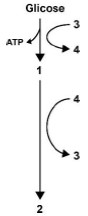
LOPES, S. Bio. v. I. 3ª ed. São Paulo: Saraiva, 2016. Adaptado.
A respeito do processo metabólico em questão, analise as afirmativas a seguir e assinale (V) para a verdadeira e (F) para a falsa.
( ) No esquema acima, os números 1, 2 e 4 representam, respectivamente, as substâncias piruvato, lactato e NADH.
( ) Quando comparadas, a quebra da glicose em condição anaeróbia é mais vantajosa que em condição aeróbia, pois fornece mais ATP às células e em menor intervalo de tempo, já que o processo possui menos etapas bioquímicas.
( ) Além das células do músculo estriado esquelético, o processo pode ser realizado por hemácias humanas adultas e alguns tipos de bactérias.
As afirmativas são, na ordem apresentada, respectivamente,
Provas
Uma chave dicotômica é uma ferramenta usada para identificar diferentes organismos, com base em suas características. Tais chaves consistem em uma série de afirmações, com duas escolhas em cada etapa, que levarão os usuários à identificação do organismo.
A chave dicotômica a seguir permite a identificação de quatro espécies vegetais, encontradas em um parque.
| 1 | Possui sementes? | Não ..... vá para o 3. Sim ..... vá para o 2. |
| 2 | Possui flores e frutos? | Não ...... Cryptomeria japonica Sim ...... Musa paradisiaca |
| 3 | Possui tecidos vasculares? | Não ..... Polytrichum commune Sim ...... Athyrium filix-femina |
A análise da chave permite afirmar, corretamente, que
Provas
A árvore filogenética a seguir mostra uma hipótese sobre as relações evolutivas entre quatro organismos.
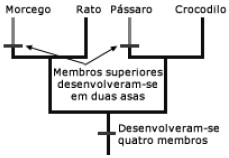
Fonte: https://evosite.ib.usp.br/evo101/index.shtml
De acordo com o esquema, as asas dos morcegos e as asas das aves são estruturas
Provas
Read Text III and answer the question that follow it.
Text III
How ghost cities in the Amazon are rewriting the story of civilisation
Try to imagine an environment largely untouched by humans and the Amazon rainforest might spring to mind. After all, large swathes of this South American landscape are blanketed in thick vegetation, suggesting it is one corner of the world that humans never managed to tame. Here, there must have been no deforestation, no agricultural revolution and no cities. It seems like a pristine environment.
Or so we thought. But a very different picture is emerging. Archaeologists working with Indigenous communities have been shown crumbling urban remains and remote sensing technologies such as LiDAR (Light Detection and Ranging) are revealing the footprints of vast ghost cities. With so much evidence of ancient human activity, it is now thought the pre-Columbian Amazon was inhabited by millions of people – some living in large built-up areas complete with road networks, temples and pyramids.
But that’s not all this research reveals. Paradoxically, it also provides evidence that the traditional view of the Amazon isn’t completely wide of the mark. For instance, while the ancient Amazonians managed their landscape intensively, they didn’t deforest it. And although they developed complex societies, they never went through a wholesale agricultural revolution. This might suggest that the pre-Columbian Amazonians broke the mould of human cultural development, which is traditionally seen as a relentless march from hunting and gathering to farming to urban complexity. The truth is more surprising. In fact, we are now coming to understand that there was no such mould – civilisation arose in myriad ways. What looks like an anomaly in the Amazon is actually a shining example of a process that was as vibrant and diverse as the rainforest itself.
Adapted from: https://www.newscientist.com/article/mg26334980-500-how-ghost-cities-in-the-amazon-are-rewriting-the-story-of-civilisation/
The extract This might suggest indicates
Provas
Read Text III and answer the question that follow it.
Text III
How ghost cities in the Amazon are rewriting the story of civilisation
Try to imagine an environment largely untouched by humans and the Amazon rainforest might spring to mind. After all, large swathes of this South American landscape are blanketed in thick vegetation, suggesting it is one corner of the world that humans never managed to tame. Here, there must have been no deforestation, no agricultural revolution and no cities. It seems like a pristine environment.
Or so we thought. But a very different picture is emerging. Archaeologists working with Indigenous communities have been shown crumbling urban remains and remote sensing technologies such as LiDAR (Light Detection and Ranging) are revealing the footprints of vast ghost cities. With so much evidence of ancient human activity, it is now thought the pre-Columbian Amazon was inhabited by millions of people – some living in large built-up areas complete with road networks, temples and pyramids.
But that’s not all this research reveals. Paradoxically, it also provides evidence that the traditional view of the Amazon isn’t completely wide of the mark. For instance, while the ancient Amazonians managed their landscape intensively, they didn’t deforest it. And although they developed complex societies, they never went through a wholesale agricultural revolution. This might suggest that the pre-Columbian Amazonians broke the mould of human cultural development, which is traditionally seen as a relentless march from hunting and gathering to farming to urban complexity. The truth is more surprising. In fact, we are now coming to understand that there was no such mould – civilisation arose in myriad ways. What looks like an anomaly in the Amazon is actually a shining example of a process that was as vibrant and diverse as the rainforest itself.
Adapted from: https://www.newscientist.com/article/mg26334980-500-how-ghost-cities-in-the-amazon-are-rewriting-the-story-of-civilisation/
The phrase a pristine environment means that the area is
Provas
Read Text III and answer the question that follow it.
Text III
How ghost cities in the Amazon are rewriting the story of civilisation
Try to imagine an environment largely untouched by humans and the Amazon rainforest might spring to mind. After all, large swathes of this South American landscape are blanketed in thick vegetation, suggesting it is one corner of the world that humans never managed to tame. Here, there must have been no deforestation, no agricultural revolution and no cities. It seems like a pristine environment.
Or so we thought. But a very different picture is emerging. Archaeologists working with Indigenous communities have been shown crumbling urban remains and remote sensing technologies such as LiDAR (Light Detection and Ranging) are revealing the footprints of vast ghost cities. With so much evidence of ancient human activity, it is now thought the pre-Columbian Amazon was inhabited by millions of people – some living in large built-up areas complete with road networks, temples and pyramids.
But that’s not all this research reveals. Paradoxically, it also provides evidence that the traditional view of the Amazon isn’t completely wide of the mark. For instance, while the ancient Amazonians managed their landscape intensively, they didn’t deforest it. And although they developed complex societies, they never went through a wholesale agricultural revolution. This might suggest that the pre-Columbian Amazonians broke the mould of human cultural development, which is traditionally seen as a relentless march from hunting and gathering to farming to urban complexity. The truth is more surprising. In fact, we are now coming to understand that there was no such mould – civilisation arose in myriad ways. What looks like an anomaly in the Amazon is actually a shining example of a process that was as vibrant and diverse as the rainforest itself.
Adapted from: https://www.newscientist.com/article/mg26334980-500-how-ghost-cities-in-the-amazon-are-rewriting-the-story-of-civilisation/
The phrase ghost cities in the title indicates that they
Provas
Caderno Container