Foram encontradas 90 questões.
O esquema a seguir mostra como a informação hereditária flui do DNA para o RNA, e do RNA para a proteína.
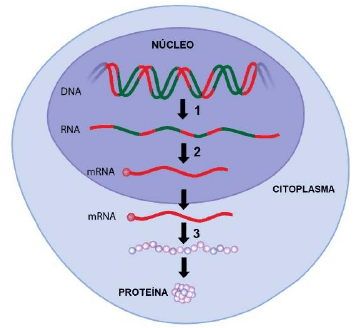
Com relação ao esquema, assinale (V) para a afirmativa verdadeira e (F) a falsa.
( ) 1 indica a etapa de transcrição, em que uma fita de DNA serve de molde para a síntese de RNAm. Se a fita molde de DNA apresentar a sequência de bases AGCTTCGA, a sequência correspondente no RNAm será TCGAAGCT.
( ) 2 indica a etapa de processamento, quando trechos da molécula de RNAm que não codificam proteínas (chamados íntrons) são retirados, originando uma molécula de RNAm funcional.
( ) 3 indica a etapa de tradução. Nela há a participação de moléculas de RNAt, cuja função é transportar o ribossomo até o local da síntese proteica.
As afirmativas são, na ordem apresentada, respectivamente,
Provas

Em junho de 2016, a ocorrência do fenômeno ‘maré vermelha’ nas baías de Paranaguá e Guaratuba fez com que o governo do Paraná proibisse temporariamente a venda e o consumo de ostras e mariscos produzidos no estado. A decisão foi tomada após um laudo que confirmou a presença de microalgas e toxinas nocivas à saúde humana em amostras de água e ostras.
O fenômeno acima descrito pode ser natural ou ter origem antrópica. Neste caso, a maré vermelha é uma consequência da poluição da água por
Provas
Estima-se que 2 bilhões de pessoas no mundo sofrem com as consequências das deficiências de micronutrientes, sendo que ferro, iodo e vitamina A são as de maior significância.
Com relação aos micronutrientes, analise as afirmativas a seguir.
I. A carência de ferro no organismo ocasiona problemas de coagulação sanguínea e anemia. Este mineral é essencial para a ativação das proteínas protrombina e fibrinogênio e é, também, componente da hemoglobina, proteína que transporta o gás oxigênio.
II. O iodo é um componente essencial dos hormônios produzidos pela glândula tireoide. A deficiência de iodo na dieta causa o bócio, um aumento anormal da glândula. A iodação do sal de cozinha é uma forma de prevenir essa deficiência.
III. A vitamina A, conhecida como retinol, é uma vitamina hidrossolúvel. O precursor da vitamina A é ativado pela ação dos raios ultravioleta do Sol e fica armazenado principalmente no fígado. Sua carência causa o raquitismo e a osteomalácia.
Está correto o que se afirma em
Provas
O heredograma a seguir mostra a herança da hemocromatose em uma família. A doença, de herança autossômica, caracteriza-se pelo acúmulo de ferro em órgãos como o fígado, o coração e o pâncreas, podendo ocasionar lesão nos tecidos e insuficiência funcional.
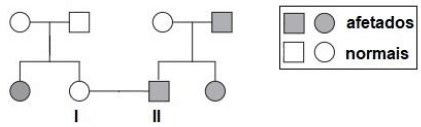
Em relação à herança da hemocromatose, assinale a afirmativa correta.
Provas
Leia o texto a seguir.
“Ele escondeu o objeto no oco de suas mãos. Era um objeto maravilhoso por sua própria estranheza: como um fragmento de escultura grega, encontrado no leito seco de um rio.
É uma “cápsula do tempo”, pensa Pedro, um outro universo está condensado nessa concha, e ele não estava longe de pensar que o mar noturno que lhe guardava o sono, se livrara da antiga concha, num dia em que ele havia, descuidadamente, quebrado uma de suas cápsulas.”
Por suas marcas, esse texto pode ser classificado como
Provas
The “Modern Physician” needs to embrace technology

February 12, 2021
Veronica Diaz, MD
Even before the COVID-19 pandemic forced health systems and private practices to implement technology solutions such as telehealth, the evolution toward a more tech-savvy healthcare experience was firmly underway. The days of carting paper charts and hard film x-rays has been broadly supplanted with cloud-based electronic health records and digital Picture Archiving Communications Systems (PACS). The pandemic has made those previously reticent to adopt technology wake up to its necessity.
Practicing medicine today requires a higher degree of technical literacy than ever before, and the challenges of the pandemic have only reinforced and accelerated that trend. We have reached an inflection point in the industry where clinical expertise is not the only prerequisite for a successful career. Physicians who familiarize, vet, and incorporate new technology into their practices will likely be in the best position to deliver optimal care.
From: https://www.physicianspractice.com/view/ the-modern-physician-needs-to-embrace-technology
“Likely” in “Physicians […] will likely be in the best position to deliver optimal care” (2nd paragraph) introduces a
Provas
The “Modern Physician” needs to embrace technology
February 12, 2021
Veronica Diaz, MD
Even before the COVID-19 pandemic forced health systems and private practices to implement technology solutions such as telehealth, the evolution toward a more tech-savvy healthcare experience was firmly underway. The days of carting paper charts and hard film x-rays has been broadly supplanted with cloud-based electronic health records and digital Picture Archiving Communications Systems (PACS). The pandemic has made those previously reticent to adopt technology wake up to its necessity.
Practicing medicine today requires a higher degree of technical literacy than ever before, and the challenges of the pandemic have only reinforced and accelerated that trend. We have reached an inflection point in the industry where clinical expertise is not the only prerequisite for a successful career. Physicians who familiarize, vet, and incorporate new technology into their practices will likely be in the best position to deliver optimal care.
From: https://www.physicianspractice.com/view/ the-modern-physician-needs-to-embrace-technology
In the first sentence, the author makes clear that technology in healthcare had been evolving
Provas
The “Modern Physician” needs to embrace technology
February 12, 2021
Veronica Diaz, MD
Even before the COVID-19 pandemic forced health systems and private practices to implement technology solutions such as telehealth, the evolution toward a more tech-savvy healthcare experience was firmly underway. The days of carting paper charts and hard film x-rays has been broadly supplanted with cloud-based electronic health records and digital Picture Archiving Communications Systems (PACS). The pandemic has made those previously reticent to adopt technology wake up to its necessity.
Practicing medicine today requires a higher degree of technical literacy than ever before, and the challenges of the pandemic have only reinforced and accelerated that trend. We have reached an inflection point in the industry where clinical expertise is not the only prerequisite for a successful career. Physicians who familiarize, vet, and incorporate new technology into their practices will likely be in the best position to deliver optimal care.
From: https://www.physicianspractice.com/view/ the-modern-physician-needs-to-embrace-technology
The text implies that, in today’s medicine, technology should be
Provas

Source: https://www.brainyquote.com/quotes/mark_twain_102859
The phrase “the world owes you nothing” means that the world
Provas
Advancing gender equity in medicine
[…]
The problem of gender inequity in medical leadership is not the result of too few candidates who are not men with the appropriate experience and training to fulfill leadership roles, nor can it be explained by merely suggesting that different genders do not have the same aspirations as men. Gender inequity is largely underpinned by socially constructed gender norms, roles and relations. For example, gender roles explain why female clinicians with children spend 100.2 minutes more per day on household activities and child care than their male counterparts. This makes it more challenging for female clinicians with children to get ahead. Gender norms explain why more men are given leadership opportunities and have stronger letters of reference than other genders. Furthermore, gender relations explain why men have fewer consequences for uncivil behaviour or for harassment in the workplace compared with other genders. A recent observational study of operating room culture evaluated the prevalence and predictors of exposure to disruptive behaviour in the operating room. Disruptive behaviour was described as a range of unacceptable workplace behaviours, including incivility, bullying and harassment. A further definition provided is “interpersonal behaviour (i.e., directed toward others or occurring in the presence of others) that results in a perceived threat to victims and/or witnesses and violates a reasonable person’s standard of respectful behaviour.” The study found that clinicians who are women report more exposure to disruptive behaviour and are substantially less confident or empowered to take action to address incivility in their hospital and university settings. Gender and sexual harassment may be associated with environments that exhibit gender inequity in pay, opportunity and promotion. Disruptive behaviour and overt harassment likely endure within our medical institutions because the offenders are often considered invaluable to the organization for their stature, leadership, productivity or reputation, and are largely not held unaccountable for their actions, which further amplifies gender inequities.
Ensuring gender equity in medicine is an issue of justice and rights. Having more physicians who are women and more women in health policy leadership also appears to enhance the provision of high-quality patient care. Large, well-conducted observational studies have shown that patients of female clinicians experience better quality of care for diabetes, and significantly lower rates of mortality, hospital readmissions and emergency department visits than those treated by male clinicians. One study considered that reasons for this may include that women spend more time with their patients, are more patient-centred in their approach and provide more evidence-based care. Two recent opinion pieces discuss research showing that female representation on corporate boards, such as hospital boards, results in more socially thoughtful decisions and less corruption. Without gender equity, we risk extinguishing creative solutions to complex health problems and, most importantly, limiting patient access to the best care.
From: https://www.ncbi.nlm.nih.gov/pmc/articles/PMC8034331/ CMAJ. 2021 Feb 16; 193(7): E244–E250.
The opposite of “often” in “the offenders are often considered invaluable” (1st paragraph) is
Provas
Caderno Container