Foram encontradas 50 questões.

(www1.folha.uol.com.br/mundo)
Essa foto ilustra a recente retomada do poder, no Afeganistão, pelo grupo Taleban, o qual
Provas

A política econômica desenvolvida no Brasil na segunda metade da década de 1950, durante o governo de Juscelino Kubitschek, é caracterizada como nacional-desenvolvimentista. Essa política
Provas
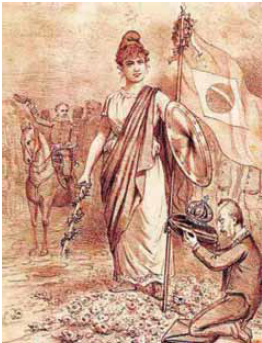
(Pereira Neto. “Glória à Pátria!”. In: Renato Lemos (org.). Uma história do Brasil através da caricatura: 1840-2006, 2006.)
Na homenagem feita pela revista à então recente proclamação da República, destacam-se:
Provas
Enquanto, em Paris, a guilhotina decepava as cabeças dos jacobinos, em São Domingos [Jean-Jacques] Dessalines e seus companheiros continuavam a defender, de armas na mão, o ideal jacobino da liberdade e igualdade de todos os homens. [...]
A 29 de novembro de 1803, os revolucionários negros divulgaram uma declaração preliminar de Independência. A 31 de dezembro, foi lida a Declaração de Independência definitiva. O novo Estado recebeu, no batismo, a denominação indígena de Haiti.
Dessalines se tornou o primeiro chefe de Estado haitiano [...]. Começou a governar com as bençãos dos capitalistas ingleses e americanos [...].
Os ex-escravos, por sua vez, viram-se definitivamente livres do trabalho compulsório nas plantações de cana e nos engenhos de açúcar. [...] O Haiti saiu do mercado mundial do açúcar e eliminou a possibilidade de progredir em direção a um nível econômico superior. De colônia mais produtiva das Américas passou a país independente pauperizado e fora de um intercâmbio favorável na economia internacional.
(Jacob Gorender. “O épico e o trágico na história do Haiti”. In: Estudos Avançados, no 50, 2004.)
O excerto apresenta um aspecto central da independência do Haiti, em 1803-1804:
Provas
Nos dois primeiros séculos de colonização, a empresa colonial giraria em torno da cana: a formação de vilas e cidades, a defesa de territórios, a divisão de propriedades, as relações com diferentes grupos sociais e até a escolha da capital.
(Lilia M. Schwarcz e Heloisa M. Starling. Brasil: uma biografia, 2018. Adaptado.)
O excerto apresenta o avanço da produção de cana-de-açúcar no Brasil colonial como
Provas
In 2008 at least six babies died and 300,000 fell ill after drinking made-in-China infant formula contaminated with toxic chemicals. In response, many Chinese parents embraced foreign baby food brands, catapulting the likes of Danone SA’s Aptamil and Nestlé SA’s Illuma to the top of the market. Yet for the past two years, the leading formula brand in China has been made by China Feihe Ltd., a Beijing company that emphasizes its local roots rather than seeking to obscure them. “More suitable for Chinese babies,” the company’s advertising boasts.
In categories ranging from baby food to sportswear and skin cream, Chinese brands are putting pressure on global rivals that depend on the country for much of their growth. While increasing nationalism has boosted the momentum of domestic products for the past couple of years, the covid-19 pandemic is speeding up the shift. With prices typically lower than foreign brands’, domestic products have increasing appeal in times of constrained household budgets, and the growth of online sales has weakened the multinationals’ advantages in distribution and marketing.
Foreign brands aren’t finished in China, of course. They dominate categories such as expensive handbags and luxury cars. Kentucky Fried Chicken (KFC) — still the biggest fast- -food chain in China — is supplementing its fried chicken with products such as fast-cooking snail noodles to cater to diners stuck at home in the pandemic. “The attitude of big international brands is changing significantly,” says Wu Wenmi, founder of Wenzihui MCN agency. “They are more humble now and willing to hear our opinions of how to play the game.”
One way Chinese companies are playing the game is with marketing that resonates for locals. While foreigners’ ads stress the nutritional value of their infant formula, Feihe nurtures relationships with consumers via loyalty programs and new-parent support groups. And Chinese brands are increasingly tailoring their products to domestic tastes. China Mengniu Dairy Co., for instance, is stepping up sales of innovations such as pineapple-flavored cheese in addition to its lineup of basic milk and fruit yogurts. “Foreign brands were so innovative three decades ago when they first came to China,” Mengniu CEO Lu Minfang says. “But now they’re developing slower than local brands.”
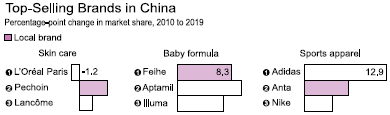
(Bruce Einhorn and Daniela Wei. Bloomberg Businessweek, 07.12.2020. Adapted.)
By comparing the first two paragraphs and the graphs it is possible to state that, in China,
Provas
In 2008 at least six babies died and 300,000 fell ill after drinking made-in-China infant formula contaminated with toxic chemicals. In response, many Chinese parents embraced foreign baby food brands, catapulting the likes of Danone SA’s Aptamil and Nestlé SA’s Illuma to the top of the market. Yet for the past two years, the leading formula brand in China has been made by China Feihe Ltd., a Beijing company that emphasizes its local roots rather than seeking to obscure them. “More suitable for Chinese babies,” the company’s advertising boasts.
In categories ranging from baby food to sportswear and skin cream, Chinese brands are putting pressure on global rivals that depend on the country for much of their growth. While increasing nationalism has boosted the momentum of domestic products for the past couple of years, the covid-19 pandemic is speeding up the shift. With prices typically lower than foreign brands’, domestic products have increasing appeal in times of constrained household budgets, and the growth of online sales has weakened the multinationals’ advantages in distribution and marketing.
Foreign brands aren’t finished in China, of course. They dominate categories such as expensive handbags and luxury cars. Kentucky Fried Chicken (KFC) — still the biggest fast- -food chain in China — is supplementing its fried chicken with products such as fast-cooking snail noodles to cater to diners stuck at home in the pandemic. “The attitude of big international brands is changing significantly,” says Wu Wenmi, founder of Wenzihui MCN agency. “They are more humble now and willing to hear our opinions of how to play the game.”
One way Chinese companies are playing the game is with marketing that resonates for locals. While foreigners’ ads stress the nutritional value of their infant formula, Feihe nurtures relationships with consumers via loyalty programs and new-parent support groups. And Chinese brands are increasingly tailoring their products to domestic tastes. China Mengniu Dairy Co., for instance, is stepping up sales of innovations such as pineapple-flavored cheese in addition to its lineup of basic milk and fruit yogurts. “Foreign brands were so innovative three decades ago when they first came to China,” Mengniu CEO Lu Minfang says. “But now they’re developing slower than local brands.”
(Bruce Einhorn and Daniela Wei. Bloomberg Businessweek, 07.12.2020. Adapted.)
The last paragraph makes reference to
Provas
In 2008 at least six babies died and 300,000 fell ill after drinking made-in-China infant formula contaminated with toxic chemicals. In response, many Chinese parents embraced foreign baby food brands, catapulting the likes of Danone SA’s Aptamil and Nestlé SA’s Illuma to the top of the market. Yet for the past two years, the leading formula brand in China has been made by China Feihe Ltd., a Beijing company that emphasizes its local roots rather than seeking to obscure them. “More suitable for Chinese babies,” the company’s advertising boasts.
In categories ranging from baby food to sportswear and skin cream, Chinese brands are putting pressure on global rivals that depend on the country for much of their growth. While increasing nationalism has boosted the momentum of domestic products for the past couple of years, the covid-19 pandemic is speeding up the shift. With prices typically lower than foreign brands’, domestic products have increasing appeal in times of constrained household budgets, and the growth of online sales has weakened the multinationals’ advantages in distribution and marketing.
Foreign brands aren’t finished in China, of course. They dominate categories such as expensive handbags and luxury cars. Kentucky Fried Chicken (KFC) — still the biggest fast- -food chain in China — is supplementing its fried chicken with products such as fast-cooking snail noodles to cater to diners stuck at home in the pandemic. “The attitude of big international brands is changing significantly,” says Wu Wenmi, founder of Wenzihui MCN agency. “They are more humble now and willing to hear our opinions of how to play the game.”
One way Chinese companies are playing the game is with marketing that resonates for locals. While foreigners’ ads stress the nutritional value of their infant formula, Feihe nurtures relationships with consumers via loyalty programs and new-parent support groups. And Chinese brands are increasingly tailoring their products to domestic tastes. China Mengniu Dairy Co., for instance, is stepping up sales of innovations such as pineapple-flavored cheese in addition to its lineup of basic milk and fruit yogurts. “Foreign brands were so innovative three decades ago when they first came to China,” Mengniu CEO Lu Minfang says. “But now they’re developing slower than local brands.”
(Bruce Einhorn and Daniela Wei. Bloomberg Businessweek, 07.12.2020. Adapted.)
The mention of Kentucky Fried Chicken, in the third paragraph, illustrates
Provas
In 2008 at least six babies died and 300,000 fell ill after drinking made-in-China infant formula contaminated with toxic chemicals. In response, many Chinese parents embraced foreign baby food brands, catapulting the likes of Danone SA’s Aptamil and Nestlé SA’s Illuma to the top of the market. Yet for the past two years, the leading formula brand in China has been made by China Feihe Ltd., a Beijing company that emphasizes its local roots rather than seeking to obscure them. “More suitable for Chinese babies,” the company’s advertising boasts.
In categories ranging from baby food to sportswear and skin cream, Chinese brands are putting pressure on global rivals that depend on the country for much of their growth. While increasing nationalism has boosted the momentum of domestic products for the past couple of years, the covid-19 pandemic is speeding up the shift. With prices typically lower than foreign brands’, domestic products have increasing appeal in times of constrained household budgets, and the growth of online sales has weakened the multinationals’ advantages in distribution and marketing.
Foreign brands aren’t finished in China, of course. They dominate categories such as expensive handbags and luxury cars. Kentucky Fried Chicken (KFC) — still the biggest fast- -food chain in China — is supplementing its fried chicken with products such as fast-cooking snail noodles to cater to diners stuck at home in the pandemic. “The attitude of big international brands is changing significantly,” says Wu Wenmi, founder of Wenzihui MCN agency. “They are more humble now and willing to hear our opinions of how to play the game.”
One way Chinese companies are playing the game is with marketing that resonates for locals. While foreigners’ ads stress the nutritional value of their infant formula, Feihe nurtures relationships with consumers via loyalty programs and new-parent support groups. And Chinese brands are increasingly tailoring their products to domestic tastes. China Mengniu Dairy Co., for instance, is stepping up sales of innovations such as pineapple-flavored cheese in addition to its lineup of basic milk and fruit yogurts. “Foreign brands were so innovative three decades ago when they first came to China,” Mengniu CEO Lu Minfang says. “But now they’re developing slower than local brands.”
(Bruce Einhorn and Daniela Wei. Bloomberg Businessweek, 07.12.2020. Adapted.)
According to the second paragraph, the position of domestic products in the Chinese market at the end of 2020 was due to, among others,
Provas
In 2008 at least six babies died and 300,000 fell ill after drinking made-in-China infant formula contaminated with toxic chemicals. In response, many Chinese parents embraced foreign baby food brands, catapulting the likes of Danone SA’s Aptamil and Nestlé SA’s Illuma to the top of the market. Yet for the past two years, the leading formula brand in China has been made by China Feihe Ltd., a Beijing company that emphasizes its local roots rather than seeking to obscure them. “More suitable for Chinese babies,” the company’s advertising boasts.
In categories ranging from baby food to sportswear and skin cream, Chinese brands are putting pressure on global rivals that depend on the country for much of their growth. While increasing nationalism has boosted the momentum of domestic products for the past couple of years, the covid-19 pandemic is speeding up the shift. With prices typically lower than foreign brands’, domestic products have increasing appeal in times of constrained household budgets, and the growth of online sales has weakened the multinationals’ advantages in distribution and marketing.
Foreign brands aren’t finished in China, of course. They dominate categories such as expensive handbags and luxury cars. Kentucky Fried Chicken (KFC) — still the biggest fast- -food chain in China — is supplementing its fried chicken with products such as fast-cooking snail noodles to cater to diners stuck at home in the pandemic. “The attitude of big international brands is changing significantly,” says Wu Wenmi, founder of Wenzihui MCN agency. “They are more humble now and willing to hear our opinions of how to play the game.”
One way Chinese companies are playing the game is with marketing that resonates for locals. While foreigners’ ads stress the nutritional value of their infant formula, Feihe nurtures relationships with consumers via loyalty programs and new-parent support groups. And Chinese brands are increasingly tailoring their products to domestic tastes. China Mengniu Dairy Co., for instance, is stepping up sales of innovations such as pineapple-flavored cheese in addition to its lineup of basic milk and fruit yogurts. “Foreign brands were so innovative three decades ago when they first came to China,” Mengniu CEO Lu Minfang says. “But now they’re developing slower than local brands.”
(Bruce Einhorn and Daniela Wei. Bloomberg Businessweek, 07.12.2020. Adapted.)
The text is mainly about
Provas
Caderno Container