Foram encontradas 40 questões.
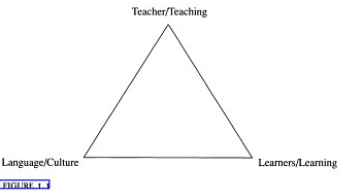
Considering Figure 1.1, choose the CORRECT alternative:
Provas

Read the following statements and decide if they are true (T) or false (F) considering 'SLA studies'.
( ) The most obvious beneficiaries of the studies are the students.
( ) SLA studies can influence other knowledge areas.
( ) SLA studies can be influenced by other knowledge areas.
( ) Developing teachers' awareness is the final purpose of SLA studies.
Choose the alternative which CORRECTLY shows if the statements are true or false:
Provas
Why study second language acquisition?
There are almost as many reasons to study SLA as there are places where second languages are acquired and used. First of all, the study of SLA is fascinating in its own right. It is a true conundrum. Understanding it requires drawing upon knowledge of psychology, linguistics, sociology, anthropology, psycholinguistics, sociolinguistics and neurolinguistics, among others. As Davi Cook (1965) has said:
We sometimes overlook the fact that there is much that we can know and need to know about our universe and ourselves that is not necessary useful at the moment of discovery. By the same token, we are too prone to reject knowledge for which we cannot find an immediate practical application.
Yet much of what those who apply knowledge have discovered in their practical persuits was made possible by those who were only persuing knowledge for its own sake. In an ultimate sense all knowledge is practical. (p.9)
But there is more to be gained from grappling with the complexity of SLA than the sating of intellectual curiosity. The most obvious beneficiary of an increased understanding of SLA is the second language teaching profession, and through the teachers, the learners themselves. Indeed, many researchers have been or remain language teachers who find themselves attracted to SLA research as a source of insight into the teaching/learning process. As Corder (1981, p. 7) puts it, 'Efficient language teaching must work with, rather than against, natural processes, facilitate and expedite rather than impede learning.' This can happen best when we know what those natural processes are.
Indeed, we have found it helpful to depict the central players, processes and content in the language teaching field as a triangle. As the Figure 1.1 implies, we believe that language teachers' decisions about the teaching process should, to a large extent, be informed by knowledge of the subject matter they are teaching (i.e. the target language and culture) and by knowledge of the unique group of learners with whom they are working and of the languagelearning process. It is the lower right angle of the triangle with which we are concerned in this book. Teacher's expectations about what SLA research can tell us at this point must be modest, though. As Lightbown (1985) reminds us, at the moment SLA research does reveal to a certain extent what learners do and what they know. It has not yet, however, reached the point where
we can say with assurance how they have come to do and to know these things, and we are further still from saying what teaching practices should therefore follow. On the other hand, if our research leads to greater teacher awareness of the acquisition process and increased sensitivity towards learners, then it seems to us the effort has been worthwhile.
Then, too, although we have no independent evidence to corroborate their claim, second language learners who have studied SLA research report anecdotally that their awareness of the SLA process facilitates their subsequent attempts at language learning. Clearly a heightened understanding of second language acquisition could also have impact on other educational programmes involving language acquisition, such as bilingual education and immersion programmes.
But there are other, less obvious areas for which an understanding of SLA may prove helpful. One such example is with certain populations which have specific language-learning needs. For instance, language intervention issues for mentally retarded individuals parallel second language teaching issues to a striking degree (see, for example, Rosenberg 1982). Diagnosing non-native speaking children’s learning disabilities as distinct from their second language problems is another example. Facilitating the acquisition of a spoken language by deaf individuals already fluent in sign language is yet a third. Many other potential applications could be cited here.
Mention was made earlier about how knowledge of certain disciplines helps us to understand the SLA process better. Ideally SLA research can and should inform these disciplines as well. SLA provides a good test case for linguists` observations on individual learning style differences. It also provides fertile ground for anthropologists’ exploration of cultural universals and for sociologists’ study of the effect of group membership on task achievement. Psycholinguists should be able to use SLA research findings in order to address a perennial problem for them: How to sort out the effects of cognitive development from normal child language development. Sociolinguists should find second language acquisition research helpful in expanding their understanding of when speakers prefer one speech style over another. Neurolinguists will find that SLA evidence can be brought to bear on issues in human biological development. For example, is there such a thing as a critical period in an individual’s development, beyond which it is very difficult or impossible for anyone to truly master something as complex as a second language? There are but a few of the issues which SLA research should shed some light on in these related disciplines.
(Adapted from Larsen-Freeman, D. and Long, M.H. Introduction to Second Language Acquisition Research, Routledge, 2014)
Choose the alternative which CORRECTLY correlates ideas from Text 2:
1. Reason to study SLA
2. Teachers` expectations
3. SLA process awareness
A – Beneficial
B– Own delight
C– Unpretentious
The alternative which CORRECTLY correlates the ideas is:
Provas
Read attentively the assertions about learning assessment and check (T) for those that are true and (F) for those that are false:
( ) Continuous assessment should be used as a basis to the construction of intended results;
( ) Assessment must privilege validity, accuracy and reliability without possible ambiguity or mistake;
( ) The concepts of subjectivity and provisional truth suspend any assessment criteria;
( ) Assessment can be collaborative, when teachers and students share their comments and decisions;
( ) Formative assessment, in its current conception, is interactive and centered in students' cognitive processes and associated to the processes of feedback, regulation and selfassessment of learning.
Check the alternative that shows the CORRECT sequence:
Provas
A language teaching approach is a theory of linguistic education translated by a method into operative models, teaching material and the use of teaching tools. Associate the foreign language teaching approaches, on the right, to the propositions which characterize them, on the left.
(1) Formalist Approach
(2) Berlitz Approach
(3) Reading Approach
(4) Structuralist Approach
(5) Communicative Approach
( ) Related to the Audio-lingual Method, this approach grants no importance to cultural and communicative aspects of language. A deductive path is intended to enable the creation of automatic habit. Language is seen as a set of rules. The operative model is basically composed of short classes with structural tasks.
( ) This approach inspired many different methods, as the Situational Language Teaching, the Natural Way, the Total Physical Response, the Community Language Learning and Suggestopedia. Broadly speaking, there is an emphasis in the indirect, implicit and incidental learning of language.
( ) Related to the Direct Method, in which teaching/learning of languages happens through its exclusive use and meanings should be cleared with mimics and images. Language is viewed as a means for communication that carries on cultural models that should come forth spontaneously through the guidance of the ideal native speaker teacher.
( ) Related to the Grammar-Translation Method. Translation is the core of this approach to language teaching. It is based on Descriptive linguistic theory, according to which education consists in respecting the rules of the target language to attain the command of it.
( ) In this approach, priority granted to the reading ability. Students are autonomous to apprehend grammatical rules. Translation exercises are used and readings are controlled for difficulty.
The CORRECT sequence is:
Provas
In relation to the use of information and communications technology (ICT) as a teaching/learning tool, it is CORRECT to affirm that:
Provas
From the standpoint of critical pedagogy, which has in Paulo Freire its seminal thinker, it is INCORRECT to affirm that:
Provas
Read attentively the following statements and write (T) for those that are true and (F) for those that are false in relation to the beliefs of teachers/students and language teaching/learning:
( ) The students understanding of what language is and how additional language should be taught should not influence the teaching/learning process;
( ) The students', as well as teachers', beliefs influence the language teaching/learning process;
( ) The different changes of paradigm in language teaching/learning brought about different changes in the way the students and their beliefs are seen;
( ) The notion and investigation of beliefs became prominent on the learning autonomy movement;
( ) Due to the fact that beliefs are still an intricate and obscure issue, there is the need of further investigation before its influence is taken into account in the teaching/learning of languages.
Check the alternative that shows the CORRECT sequence:
Provas
The study of languages and their variations play an important role in the formation of language teachers. It is important to foster the awareness of the student of additional language to linguistic variation relating it to the situations in which it occurs.
Analyze the following situations.
Police officers in Switzerland use the Swiss variation of German language in intimate and casual circumstances and the standard variation of German language in formal occasions. Inhabitants of urban regions of Paraguay use Spanish language to communicate in formal occasions and switch to Guarani language in intimate and informal conversation among themselves. Arabic language speakers who generally use the vernacular variation of Arabic language, make use of modern standard Arabic language in public speeches.
Those situations are examples related to which of the following concepts?
Provas
Associate the approaches to language (1) e (2) on the right column, to the propositions that characterize them on the left column.
(1) Synchronic approach to language
(2) Diachronic approach to language
( ) Traditional concept of language based on formalist and structuralist concepts.
( ) Understanding of language as an entity that is re-signified by the relationships established among its users.
( ) Formal-systemic vision of language.
( ) View of language as changeable, living and historical entity.
( ) Perception of language as normative entity, thus, possible of being analyzed, classified and regulated by orthographic agreements.
( ) Understanding of language as an organic entity.
( ) View of language as a non-political entity.
The CORRECT sequence is:
Provas
Caderno Container