Foram encontradas 80 questões.
Um físico pilotando uma espaçonave foi multado por avanço de um semáforo de trânsito interestelar. Em sua defesa, alegou que via luz verde ao avançar o semáforo. Além de ter sua defesa indeferida, o físico ainda recebeu outra multa por excesso de velocidade.
Dados:
!$ \bullet !$ velocidade da luz no vácuo: c;
!$ \bullet !$ comprimento de onda da cor verde (“siga"): λg;
!$ \bullet !$ comprimento de onda da cor vermelho (“pare"): λr.
A velocidade mínima da espaçonave era:
Provas

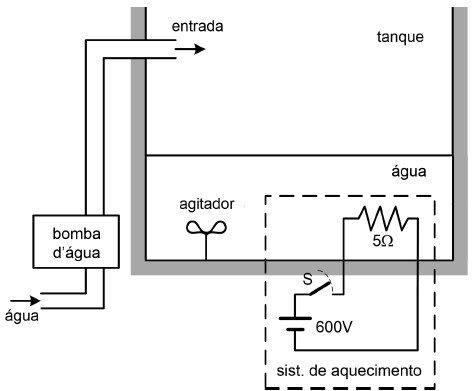
Na figura mostra-se um tanque sendo alimentado por uma bomba d’água, um agitador e um sistema de aquecimento.
Dados:
!$ \bullet !$ massa específica da água: 1 g/cm3;
!$ \bullet !$ calor específico da água: 1 cal/(g.°C);
!$ \bullet !$ vazão de água da bomba: 10 L/min;
!$ \bullet !$ 1 cal = 4,2 J.
Observações:
!$ \bullet !$ não há perdas de calor pelo tanque;
!$ \bullet !$ toda energia dissipada pela resistência aquece a água;
!$ \bullet !$ o agitador mistura toda a água do tanque, mantendo-a numa mesma temperatura.
A água do tanque e a fornecida pela bomba encontram-se a 20 °C. Em determinado instante, o tanque contém 220 L de água e a chave S do sistema de aquecimento é fechada. O tempo, em minutos, para que a água do tanque atinja 60 °C será:
Provas
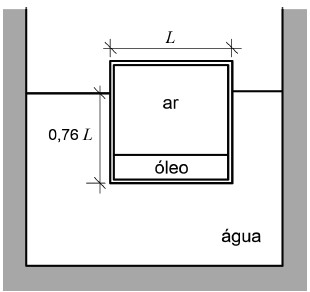
Um cubo de arestas de comprimento L é fabricado a partir de uma chapa metálica fina de densidade superficial de massa S. O cubo encontra-se bem vedado e possui 20% de seu volume interior preenchido com óleo e o restante preenchido com ar. Em certo momento, o cubo é colocado dentro de um reservatório de água e permanece em equilíbrio na posição ilustrada na figura.
Dados:
!$ \bullet !$ massa específica da água: 1 g/cm3;
!$ \bullet !$ massa específica do óleo: 0,8 g/cm3.
Observações:
!$ \bullet !$ a massa do ar no interior do cubo é desprezível;
!$ \bullet !$ a espessura da chapa é desprezível em relação ao comprimento L das arestas;
!$ \bullet !$ a unidade de L é cm;
!$ \bullet !$ a unidade de S é g/cm2.
A relação L/S, em cm3/g, é:
Provas
Text 1
XAI-Explainable artificial intelligence
Gunning, D., Stefik, M., Choi, J., Miller, T., Stumpf, S. e Yang, G-Z
Recent successes in machine learning (ML) have led to a new wave of artificial intelligence (AI) applications that offer extensive benefits to a diverse range of fields. However, many of these systems are not able to explain their autonomous decisions and actions to human users. Explanations may not be essential for certain AI applications, and some AI researchers argue that the emphasis on explanation is misplaced, too difficult to achieve, and perhaps unnecessary. However, for many critical applications in defense, medicine, finance, and law, explanations are essential for users to understand, trust, and effectively manage these new, artificially intelligent partners.
Recent AI successes are largely attributed to new ML techniques that construct models in their internal representations. These include support vector machines (SVMs), random forests, probabilistic graphical models, reinforcement learning (RL), and deep learning (DL) neural networks. Although these models exhibit high performance, they are opaque in terms of explainability. There may be inherent conflict between ML performance (e.g., predictive accuracy) and explainability. Often, the highest performing methods (e.g., DL) are the least explainable, and the most explainable (e.g., decision trees) are the least accurate.
The (purpose) of an explainable AI (XAI) system is to make its behavior more intelligible to humans by providing explanations. There are some general principles to help create effective, more human-understandable AI systems: The XAI system should be able to explain its capabilities and understandings; explain what it has done, what it is doing now, and what will happen next; and disclose the salient information that it is acting on.
However, every explanation is set within a context that depends (on) the task, abilities, and expectations of the user of the AI system. The definitions of interpretability and explainability are, thus, domain dependent and may not be defined independently from a domain. Explanations can be full or partial.
Models that are fully interpretable give full and completely (transparent) explanations. Models that are partially interpretable reveal important pieces of their (reasoning) process. Interpretable models obey “interpretability constraints” that are defined according to the domain, whereas black box or unconstrained models do not necessarily obey these constraints. Partial explanations may include variable importance measures, local models that approximate global models at specific points and saliency maps.
XAI assumes that an explanation is (provided) to an “end user” who depends on the decisions, recommendations, or actions produced by an AI system yet there could be many different kinds of users, often (at) different time points in the development and use of the system. For example, a type of user might be an intelligence analyst, judge or an operator. However, other users who demand an explanation of the system might be a developer or test operator who needs to understand where there might be areas of improvements. Yet another user might be policy-makers, who are trying to (assess) the fairness of the system. Each user group may have a preferred explanation type that is able to communicate information in the most effective way. An effective explanation will take the target user group of the system into account, who might vary in their background knowledge and needs for what should be explained.
A number of ways of evaluating and measuring the effectiveness of an explanation have been proposed, however, there is currently no common means of measuring if an XAI system is more intelligible to a user than a non-XAI system. Some of these measures are subjective measures from the user’s point of view, such as user (satisfaction) which can be measured through a subjective rating of the clarity and utility of an explanation. More objective measures for an explanation’s effectiveness might be task performance, i.e., does the explanation improve the user’s decision-making. Reliable and consistent measurement of the effects of explanations is still an open research question. Evaluation and measurement for XAI systems include valuation frameworks, common ground, common sense, and argumentation.
(. . . )
From a human-centered research perspective, research on competencies and knowledge could take XAI beyond the role of explaining a particular XAI system and helping its users to determine appropriate trust. In the future, XAIs may eventually have substantial social roles. These roles could include not only learning and explaining to individuals but also coordinating with other agents to connect knowledge, developing cross-disciplinary insights and common ground, partnering in teaching people and other agents, and drawing on previously discovered knowledge to accelerate the further discovery and application of knowledge. From such a social perspective of knowledge understanding and generation, the future (of) XAI is just beginning.
Adapted from: Science Robotics in <https://www.science.org/doi/10.1126/scirobotics.aay7120> [Accessed on 15th April 2022]
Text 2
Overview of current additive manufacturing technologies and selected applications
Horn, T..J. e Harrysson, O.L
Three-dimensional printing or rapid prototyping are processes by which components are fabricated directly from computer models by selectively curing, depositing or consolidating materials in successive layers. These technologies have traditionally been limited to the fabrication of models suitable for product visualization but, over the past decade, have quickly developed into a new paradigm called additive manufacturing.
It remains to be seen what the long term implications of additive manufacturing will be. In many regards, it is a technology that is still in its infancy and it represents a very small segment of manufacturing overall. That small segment is growing quickly but the future is by no means certain. Scarcely a quarter century has passed since the first stereolithography systems for rapid prototyping appeared on the market.
In that short time, additive manufacturing has not only become relatively common place in science, academia, and industry, but it has also evolved from a method to quickly produce visual models into a new manufacturing paradigm. In the past two decades, revenues associated with products and services show that additive manufacturing has grown into a multi-billion dollar industry.
Additive manufacturing has the potential to radically change the way in which many products are made and distributed. Throughout history, key innovations in manufacturing technology have had a profound impact on our society and our culture. An examination of the applications and technologies suggest that additive manufacturing may become a truly disruptive technology.
Prior to the industrial revolution goods were typically produced by skilled artisans and were often tailored to satisfy a specific, individual demand. While this approach may have had many inherent advantages to the consumer (i.e. high quality, custom parts on demand) it is doubtful that system could have persisted under the growing demands of society.
The invention of the first machine tools (that is tools capable of precisely controlling the relative motion between a tool and a work piece) along with advances in fixturing and metrology facilitated the manufacture of interchangeable parts which, in turn, supported the development of the mass production system. The model of mass production also has many clear advantages to both the producers and the consumers of products, including; high throughput, high quality and product consistency at a low unit cost. This, of course, comes at the cost of reduced product diversity.
In the last century, the means by which many goods are manufactured has been radically enhanced by computer controlled machinery and automation. However, in general, the basic methods and materials are quite similar to those used at the turn of the 19th century. Bulk materials must still be either cut, formed, or molded in order to fabricate value-added products. In fact, a large portion of the products that we consume or use at the present time are manufactured using processes like forming, injection molding, casting, extrusion, stamping, and machining. Each one of these processes requires some form of tooling (mold, die, flask, stamp, fixture, etc.). For instance, if we consider casting an exhaust manifold in steel we must first design and fabricate a sand or investment mold with the negative shape of the final part. A metal stamped part, as simple as a washer, requires a die and a large stamping press in order to be produced. A simple plastic cover for a smart phone requires an injection mold that may cost thousands of dollars and an injection molding machine that may costs hundreds of thousands to millions of dollars. The cost and time dedicated to the design and fabrication of tooling that supports mass production represents a significant percentage of the total cost of a product.
The natural result of high tooling costs is that within a given mass production system there is an inverse relationship between the quantity of a product that is produced and the variety of product designs available.
It is necessary that we recognize that production tooling is not only expensive, but it also constrains the design of products based on innate limitations imposed by the various mass production processes. This is a widely studied area of manufacturing known as design for manufacture (DFM).
As a brief example, consider a plastic injection molded part. One of the key limitations is that the mold must provide for the easy removal of the part. This means that the part must have slightly outward sloping surfaces (called positive draft), as inward sloping surfaces would essentially lock the part to the mold like a dovetail making it impossible to remove. Further, the injection mold itself must be precisely machined, ground, and polished from a block of metal, and the processes that are used to do that, like milling with a cutting tool, also have similar limitations (i.e. the cutting tool must be able to access the feature that will be cut).
Increasing the complexity of the part to better serve a given function can drive up the cost of the tooling required for producing it and, in many cases, the optimal design for a given purpose is impossible to produce using traditional mass production methods.
Additive manufacturing represents a fundamentally new method of part fabrication. It is the process of fabricating components directly from 3D computer models by selectively depositing, curing, or consolidating materials one layer upon the next. Each layer represents the cross-sectional geometry of the part at a given height. This is a stark contrast to traditional manufacturing processes like forming, casting, and machining because tooling is not required to produce a part. The freeform nature of additive manufacturing is therefore changing the way we look at traditional DFM constraints. In many cases the traditional constraints no longer apply.
By building parts additively, in layers, components can be manufactured with extremely complex geometries, such as internal channels, undercut features, or engineered lattice structures with controlled and/or variable porosity. These are features that are extremely difficult or impossible to produce with traditional methods.
The implication of this is quite simple to recognize but at the same time has a profound result. Removing the need for tooling facilitates the economical production of small lot sizes of parts (as low as one) without sacrificing interchangeability, thereby reducing the lead time for production (because the tools do not need to be produced), allowing flexibility in the supply chain and the production location (parts can be made where and when they are demanded), and raising the possibility of transitioning from a system of mass production to one off mass customization. It also means that design changes incur much less cost in production so products can potentially be customized to conform to the needs of the individual consumer. In many ways this concept goes far beyond the definition of most existing mass customization models in which mass produced components are fabricated and then assembled on demand to specific customer orders.
Adapted from: Sage Journals. Available at:<https://journals.sagepub.com/doi/abs/10.3184/003685012X134209844630 47> [Accessed on 10th March 2022].
The main idea presented in Text 1 and Text 2 is related to:
Provas
NA QUESTÃO, RESPONDA DE ACORDO COM O TEXTO 2.
Text 2
Overview of current additive manufacturing technologies and selected applications
Horn, T..J. e Harrysson, O.L
Three-dimensional printing or rapid prototyping are processes by which components are fabricated directly from computer models by selectively curing, depositing or consolidating materials in successive layers. These technologies have traditionally been limited to the fabrication of models suitable for product visualization but, over the past decade, have quickly developed into a new paradigm called additive manufacturing.
It remains to be seen what the long term implications of additive manufacturing will be. In many regards, it is a technology that is still in its infancy and it represents a very small segment of manufacturing overall. That small segment is growing quickly but the future is by no means certain. Scarcely a quarter century has passed since the first stereolithography systems for rapid prototyping appeared on the market.
In that short time, additive manufacturing has not only become relatively common place in science, academia, and industry, but it has also evolved from a method to quickly produce visual models into a new manufacturing paradigm. In the past two decades, revenues associated with products and services show that additive manufacturing has grown into a multi-billion dollar industry.
Additive manufacturing has the potential to radically change the way in which many products are made and distributed. Throughout history, key innovations in manufacturing technology have had a profound impact on our society and our culture. An examination of the applications and technologies suggest that additive manufacturing may become a truly disruptive technology.
Prior to the industrial revolution goods were typically produced by skilled artisans and were often tailored to satisfy a specific, individual demand. While this approach may have had many inherent advantages to the consumer (i.e. high quality, custom parts on demand) it is doubtful that system could have persisted under the growing demands of society.
The invention of the first machine tools (that is tools capable of precisely controlling the relative motion between a tool and a work piece) along with advances in fixturing and metrology facilitated the manufacture of interchangeable parts which, in turn, supported the development of the mass production system. The model of mass production also has many clear advantages to both the producers and the consumers of products, including; high throughput, high quality and product consistency at a low unit cost. This, of course, comes at the cost of reduced product diversity.
In the last century, the means by which many goods are manufactured has been radically enhanced by computer controlled machinery and automation. However, in general, the basic methods and materials are quite similar to those used at the turn of the 19th century. Bulk materials must still be either cut, formed, or molded in order to fabricate value-added products. In fact, a large portion of the products that we consume or use at the present time are manufactured using processes like forming, injection molding, casting, extrusion, stamping, and machining. Each one of these processes requires some form of tooling (mold, die, flask, stamp, fixture, etc.). For instance, if we consider casting an exhaust manifold in steel we must first design and fabricate a sand or investment mold with the negative shape of the final part. A metal stamped part, as simple as a washer, requires a die and a large stamping press in order to be produced. A simple plastic cover for a smart phone requires an injection mold that may cost thousands of dollars and an injection molding machine that may costs hundreds of thousands to millions of dollars. The cost and time dedicated to the design and fabrication of tooling that supports mass production represents a significant percentage of the total cost of a product.
The natural result of high tooling costs is that within a given mass production system there is an inverse relationship between the quantity of a product that is produced and the variety of product designs available.
It is necessary that we recognize that production tooling is not only expensive, but it also constrains the design of products based on innate limitations imposed by the various mass production processes. This is a widely studied area of manufacturing known as design for manufacture (DFM).
As a brief example, consider a plastic injection molded part. One of the key limitations is that the mold must provide for the easy removal of the part. This means that the part must have slightly outward sloping surfaces (called positive draft), as inward sloping surfaces would essentially lock the part to the mold like a dovetail making it impossible to remove. Further, the injection mold itself must be precisely machined, ground, and polished from a block of metal, and the processes that are used to do that, like milling with a cutting tool, also have similar limitations (i.e. the cutting tool must be able to access the feature that will be cut).
Increasing the complexity of the part to better serve a given function can drive up the cost of the tooling required for producing it and, in many cases, the optimal design for a given purpose is impossible to produce using traditional mass production methods.
Additive manufacturing represents a fundamentally new method of part fabrication. It is the process of fabricating components directly from 3D computer models by selectively depositing, curing, or consolidating materials one layer upon the next. Each layer represents the cross-sectional geometry of the part at a given height. This is a stark contrast to traditional manufacturing processes like forming, casting, and machining because tooling is not required to produce a part. The freeform nature of additive manufacturing is therefore changing the way we look at traditional DFM constraints. In many cases the traditional constraints no longer apply.
By building parts additively, in layers, components can be manufactured with extremely complex geometries, such as internal channels, undercut features, or engineered lattice structures with controlled and/or variable porosity. These are features that are extremely difficult or impossible to produce with traditional methods.
The implication of this is quite simple to recognize but at the same time has a profound result. Removing the need for tooling facilitates the economical production of small lot sizes of parts (as low as one) without sacrificing interchangeability, thereby reducing the lead time for production (because the tools do not need to be produced), allowing flexibility in the supply chain and the production location (parts can be made where and when they are demanded), and raising the possibility of transitioning from a system of mass production to one off mass customization. It also means that design changes incur much less cost in production so products can potentially be customized to conform to the needs of the individual consumer. In many ways this concept goes far beyond the definition of most existing mass customization models in which mass produced components are fabricated and then assembled on demand to specific customer orders.
Adapted from: Sage Journals. Available at:<https://journals.sagepub.com/doi/abs/10.3184/003685012X134209844630 47> [Accessed on 10th March 2022].
The meaning of the underlined word in the sentence:“it is a technology that is still in its infancy and it represents a very small segment of manufacturing overall.” is:
Provas
NA QUESTÃO, RESPONDA DE ACORDO COM O TEXTO 2.
Text 2
Overview of current additive manufacturing technologies and selected applications
Horn, T..J. e Harrysson, O.L
Three-dimensional printing or rapid prototyping are processes by which components are fabricated directly from computer models by selectively curing, depositing or consolidating materials in successive layers. These technologies have traditionally been limited to the fabrication of models suitable for product visualization but, over the past decade, have quickly developed into a new paradigm called additive manufacturing.
It remains to be seen what the long term implications of additive manufacturing will be. In many regards, it is a technology that is still in its infancy and it represents a very small segment of manufacturing overall. That small segment is growing quickly but the future is by no means certain. Scarcely a quarter century has passed since the first stereolithography systems for rapid prototyping appeared on the market.
In that short time, additive manufacturing has not only become relatively common place in science, academia, and industry, but it has also evolved from a method to quickly produce visual models into a new manufacturing paradigm. In the past two decades, revenues associated with products and services show that additive manufacturing has grown into a multi-billion dollar industry.
Additive manufacturing has the potential to radically change the way in which many products are made and distributed. Throughout history, key innovations in manufacturing technology have had a profound impact on our society and our culture. An examination of the applications and technologies suggest that additive manufacturing may become a truly disruptive technology.
Prior to the industrial revolution goods were typically produced by skilled artisans and were often tailored to satisfy a specific, individual demand. While this approach may have had many inherent advantages to the consumer (i.e. high quality, custom parts on demand) it is doubtful that system could have persisted under the growing demands of society.
The invention of the first machine tools (that is tools capable of precisely controlling the relative motion between a tool and a work piece) along with advances in fixturing and metrology facilitated the manufacture of interchangeable parts which, in turn, supported the development of the mass production system. The model of mass production also has many clear advantages to both the producers and the consumers of products, including; high throughput, high quality and product consistency at a low unit cost. This, of course, comes at the cost of reduced product diversity.
In the last century, the means by which many goods are manufactured has been radically enhanced by computer controlled machinery and automation. However, in general, the basic methods and materials are quite similar to those used at the turn of the 19th century. Bulk materials must still be either cut, formed, or molded in order to fabricate value-added products. In fact, a large portion of the products that we consume or use at the present time are manufactured using processes like forming, injection molding, casting, extrusion, stamping, and machining. Each one of these processes requires some form of tooling (mold, die, flask, stamp, fixture, etc.). For instance, if we consider casting an exhaust manifold in steel we must first design and fabricate a sand or investment mold with the negative shape of the final part. A metal stamped part, as simple as a washer, requires a die and a large stamping press in order to be produced. A simple plastic cover for a smart phone requires an injection mold that may cost thousands of dollars and an injection molding machine that may costs hundreds of thousands to millions of dollars. The cost and time dedicated to the design and fabrication of tooling that supports mass production represents a significant percentage of the total cost of a product.
The natural result of high tooling costs is that within a given mass production system there is an inverse relationship between the quantity of a product that is produced and the variety of product designs available.
It is necessary that we recognize that production tooling is not only expensive, but it also constrains the design of products based on innate limitations imposed by the various mass production processes. This is a widely studied area of manufacturing known as design for manufacture (DFM).
As a brief example, consider a plastic injection molded part. One of the key limitations is that the mold must provide for the easy removal of the part. This means that the part must have slightly outward sloping surfaces (called positive draft), as inward sloping surfaces would essentially lock the part to the mold like a dovetail making it impossible to remove. Further, the injection mold itself must be precisely machined, ground, and polished from a block of metal, and the processes that are used to do that, like milling with a cutting tool, also have similar limitations (i.e. the cutting tool must be able to access the feature that will be cut).
Increasing the complexity of the part to better serve a given function can drive up the cost of the tooling required for producing it and, in many cases, the optimal design for a given purpose is impossible to produce using traditional mass production methods.
Additive manufacturing represents a fundamentally new method of part fabrication. It is the process of fabricating components directly from 3D computer models by selectively depositing, curing, or consolidating materials one layer upon the next. Each layer represents the cross-sectional geometry of the part at a given height. This is a stark contrast to traditional manufacturing processes like forming, casting, and machining because tooling is not required to produce a part. The freeform nature of additive manufacturing is therefore changing the way we look at traditional DFM constraints. In many cases the traditional constraints no longer apply.
By building parts additively, in layers, components can be manufactured with extremely complex geometries, such as internal channels, undercut features, or engineered lattice structures with controlled and/or variable porosity. These are features that are extremely difficult or impossible to produce with traditional methods.
The implication of this is quite simple to recognize but at the same time has a profound result. Removing the need for tooling facilitates the economical production of small lot sizes of parts (as low as one) without sacrificing interchangeability, thereby reducing the lead time for production (because the tools do not need to be produced), allowing flexibility in the supply chain and the production location (parts can be made where and when they are demanded), and raising the possibility of transitioning from a system of mass production to one off mass customization. It also means that design changes incur much less cost in production so products can potentially be customized to conform to the needs of the individual consumer. In many ways this concept goes far beyond the definition of most existing mass customization models in which mass produced components are fabricated and then assembled on demand to specific customer orders.
Adapted from: Sage Journals. Available at:<https://journals.sagepub.com/doi/abs/10.3184/003685012X134209844630 47> [Accessed on 10th March 2022].
Choose the correct option.
Provas
NA QUESTÃO, RESPONDA DE ACORDO COM O TEXTO 2.
Text 2
Overview of current additive manufacturing technologies and selected applications
Horn, T..J. e Harrysson, O.L
Three-dimensional printing or rapid prototyping are processes by which components are fabricated directly from computer models by selectively curing, depositing or consolidating materials in successive layers. These technologies have traditionally been limited to the fabrication of models suitable for product visualization but, over the past decade, have quickly developed into a new paradigm called additive manufacturing.
It remains to be seen what the long term implications of additive manufacturing will be. In many regards, it is a technology that is still in its infancy and it represents a very small segment of manufacturing overall. That small segment is growing quickly but the future is by no means certain. Scarcely a quarter century has passed since the first stereolithography systems for rapid prototyping appeared on the market.
In that short time, additive manufacturing has not only become relatively common place in science, academia, and industry, but it has also evolved from a method to quickly produce visual models into a new manufacturing paradigm. In the past two decades, revenues associated with products and services show that additive manufacturing has grown into a multi-billion dollar industry.
Additive manufacturing has the potential to radically change the way in which many products are made and distributed. Throughout history, key innovations in manufacturing technology have had a profound impact on our society and our culture. An examination of the applications and technologies suggest that additive manufacturing may become a truly disruptive technology.
Prior to the industrial revolution goods were typically produced by skilled artisans and were often tailored to satisfy a specific, individual demand. While this approach may have had many inherent advantages to the consumer (i.e. high quality, custom parts on demand) it is doubtful that system could have persisted under the growing demands of society.
The invention of the first machine tools (that is tools capable of precisely controlling the relative motion between a tool and a work piece) along with advances in fixturing and metrology facilitated the manufacture of interchangeable parts which, in turn, supported the development of the mass production system. The model of mass production also has many clear advantages to both the producers and the consumers of products, including; high throughput, high quality and product consistency at a low unit cost. This, of course, comes at the cost of reduced product diversity.
In the last century, the means by which many goods are manufactured has been radically enhanced by computer controlled machinery and automation. However, in general, the basic methods and materials are quite similar to those used at the turn of the 19th century. Bulk materials must still be either cut, formed, or molded in order to fabricate value-added products. In fact, a large portion of the products that we consume or use at the present time are manufactured using processes like forming, injection molding, casting, extrusion, stamping, and machining. Each one of these processes requires some form of tooling (mold, die, flask, stamp, fixture, etc.). For instance, if we consider casting an exhaust manifold in steel we must first design and fabricate a sand or investment mold with the negative shape of the final part. A metal stamped part, as simple as a washer, requires a die and a large stamping press in order to be produced. A simple plastic cover for a smart phone requires an injection mold that may cost thousands of dollars and an injection molding machine that may costs hundreds of thousands to millions of dollars. The cost and time dedicated to the design and fabrication of tooling that supports mass production represents a significant percentage of the total cost of a product.
The natural result of high tooling costs is that within a given mass production system there is an inverse relationship between the quantity of a product that is produced and the variety of product designs available.
It is necessary that we recognize that production tooling is not only expensive, but it also constrains the design of products based on innate limitations imposed by the various mass production processes. This is a widely studied area of manufacturing known as design for manufacture (DFM).
As a brief example, consider a plastic injection molded part. One of the key limitations is that the mold must provide for the easy removal of the part. This means that the part must have slightly outward sloping surfaces (called positive draft), as inward sloping surfaces would essentially lock the part to the mold like a dovetail making it impossible to remove. Further, the injection mold itself must be precisely machined, ground, and polished from a block of metal, and the processes that are used to do that, like milling with a cutting tool, also have similar limitations (i.e. the cutting tool must be able to access the feature that will be cut).
Increasing the complexity of the part to better serve a given function can drive up the cost of the tooling required for producing it and, in many cases, the optimal design for a given purpose is impossible to produce using traditional mass production methods.
Additive manufacturing represents a fundamentally new method of part fabrication. It is the process of fabricating components directly from 3D computer models by selectively depositing, curing, or consolidating materials one layer upon the next. Each layer represents the cross-sectional geometry of the part at a given height. This is a stark contrast to traditional manufacturing processes like forming, casting, and machining because tooling is not required to produce a part. The freeform nature of additive manufacturing is therefore changing the way we look at traditional DFM constraints. In many cases the traditional constraints no longer apply.
By building parts additively, in layers, components can be manufactured with extremely complex geometries, such as internal channels, undercut features, or engineered lattice structures with controlled and/or variable porosity. These are features that are extremely difficult or impossible to produce with traditional methods.
The implication of this is quite simple to recognize but at the same time has a profound result. Removing the need for tooling facilitates the economical production of small lot sizes of parts (as low as one) without sacrificing interchangeability, thereby reducing the lead time for production (because the tools do not need to be produced), allowing flexibility in the supply chain and the production location (parts can be made where and when they are demanded), and raising the possibility of transitioning from a system of mass production to one off mass customization. It also means that design changes incur much less cost in production so products can potentially be customized to conform to the needs of the individual consumer. In many ways this concept goes far beyond the definition of most existing mass customization models in which mass produced components are fabricated and then assembled on demand to specific customer orders.
Adapted from: Sage Journals. Available at:<https://journals.sagepub.com/doi/abs/10.3184/003685012X134209844630 47> [Accessed on 10th March 2022].
The meaning of the underlined word in the sentence: “An examination of the applications and techniques suggest that additive manufacture may become a truly disruptive technology.” (linha 16) is:
Provas
NA QUESTÃO, RESPONDA DE ACORDO COM O TEXTO 2.
Text 2
Overview of current additive manufacturing technologies and selected applications
Horn, T..J. e Harrysson, O.L
Three-dimensional printing or rapid prototyping are processes by which components are fabricated directly from computer models by selectively curing, depositing or consolidating materials in successive layers. These technologies have traditionally been limited to the fabrication of models suitable for product visualization but, over the past decade, have quickly developed into a new paradigm called additive manufacturing.
It remains to be seen what the long term implications of additive manufacturing will be. In many regards, it is a technology that is still in its infancy and it represents a very small segment of manufacturing overall. That small segment is growing quickly but the future is by no means certain. Scarcely a quarter century has passed since the first stereolithography systems for rapid prototyping appeared on the market.
In that short time, additive manufacturing has not only become relatively common place in science, academia, and industry, but it has also evolved from a method to quickly produce visual models into a new manufacturing paradigm. In the past two decades, revenues associated with products and services show that additive manufacturing has grown into a multi-billion dollar industry.
Additive manufacturing has the potential to radically change the way in which many products are made and distributed. Throughout history, key innovations in manufacturing technology have had a profound impact on our society and our culture. An examination of the applications and technologies suggest that additive manufacturing may become a truly disruptive technology.
Prior to the industrial revolution goods were typically produced by skilled artisans and were often tailored to satisfy a specific, individual demand. While this approach may have had many inherent advantages to the consumer (i.e. high quality, custom parts on demand) it is doubtful that system could have persisted under the growing demands of society.
The invention of the first machine tools (that is tools capable of precisely controlling the relative motion between a tool and a work piece) along with advances in fixturing and metrology facilitated the manufacture of interchangeable parts which, in turn, supported the development of the mass production system. The model of mass production also has many clear advantages to both the producers and the consumers of products, including; high throughput, high quality and product consistency at a low unit cost. This, of course, comes at the cost of reduced product diversity.
In the last century, the means by which many goods are manufactured has been radically enhanced by computer controlled machinery and automation. However, in general, the basic methods and materials are quite similar to those used at the turn of the 19th century. Bulk materials must still be either cut, formed, or molded in order to fabricate value-added products. In fact, a large portion of the products that we consume or use at the present time are manufactured using processes like forming, injection molding, casting, extrusion, stamping, and machining. Each one of these processes requires some form of tooling (mold, die, flask, stamp, fixture, etc.). For instance, if we consider casting an exhaust manifold in steel we must first design and fabricate a sand or investment mold with the negative shape of the final part. A metal stamped part, as simple as a washer, requires a die and a large stamping press in order to be produced. A simple plastic cover for a smart phone requires an injection mold that may cost thousands of dollars and an injection molding machine that may costs hundreds of thousands to millions of dollars. The cost and time dedicated to the design and fabrication of tooling that supports mass production represents a significant percentage of the total cost of a product.
The natural result of high tooling costs is that within a given mass production system there is an inverse relationship between the quantity of a product that is produced and the variety of product designs available.
It is necessary that we recognize that production tooling is not only expensive, but it also constrains the design of products based on innate limitations imposed by the various mass production processes. This is a widely studied area of manufacturing known as design for manufacture (DFM).
As a brief example, consider a plastic injection molded part. One of the key limitations is that the mold must provide for the easy removal of the part. This means that the part must have slightly outward sloping surfaces (called positive draft), as inward sloping surfaces would essentially lock the part to the mold like a dovetail making it impossible to remove. Further, the injection mold itself must be precisely machined, ground, and polished from a block of metal, and the processes that are used to do that, like milling with a cutting tool, also have similar limitations (i.e. the cutting tool must be able to access the feature that will be cut).
Increasing the complexity of the part to better serve a given function can drive up the cost of the tooling required for producing it and, in many cases, the optimal design for a given purpose is impossible to produce using traditional mass production methods.
Additive manufacturing represents a fundamentally new method of part fabrication. It is the process of fabricating components directly from 3D computer models by selectively depositing, curing, or consolidating materials one layer upon the next. Each layer represents the cross-sectional geometry of the part at a given height. This is a stark contrast to traditional manufacturing processes like forming, casting, and machining because tooling is not required to produce a part. The freeform nature of additive manufacturing is therefore changing the way we look at traditional DFM constraints. In many cases the traditional constraints no longer apply.
By building parts additively, in layers, components can be manufactured with extremely complex geometries, such as internal channels, undercut features, or engineered lattice structures with controlled and/or variable porosity. These are features that are extremely difficult or impossible to produce with traditional methods.
The implication of this is quite simple to recognize but at the same time has a profound result. Removing the need for tooling facilitates the economical production of small lot sizes of parts (as low as one) without sacrificing interchangeability, thereby reducing the lead time for production (because the tools do not need to be produced), allowing flexibility in the supply chain and the production location (parts can be made where and when they are demanded), and raising the possibility of transitioning from a system of mass production to one off mass customization. It also means that design changes incur much less cost in production so products can potentially be customized to conform to the needs of the individual consumer. In many ways this concept goes far beyond the definition of most existing mass customization models in which mass produced components are fabricated and then assembled on demand to specific customer orders.
Adapted from: Sage Journals. Available at:<https://journals.sagepub.com/doi/abs/10.3184/003685012X134209844630 47> [Accessed on 10th March 2022].
Read the following statements about text 2:
I. Additive manufacturing can significantly change the manufacturing and distribution of many products.
II. Additive manufacturing represents a high percentage of the manufacturing industry.
III. Our culture and society have been profoundly impacted by innovations in manufacturing technology.
According to the mentioned text, the correct statement(s) is(are):
Provas
NA QUESTÃO, RESPONDA DE ACORDO COM O TEXTO 2.
Text 2
Overview of current additive manufacturing technologies and selected applications
Horn, T..J. e Harrysson, O.L
Three-dimensional printing or rapid prototyping are processes by which components are fabricated directly from computer models by selectively curing, depositing or consolidating materials in successive layers. These technologies have traditionally been limited to the fabrication of models suitable for product visualization but, over the past decade, have quickly developed into a new paradigm called additive manufacturing.
It remains to be seen what the long term implications of additive manufacturing will be. In many regards, it is a technology that is still in its infancy and it represents a very small segment of manufacturing overall. That small segment is growing quickly but the future is by no means certain. Scarcely a quarter century has passed since the first stereolithography systems for rapid prototyping appeared on the market.
In that short time, additive manufacturing has not only become relatively common place in science, academia, and industry, but it has also evolved from a method to quickly produce visual models into a new manufacturing paradigm. In the past two decades, revenues associated with products and services show that additive manufacturing has grown into a multi-billion dollar industry.
Additive manufacturing has the potential to radically change the way in which many products are made and distributed. Throughout history, key innovations in manufacturing technology have had a profound impact on our society and our culture. An examination of the applications and technologies suggest that additive manufacturing may become a truly disruptive technology.
Prior to the industrial revolution goods were typically produced by skilled artisans and were often tailored to satisfy a specific, individual demand. While this approach may have had many inherent advantages to the consumer (i.e. high quality, custom parts on demand) it is doubtful that system could have persisted under the growing demands of society.
The invention of the first machine tools (that is tools capable of precisely controlling the relative motion between a tool and a work piece) along with advances in fixturing and metrology facilitated the manufacture of interchangeable parts which, in turn, supported the development of the mass production system. The model of mass production also has many clear advantages to both the producers and the consumers of products, including; high throughput, high quality and product consistency at a low unit cost. This, of course, comes at the cost of reduced product diversity.
In the last century, the means by which many goods are manufactured has been radically enhanced by computer controlled machinery and automation. However, in general, the basic methods and materials are quite similar to those used at the turn of the 19th century. Bulk materials must still be either cut, formed, or molded in order to fabricate value-added products. In fact, a large portion of the products that we consume or use at the present time are manufactured using processes like forming, injection molding, casting, extrusion, stamping, and machining. Each one of these processes requires some form of tooling (mold, die, flask, stamp, fixture, etc.). For instance, if we consider casting an exhaust manifold in steel we must first design and fabricate a sand or investment mold with the negative shape of the final part. A metal stamped part, as simple as a washer, requires a die and a large stamping press in order to be produced. A simple plastic cover for a smart phone requires an injection mold that may cost thousands of dollars and an injection molding machine that may costs hundreds of thousands to millions of dollars. The cost and time dedicated to the design and fabrication of tooling that supports mass production represents a significant percentage of the total cost of a product.
The natural result of high tooling costs is that within a given mass production system there is an inverse relationship between the quantity of a product that is produced and the variety of product designs available.
It is necessary that we recognize that production tooling is not only expensive, but it also constrains the design of products based on innate limitations imposed by the various mass production processes. This is a widely studied area of manufacturing known as design for manufacture (DFM).
As a brief example, consider a plastic injection molded part. One of the key limitations is that the mold must provide for the easy removal of the part. This means that the part must have slightly outward sloping surfaces (called positive draft), as inward sloping surfaces would essentially lock the part to the mold like a dovetail making it impossible to remove. Further, the injection mold itself must be precisely machined, ground, and polished from a block of metal, and the processes that are used to do that, like milling with a cutting tool, also have similar limitations (i.e. the cutting tool must be able to access the feature that will be cut).
Increasing the complexity of the part to better serve a given function can drive up the cost of the tooling required for producing it and, in many cases, the optimal design for a given purpose is impossible to produce using traditional mass production methods.
Additive manufacturing represents a fundamentally new method of part fabrication. It is the process of fabricating components directly from 3D computer models by selectively depositing, curing, or consolidating materials one layer upon the next. Each layer represents the cross-sectional geometry of the part at a given height. This is a stark contrast to traditional manufacturing processes like forming, casting, and machining because tooling is not required to produce a part. The freeform nature of additive manufacturing is therefore changing the way we look at traditional DFM constraints. In many cases the traditional constraints no longer apply.
By building parts additively, in layers, components can be manufactured with extremely complex geometries, such as internal channels, undercut features, or engineered lattice structures with controlled and/or variable porosity. These are features that are extremely difficult or impossible to produce with traditional methods.
The implication of this is quite simple to recognize but at the same time has a profound result. Removing the need for tooling facilitates the economical production of small lot sizes of parts (as low as one) without sacrificing interchangeability, thereby reducing the lead time for production (because the tools do not need to be produced), allowing flexibility in the supply chain and the production location (parts can be made where and when they are demanded), and raising the possibility of transitioning from a system of mass production to one off mass customization. It also means that design changes incur much less cost in production so products can potentially be customized to conform to the needs of the individual consumer. In many ways this concept goes far beyond the definition of most existing mass customization models in which mass produced components are fabricated and then assembled on demand to specific customer orders.
Adapted from: Sage Journals. Available at:<https://journals.sagepub.com/doi/abs/10.3184/003685012X134209844630 47> [Accessed on 10th March 2022].
Choose the wrong option:
Provas
NA QUESTÃO, RESPONDA DE ACORDO COM O TEXTO 2.
Text 2
Overview of current additive manufacturing technologies and selected applications
Horn, T..J. e Harrysson, O.L
Three-dimensional printing or rapid prototyping are processes by which components are fabricated directly from computer models by selectively curing, depositing or consolidating materials in successive layers. These technologies have traditionally been limited to the fabrication of models suitable for product visualization but, over the past decade, have quickly developed into a new paradigm called additive manufacturing.
It remains to be seen what the long term implications of additive manufacturing will be. In many regards, it is a technology that is still in its infancy and it represents a very small segment of manufacturing overall. That small segment is growing quickly but the future is by no means certain. Scarcely a quarter century has passed since the first stereolithography systems for rapid prototyping appeared on the market.
In that short time, additive manufacturing has not only become relatively common place in science, academia, and industry, but it has also evolved from a method to quickly produce visual models into a new manufacturing paradigm. In the past two decades, revenues associated with products and services show that additive manufacturing has grown into a multi-billion dollar industry.
Additive manufacturing has the potential to radically change the way in which many products are made and distributed. Throughout history, key innovations in manufacturing technology have had a profound impact on our society and our culture. An examination of the applications and technologies suggest that additive manufacturing may become a truly disruptive technology.
Prior to the industrial revolution goods were typically produced by skilled artisans and were often tailored to satisfy a specific, individual demand. While this approach may have had many inherent advantages to the consumer (i.e. high quality, custom parts on demand) it is doubtful that system could have persisted under the growing demands of society.
The invention of the first machine tools (that is tools capable of precisely controlling the relative motion between a tool and a work piece) along with advances in fixturing and metrology facilitated the manufacture of interchangeable parts which, in turn, supported the development of the mass production system. The model of mass production also has many clear advantages to both the producers and the consumers of products, including; high throughput, high quality and product consistency at a low unit cost. This, of course, comes at the cost of reduced product diversity.
In the last century, the means by which many goods are manufactured has been radically enhanced by computer controlled machinery and automation. However, in general, the basic methods and materials are quite similar to those used at the turn of the 19th century. Bulk materials must still be either cut, formed, or molded in order to fabricate value-added products. In fact, a large portion of the products that we consume or use at the present time are manufactured using processes like forming, injection molding, casting, extrusion, stamping, and machining. Each one of these processes requires some form of tooling (mold, die, flask, stamp, fixture, etc.). For instance, if we consider casting an exhaust manifold in steel we must first design and fabricate a sand or investment mold with the negative shape of the final part. A metal stamped part, as simple as a washer, requires a die and a large stamping press in order to be produced. A simple plastic cover for a smart phone requires an injection mold that may cost thousands of dollars and an injection molding machine that may costs hundreds of thousands to millions of dollars. The cost and time dedicated to the design and fabrication of tooling that supports mass production represents a significant percentage of the total cost of a product.
The natural result of high tooling costs is that within a given mass production system there is an inverse relationship between the quantity of a product that is produced and the variety of product designs available.
It is necessary that we recognize that production tooling is not only expensive, but it also constrains the design of products based on innate limitations imposed by the various mass production processes. This is a widely studied area of manufacturing known as design for manufacture (DFM).
As a brief example, consider a plastic injection molded part. One of the key limitations is that the mold must provide for the easy removal of the part. This means that the part must have slightly outward sloping surfaces (called positive draft), as inward sloping surfaces would essentially lock the part to the mold like a dovetail making it impossible to remove. Further, the injection mold itself must be precisely machined, ground, and polished from a block of metal, and the processes that are used to do that, like milling with a cutting tool, also have similar limitations (i.e. the cutting tool must be able to access the feature that will be cut).
Increasing the complexity of the part to better serve a given function can drive up the cost of the tooling required for producing it and, in many cases, the optimal design for a given purpose is impossible to produce using traditional mass production methods.
Additive manufacturing represents a fundamentally new method of part fabrication. It is the process of fabricating components directly from 3D computer models by selectively depositing, curing, or consolidating materials one layer upon the next. Each layer represents the cross-sectional geometry of the part at a given height. This is a stark contrast to traditional manufacturing processes like forming, casting, and machining because tooling is not required to produce a part. The freeform nature of additive manufacturing is therefore changing the way we look at traditional DFM constraints. In many cases the traditional constraints no longer apply.
By building parts additively, in layers, components can be manufactured with extremely complex geometries, such as internal channels, undercut features, or engineered lattice structures with controlled and/or variable porosity. These are features that are extremely difficult or impossible to produce with traditional methods.
The implication of this is quite simple to recognize but at the same time has a profound result. Removing the need for tooling facilitates the economical production of small lot sizes of parts (as low as one) without sacrificing interchangeability, thereby reducing the lead time for production (because the tools do not need to be produced), allowing flexibility in the supply chain and the production location (parts can be made where and when they are demanded), and raising the possibility of transitioning from a system of mass production to one off mass customization. It also means that design changes incur much less cost in production so products can potentially be customized to conform to the needs of the individual consumer. In many ways this concept goes far beyond the definition of most existing mass customization models in which mass produced components are fabricated and then assembled on demand to specific customer orders.
Adapted from: Sage Journals. Available at:<https://journals.sagepub.com/doi/abs/10.3184/003685012X134209844630 47> [Accessed on 10th March 2022].
Choose the option that does not refer to the rapid prototyping process:
Provas
Caderno Container