Foram encontradas 80 questões.
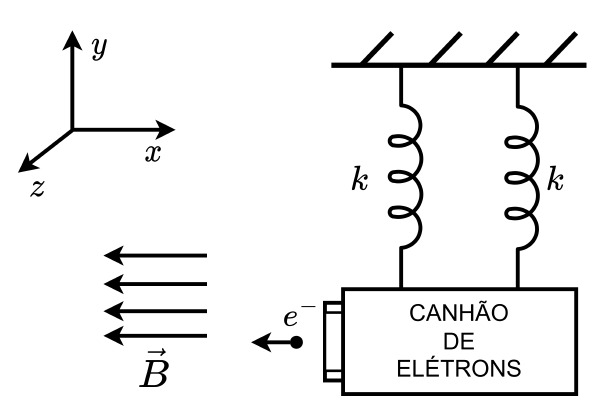
Na figura, é apresentado um canhão oscilando preso ao teto por duas molas e disparando continuamente elétrons numa região sujeita a um campo magnético constante.
Dados:
• constante elástica de cada mola: k;
• amplitude de oscilação do canhão / par de molas: A;
• direção de oscilação do canhão / par de molas: y;
• vetor campo magnético: (˘B,0,0);
• velocidade relativa de disparo dos elétrons em relação ao canhão: (˘v,0,0);
• massa do elétron: m;
• massa do canhão: M;
• carga do elétron: ˘e.
Observações:
• o canhão oscila no plano xy;
• a velocidade inicial de um elétron disparado é obtida ao se somarem vetorialmente os efeitos da oscilação e do canhão parado;
• despreze o efeito gravitacional no movimento dos elétrons;
• m << M;
• despreze as interações elétricas entre os elétrons.
Nas condições acima, a maior coordenada \( z \) que algum elétron pode alcançar é:
Provas

Text 2
Drones Could Spot Crime Scenes from Afar
A system could aid forensic searches and crime-scene mapping by detecting reflections ffom human materials
BY RACHEL BERKOWITZ
Volunteers sometimes spend months trudging through remote terrain to search for lost hikers or crime victims. But a new tool could soon pinpoint forensic evidence from the sky instead. By identifying how traces of blood and other human signs reflect light when found on various natural surfaces, the scientists say searchers will be able to quickly scour large areas for clues about missing persons—dead or alive—using images acquired by drones.
Special drone-mounted sensors can record wavelength intensity for the entire electromagnetic spectrum (rather than just the red, green and blue of a typical camera) in each pixel of an image. Geologists routinely use this technology to pinpoint mineral deposits. Mark Krekeler, a mineralogist at Miami University in Ohio, and his colleagues realized that the same approach, supported by the right spectral data library, could potentially detect forensic evidence.
To build their tool, the researchers measured how human-related features, including blood, sweaty clothing and skin tones, reflect different wavelengths of light. Previous studies have examined such reflective “signatures” to identify blood, “but the signature depends on the surface itself and may change over time” Krekeler says. He and his team analyzed thousands of samples, such as bloodstains on different rock types, recording how they changed as the blood dried.
The researchers customized software that mixes the known reflective signatures of various surfaces to reproduce a target of interest. For example, rock and clothing signatures can be combined to seek a hiker lost in the mountains, or a blood signature can be mixed with those of clothing and sand to search for a wounded person in a desert.
The software estimates whether the target exists in any pixel in an image. It can distinguish between an animal and a human in dense forest, search a cityscape for evidence of a specific person in a blue cotton dress, or determine whether soil is stained by blood or diesel fuel, Krekeler says. His team was slated to present its work at the Geological Society of America's meeting of the North-Central Section in April.
Wendy Calvin, a planetary scientist at the University of Nevada, Reno, who was not involved with the study, calls it “an interesting and novel use of spectral data—and the technique looks promising” But she says it could be challenging to use from afar because of how much of a substance would likely be needed to show up in a pixel.
Within months, officials will be able to download and test the tool for themselves. Developing best-practice protocols for search teams could make such technology routine for investigations and forensics, Krekeler says. As drones and sensors become more widespread, he adds, they can transform investigations that are currently costly, labor-intensive or even impossible.
Available at: <https:/Awww.scientificamerican.com/article/drones-could-spot-crime-scenes-from-afar/> [on May Ist, 2024].
Which option can replace the emphasized word without changing its meaning?
"Volunteers sometimes spend months trudging through remote terrain to search for lost hikers or crime victims”
Provas
Text 2
Drones Could Spot Crime Scenes from Afar
A system could aid forensic searches and crime-scene mapping by detecting reflections ffom human materials
BY RACHEL BERKOWITZ
Volunteers sometimes spend months trudging through remote terrain to search for lost hikers or crime victims. But a new tool could soon pinpoint forensic evidence from the sky instead. By identifying how traces of blood and other human signs reflect light when found on various natural surfaces, the scientists say searchers will be able to quickly scour large areas for clues about missing persons—dead or alive—using images acquired by drones.
Special drone-mounted sensors can record wavelength intensity for the entire electromagnetic spectrum (rather than just the red, green and blue of a typical camera) in each pixel of an image. Geologists routinely use this technology to pinpoint mineral deposits. Mark Krekeler, a mineralogist at Miami University in Ohio, and his colleagues realized that the same approach, supported by the right spectral data library, could potentially detect forensic evidence.
To build their tool, the researchers measured how human-related features, including blood, sweaty clothing and skin tones, reflect different wavelengths of light. Previous studies have examined such reflective “signatures” to identify blood, “but the signature depends on the surface itself and may change over time” Krekeler says. He and his team analyzed thousands of samples, such as bloodstains on different rock types, recording how they changed as the blood dried.
The researchers customized software that mixes the known reflective signatures of various surfaces to reproduce a target of interest. For example, rock and clothing signatures can be combined to seek a hiker lost in the mountains, or a blood signature can be mixed with those of clothing and sand to search for a wounded person in a desert.
The software estimates whether the target exists in any pixel in an image. It can distinguish between an animal and a human in dense forest, search a cityscape for evidence of a specific person in a blue cotton dress, or determine whether soil is stained by blood or diesel fuel, Krekeler says. His team was slated to present its work at the Geological Society of America's meeting of the North-Central Section in April.
Wendy Calvin, a planetary scientist at the University of Nevada, Reno, who was not involved with the study, calls it “an interesting and novel use of spectral data—and the technique looks promising” But she says it could be challenging to use from afar because of how much of a substance would likely be needed to show up in a pixel.
Within months, officials will be able to download and test the tool for themselves. Developing best-practice protocols for search teams could make such technology routine for investigations and forensics, Krekeler says. As drones and sensors become more widespread, he adds, they can transform investigations that are currently costly, labor-intensive or even impossible.
Available at: <https:/Awww.scientificamerican.com/article/drones-could-spot-crime-scenes-from-afar/> [on May Ist, 2024].
Mark the option that uses the passive voice correctly.
Provas
Text 2
Drones Could Spot Crime Scenes from Afar
A system could aid forensic searches and crime-scene mapping by detecting reflections ffom human materials
BY RACHEL BERKOWITZ
Volunteers sometimes spend months trudging through remote terrain to search for lost hikers or crime victims. But a new tool could soon pinpoint forensic evidence from the sky instead. By identifying how traces of blood and other human signs reflect light when found on various natural surfaces, the scientists say searchers will be able to quickly scour large areas for clues about missing persons—dead or alive—using images acquired by drones.
Special drone-mounted sensors can record wavelength intensity for the entire electromagnetic spectrum (rather than just the red, green and blue of a typical camera) in each pixel of an image. Geologists routinely use this technology to pinpoint mineral deposits. Mark Krekeler, a mineralogist at Miami University in Ohio, and his colleagues realized that the same approach, supported by the right spectral data library, could potentially detect forensic evidence.
To build their tool, the researchers measured how human-related features, including blood, sweaty clothing and skin tones, reflect different wavelengths of light. Previous studies have examined such reflective “signatures” to identify blood, “but the signature depends on the surface itself and may change over time” Krekeler says. He and his team analyzed thousands of samples, such as bloodstains on different rock types, recording how they changed as the blood dried.
The researchers customized software that mixes the known reflective signatures of various surfaces to reproduce a target of interest. For example, rock and clothing signatures can be combined to seek a hiker lost in the mountains, or a blood signature can be mixed with those of clothing and sand to search for a wounded person in a desert.
The software estimates whether the target exists in any pixel in an image. It can distinguish between an animal and a human in dense forest, search a cityscape for evidence of a specific person in a blue cotton dress, or determine whether soil is stained by blood or diesel fuel, Krekeler says. His team was slated to present its work at the Geological Society of America's meeting of the North-Central Section in April.
Wendy Calvin, a planetary scientist at the University of Nevada, Reno, who was not involved with the study, calls it “an interesting and novel use of spectral data—and the technique looks promising” But she says it could be challenging to use from afar because of how much of a substance would likely be needed to show up in a pixel.
Within months, officials will be able to download and test the tool for themselves. Developing best-practice protocols for search teams could make such technology routine for investigations and forensics, Krekeler says. As drones and sensors become more widespread, he adds, they can transform investigations that are currently costly, labor-intensive or even impossible.
Available at: <https:/Awww.scientificamerican.com/article/drones-could-spot-crime-scenes-from-afar/> [on May Ist, 2024].
Which of these options is NOT an item of the invention mentioned in the text?
Provas
Text 2
Drones Could Spot Crime Scenes from Afar
A system could aid forensic searches and crime-scene mapping by detecting reflections ffom human materials
BY RACHEL BERKOWITZ
Volunteers sometimes spend months trudging through remote terrain to search for lost hikers or crime victims. But a new tool could soon pinpoint forensic evidence from the sky instead. By identifying how traces of blood and other human signs reflect light when found on various natural surfaces, the scientists say searchers will be able to quickly scour large areas for clues about missing persons—dead or alive—using images acquired by drones.
Special drone-mounted sensors can record wavelength intensity for the entire electromagnetic spectrum (rather than just the red, green and blue of a typical camera) in each pixel of an image. Geologists routinely use this technology to pinpoint mineral deposits. Mark Krekeler, a mineralogist at Miami University in Ohio, and his colleagues realized that the same approach, supported by the right spectral data library, could potentially detect forensic evidence.
To build their tool, the researchers measured how human-related features, including blood, sweaty clothing and skin tones, reflect different wavelengths of light. Previous studies have examined such reflective “signatures” to identify blood, “but the signature depends on the surface itself and may change over time” Krekeler says. He and his team analyzed thousands of samples, such as bloodstains on different rock types, recording how they changed as the blood dried.
The researchers customized software that mixes the known reflective signatures of various surfaces to reproduce a target of interest. For example, rock and clothing signatures can be combined to seek a hiker lost in the mountains, or a blood signature can be mixed with those of clothing and sand to search for a wounded person in a desert.
The software estimates whether the target exists in any pixel in an image. It can distinguish between an animal and a human in dense forest, search a cityscape for evidence of a specific person in a blue cotton dress, or determine whether soil is stained by blood or diesel fuel, Krekeler says. His team was slated to present its work at the Geological Society of America's meeting of the North-Central Section in April.
Wendy Calvin, a planetary scientist at the University of Nevada, Reno, who was not involved with the study, calls it “an interesting and novel use of spectral data—and the technique looks promising” But she says it could be challenging to use from afar because of how much of a substance would likely be needed to show up in a pixel.
Within months, officials will be able to download and test the tool for themselves. Developing best-practice protocols for search teams could make such technology routine for investigations and forensics, Krekeler says. As drones and sensors become more widespread, he adds, they can transform investigations that are currently costly, labor-intensive or even impossible.
Available at: <https:/Awww.scientificamerican.com/article/drones-could-spot-crime-scenes-from-afar/> [on May Ist, 2024].
According to the text, choose the correct sentence:
Provas
Text 2
Drones Could Spot Crime Scenes from Afar
A system could aid forensic searches and crime-scene mapping by detecting reflections ffom human materials
BY RACHEL BERKOWITZ
Volunteers sometimes spend months trudging through remote terrain to search for lost hikers or crime victims. But a new tool could soon pinpoint forensic evidence from the sky instead. By identifying how traces of blood and other human signs reflect light when found on various natural surfaces, the scientists say searchers will be able to quickly scour large areas for clues about missing persons—dead or alive—using images acquired by drones.
Special drone-mounted sensors can record wavelength intensity for the entire electromagnetic spectrum (rather than just the red, green and blue of a typical camera) in each pixel of an image. Geologists routinely use this technology to pinpoint mineral deposits. Mark Krekeler, a mineralogist at Miami University in Ohio, and his colleagues realized that the same approach, supported by the right spectral data library, could potentially detect forensic evidence.
To build their tool, the researchers measured how human-related features, including blood, sweaty clothing and skin tones, reflect different wavelengths of light. Previous studies have examined such reflective “signatures” to identify blood, “but the signature depends on the surface itself and may change over time” Krekeler says. He and his team analyzed thousands of samples, such as bloodstains on different rock types, recording how they changed as the blood dried.
The researchers customized software that mixes the known reflective signatures of various surfaces to reproduce a target of interest. For example, rock and clothing signatures can be combined to seek a hiker lost in the mountains, or a blood signature can be mixed with those of clothing and sand to search for a wounded person in a desert.
The software estimates whether the target exists in any pixel in an image. It can distinguish between an animal and a human in dense forest, search a cityscape for evidence of a specific person in a blue cotton dress, or determine whether soil is stained by blood or diesel fuel, Krekeler says. His team was slated to present its work at the Geological Society of America's meeting of the North-Central Section in April.
Wendy Calvin, a planetary scientist at the University of Nevada, Reno, who was not involved with the study, calls it “an interesting and novel use of spectral data—and the technique looks promising” But she says it could be challenging to use from afar because of how much of a substance would likely be needed to show up in a pixel.
Within months, officials will be able to download and test the tool for themselves. Developing best-practice protocols for search teams could make such technology routine for investigations and forensics, Krekeler says. As drones and sensors become more widespread, he adds, they can transform investigations that are currently costly, labor-intensive or even impossible.
Available at: <https:/Awww.scientificamerican.com/article/drones-could-spot-crime-scenes-from-afar/> [on May Ist, 2024].
According to the text, what will the drones be able to record through its sensors?
Provas
Text 2
Drones Could Spot Crime Scenes from Afar
A system could aid forensic searches and crime-scene mapping by detecting reflections ffom human materials
BY RACHEL BERKOWITZ
Volunteers sometimes spend months trudging through remote terrain to search for lost hikers or crime victims. But a new tool could soon pinpoint forensic evidence from the sky instead. By identifying how traces of blood and other human signs reflect light when found on various natural surfaces, the scientists say searchers will be able to quickly scour large areas for clues about missing persons—dead or alive—using images acquired by drones.
Special drone-mounted sensors can record wavelength intensity for the entire electromagnetic spectrum (rather than just the red, green and blue of a typical camera) in each pixel of an image. Geologists routinely use this technology to pinpoint mineral deposits. Mark Krekeler, a mineralogist at Miami University in Ohio, and his colleagues realized that the same approach, supported by the right spectral data library, could potentially detect forensic evidence.
To build their tool, the researchers measured how human-related features, including blood, sweaty clothing and skin tones, reflect different wavelengths of light. Previous studies have examined such reflective “signatures” to identify blood, “but the signature depends on the surface itself and may change over time” Krekeler says. He and his team analyzed thousands of samples, such as bloodstains on different rock types, recording how they changed as the blood dried.
The researchers customized software that mixes the known reflective signatures of various surfaces to reproduce a target of interest. For example, rock and clothing signatures can be combined to seek a hiker lost in the mountains, or a blood signature can be mixed with those of clothing and sand to search for a wounded person in a desert.
The software estimates whether the target exists in any pixel in an image. It can distinguish between an animal and a human in dense forest, search a cityscape for evidence of a specific person in a blue cotton dress, or determine whether soil is stained by blood or diesel fuel, Krekeler says. His team was slated to present its work at the Geological Society of America's meeting of the North-Central Section in April.
Wendy Calvin, a planetary scientist at the University of Nevada, Reno, who was not involved with the study, calls it “an interesting and novel use of spectral data—and the technique looks promising” But she says it could be challenging to use from afar because of how much of a substance would likely be needed to show up in a pixel.
Within months, officials will be able to download and test the tool for themselves. Developing best-practice protocols for search teams could make such technology routine for investigations and forensics, Krekeler says. As drones and sensors become more widespread, he adds, they can transform investigations that are currently costly, labor-intensive or even impossible.
Available at: <https:/Awww.scientificamerican.com/article/drones-could-spot-crime-scenes-from-afar/> [on May Ist, 2024].
According to the text, which potential impact the new tool could have on future investigations?
Provas
Text 2
Drones Could Spot Crime Scenes from Afar
A system could aid forensic searches and crime-scene mapping by detecting reflections ffom human materials
BY RACHEL BERKOWITZ
Volunteers sometimes spend months trudging through remote terrain to search for lost hikers or crime victims. But a new tool could soon pinpoint forensic evidence from the sky instead. By identifying how traces of blood and other human signs reflect light when found on various natural surfaces, the scientists say searchers will be able to quickly scour large areas for clues about missing persons—dead or alive—using images acquired by drones.
Special drone-mounted sensors can record wavelength intensity for the entire electromagnetic spectrum (rather than just the red, green and blue of a typical camera) in each pixel of an image. Geologists routinely use this technology to pinpoint mineral deposits. Mark Krekeler, a mineralogist at Miami University in Ohio, and his colleagues realized that the same approach, supported by the right spectral data library, could potentially detect forensic evidence.
To build their tool, the researchers measured how human-related features, including blood, sweaty clothing and skin tones, reflect different wavelengths of light. Previous studies have examined such reflective “signatures” to identify blood, “but the signature depends on the surface itself and may change over time” Krekeler says. He and his team analyzed thousands of samples, such as bloodstains on different rock types, recording how they changed as the blood dried.
The researchers customized software that mixes the known reflective signatures of various surfaces to reproduce a target of interest. For example, rock and clothing signatures can be combined to seek a hiker lost in the mountains, or a blood signature can be mixed with those of clothing and sand to search for a wounded person in a desert.
The software estimates whether the target exists in any pixel in an image. It can distinguish between an animal and a human in dense forest, search a cityscape for evidence of a specific person in a blue cotton dress, or determine whether soil is stained by blood or diesel fuel, Krekeler says. His team was slated to present its work at the Geological Society of America's meeting of the North-Central Section in April.
Wendy Calvin, a planetary scientist at the University of Nevada, Reno, who was not involved with the study, calls it “an interesting and novel use of spectral data—and the technique looks promising” But she says it could be challenging to use from afar because of how much of a substance would likely be needed to show up in a pixel.
Within months, officials will be able to download and test the tool for themselves. Developing best-practice protocols for search teams could make such technology routine for investigations and forensics, Krekeler says. As drones and sensors become more widespread, he adds, they can transform investigations that are currently costly, labor-intensive or even impossible.
Available at: <https:/Awww.scientificamerican.com/article/drones-could-spot-crime-scenes-from-afar/> [on May Ist, 2024].
According to the text, what challenge did researchers face in identifying blood using reflective signatures?
Provas
Text 2
Drones Could Spot Crime Scenes from Afar
A system could aid forensic searches and crime-scene mapping by detecting reflections ffom human materials
BY RACHEL BERKOWITZ
Volunteers sometimes spend months trudging through remote terrain to search for lost hikers or crime victims. But a new tool could soon pinpoint forensic evidence from the sky instead. By identifying how traces of blood and other human signs reflect light when found on various natural surfaces, the scientists say searchers will be able to quickly scour large areas for clues about missing persons—dead or alive—using images acquired by drones.
Special drone-mounted sensors can record wavelength intensity for the entire electromagnetic spectrum (rather than just the red, green and blue of a typical camera) in each pixel of an image. Geologists routinely use this technology to pinpoint mineral deposits. Mark Krekeler, a mineralogist at Miami University in Ohio, and his colleagues realized that the same approach, supported by the right spectral data library, could potentially detect forensic evidence.
To build their tool, the researchers measured how human-related features, including blood, sweaty clothing and skin tones, reflect different wavelengths of light. Previous studies have examined such reflective “signatures” to identify blood, “but the signature depends on the surface itself and may change over time” Krekeler says. He and his team analyzed thousands of samples, such as bloodstains on different rock types, recording how they changed as the blood dried.
The researchers customized software that mixes the known reflective signatures of various surfaces to reproduce a target of interest. For example, rock and clothing signatures can be combined to seek a hiker lost in the mountains, or a blood signature can be mixed with those of clothing and sand to search for a wounded person in a desert.
The software estimates whether the target exists in any pixel in an image. It can distinguish between an animal and a human in dense forest, search a cityscape for evidence of a specific person in a blue cotton dress, or determine whether soil is stained by blood or diesel fuel, Krekeler says. His team was slated to present its work at the Geological Society of America's meeting of the North-Central Section in April.
Wendy Calvin, a planetary scientist at the University of Nevada, Reno, who was not involved with the study, calls it “an interesting and novel use of spectral data—and the technique looks promising” But she says it could be challenging to use from afar because of how much of a substance would likely be needed to show up in a pixel.
Within months, officials will be able to download and test the tool for themselves. Developing best-practice protocols for search teams could make such technology routine for investigations and forensics, Krekeler says. As drones and sensors become more widespread, he adds, they can transform investigations that are currently costly, labor-intensive or even impossible.
Available at: <https:/Awww.scientificamerican.com/article/drones-could-spot-crime-scenes-from-afar/> [on May Ist, 2024].
According to the text, what does the word "scour” mean?
Provas
In the ever-expanding realm of artificial inteligence, ChatGPT X stands as a beacon of innovation, heralding a new era in digital interactions. Developed by OpenAI, ChatGPT X representes the cutting edge of conversational AI, offering a glimpse into the future of human-computer interaction. Step into the future of chatbots - ChatGPT X Online is here to chat and assist you. ChatGPT X builds upon the foundations laid by its predecessor, incorporating sophisticated deep learning techniques and vast datasets to comprehend and generate human-linke text. Its ability to engage in nuanced contextually relevant conversations marks a significant advancement in natural language processing, setting it apart from convectional chatbots.
Unlike earlier iterations, ChatGPT X awareness na impressive capibility to maintain contexto througout conversations. This means it can understand the simplicities of dialogue, respond coherently, and adapt its answers based on the ongoing conversation. This contextual adds a layer of sophistication, making interactions with ChatGPT X feel remarkably natural. The versatility of ChatGPT X extends across a myriad of applications, making it a versatily tool in diverse fields.
Adapted from: <https://chatgptxonline.confetti.events/> [Accessed on 9th May, 2024].
Provas
Caderno Container