Foram encontradas 100 questões.
Considere um pêndulo simples de comprimento L e massa m abandonado da horizontal. Então, para que não arrebente, o fio do pêndulo deve ter uma resistência à tração pelo menos igual a
Provas
Questão presente nas seguintes provas

A questão refere-se ao seguinte texto:
TEXTILES
Smarter Clothes. Europe wants to own the market for fabrics that can monitor you and your environment
SALLY MCGRANE/PAVIA
AT THE EUCENTRE, A RESEARCH SITE cofounded by the Italian Civil Protection Department in Pavia, Italy, a young engineer dons a firefighter’s uniform that has been in testing for six months. The first prototype of the Proetex project, the ordinary looking navy blue jacket and pants contain high-tech fabrics that can keep track of a firefighter’s vital signs, warn him if the fire is too hot up ahead, provide GPS readings of his position and alert the command center if he has passed out. (...)
Though the technology was pioneered in the U.S., the Europeans have taken the reins in a bid to revitalize their traditional-textile industry, which has been hammered by Asian competition. “We want to develop state-of-the-art know-how that can’t be found in Asia,” says Andreas Lymberis, a scientific officer with the European Commission who has championed smart textiles. “Our purpose is to create a new market.”
Bringing industry partners like Philips and traditional clothing and textile companies together with university researchers from across the E.U. and Switzerland, Commission-funded teams have already produced prototypes with limited commercial availability, such as a tank top that wirelessly monitors cardiac patients and sports clothes that keep track of breathing. Other projects include fabrics that look and feel normal but are embedded with microcomputers, solar panels and energy-harvesting systems, as well as fabrics that measure blood oxygen levels and track biochemicals in sweat and bedsheets that monitor depression.
The world market for smart textiles is still small – about $ 550 million in revenue in 2008 – but that could double by 2010, according to Massachusetts-based venture Development Corp. The challenge is to fit applications to the market, says Lutz Walter, R&D manager at Euratex, a group representing the $ 326 billion European clothing-and-textile industry. “In the medical field, there’s high value added. But to be approved as devices takes 10 years,” says Walter. “In other areas, it’s price: How much are consumers going to be willing to pay for a smart jogging shirt or for a baby suit that detects sudden death syndrome?” (...)
The development of these technologies is currently taking place largely in the biomedical and safety fields, but Annalisa Bonfiglio, a professor of electrical and electronic engineering at the University of Cagliari who coordinates the Proetex project, thinks sports could be the sector where the most potential lies. “Sportswear is an extremely powerful means for promoting the acceptance of these new technologies by common people,” says Bonfiglio, noting that the technology Proetex develops for rescue workers could easily be used later for sports applications.
At the Spaulding Rehabilitation Hospital in Boston, researchers are testing a glove made by Smartex, an Italian smart-materials company, that tracks motor functions in poststroke patients.
Smartex founder and University of Pisa biomedical-engineering professor Danilo De Rossi says there is no way of knowing if Europe will maintain its edge. “Right now we are leading in this field,” he says, since Europe tends to be concerned with medicine, social welfare and the elderly, whereas the U.S. tends to focus on military technology. That could change. But in a business driven by technology rather than price, the Europeans would still have a fighting chance.
Time, July 14, 2008 (adapded)
Assinale a opção que indica o projeto, ou protótipo, de uso de tecido inteligente que NÃO é mencionado no texto.
Provas
Questão presente nas seguintes provas
A questão refere-se ao seguinte texto:
TEXTILES
Smarter Clothes. Europe wants to own the market for fabrics that can monitor you and your environment
SALLY MCGRANE/PAVIA
AT THE EUCENTRE, A RESEARCH SITE cofounded by the Italian Civil Protection Department in Pavia, Italy, a young engineer dons a firefighter’s uniform that has been in testing for six months. The first prototype of the Proetex project, the ordinary looking navy blue jacket and pants contain high-tech fabrics that can keep track of a firefighter’s vital signs, warn him if the fire is too hot up ahead, provide GPS readings of his position and alert the command center if he has passed out. (...)
Though the technology was pioneered in the U.S., the Europeans have taken the reins in a bid to revitalize their traditional-textile industry, which has been hammered by Asian competition. “We want to develop state-of-the-art know-how that can’t be found in Asia,” says Andreas Lymberis, a scientific officer with the European Commission who has championed smart textiles. “Our purpose is to create a new market.”
Bringing industry partners like Philips and traditional clothing and textile companies together with university researchers from across the E.U. and Switzerland, Commission-funded teams have already produced prototypes with limited commercial availability, such as a tank top that wirelessly monitors cardiac patients and sports clothes that keep track of breathing. Other projects include fabrics that look and feel normal but are embedded with microcomputers, solar panels and energy-harvesting systems, as well as fabrics that measure blood oxygen levels and track biochemicals in sweat and bedsheets that monitor depression.
The world market for smart textiles is still small – about $ 550 million in revenue in 2008 – but that could double by 2010, according to Massachusetts-based venture Development Corp. The challenge is to fit applications to the market, says Lutz Walter, R&D manager at Euratex, a group representing the $ 326 billion European clothing-and-textile industry. “In the medical field, there’s high value added. But to be approved as devices takes 10 years,” says Walter. “In other areas, it’s price: How much are consumers going to be willing to pay for a smart jogging shirt or for a baby suit that detects sudden death syndrome?” (...)
The development of these technologies is currently taking place largely in the biomedical and safety fields, but Annalisa Bonfiglio, a professor of electrical and electronic engineering at the University of Cagliari who coordinates the Proetex project, thinks sports could be the sector where the most potential lies. “Sportswear is an extremely powerful means for promoting the acceptance of these new technologies by common people,” says Bonfiglio, noting that the technology Proetex develops for rescue workers could easily be used later for sports applications.
At the Spaulding Rehabilitation Hospital in Boston, researchers are testing a glove made by Smartex, an Italian smart-materials company, that tracks motor functions in poststroke patients.
Smartex founder and University of Pisa biomedical-engineering professor Danilo De Rossi says there is no way of knowing if Europe will maintain its edge. “Right now we are leading in this field,” he says, since Europe tends to be concerned with medicine, social welfare and the elderly, whereas the U.S. tends to focus on military technology. That could change. But in a business driven by technology rather than price, the Europeans would still have a fighting chance.
Time, July 14, 2008 (adapted).
De acordo com o texto, a indumentária desenvolvida no Projeto Proetex permite, dentre outras funções, que:
I. os sinais vitais e a localização do usuário sejam monitorados.
II. o usuário seja alertado sobre aumento da temperatura externa.
III. um possível desmaio do usuário seja evitado.
II. o usuário seja alertado sobre aumento da temperatura externa.
III. um possível desmaio do usuário seja evitado.
Está(ão) correta(s)
Provas
Questão presente nas seguintes provas
Considere os seguintes sais:
I. !$ Al (NO_3)_3 !$
II.!$ NaCl !$
III.!$ ZbCl_2 !$
IV !$ CaCl_2 !$
Assinale a opção que apresenta o(s) sal(is) que causa(m) a desestabilização de uma suspensão coloidal estável de sulfeto de arsênio (As2S3) em água.
Provas
Questão presente nas seguintes provas
A questão refere-se à seguinte reprodução de uma página da web:
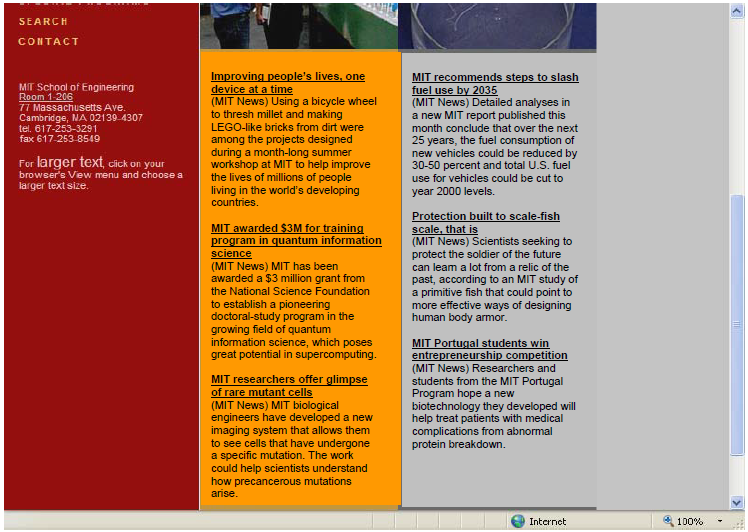
http://web.mit.edu/engineering, em 19/09/2008 (adaptd)
De acordo com a página da web:
I. o MIT recebeu recursos para implementar um curso de pós-graduação na área de Ciência da Informação Quântica.
II. o MIT sediou evento de um mês para atrair pessoas que vivem em países em desenvolvimento.
III. o brinquedo LEGO foi utilizado como protótipo em um dos projetos do Workshop de verão realizado no MIT.
IV. dentro de aproximadamente 25 anos, o consumo de combustíveis dos veículos americanos poderá ser semelhante ao consumo dos veículos no início desta década.
II. o MIT sediou evento de um mês para atrair pessoas que vivem em países em desenvolvimento.
III. o brinquedo LEGO foi utilizado como protótipo em um dos projetos do Workshop de verão realizado no MIT.
IV. dentro de aproximadamente 25 anos, o consumo de combustíveis dos veículos americanos poderá ser semelhante ao consumo dos veículos no início desta década.
Está(ão) correta(s)
Provas
Questão presente nas seguintes provas
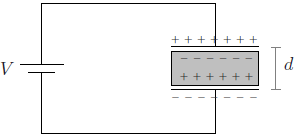
Na figura, o circuito consiste de uma bateria de tensão !$ V !$ conectada a um capacitor de placas paralelas, de área !$ S !$ e distância !$ d !$ entre si, dispondo de um dielétrico de permissividade elétrica !$ \epsilon !$ que preenche completamente o espaço entre elas. Assinale a magnitude da carga !$ q !$ induzida sobre a superfície do dielétrico.
Provas
Questão presente nas seguintes provas
Foi observada a reação entre um composto X e uma solução aquosa de permanganato de potássio, a quente, ocorrendo o aumento do pH da solução e a formação de um composto Y sólido. Após a separação do composto Y e a neutralização da solução resultante, verificou-se a formação de um composto Z pouco solúvel em água. Assinale a opção que melhor representa o grupo funcional do composto orgânico X.
Provas
Questão presente nas seguintes provas
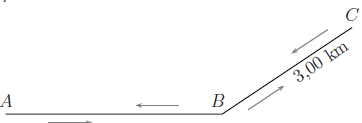
Na figura, um ciclista percorre o trecho !$ AB !$ com velocidade escalar média de 22,5 km/h e, em seguida, o trecho !$ BC !$ de 3,00 km de extensão. No retorno, ao passar em !$ B !$ verifica ser de 20,0 km/h sua velocidade escalar média no percurso então percorrido, !$ ABCB !$. Finalmente, ele chega em A perfazendo todo o percurso de ida e volta em 1,00 h, com velocidade escalar média de 24,0 km/h. Assinale o módulo v do vetor velocidade média referente ao percurso !$ ABCB !$.
Provas
Questão presente nas seguintes provas
A questão refere-se ao seguinte texto:
TEXTILES
Smarter Clothes. Europe wants to own the market for fabrics that can monitor you and your environment
SALLY MCGRANE/PAVIA
AT THE EUCENTRE, A RESEARCH SITE cofounded by the Italian Civil Protection Department in Pavia, Italy, a young engineer dons a firefighter’s uniform that has been in testing for six months. The first prototype of the Proetex project, the ordinary looking navy blue jacket and pants contain high-tech fabrics that can keep track of a firefighter’s vital signs, warn him if the fire is too hot up ahead, provide GPS readings of his position and alert the command center if he has passed out. (...)
Though the technology was pioneered in the U.S., the Europeans have taken the reins in a bid to revitalize their traditional-textile industry, which has been hammered by Asian competition. “We want to develop state-of-the-art know-how that can’t be found in Asia,” says Andreas Lymberis, a scientific officer with the European Commission who has championed smart textiles. “Our purpose is to create a new market.”
Bringing industry partners like Philips and traditional clothing and textile companies together with university researchers from across the E.U. and Switzerland, Commission-funded teams have already produced prototypes with limited commercial availability, such as a tank top that wirelessly monitors cardiac patients and sports clothes that keep track of breathing. Other projects include fabrics that look and feel normal but are embedded with microcomputers, solar panels and energy-harvesting systems, as well as fabrics that measure blood oxygen levels and track biochemicals in sweat and bedsheets that monitor depression.
The world market for smart textiles is still small – about $ 550 million in revenue in 2008 – but that could double by 2010, according to Massachusetts-based venture Development Corp. The challenge is to fit applications to the market, says Lutz Walter, R&D manager at Euratex, a group representing the $ 326 billion European clothing-and-textile industry. “In the medical field, there’s high value added. But to be approved as devices takes 10 years,” says Walter. “In other areas, it’s price: How much are consumers going to be willing to pay for a smart jogging shirt or for a baby suit that detects sudden death syndrome?” (...)
The development of these technologies is currently taking place largely in the biomedical and safety fields, but Annalisa Bonfiglio, a professor of electrical and electronic engineering at the University of Cagliari who coordinates the Proetex project, thinks sports could be the sector where the most potential lies. “Sportswear is an extremely powerful means for promoting the acceptance of these new technologies by common people,” says Bonfiglio, noting that the technology Proetex develops for rescue workers could easily be used later for sports applications.
At the Spaulding Rehabilitation Hospital in Boston, researchers are testing a glove made by Smartex, an Italian smart-materials company, that tracks motor functions in poststroke patients.
Smartex founder and University of Pisa biomedical-engineering professor Danilo De Rossi says there is no way of knowing if Europe will maintain its edge. “Right now we are leading in this field,” he says, since Europe tends to be concerned with medicine, social welfare and the elderly, whereas the U.S. tends to focus on military technology. That could change. But in a business driven by technology rather than price, the Europeans would still have a fighting chance.
Time, July 14, 2008 (adapted).
Assinale a opção que melhor indica o tema central do texto.
Provas
Questão presente nas seguintes provas
A questão refere-se ao texto abaixo:
Persuading Leonardo
Although both Ben Shneiderman's Leonardo's Laptop: Human Needs and the New Computing Technologies and B.J. Fogg's Persuasive Technology: Using Computers to Change What We Think and Do are written by academics, the books transcend academia to provide a different view of the Internet's potential. Shneiderman prepares the groundwork for what he calls the "new computing," while Fogg describes how to make that computing persuasive.
The idea behind Leonardo's Laptop is a consideration of what Leonardo da Vinci would demand from a laptop computer and what he would do with it. To Shneiderman, who is founding director of the Human-Computer Interaction Lab at the University of Maryland, the new computing puts users first. Shneiderman begins with a brief history of computing and computer applications, declaring that, "These founders of the old computing overcame technological limitations to build impressive projects and then turned to producing tools for themselves, giving little thought to the needs of other users." Although not a founder, I admit to being of the old computing generation. I programmed in dead languages such as IBM's 1401 Autocoder and 360 Assembler before progressing to Cobol and RPG. I have now learned Visual Basic and C++, and I can report that there is nothing intrinsic to any of these languages that center a programmer's focus on those who use their applications. The new computing is not about languages but, as Shneiderman suggests, about understanding human activities and human relationships.
With Leonardo as both creator and user, his laptop will enable greater creativity and grander goals. This book goads you with ideas for applications in e-learning, e-business, e-healthcare, and e-government. Each area is built around a framework for technology innovation that Shneiderman calls the "four circles of relationships" and the "four stages of activities." (…)
Although the mental picture of Leonardo with a notebook computer excites the imagination, as a literary device, it does not wear well as the book progresses. Nonetheless, Shneiderman achieves the objective of Leonardo's Laptop — creating a foundation for the new computing.
With a new computing application in hand, B.J. Fogg's Persuasive Technology: Using Computers to Change What We Think and Do gives you advice on its implementation. To Fogg, who launched Stanford's Persuasive Technology Lab and who holds seven patents in the area of UI* design, a web site must first be credible to be persuasive. Fogg has coined the term "captology" to describe this branch of the study of computers. From the book's "Introduction:"
Captology focuses on the design, research, and analysis of interactive computing products created for the purpose of changing people's attitudes or behaviors.
It is the computer's ability to provide interactivity that gives its applications an advantage over other forms of media.
Persuasive Technology describes three basic roles that computers play: the computer as a tool, as media, and as a social actor. Further, there are seven types of persuasive tools described by Fogg. Such tools persuade by simplifying, tunneling (guiding), customizing, being there at the right time, removing tedium, rewarding after observation, and reinforcing proper behavior. As media, computers can modify behavior by simulating new endeavors. As a social actor, computers persuade through praise. However, no matter the role, to persuade, the application must be credible.
Perhaps the most interesting parts of Fogg's book are the two chapters that discuss the ways in which computer applications destroy their own credibility and what an application or web site must do to be considered, by its users, trustworthy. According to Fogg, a computing device or application is perceived to be credible only if it is first perceived as believable—trustworthiness based on expertise. In brief, an application is trustworthy if it is thought to be fair and unbiased. It is trustworthy if its author or origin is thought to be skilled and knowledgeable. The crux of the issue is that credibility matters.
Both books are thoroughly documented and both are excellent points of departure for a more detailed inquiry into the available material. If both books are taken to heart, using computers and their applications will become enjoyable and satisfying.
* U.I. - User Inteface
D. Wohlbruck, Dr Dobb’s Journal, January, 2004.
Considere as seguintes afirmações.
I. As duas obras discutidas no texto têm como assunto principal o uso do computador e suas aplicações atuais e potenciais.
II. Shneiderman e Fogg, autores do texto, mostram a potencial aplicação da internet nos dias atuais.
III. De acordo com Shneiderman, o computador eficaz deve ser, concomitantemente, uma ferramenta capaz de persuadir e um agente interativo.
Está(ão) correta(s)
Provas
Questão presente nas seguintes provas
Cadernos
Caderno Container