Foram encontradas 125 questões.
A questão refere-se aos dois primeiros parágrafos de um artigo publicado pela revista TIME:
The Gentle Cosmic Rain
Hardly anybody took Louis Frank seriously when he first proposed, more tahn 10 years ago, that Earth was being bombarded by cosmic snowballs at the rate of as many as 30 a minute. Part of the problem was how preposterous his theory sounded: every day, he suggested, tens of thousands of icy comets, each the size of a small house and containing 36 metric tons of water, were vaporizing in the upper atmosphere and raining down on Earth. It didn't help that the University of lowa physicist happened to release his findings on April 1, 1986. "Newspapers, " he recalls, "phoned to ask if this was an April Fool's joke."
Frank is unlikely to hear that kind of question again. Last week, at the American Geophysical Union's annual convention in Baltimore, Md., he backed up his theory with fresh evidence: sattelite images that capture his cosmic hail in midfliht. Suddenly it seems entirely possible that the source of much of the water on Earth - and even of life itself - might be Frank's "gentle cosmic rains." (...)
Time, June 9, 1997
A questão refere-se ao texto, cujo vocabulário segue abaixo:
• hardly anybody = quase ninguém
• to take seriously = levar a sério
• Earth = Terra
• snowballs = bolas de neve
• rate = taxa, proporção, índice
• preposterous = ilógico
• to sound = parecer
• tens of thousands = dezenas de milhares
• icy = congelados
• each = cada
• size = tamanho
• small = pequeno
• to contain = conter
• tons = toneladas
• upper = superior
• It didn't help that = não adiantou nada
• to release = publicar
• findings = descobertas
• to recaIl = lembrar-se
• April Fool's joke = brincadeira de 1º de Abril
• to be unlikely to = ser improvável
• to hear = ouvir
• kind = tipo, espécie
• again = novamente
• last week = na semana passada
• to back up = sustentar
• fresh = nova, recente
• hail = granizo
• suddenly = de repente
• to seem = parecer
• entirely = inteiramente
• source = fonte
• even = até mesmo
• might be = poderia ser
Assinale a opção que melhor traduz o trecho sublinhado no início do primeiro parágrafo.
Provas

A questão refere-se ao texto abaixo:
Hacker jailed for £ 50,000 phone fraud
A British computer hacker has been jailed for tricking British Telecom's telephone system out of £51,000 of international telephone calls to feed his obsession for computer games.
Paul Turner, 16, described by his barrister as " extremely gifted" and a "social isolate", used a technique known as "blue boxing" to trick international phone exchanges into giving him free international calls.
During a three-month period he spent over 1,100 hours connected to the Internet via a telephone number in Indonesia, accessed through a lengthy chain of international exchanges that began by calling a freephone number from Norwich.
Tuner's defence barrister explained to Southwark Crown Court that the calls remained free until the final connection was completed in the destination country and said Turner was all but oblivious to the fact that what he ws doingwas illegal.
The teenage hacker used a series of audible signals to fool the telephone exchanges into thinking the calls he made had ended when in fact had not.
BT's fraud investigation department eventually realised that a huge number of calls were being made on this part of the 0800 service from an address in Norwich. By the time Turner had been arrested, BT had lost out to the tune of £51,854.19.
Passing sentence, Judge Christopher Hardy said while immediate prison was unavoidable for such "sustained and sophisticated" offending, he did not want to interfere with the resumption of Turner's studies September.
The sentence was cut to eight weeks, or four weeks with good behaviour.
THE DAILY TELEGRAPH - CONNECTED
Thursday, July 23, 1998
A questão refere-se ao texto, cujo vocabulário segue abaixo:
• to be jailed = ser preso
• to trick out of = lesar em
• to feed = alimentar
• barrister = advogado
• gifted = dotado, talentoso
• internacional phone exchanges = centrais telefônicas
• free = grátis
• during = durante
• to spend, spent, spent = gastar
• over = mais de
• through = através
• lengthy = longo
• chain = cadeia
• to begin, began, begun = começar
• to remain = permanecer
• until = até
• country = país
• but = exceto
• oblivious = não ciente
• to fool = ludibriar
• to end = terminar
• eventually = por fim, finalmente
• to realise = perceber
• huge = enorme
• by the time = quando
• to be arrested = ser preso
• unavoidable = inevitável
• such = tal
• resumption = retomada
• to cut to eight weeks = reduzir para oito semanas
• good behaviour = bom comportamento
Dadas as asserções:
I. Paul Turner fraudou o sistema telefônico britânico e, por isso, foi multado em £51 ,854.19 e condenado à prisão.
II. O número do telefone utilizado por Paul Turner era acessado através de uma série de telefonemas cujo ponto de partida era um serviço telefônico gratuito (0800) na cidade de Norwich .
III. Através de uma série de sinais audíveis. Paul Turner fazia crer que havia terminado uma ligação telefônica quando, na verdade, ainda permanecia conectado à Internet.
está(ão) correta(s):
Provas
A questão refere-se aos dois primeiros parágrafos de um artigo publicado pela revista TIME:
The Gentle Cosmic Rain
Hardly anybody took Louis Frank seriously when he first proposed, more tahn 10 years ago, that Earth was being bombarded by cosmic snowballs at the rate of as many as 30 a minute. Part of the problem was how preposterous his theory sounded: every day, he suggested, tens of thousands of icy comets, each the size of a small house and containing 36 metric tons of water, were vaporizing in the upper atmosphere and raining down on Earth. It didn't help that the University of lowa physicist happened to release his findings on April 1, 1986. "Newspapers, " he recalls, "phoned to ask if this was an April Fool's joke."
Frank is unlikely to hear that kind of question again. Last week, at the American Geophysical Union's annual convention in Baltimore, Md., he backed up his theory with fresh evidence: sattelite images that capture his cosmic hail in midfliht. Suddenly it seems entirely possible that the source of much of the water on Earth - and even of life itself - might be Frank's "gentle cosmic rains." (...)
Time, June 9, 1997
A questão refere-se ao texto, cujo vocabulário segue abaixo:
• hardly anybody = quase ninguém
• to take seriously = levar a sério
• Earth = Terra
• snowballs = bolas de neve
• rate = taxa, proporção, índice
• preposterous = ilógico
• to sound = parecer
• tens of thousands = dezenas de milhares
• icy = congelados
• each = cada
• size = tamanho
• small = pequeno
• to contain = conter
• tons = toneladas
• upper = superior
• It didn't help that = não adiantou nada
• to release = publicar
• findings = descobertas
• to recaIl = lembrar-se
• April Fool's joke = brincadeira de 1º de Abril
• to be unlikely to = ser improvável
• to hear = ouvir
• kind = tipo, espécie
• again = novamente
• last week = na semana passada
• to back up = sustentar
• fresh = nova, recente
• hail = granizo
• suddenly = de repente
• to seem = parecer
• entirely = inteiramente
• source = fonte
• even = até mesmo
• might be = poderia ser
A palavra "recalls" do primeiro parágrafo do texto, poderia ser substituída por:
Provas
A questão refere-se ao texto abaixo:
Time Doesn't Stand Still for Cities on the Go
"Places , like people, have personalities," says Robert Levine, a psychologist at California State University, Fresno. Levine wanted to know which of 36 U.S. cities had the fastest pace of life. He found that Bostonians topped lhe list, outhustling surprising runnersup Buffalo and New York. His study, A Geography of Time, charted walking speed, talking speed, how long it took bank clerks to make change, and the number of passersby wearing watches. New Yorkers led in watches, but the Big Apple placed third overall due to a !$ 28^{th} !$ place finish in talking speed. Fast-moving cities are more stressful , but tend to be more productive economically than their slower moving counterparts, Levine discovered. At the bottom of the list: laid-back Los Angeles. People there talk so slowly that reading the 6 p.m. news would take them until 7:25 to report what residents of Columbus, Ohio, would finish by 7 p.m.
TEXT BY BORIS WEINTRAUB
National Geographic March 1998
A questão refere-se ao texto, cujo vocabulário segue abaixo:
• places = lugares
• like = como
• people = pessoas
• to want = querer
• to know = saber
• pace of life = ritmo de vida
• to find, found, found = descobrir
• to top the list = liderar a lista
• to outhustle = superar, ultrapassar
• runnersup = vice
• study = estudo
• to chart = apresentar (sob forma de gráfico)
• walking speed = velocidade ao andar
• talking speed = velocidade ao falar
• how long = quanto tempo
• bank clerks = bancários
• to make change = trocar (dinheiro)
• passersby = transeunte
• to wear = usar
• watches = relógios
• to lead, led, led = liderar
• Big Apple = Nova York
• to place = situar-se
• overall = no total
• due to = devido a, graças a
• fast-moving cities = cidades mais movimentadas
• counter-parts = semelhantes
• at the bottom of the list = no fim da lista
• so = tão
• slowly = lentamente
• news = notícias
• until = até
• to report = relatar
O estudo denominado "A Geography of Time" levou em consideração quatro fatores. Assinale a opção que não apresenta fator analisado no estudo:
Provas
A questão refere-se ao texto abaixo:
Time Doesn't Stand Still for Cities on the Go
"Places , like people, have personalities," says Robert Levine, a psychologist at California State University, Fresno. Levine wanted to know which of 36 U.S. cities had the fastest pace of life. He found that Bostonians topped lhe list, outhustling surprising runnersup Buffalo and New York. His study, A Geography of Time, charted walking speed, talking speed, how long it took bank clerks to make change, and the number of passersby wearing watches. New Yorkers led in watches, but the Big Apple placed third overall due to a !$ 28^{th} !$ place finish in talking speed. Fast-moving cities are more stressful , but tend to be more productive economically than their slower moving counterparts, Levine discovered. At the bottom of the list: laid-back Los Angeles. People there talk so slowly that reading the 6 p.m. news would take them until 7:25 to report what residents of Columbus, Ohio, would finish by 7 p.m.
TEXT BY BORIS WEINTRAUB
National Geographic March 1998
A questão refere-se ao texto, cujo vocabulário segue abaixo:
• places = lugares
• like = como
• people = pessoas
• to want = querer
• to know = saber
• pace of life = ritmo de vida
• to find, found, found = descobrir
• to top the list = liderar a lista
• to outhustle = superar, ultrapassar
• runnersup = vice
• study = estudo
• to chart = apresentar (sob forma de gráfico)
• walking speed = velocidade ao andar
• talking speed = velocidade ao falar
• how long = quanto tempo
• bank clerks = bancários
• to make change = trocar (dinheiro)
• passersby = transeunte
• to wear = usar
• watches = relógios
• to lead, led, led = liderar
• Big Apple = Nova York
• to place = situar-se
• overall = no total
• due to = devido a, graças a
• fast-moving cities = cidades mais movimentadas
• counter-parts = semelhantes
• at the bottom of the list = no fim da lista
• so = tão
• slowly = lentamente
• news = notícias
• until = até
• to report = relatar
De acordo com o texto:
l. As três cidades americanas que possuem o ritmo de vida mais acelerado são Buffalo, New York e Boston, nesta ordem.
II. Os residentes de Columbus, Ohio, expressam-se oralmente mais rápido que os residentes de Los Angeles.
III. As cidades mais pacatas são menos estressantes e, portanto, são economicamente mais produtivas.
está(ão) correta(s):
Provas
A questão refere-se ao texto abaixo:
Wonder What He's Up To?
Ever wanted to know if Stevie Wonder goes to the movies? He does. "You catch nearly all of it if you pay close attention," says Wonder, who has founded, along with SAP, a German software company, the SAP/Stevie Wonder Vision Awards. The awards recognize products and research that assimilate blind people into the workplace, because while visually impaired people can follow a movie, a big percentage of them can't find a job. "I don't get too surprised by anything, " says Wonder of the inventions, "but we did see some good things" . One of the productions is a mouse pad that helps people feel what is going on on the screen. Wonder is amazed by how few manufacturers think of the visually impaired when making appliances. "It's weird. It's so simple to add voice capability," he says. "And it means complete independence for a blind person. "In between his good works, Wonder is still song writing. He hopes to record an album next year.
BY BELlNDA LUSCOMBE
TIME, June. 29, 1998
A questão refere-se ao texto, cujo vocabulário segue abaixo:
• to wonder = imaginar
• to be up to = ser capaz de
• ever = alguma vez
• to catch = captar
• nearly = quase
• to pay close attention = prestar muita atenção
• to found = fundar
• along with = junto com
• awards = prêmios
• research = pesquisa
• blind people = pessoas cegas
• workplace = local de trabalho
• while = enquanto
• impaired people = pessoas deficientes
• to follow = acompanhar
• to find a job = encontrar um emprego
• to help = ajudar
• to feel = sentir
• to go on the screen = passar na tela
• amazed = surpreso
• manufacturers = fabricantes
• to think of = pensar em
• appliances = instrumentos
• weird = estranho
• to add = acrescentar
• voice = voz
• to say = dizer
• to mean = significar
• still = ainda
• song = canção
• to record = gravar
A palavra "weird ", destacada no texto, quer dizer.
Provas
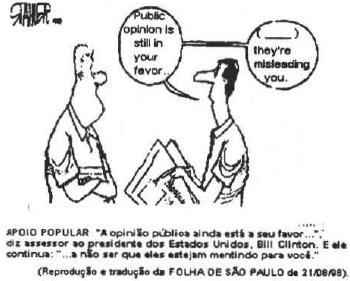
Considerando a charge abaixo bem como a sua tradução, assinale a opção cuja conjunção corresponda à palavra que foi excluída (entre parênteses) da fala do assessor de Clinton.
Provas
Leia o recado de Ho Chi Minh aos franceses, em 1946, e responda a questão.
" You can kill 10 of my men for every one I kill of yours, yet even at those odds, you will lose and I will win".
Assinale a opção cuja conjunção tenha significado semelhante ao de "yet":
Provas
A questão refere-se aos dois primeiros parágrafos de um artigo publicado pela revista TIME:
The Gentle Cosmic Rain
Hardly anybody took Louis Frank seriously when he first proposed, more tahn 10 years ago, that Earth was being bombarded by cosmic snowballs at the rate of as many as 30 a minute. Part of the problem was how preposterous his theory sounded: every day, he suggested, tens of thousands of icy comets, each the size of a small house and containing 36 metric tons of water, were vaporizing in the upper atmosphere and raining down on Earth. It didn't help that the University of lowa physicist happened to release his findings on April 1, 1986. "Newspapers, " he recalls, "phoned to ask if this was an April Fool's joke."
Frank is unlikely to hear that kind of question again. Last week, at the American Geophysical Union's annual convention in Baltimore, Md., he backed up his theory with fresh evidence: sattelite images that capture his cosmic hail in midfliht. Suddenly it seems entirely possible that the source of much of the water on Earth - and even of life itself - might be Frank's "gentle cosmic rains." (...)
Time, June 9, 1997
A questão refere-se ao texto, cujo vocabulário segue abaixo:
• hardly anybody = quase ninguém
• to take seriously = levar a sério
• Earth = Terra
• snowballs = bolas de neve
• rate = taxa, proporção, índice
• preposterous = ilógico
• to sound = parecer
• tens of thousands = dezenas de milhares
• icy = congelados
• each = cada
• size = tamanho
• small = pequeno
• to contain = conter
• tons = toneladas
• upper = superior
• It didn't help that = não adiantou nada
• to release = publicar
• findings = descobertas
• to recaIl = lembrar-se
• April Fool's joke = brincadeira de 1º de Abril
• to be unlikely to = ser improvável
• to hear = ouvir
• kind = tipo, espécie
• again = novamente
• last week = na semana passada
• to back up = sustentar
• fresh = nova, recente
• hail = granizo
• suddenly = de repente
• to seem = parecer
• entirely = inteiramente
• source = fonte
• even = até mesmo
• might be = poderia ser
Dadas as asserções:
I. Dez anos atrás, Louis Frank não contava com instrumentos necessários para confirmar sua descoberta .
II. Louis Frank evitou divulgar sua descoberta em 1º de abril, receoso de que pensassem que estivesse "pregando uma peça" .
III. Frank não gostava de ouvir perguntas do tipo das que lhe foram feitas pela imprensa por ocasião da divulgação de sua descoberta.
está(ão) corretas(s),
Provas
A questão refere-se ao texto abaixo:
Time Doesn't Stand Still for Cities on the Go
"Places , like people, have personalities," says Robert Levine, a psychologist at California State University, Fresno. Levine wanted to know which of 36 U.S. cities had (1) pace of life. He found that Bostonians topped lhe list, outhustling surprising runnersup Buffalo and New York. His study, A Geography of Time, charted walking speed, talking speed, how long it took bank clerks to make change, and the number of passersby wearing watches. New Yorkers led in watches, but the Big Apple placed third overall due to a !$ 28^{th} !$ place finish in talking speed. Fast-moving cities are (2) , but tend to be more productive economically than their (3) moving counterparts, Levine discovered. At the bottom of the list: laid-back Los Angeles. People there talk so slowly that reading the 6 p.m. news would take them until 7:25 to report what residents of Columbus, Ohio, would finish by 7 p.m.
TEXT BY BORIS WEINTRAUB
National Geographic March 1998
A questão refere-se ao texto, cujo vocabulário segue abaixo:
• places = lugares
• like = como
• people = pessoas
• to want = querer
• to know = saber
• pace of life = ritmo de vida
• to find, found, found = descobrir
• to top the list = liderar a lista
• to outhustle = superar, ultrapassar
• runnersup = vice
• study = estudo
• to chart = apresentar (sob forma de gráfico)
• walking speed = velocidade ao andar
• talking speed = velocidade ao falar
• how long = quanto tempo
• bank clerks = bancários
• to make change = trocar (dinheiro)
• passersby = transeunte
• to wear = usar
• watches = relógios
• to lead, led, led = liderar
• Big Apple = Nova York
• to place = situar-se
• overall = no total
• due to = devido a, graças a
• fast-moving cities = cidades mais movimentadas
• counter-parts = semelhantes
• at the bottom of the list = no fim da lista
• so = tão
• slowly = lentamente
• news = notícias
• until = até
• to report = relatar
A opção que preenche corretamente as lacunas 1, 2 e 3, respectivamente, é:
Provas
Caderno Container