Foram encontradas 430 questões.
Atenção: Para responder à questão, utilize as informações contidas no ORÇAMENTO de OBRA abaixo.
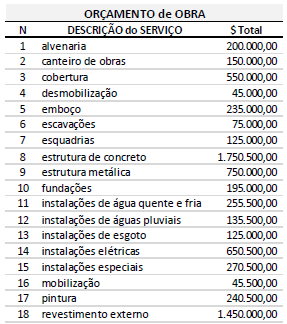
Trata-se de um orçamento genérico onde constam os valores totais (em reais X itens) de cada item de uma obra que será executada no Ministério.
Para os dados abaixo, referentes a uma planilha de preços totais de uma obra a ser realizada no Ministério, o único gráfico que corresponde à curva ABC, referente aos valores da tabela é representada por
Provas
Questão presente nas seguintes provas

Atenção: Para responder à questão, utilize as informações contidas no ORÇAMENTO de OBRA abaixo.
Trata-se de um orçamento genérico onde constam os valores totais (em reais X itens) de cada item de uma obra que será executada no Ministério.
O gráfico de Pareto referente aos dados da tabela ORÇAMENTO de OBRA é
Provas
Questão presente nas seguintes provas
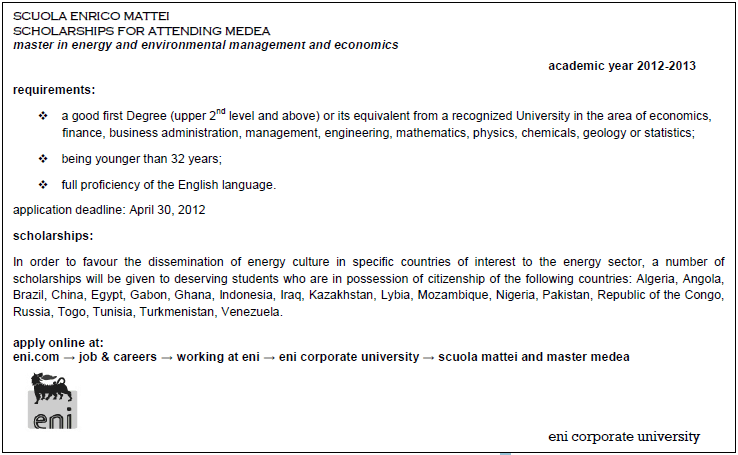
(Disponível em: Courses, Magazine The Economist, nº 8.776. Página 99, março de 2012. Adaptado)
É necessário que os candidatos à bolsa-de-estudos
Provas
Questão presente nas seguintes provas
(Disponível em: Courses, Magazine The Economist, nº 8.776. Página 99, março de 2012. Adaptado)
As informações contidas neste anúncio incluem
Provas
Questão presente nas seguintes provas
Online security
A security patch for your brain
The quickest way to improve online security is to upgrade your mental software
A security patch for your brain
The quickest way to improve online security is to upgrade your mental software
Mar 24th 2012 | from the print edition
(01) TWO decades ago only spies and systems administrators had to worry about passwords. But today you have to enter one even to do humdrum things like turning on your computer, downloading an album or buying a book online. No wonder many people use a single, simple password for everything.
(02) Analysis of password databases, often stolen from websites (something that happens with disturbing frequency), shows that the most common choices include “password”, “123456” and “abc123”. But using these, or any word that appears in a dictionary, is insecure. Even changing some letters to numbers (“e” to “3”, “i” to “1” and so forth) does little to reduce the vulnerability of such passwords to an automated “dictionary attack”, because these substitutions are so common. The fundamental problem is that secure passwords tend to be hard to remember, and memorable passwords tend to be insecure.
(03) Weak passwords open the door to fraud, identity theft and breaches of privacy. An analysis by Verizon, an American telecoms firm, found that the biggest reason for successful security breaches was easily guessable passwords. Some viruses spread by trying common passwords. Attacks need only work enough of the time − say, in 1% of cases − to be worthwhile. And it turns out that a relatively short list of passwords provides access to 1% of accounts on many sites and systems.
(04) Fingerprint scanners and devices that generate time-specific codes offer greater security, but they require hardware. Passwords, which need only software, are cheaper. In terms of security delivered per dollar spent, they are hard to beat, so they are not going away. But they need to be made more secure.
[ . . . ]
(Adaptado de http://www.economist.com/node/21551060; Acessado em 28/03/2012)
As palavras "that" e "which" que aparecem em negrito no último parágrafo do texto referem-se respectivamente a
Provas
Questão presente nas seguintes provas
Online security
A security patch for your brain
The quickest way to improve online security is to upgrade your mental software
A security patch for your brain
The quickest way to improve online security is to upgrade your mental software
Mar 24th 2012 | from the print edition
(01) TWO decades ago only spies and systems administrators had to worry about passwords. But today you have to enter one even to do humdrum things like turning on your computer, downloading an album or buying a book online. No wonder many people use a single, simple password for everything.
(02) Analysis of password databases, often stolen from websites (something that happens with disturbing frequency), shows that the most common choices include “password”, “123456” and “abc123”. But using these, or any word that appears in a dictionary, is insecure. Even changing some letters to numbers (“e” to “3”, “i” to “1” and so forth) does little to reduce the vulnerability of such passwords to an automated “dictionary attack”, because these substitutions are so common. The fundamental problem is that secure passwords tend to be hard to remember, and memorable passwords tend to be insecure.
(03) Weak passwords open the door to fraud, identity theft and breaches of privacy. An analysis by Verizon, an American telecoms firm, found that the biggest reason for successful security breaches was easily guessable passwords. Some viruses spread by trying common passwords. Attacks need only work enough of the time − say, in 1% of cases − to be worthwhile. And it turns out that a relatively short list of passwords provides access to 1% of accounts on many sites and systems.
(04) Fingerprint scanners and devices that generate time-specific codes offer greater security, but they require hardware. Passwords, which need only software, are cheaper. In terms of security delivered per dollar spent, they are hard to beat, so they are not going away. But they need to be made more secure.
[ . . . ]
(Adaptado de http://www.economist.com/node/21551060; Acessado em 28/03/2012)
Segundo o texto, “password”, “123456” e “abc123” são exemplos comuns de
Provas
Questão presente nas seguintes provas
Online security
A security patch for your brain
The quickest way to improve online security is to upgrade your mental software
A security patch for your brain
The quickest way to improve online security is to upgrade your mental software
Mar 24th 2012 | from the print edition
(01) TWO decades ago only spies and systems administrators had to worry about passwords. But today you have to enter one even to do humdrum things like turning on your computer, downloading an album or buying a book online. No wonder many people use a single, simple password for everything.
(02) Analysis of password databases, often stolen from websites (something that happens with disturbing frequency), shows that the most common choices include “password”, “123456” and “abc123”. But using these, or any word that appears in a dictionary, is insecure. Even changing some letters to numbers (“e” to “3”, “i” to “1” and so forth) does little to reduce the vulnerability of such passwords to an automated “dictionary attack”, because these substitutions are so common. The fundamental problem is that secure passwords tend to be hard to remember, and memorable passwords tend to be insecure.
(03) Weak passwords open the door to fraud, identity theft and breaches of privacy. An analysis by Verizon, an American telecoms firm, found that the biggest reason for successful security breaches was easily guessable passwords. Some viruses spread by trying common passwords. Attacks need only work enough of the time − say, in 1% of cases − to be worthwhile. And it turns out that a relatively short list of passwords provides access to 1% of accounts on many sites and systems.
(04) Fingerprint scanners and devices that generate time-specific codes offer greater security, but they require hardware. Passwords, which need only software, are cheaper. In terms of security delivered per dollar spent, they are hard to beat, so they are not going away. But they need to be made more secure.
[ . . . ]
(Adaptado de http://www.economist.com/node/21551060; Acessado em 28/03/2012)
Ligar o computador, baixar músicas ou comprar um livro online são consideradas atividades
Provas
Questão presente nas seguintes provas
Online security
A security patch for your brain
The quickest way to improve online security is to upgrade your mental software
A security patch for your brain
The quickest way to improve online security is to upgrade your mental software
Mar 24th 2012 | from the print edition
(01) TWO decades ago only spies and systems administrators had to worry about passwords. But today you have to enter one even to do humdrum things like turning on your computer, downloading an album or buying a book online. No wonder many people use a single, simple password for everything.
(02) Analysis of password databases, often stolen from websites (something that happens with disturbing frequency), shows that the most common choices include “password”, “123456” and “abc123”. But using these, or any word that appears in a dictionary, is insecure. Even changing some letters to numbers (“e” to “3”, “i” to “1” and so forth) does little to reduce the vulnerability of such passwords to an automated “dictionary attack”, because these substitutions are so common. The fundamental problem is that secure passwords tend to be hard to remember, and memorable passwords tend to be insecure.
(03) Weak passwords open the door to fraud, identity theft and breaches of privacy. An analysis by Verizon, an American telecoms firm, found that the biggest reason for successful security breaches was easily guessable passwords. Some viruses spread by trying common passwords. Attacks need only work enough of the time − say, in 1% of cases − to be worthwhile. And it turns out that a relatively short list of passwords provides access to 1% of accounts on many sites and systems.
(04) Fingerprint scanners and devices that generate time-specific codes offer greater security, but they require hardware. Passwords, which need only software, are cheaper. In terms of security delivered per dollar spent, they are hard to beat, so they are not going away. But they need to be made more secure.
[ . . . ]
(Adaptado de http://www.economist.com/node/21551060; Acessado em 28/03/2012)
O sub-título The quickest way to improve online security is to upgrade your mental software refere-se à forma mais rápida de
Provas
Questão presente nas seguintes provas
Considere a charge abaixo.
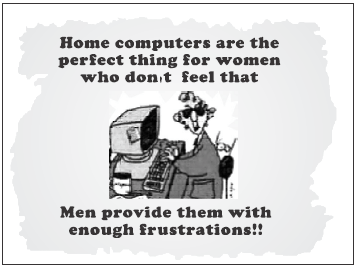
(http://www.myspace.com/8-grandmabetty_8361photos/21960841)
O tom que o autor da charge dá ao texto é
Provas
Questão presente nas seguintes provas

Microsoft's test version of its new Skype for Windows Phone app lets you call Skype contacts over 3G, 4G and wi-fi networks. Larry Greenemeier reports
March 1, 2012
(01) Nine months ago, Microsoft announced an $8.5-billion bid to buy Skype, the provider of voice-over-Internet Protocol software and services. The move promised to add an important video chat feature to help handsets running the Windows Phone operating system better compete with FaceTime on the iPhone and Android's Google Talk feature.
(02) But when the move would actually happen has been something of a mystery. At January's Consumer Electronics Show Microsoft CEO Steve Ballmer barely even mentioned Skype during his keynote speech.
(03) Now we know that the wait is almost over. Microsoft just released a test version of its new Skype for Windows Phone app. The free app lets you call Skype contacts over 3G, 4G and wi-fi networks.
(04) Of course, as with all software test versions, there's no doubt room for improvement. For example, Skype for Windows is now available only in English. And you can't receive calls ..I.. the app is open and running on your phone. It's likely, ..II.. , that most issues will be worked out by April, when the market version of the app should be ready to say hello.
(Adaptado de http://www.scientificamerican.com/podcast/episode.cfm?id=skype-video-chat-arrives-for-window-12-03-01; Acessado em 03/04/2012)
No quarto parágrafo, as palavras que correta e respectivamente preenchem os espaços I e II são
Provas
Questão presente nas seguintes provas
Cadernos
Caderno Container