Foram encontradas 80 questões.
TEXT II
World Work Worker Workplace
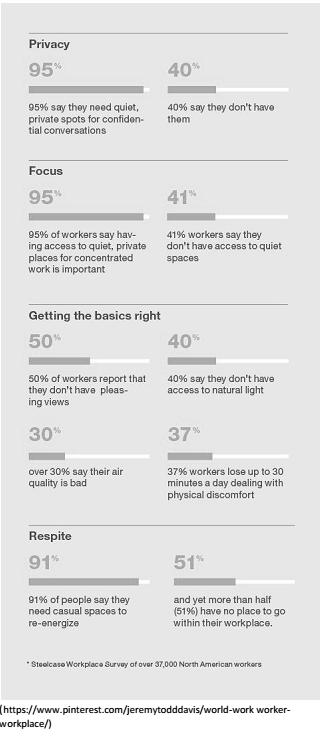
Does your workplace offer affordances for #wellbeing? Natural light, movement, a view, informal areas to socialize or collaborate? 40% say no.
Provas

TEXT II
World Work Worker Workplace
Does your workplace offer affordances for #wellbeing? Natural light, movement, a view, informal areas to socialize or collaborate? 40% say no.
Provas
- Gramática - Língua InglesaAdvérbios e conjunções | Adverbs and conjunctions
- Gramática - Língua InglesaDeterminantes e quantificadores | Determiners and quantifiers
TEXT II
World Work Worker Workplace
Does your workplace offer affordances for #wellbeing? Natural light, movement, a view, informal areas to socialize or collaborate? 40% say no.
Provas
TEXT I
How music is the real language of political diplomacy
Forget guns and bombs, it is the power of melody that has changed the world
Marie Zawisza
Saturday 31 October 2015 10.00 GMT
Last modified on Tuesday 10 November 201513.19 GMT

An old man plays his cello at the foot of a crumbling wall. The notes of the sarabande of Bach’s Suite No 2 rise in the cold air, praising God for the “miracle” of the fall of the Berlin Wall, as Mstislav Rostropovich later put it. The photograph is seen around the world. The date is 11 November 1989, and the Russian virtuoso is marching to the beat of history.
Publicity stunt or political act? No doubt a bit of both – and proof, in any case, that music can have a political dimension. Yo-Yo Ma showed as much in September when the cellist opened the new season of the Philharmonie de Paris with the Boston Symphony Orchestra. As a “messenger of peace” for the United Nations, the Chinese American is the founder of Silk Road Project, which trains young musicians from a variety of cultures to listen to and improvise with each other and develop a common repertoire. “In this way, musicians create a dialogue and arrive at common policies,” says analyst Frédéric Ramel, a professor at the Institut d’Études Politiques in Paris. By having music take the place of speeches and peace talks, the hope is that it will succeed where diplomacy has failed.[…]
Curiously, the study of the role of music in international relations is still in its infancy. “Historians must have long seen it as something fanciful, because history has long been dominated by interpretations that stress economic, social and political factors,” says Anaïs Fléchet, a lecturer in contemporary history at the Université de Versailles-St-Quentin and co-editor of a book about music and globalisation.
“As for musicologists,” she adds, “until quite recently they were more interested in analysing musical scores than the actual context in which these were produced and how they were received.” In the 1990s came a cultural shift. Scholars were no longer interested solely in “hard power” – that is, in the balance of powers and in geopolitics – but also in “soft power”, where political issues are resolved by mutual support rather than force. […]
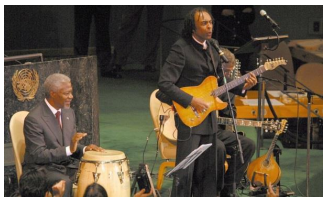
Gilberto Gil sings while then UN secretary general Kofi Annan plays percussion at a September 2003 concert at the UN headquarters honouring those killed by a bomb at a UN office in Baghdad a month earlier. Photograph: Zuma/Alamy
Since then, every embassy has a cultural attaché. The US engages in “audio diplomacy” by financing hip-hop festivals in the Middle East. China promotes opera in neighbouring states to project an image of harmony. Brazil has invested in culture to assert itself as a leader in Latin America, notably by establishing close collaboration between its ministries of foreign affairs and culture; musician Gilberto Gil was culture minister during Luiz Inácio Lula da Silva's presidency from 2003 to 2008. He was involved in France’s Year of Brazil. As Fléchet recalls, “the free concert he gave on 13 July, 2005 at the Place de la Bastille was the pinnacle. That day, he sang La Marseillaise in the presence of presidents Lula and Jacques Chirac.” Two years earlier, in September 2003, Gil sang at the UN in honour of the victims of the 19 August bombing of the UN headquartes in Baghdad. He was delivering a message of peace, criticising the war on Iraq by the US: “There is no point in preaching security without giving a thought to respecting others,” he told his audience. Closing the concert, he invited then UN secretary general Kofi Annan on stage for a surprise appearance as a percussionist. “This highly symbolic image, which highlighted the conviction that culture can play a role in bringing people together, shows how music can become a political language,” Fléchet says.
(adapted from http://www.theguardian.com/music/2015/oct/31 /music-language-human-rights-political-diplomacy)
Provas
TEXT I
How music is the real language of political diplomacy
Forget guns and bombs, it is the power of melody that has changed the world
Marie Zawisza
Saturday 31 October 2015 10.00 GMT
Last modified on Tuesday 10 November 201513.19 GMT
An old man plays his cello at the foot of a crumbling wall. The notes of the sarabande of Bach’s Suite No 2 rise in the cold air, praising God for the “miracle” of the fall of the Berlin Wall, as Mstislav Rostropovich later put it. The photograph is seen around the world. The date is 11 November 1989, and the Russian virtuoso is marching to the beat of history.
Publicity stunt or political act? No doubt a bit of both – and proof, in any case, that music can have a political dimension. Yo-Yo Ma showed as much in September when the cellist opened the new season of the Philharmonie de Paris with the Boston Symphony Orchestra. As a “messenger of peace” for the United Nations, the Chinese American is the founder of Silk Road Project, which trains young musicians from a variety of cultures to listen to and improvise with each other and develop a common repertoire. “In this way, musicians create a dialogue and arrive at common policies,” says analyst Frédéric Ramel, a professor at the Institut d’Études Politiques in Paris. By having music take the place of speeches and peace talks, the hope is that it will succeed where diplomacy has failed.[…]
Curiously, the study of the role of music in international relations is still in its infancy. “Historians must have long seen it as something fanciful, because history has long been dominated by interpretations that stress economic, social and political factors,” says Anaïs Fléchet, a lecturer in contemporary history at the Université de Versailles-St-Quentin and co-editor of a book about music and globalisation.
“As for musicologists,” she adds, “until quite recently they were more interested in analysing musical scores than the actual context in which these were produced and how they were received.” In the 1990s came a cultural shift. Scholars were no longer interested solely in “hard power” – that is, in the balance of powers and in geopolitics – but also in “soft power”, where political issues are resolved by mutual support rather than force. […]
Gilberto Gil sings while then UN secretary general Kofi Annan plays percussion at a September 2003 concert at the UN headquarters honouring those killed by a bomb at a UN office in Baghdad a month earlier. Photograph: Zuma/Alamy
Since then, every embassy has a cultural attaché. The US engages in “audio diplomacy” by financing hip-hop festivals in the Middle East. China promotes opera in neighbouring states to project an image of harmony. Brazil has invested in culture to assert itself as a leader in Latin America, notably by establishing close collaboration between its ministries of foreign affairs and culture; musician Gilberto Gil was culture minister during Luiz Inácio Lula da Silva's presidency from 2003 to 2008. He was involved in France’s Year of Brazil. As Fléchet recalls, “the free concert he gave on 13 July, 2005 at the Place de la Bastille was the pinnacle. That day, he sang La Marseillaise in the presence of presidents Lula and Jacques Chirac.” Two years earlier, in September 2003, Gil sang at the UN in honour of the victims of the 19 August bombing of the UN headquartes in Baghdad. He was delivering a message of peace, criticising the war on Iraq by the US: “There is no point in preaching security without giving a thought to respecting others,” he told his audience. Closing the concert, he invited then UN secretary general Kofi Annan on stage for a surprise appearance as a percussionist. “This highly symbolic image, which highlighted the conviction that culture can play a role in bringing people together, shows how music can become a political language,” Fléchet says.
(adapted from http://www.theguardian.com/music/2015/oct/31 /music-language-human-rights-political-diplomacy)
Provas
TEXT I
How music is the real language of political diplomacy
Forget guns and bombs, it is the power of melody that has changed the world
Marie Zawisza
Saturday 31 October 2015 10.00 GMT
Last modified on Tuesday 10 November 201513.19 GMT
An old man plays his cello at the foot of a crumbling wall. The notes of the sarabande of Bach’s Suite No 2 rise in the cold air, praising God for the “miracle” of the fall of the Berlin Wall, as Mstislav Rostropovich later put it. The photograph is seen around the world. The date is 11 November 1989, and the Russian virtuoso is marching to the beat of history.
Publicity stunt or political act? No doubt a bit of both – and proof, in any case, that music can have a political dimension. Yo-Yo Ma showed as much in September when the cellist opened the new season of the Philharmonie de Paris with the Boston Symphony Orchestra. As a “messenger of peace” for the United Nations, the Chinese American is the founder of Silk Road Project, which trains young musicians from a variety of cultures to listen to and improvise with each other and develop a common repertoire. “In this way, musicians create a dialogue and arrive at common policies,” says analyst Frédéric Ramel, a professor at the Institut d’Études Politiques in Paris. By having music take the place of speeches and peace talks, the hope is that it will succeed where diplomacy has failed.[…]
Curiously, the study of the role of music in international relations is still in its infancy. “Historians must have long seen it as something fanciful, because history has long been dominated by interpretations that stress economic, social and political factors,” says Anaïs Fléchet, a lecturer in contemporary history at the Université de Versailles-St-Quentin and co-editor of a book about music and globalisation.
“As for musicologists,” she adds, “until quite recently they were more interested in analysing musical scores than the actual context in which these were produced and how they were received.” In the 1990s came a cultural shift. Scholars were no longer interested solely in “hard power” – that is, in the balance of powers and in geopolitics – but also in “soft power”, where political issues are resolved by mutual support rather than force. […]
Gilberto Gil sings while then UN secretary general Kofi Annan plays percussion at a September 2003 concert at the UN headquarters honouring those killed by a bomb at a UN office in Baghdad a month earlier. Photograph: Zuma/Alamy
Since then, every embassy has a cultural attaché. The US engages in “audio diplomacy” by financing hip-hop festivals in the Middle East. China promotes opera in neighbouring states to project an image of harmony. Brazil has invested in culture to assert itself as a leader in Latin America, notably by establishing close collaboration between its ministries of foreign affairs and culture; musician Gilberto Gil was culture minister during Luiz Inácio Lula da Silva's presidency from 2003 to 2008. He was involved in France’s Year of Brazil. As Fléchet recalls, “the free concert he gave on 13 July, 2005 at the Place de la Bastille was the pinnacle. That day, he sang La Marseillaise in the presence of presidents Lula and Jacques Chirac.” Two years earlier, in September 2003, Gil sang at the UN in honour of the victims of the 19 August bombing of the UN headquartes in Baghdad. He was delivering a message of peace, criticising the war on Iraq by the US: “There is no point in preaching security without giving a thought to respecting others,” he told his audience. Closing the concert, he invited then UN secretary general Kofi Annan on stage for a surprise appearance as a percussionist. “This highly symbolic image, which highlighted the conviction that culture can play a role in bringing people together, shows how music can become a political language,” Fléchet says.
(adapted from http://www.theguardian.com/music/2015/oct/31 /music-language-human-rights-political-diplomacy)
Provas
TEXT I
How music is the real language of political diplomacy
Forget guns and bombs, it is the power of melody that has changed the world
Marie Zawisza
Saturday 31 October 2015 10.00 GMT
Last modified on Tuesday 10 November 201513.19 GMT
An old man plays his cello at the foot of a crumbling wall. The notes of the sarabande of Bach’s Suite No 2 rise in the cold air, praising God for the “miracle” of the fall of the Berlin Wall, as Mstislav Rostropovich later put it. The photograph is seen around the world. The date is 11 November 1989, and the Russian virtuoso is marching to the beat of history.
Publicity stunt or political act? No doubt a bit of both – and proof, in any case, that music can have a political dimension. Yo-Yo Ma showed as much in September when the cellist opened the new season of the Philharmonie de Paris with the Boston Symphony Orchestra. As a “messenger of peace” for the United Nations, the Chinese American is the founder of Silk Road Project, which trains young musicians from a variety of cultures to listen to and improvise with each other and develop a common repertoire. “In this way, musicians create a dialogue and arrive at common policies,” says analyst Frédéric Ramel, a professor at the Institut d’Études Politiques in Paris. By having music take the place of speeches and peace talks, the hope is that it will succeed where diplomacy has failed.[…]
Curiously, the study of the role of music in international relations is still in its infancy. “Historians must have long seen it as something fanciful, because history has long been dominated by interpretations that stress economic, social and political factors,” says Anaïs Fléchet, a lecturer in contemporary history at the Université de Versailles-St-Quentin and co-editor of a book about music and globalisation.
“As for musicologists,” she adds, “until quite recently they were more interested in analysing musical scores than the actual context in which these were produced and how they were received.” In the 1990s came a cultural shift. Scholars were no longer interested solely in “hard power” – that is, in the balance of powers and in geopolitics – but also in “soft power”, where political issues are resolved by mutual support rather than force. […]
Gilberto Gil sings while then UN secretary general Kofi Annan plays percussion at a September 2003 concert at the UN headquarters honouring those killed by a bomb at a UN office in Baghdad a month earlier. Photograph: Zuma/Alamy
Since then, every embassy has a cultural attaché. The US engages in “audio diplomacy” by financing hip-hop festivals in the Middle East. China promotes opera in neighbouring states to project an image of harmony. Brazil has invested in culture to assert itself as a leader in Latin America, notably by establishing close collaboration between its ministries of foreign affairs and culture; musician Gilberto Gil was culture minister during Luiz Inácio Lula da Silva's presidency from 2003 to 2008. He was involved in France’s Year of Brazil. As Fléchet recalls, “the free concert he gave on 13 July, 2005 at the Place de la Bastille was the pinnacle. That day, he sang La Marseillaise in the presence of presidents Lula and Jacques Chirac.” Two years earlier, in September 2003, Gil sang at the UN in honour of the victims of the 19 August bombing of the UN headquartes in Baghdad. He was delivering a message of peace, criticising the war on Iraq by the US: “There is no point in preaching security without giving a thought to respecting others,” he told his audience. Closing the concert, he invited then UN secretary general Kofi Annan on stage for a surprise appearance as a percussionist. “This highly symbolic image, which highlighted the conviction that culture can play a role in bringing people together, shows how music can become a political language,” Fléchet says.
(adapted from http://www.theguardian.com/music/2015/oct/31 /music-language-human-rights-political-diplomacy)
Provas
TEXT I
How music is the real language of political diplomacy
Forget guns and bombs, it is the power of melody that has changed the world
Marie Zawisza
Saturday 31 October 2015 10.00 GMT
Last modified on Tuesday 10 November 201513.19 GMT
An old man plays his cello at the foot of a crumbling wall. The notes of the sarabande of Bach’s Suite No 2 rise in the cold air, praising God for the “miracle” of the fall of the Berlin Wall, as Mstislav Rostropovich later put it. The photograph is seen around the world. The date is 11 November 1989, and the Russian virtuoso is marching to the beat of history.
Publicity stunt or political act? No doubt a bit of both – and proof, in any case, that music can have a political dimension. Yo-Yo Ma showed as much in September when the cellist opened the new season of the Philharmonie de Paris with the Boston Symphony Orchestra. As a “messenger of peace” for the United Nations, the Chinese American is the founder of Silk Road Project, which trains young musicians from a variety of cultures to listen to and improvise with each other and develop a common repertoire. “In this way, musicians create a dialogue and arrive at common policies,” says analyst Frédéric Ramel, a professor at the Institut d’Études Politiques in Paris. By having music take the place of speeches and peace talks, the hope is that it will succeed where diplomacy has failed.[…]
Curiously, the study of the role of music in international relations is still in its infancy. “Historians must have long seen it as something fanciful, because history has long been dominated by interpretations that stress economic, social and political factors,” says Anaïs Fléchet, a lecturer in contemporary history at the Université de Versailles-St-Quentin and co-editor of a book about music and globalisation.
“As for musicologists,” she adds, “until quite recently they were more interested in analysing musical scores than the actual context in which these were produced and how they were received.” In the 1990s came a cultural shift. Scholars were no longer interested solely in “hard power” – that is, in the balance of powers and in geopolitics – but also in “soft power”, where political issues are resolved by mutual support rather than force. […]
Gilberto Gil sings while then UN secretary general Kofi Annan plays percussion at a September 2003 concert at the UN headquarters honouring those killed by a bomb at a UN office in Baghdad a month earlier. Photograph: Zuma/Alamy
Since then, every embassy has a cultural attaché. The US engages in “audio diplomacy” by financing hip-hop festivals in the Middle East. China promotes opera in neighbouring states to project an image of harmony. Brazil has invested in culture to assert itself as a leader in Latin America, notably by establishing close collaboration between its ministries of foreign affairs and culture; musician Gilberto Gil was culture minister during Luiz Inácio Lula da Silva's presidency from 2003 to 2008. He was involved in France’s Year of Brazil. As Fléchet recalls, “the free concert he gave on 13 July, 2005 at the Place de la Bastille was the pinnacle. That day, he sang La Marseillaise in the presence of presidents Lula and Jacques Chirac.” Two years earlier, in September 2003, Gil sang at the UN in honour of the victims of the 19 August bombing of the UN headquartes in Baghdad. He was delivering a message of peace, criticising the war on Iraq by the US: “There is no point in preaching security without giving a thought to respecting others,” he told his audience. Closing the concert, he invited then UN secretary general Kofi Annan on stage for a surprise appearance as a percussionist. “This highly symbolic image, which highlighted the conviction that culture can play a role in bringing people together, shows how music can become a political language,” Fléchet says.
(adapted from http://www.theguardian.com/music/2015/oct/31 /music-language-human-rights-political-diplomacy)
Provas
TEXT I
How music is the real language of political diplomacy
Forget guns and bombs, it is the power of melody that has changed the world
Marie Zawisza
Saturday 31 October 2015 10.00 GMT
Last modified on Tuesday 10 November 201513.19 GMT
An old man plays his cello at the foot of a crumbling wall. The notes of the sarabande of Bach’s Suite No 2 rise in the cold air, praising God for the “miracle” of the fall of the Berlin Wall, as Mstislav Rostropovich later put it. The photograph is seen around the world. The date is 11 November 1989, and the Russian virtuoso is marching to the beat of history.
Publicity stunt or political act? No doubt a bit of both – and proof, in any case, that music can have a political dimension. Yo-Yo Ma showed as much in September when the cellist opened the new season of the Philharmonie de Paris with the Boston Symphony Orchestra. As a “messenger of peace” for the United Nations, the Chinese American is the founder of Silk Road Project, which trains young musicians from a variety of cultures to listen to and improvise with each other and develop a common repertoire. “In this way, musicians create a dialogue and arrive at common policies,” says analyst Frédéric Ramel, a professor at the Institut d’Études Politiques in Paris. By having music take the place of speeches and peace talks, the hope is that it will succeed where diplomacy has failed.[…]
Curiously, the study of the role of music in international relations is still in its infancy. “Historians must have long seen it as something fanciful, because history has long been dominated by interpretations that stress economic, social and political factors,” says Anaïs Fléchet, a lecturer in contemporary history at the Université de Versailles-St-Quentin and co-editor of a book about music and globalisation.
“As for musicologists,” she adds, “until quite recently they were more interested in analysing musical scores than the actual context in which these were produced and how they were received.” In the 1990s came a cultural shift. Scholars were no longer interested solely in “hard power” – that is, in the balance of powers and in geopolitics – but also in “soft power”, where political issues are resolved by mutual support rather than force. […]
Gilberto Gil sings while then UN secretary general Kofi Annan plays percussion at a September 2003 concert at the UN headquarters honouring those killed by a bomb at a UN office in Baghdad a month earlier. Photograph: Zuma/Alamy
Since then, every embassy has a cultural attaché. The US engages in “audio diplomacy” by financing hip-hop festivals in the Middle East. China promotes opera in neighbouring states to project an image of harmony. Brazil has invested in culture to assert itself as a leader in Latin America, notably by establishing close collaboration between its ministries of foreign affairs and culture; musician Gilberto Gil was culture minister during Luiz Inácio Lula da Silva's presidency from 2003 to 2008. He was involved in France’s Year of Brazil. As Fléchet recalls, “the free concert he gave on 13 July, 2005 at the Place de la Bastille was the pinnacle. That day, he sang La Marseillaise in the presence of presidents Lula and Jacques Chirac.” Two years earlier, in September 2003, Gil sang at the UN in honour of the victims of the 19 August bombing of the UN headquartes in Baghdad. He was delivering a message of peace, criticising the war on Iraq by the US: “There is no point in preaching security without giving a thought to respecting others,” he told his audience. Closing the concert, he invited then UN secretary general Kofi Annan on stage for a surprise appearance as a percussionist. “This highly symbolic image, which highlighted the conviction that culture can play a role in bringing people together, shows how music can become a political language,” Fléchet says.
(adapted from http://www.theguardian.com/music/2015/oct/31 /music-language-human-rights-political-diplomacy)
Provas
TEXT I
How music is the real language of political diplomacy
Forget guns and bombs, it is the power of melody that has changed the world
Marie Zawisza
Saturday 31 October 2015 10.00 GMT
Last modified on Tuesday 10 November 201513.19 GMT
An old man plays his cello at the foot of a crumbling wall. The notes of the sarabande of Bach’s Suite No 2 rise in the cold air, praising God for the “miracle” of the fall of the Berlin Wall, as Mstislav Rostropovich later put it. The photograph is seen around the world. The date is 11 November 1989, and the Russian virtuoso is marching to the beat of history.
Publicity stunt or political act? No doubt a bit of both – and proof, in any case, that music can have a political dimension. Yo-Yo Ma showed as much in September when the cellist opened the new season of the Philharmonie de Paris with the Boston Symphony Orchestra. As a “messenger of peace” for the United Nations, the Chinese American is the founder of Silk Road Project, which trains young musicians from a variety of cultures to listen to and improvise with each other and develop a common repertoire. “In this way, musicians create a dialogue and arrive at common policies,” says analyst Frédéric Ramel, a professor at the Institut d’Études Politiques in Paris. By having music take the place of speeches and peace talks, the hope is that it will succeed where diplomacy has failed.[…]
Curiously, the study of the role of music in international relations is still in its infancy. “Historians must have long seen it as something fanciful, because history has long been dominated by interpretations that stress economic, social and political factors,” says Anaïs Fléchet, a lecturer in contemporary history at the Université de Versailles-St-Quentin and co-editor of a book about music and globalisation.
“As for musicologists,” she adds, “until quite recently they were more interested in analysing musical scores than the actual context in which these were produced and how they were received.” In the 1990s came a cultural shift. Scholars were no longer interested solely in “hard power” – that is, in the balance of powers and in geopolitics – but also in “soft power”, where political issues are resolved by mutual support rather than force. […]
Gilberto Gil sings while then UN secretary general Kofi Annan plays percussion at a September 2003 concert at the UN headquarters honouring those killed by a bomb at a UN office in Baghdad a month earlier. Photograph: Zuma/Alamy
Since then, every embassy has a cultural attaché. The US engages in “audio diplomacy” by financing hip-hop festivals in the Middle East. China promotes opera in neighbouring states to project an image of harmony. Brazil has invested in culture to assert itself as a leader in Latin America, notably by establishing close collaboration between its ministries of foreign affairs and culture; musician Gilberto Gil was culture minister during Luiz Inácio Lula da Silva's presidency from 2003 to 2008. He was involved in France’s Year of Brazil. As Fléchet recalls, “the free concert he gave on 13 July, 2005 at the Place de la Bastille was the pinnacle. That day, he sang La Marseillaise in the presence of presidents Lula and Jacques Chirac.” Two years earlier, in September 2003, Gil sang at the UN in honour of the victims of the 19 August bombing of the UN headquartes in Baghdad. He was delivering a message of peace, criticising the war on Iraq by the US: “There is no point in preaching security without giving a thought to respecting others,” he told his audience. Closing the concert, he invited then UN secretary general Kofi Annan on stage for a surprise appearance as a percussionist. “This highly symbolic image, which highlighted the conviction that culture can play a role in bringing people together, shows how music can become a political language,” Fléchet says.
(adapted from http://www.theguardian.com/music/2015/oct/31 /music-language-human-rights-political-diplomacy)
Provas
Caderno Container