Foram encontradas 75 questões.
Australia’s plan to ban cigarette logos
Australia has unveiled what it claims are the toughest anti-smoking measures in the world. They would completely ban logos and branding on packets of cigarettes. Packets would also be plain olive green; the color that smokers apparently find least attractive.
The color olive green is the latest weapon in the ongoing battle between the Australian government and big tobacco. Under aggressive new proposals, billed as the toughest in the world, every packet of cigarettes sold in Australia would be packaged in that color after research showed that olive green was the most off-putting for smokers.
Logos and any form of distinct branding would be completely banned. Instead, the brand names would appear in a standard size and font, making them as bland and anonymous as possible. A greater area of the packaging would also be taken up with grotesque pictures of cancerous tumors and the health effects of tobacco.
Claiming a global first, the Australian government says it wants to remove any remaining glamour from cigarettes, but the big tobacco companies have questioned the legality of the legislation.
Worried about the possible worldwide knock-on effects of Australia introducing such stringent regulations, they’ve vowed to put up a fight - saying the new measures infringe international trademark and intellectual property laws.
AUSTRALIA plan to ban cigarette logos. Disponível em:<www.bbc.co.uk/worldservice/learningenglish/language/wordsinthenews/>. Acesso em:13 maio 2012.
Fill in the parentheses with T (True) or F (False). It’s stated in the text:
( ) Australia has already forbidden cigarette logos.
( ) Australia has had a hard time fighting the big tobacco companies.
( ) Tobacco companies are willing to give up confronting the Australian government.
( ) The Australian government wants people to view cigarettes as unattractive and unhealthy.
According to the text, the correct sequence, from top to bottom, is
Provas
Questão presente nas seguintes provas

“Na minha terra havia palmeiras
havia também muito pau-brasil
jacarandá, peroba e jequitibá
que parecia nunca acabar
Mas um dia o homem
resolveu a plantation implantar
dizimou muitas espécies
e também muitos sabiás
pois seu objetivo imediato
era tudo conquistar
ficar rico e poderoso
e o futuro? Pra que pensar!”
Com base na mensagem contida nos versos e nos conhecimentos sobre a ação antrópica no Brasil, marque V nas afirmativas verdadeiras e F, nas falsas.
( ) O desmatamento provoca a erosão do solo e alterações no clima.
( ) As ações predatórias só ameaçam a fauna de grande porte, pois a de pequeno porte se desloca para outras áreas mais protegidas.
( ) A desagregação ambiental acelera o escoamento superficial e aumenta a carga sólida dos rios.
( ) Os índices pluviométricos aumentam, empobrecendo os solos.
( ) A oferta de terras agriculturáveis aumenta, mas seu valor diminui, devido à “lei da oferta e da procura”.
A alternativa que indica a sequência correta, de cima para baixo, é a
Provas
Questão presente nas seguintes provas
A segurança pública, dever do Estado, direito e responsabilidade de todos, é exercida para a preservação da ordem pública e da incolumidade das pessoas e do patrimônio, através dos seguintes órgãos: polícia federal, polícia rodoviária federal, polícia ferroviária federal, polícias civis, polícias militares e corpos de bombeiros militares.
Em relação aos militares, é correto afirmar:
Provas
Questão presente nas seguintes provas
2426889
Ano: 2012
Disciplina: Atualidades e Conhecimentos Gerais
Banca: CONSULTEC
Orgão: PM-BA
Disciplina: Atualidades e Conhecimentos Gerais
Banca: CONSULTEC
Orgão: PM-BA
Provas:
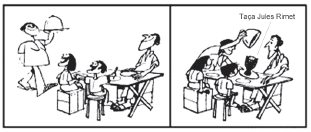
A charge do cartunista Ziraldo faz uma alusão à conquista da taça de tricampeão mundial de futebol, pelo Brasil, na Copa do Mundo de 1970, no México, período em que o país vivia o regime militar.
A crítica à realidade brasileira então vivenciada pela população refere-se à
Provas
Questão presente nas seguintes provas
O Decreto no 4.377, de 13 de setembro de 2002, publicada no DOU de 16/09/2002, promulga a Convenção, de 1979, sobre a Eliminação de Todas as Formas de Discriminação contra a Mulher e revoga o Decreto no 89.460, de 20 de março de 1984. Neste Decreto ficou estabelecido que os Estados Partes condenam a discriminação contra a mulher em todas as suas formas, por todos os meios apropriados e sem dilações, especificando uma política destinada a eliminar a discriminação contra a mulher.
Com tal objetivo, se comprometeram, no seu Art. 2º, a
Provas
Questão presente nas seguintes provas
Os conhecimentos sobre a Região Norte brasileira permitem afirmar que seu relevo se caracteriza por ser
Provas
Questão presente nas seguintes provas
Como parte de sua preparação física, um atleta foi aconselhado por um nutricionista a acrescentar à sua dieta algum suplemento alimentar, como X ou Y, dos quais se tem as seguintes informações:
X contém 2 unidades de fibras, 1 unidade de proteínas, 3 unidades de vitaminas e cada unidade desse suplemento custa r reais.
Y contém 1 unidade de fibras, 2 unidades de proteínas, 2 unidades de vitaminas e cada unidade desse suplemento custa 2r reais.
Sendo recomendada a ingestão diária mínima de 4 unidades de fibras, 5 unidades de proteínas e 8 unidades de vitaminas, pode-se afirmar que a despesa com os suplementos será mínima, se o número de unidades de X e de Y ingeridos forem, respectivamente, iguais a
Provas
Questão presente nas seguintes provas

The government in Chile has come up with a new way of saving energy. It’s advised Chilean men to take off their ties during the summer months, so they won’t need to switch on the air conditioning.
It’s a common sight during the Southern Hemisphere summer to see Chilean men sweltering in suits and neckties. From December to March, the temperature in the capital regularly tops 30 degrees Celsius. In the bone-dry north of the country it gets even higher.
So the government’s told the country’s menfolk to shed their ties, undo their top buttons and turn down the air conditioning. It estimates that by doing so Chile can save around US$ 10 million during the four hottest months of the year, and save 120,000 tons in carbon emissions.
The government launched its initiative with a video in which four ministers ripped off their ties. Energy conservation is a key issue in Chile, which, unlike many countries in Latin America, produces virtually no oil and gas. It relies heavily on hydro-electric power, but that often runs low during the summer, when the country’s reservoirs are frequently hit by drought.
CHILEANS told to take off ties. Disponível em: <www.bbc.co.uk/worldservice/learningenglish/language/wordsinthenews/>. Acesso em:13 maio 2012.
In order to save energy, the government in Chile has advised Chilean men
Provas
Questão presente nas seguintes provas
The government in Chile has come up with a new way of saving energy. It’s advised Chilean men to take off their ties during the summer months, so they won’t need to switch on the air conditioning.
It’s a common sight during the Southern Hemisphere summer to see Chilean men sweltering in suits and neckties. From December to March, the temperature in the capital regularly tops 30 degrees Celsius. In the bone-dry north of the country it gets even higher.
So the government’s told the country’s menfolk to shed their ties, undo their top buttons and turn down the air conditioning. It estimates that by doing so Chile can save around US$ 10 million during the four hottest months of the year, and save 120,000 tons in carbon emissions.
The government launched its initiative with a video in which four ministers ripped off their ties. Energy conservation is a key issue in Chile, which, unlike many countries in Latin America, produces virtually no oil and gas. It relies heavily on hydro-electric power, but that often runs low during the summer, when the country’s reservoirs are frequently hit by drought.
CHILEANS told to take off ties. Disponível em: <www.bbc.co.uk/worldservice/learningenglish/language/wordsinthenews/>. Acesso em:13 maio 2012.
The expression “bone-dry” should be understood as
Provas
Questão presente nas seguintes provas
Brasileiros são hoje recebidos em todo o mundo com tapete vermelho, como um dos melhores turistas, dada a sua disposição para compras e gastos de alto valor agregado em hotéis, passeios, aluguel de carros, etc., movimentando a milionária cadeia de serviços que vive dessa demanda. [...]. A Espanha seguiu na direção contrária. Numa postura inarredável, mantém há anos uma política restritiva extrema, com práticas arbitrárias que beiram a intolerância, levando milhares de brasileiros ao constrangimento de serem barrados na fronteira em arrastados interrogatórios, quando não — como ocorre em muitos casos — deportados. [...] Curiosamente, hoje é muito maior o fluxo de espanhóis para o Brasil do que o inverso. E o índice de admissão não concedida aqui é inferior a 10% do praticado lá. A Espanha convive atualmente com uma das maiores taxas de desemprego da Europa, da ordem de 22%, enquanto o Brasil experimenta uma primavera de oportunidades e vagas, inclusive importando mão de obra. Seria natural, nessas condições, um maior empenho daquele país em estabelecer facilidades para esse fluxo e, inexplicavelmente, não é o que acontece. Turistas brasileiros deveriam, daqui por diante, adotar o velho princípio de só ir aonde é bem-vindo. E, nesse caso, a Espanha não seria uma opção. (MARQUES. 2012, p. 20).
O maior fluxo de imigrantes espanhóis e de outros países, para o Brasil, decorre, dentre outros fatores,
Provas
Questão presente nas seguintes provas
Cadernos
Caderno Container