Foram encontradas 80 questões.
A utilização de receptores GPS é cada vez mais frequente em veículos. O princípio de funcionamento desse instrumento é baseado no intervalo de tempo de propagação de sinais, por meio de ondas eletromagnéticas, desde os satélites até os receptores GPS.
Considerando a velocidade de propagação da onda eletromagnética como sendo de 300.000 km/s e que, em determinado instante, um dos satélites encontra-se a 30.000 km de distância do receptor, qual é o tempo de propagação da onda eletromagnética emitida por esse satélite GPS até o receptor?
Provas
Questão presente nas seguintes provas

Os cerca de 300 manifestantes que ocupam o prédio do Instituto Nacional de Seguridade Social (INSS) na Rua Marechal Deodoro da Fonseca, no centro de Curitiba, decidiram nesta quarta-feira (15) que vão permanecer no local [...]. O instituto pediu que uma data fosse marcada para os ocupantes saírem do prédio. Mas, como houve recusa dos sem-teto em fazer isso, o caso agora pode ir à Justiça, com o ingresso pelo INSS de uma ação de reintegração de posse. [...] o edifício tem cerca de 3 mil metros quadrados de área útil, mas apenas uma parte de um dos quatro andares está sendo usada pelo INSS, como depósito.
(Fonte: <http://www.gazetadopovo.com.br/vida-e-cidadania/apos-reuniao-ocupacao-do-predio-do-inss-no-
centro-de-curitiba-continua-4fy22h23tbk3jhl7riwetqsop>. Publicado em 15/04/2015. Acessado em 21/08/2016.)
Com base na problemática presente no texto e nos conhecimentos de geografia urbana, identifique como verdadeiras (V) ou falsas (F) as seguintes afirmativas:
( ) Uma das causas das situações expostas no texto é a valorização do solo urbano, sobretudo em espaços com boa infraestrutura, que impede o acesso à moradia por parte significativa dos habitantes das cidades brasileiras.
( ) A participação da sociedade na gestão urbana é uma diretriz prevista legalmente, que pode contribuir para a gestão democrática dos municípios e diminuir os conflitos pelo direito ao uso da cidade.
( ) Segundo o Estatuto das Cidades, a regularização fundiária e a urbanização são instrumentos de política urbana considerados entraves à prevenção e resolução de problemas ambientais.
( ) O Poder Público possui mecanismos para combater a especulação imobiliária e promover a função social da propriedade, mas, nesse tema, há um descompasso entre as questões legais e a ação governamental.
Assinale a alternativa que apresenta a sequência correta, de cima para baixo.
Provas
Questão presente nas seguintes provas
Quatro resistores, cada um deles com valor R, estão conectados por meio de fios condutores ideais, segundo o circuito representado na figura abaixo. O circuito é alimentado por um gerador ideal que fornece uma tensão elétrica constante. Inicialmente, o circuito foi analisado segundo a situação 1 e, posteriormente, os pontos A e B foram interligados por meio de um fio condutor, de acordo com a situação 2.
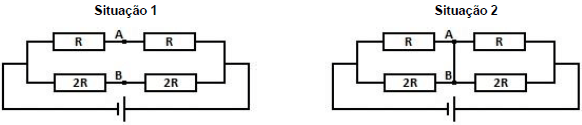
Com base nessas informações, identifique como verdadeiras (V) ou falsas (F) as seguintes afirmativas:
( ) A intensidade de corrente elétrica no gerador é a mesma para as duas situações representadas.
( ) Ao se conectar o fio condutor entre os pontos A e B, a resistência elétrica do circuito diminui.
( ) Na situação 2, a intensidade de corrente elétrica no gerador aumentará, em relação à situação 1.
( ) A diferença de potencial elétrico entre os pontos A e B, na situação 1, é maior que zero.
Assinale a alternativa que apresenta a sequência correta, de cima para baixo.
Provas
Questão presente nas seguintes provas
Recentemente, foram realizados retratos genéticos e de habitat do mais antigo ancestral universal, conhecido como LUCA. Acredita-se que esse organismo unicelular teria surgido a 3,8 bilhões de anos e seria capaz de fixar CO2, convertendo esse composto inorgânico de carbono em compostos orgânicos.
Para converter o composto inorgânico de carbono mencionado em metano (CH4), a variação do NOX no carbono é de:
Provas
Questão presente nas seguintes provas
O texto a seguir é referência para a questão.
Six things I learned from riding in a Google self-driving car
1 - Human beings are terrible drivers.
We drink. We doze. We text. In the US, 30,000 people die from automobile accidents every year. Traffic crashes are the primary cause of death worldwide for people aged 15-24, and during a crash, 40% of drivers never even hit the brakes. We’re flawed organisms, barreling around at high speeds in vessels covered in glass, metal, distraction, and death. This is one of Google’s “moonshots” – to remove human error from a job which, for the past hundred years, has been entirely human.
2 - Google self-driving cars are timid.
The car we rode in did not strike me as dangerous. It drove slowly and deliberately, and I got the impression that it’s more likely to annoy other drivers than to harm them.
In the early versions they tested on closed courses, the vehicles were programmed to be highly aggressive. Apparently during these tests, which involved obstacle courses full of traffic cones and inflatable crash-test objects, there were a lot of screeching brakes, roaring engines and terrified interns.
3 - They’re cute.
Google’s new fleet was intentionally designed to look adorable. Our brains are hardwired to treat inanimate (or animate) objects with greater care, caution, and reverence when they resemble a living thing. By turning self-driving cars into an adorable Skynet Marshmallow Bumper Bots, Google hopes to spiritually disarm other drivers. I also suspect the cuteness is used to quell some of the road rage that might emerge from being stuck behind one of these things. They’re intended as moderate-distance couriers, not open-road warriors, so their max speed is 25 miles per hour.
4 - It’s not done and it’s not perfect.
Some of the scenarios autonomous vehicles have the most trouble with are the same human beings have the most trouble with, such as traversing four-way stops or handling a yellow light.
The cars use a mixture of 3D laser-mapping, GPS, and radar to analyze and interpret their surroundings, and the latest versions are fully electric with a range of about 100 miles.
Despite the advantages over a human being in certain scenarios, however, these cars still aren’t ready for the real world. They can’t drive in the snow or heavy rain, and there’s a variety of complex situations they do not process well, such as passing through a construction zone. Google is hoping that, eventually, the cars will be able to handle all of this as well (or better) than a human could.
5 - I want this technology to succeed, like… yesterday.
I’m biased. Earlier this year my mom had a stroke. It damaged the visual cortex of her brain, and her vision was impaired to the point that she’ll probably never drive again. This reduced her from a fully-functional, independent human being with a career and a buzzing social life into someone who is homebound, disabled, and powerless.
When discussing self-driving cars, people tend to ask many superficial questions. They ignore that 45% of disabled people in the US still work. They ignore that 95% of a car’s lifetime is spent parked. They ignore how this technology could transform the lives of the elderly, or eradicate the need for parking lots or garages or gas stations. They dismiss the entire concept because they don’t think a computer could ever be as good at merging on the freeway as they are. They ignore the great, big, beautiful picture: that this technology could make our lives so much better.
6 - It wasn’t an exhilarating ride, and that’s a good thing.
Riding in a self-driving car is not the cybernetic thrill ride one might expect. The car drives like a person, and after a few minutes you forget that you’re being driven autonomously. You forget that a robot is differentiating cars from pedestrians from mopeds from raccoons. You forget that millions of photons are being fired from a laser and interpreting, processing, and reacting to the hand signals of a cyclist. You forget that instead of an organic brain, which has had millions of years to evolve the cognitive ability to fumble its way through a four-way stop, you’re being piloted by an artificial one, which was birthed in less than a decade.
The unfortunate part of something this transformative is the inevitable, ardent stupidity which is going to erupt from the general public. Even if in a few years self-driving cars are proven to be ten times safer than human-operated cars, all it’s going to take is one tragic accident and the public is going to lose their minds. There will be outrage. There will be politicizing. There will be hashtags.
I say look at the bigger picture. All the self-driving cars currently on the road learn from one another, and possess 40 years of driving experience. And this technology is still in its infancy.
(Adapted from: <http://theoatmeal.com/blog/google_self_driving_car>. 21/08/2016.)
The text points out that the design of the self-driving car is deliberately attractive because:
Provas
Questão presente nas seguintes provas
O texto a seguir é referência para a questão.
Six things I learned from riding in a Google self-driving car
1 - Human beings are terrible drivers.
We drink. We doze. We text. In the US, 30,000 people die from automobile accidents every year. Traffic crashes are the primary cause of death worldwide for people aged 15-24, and during a crash, 40% of drivers never even hit the brakes. We’re flawed organisms, barreling around at high speeds in vessels covered in glass, metal, distraction, and death. This is one of Google’s “moonshots” – to remove human error from a job which, for the past hundred years, has been entirely human.
2 - Google self-driving cars are timid.
The car we rode in did not strike me as dangerous. It drove slowly and deliberately, and I got the impression that it’s more likely to annoy other drivers than to harm them.
In the early versions they tested on closed courses, the vehicles were programmed to be highly aggressive. Apparently during these tests, which involved obstacle courses full of traffic cones and inflatable crash-test objects, there were a lot of screeching brakes, roaring engines and terrified interns.
3 - They’re cute.
Google’s new fleet was intentionally designed to look adorable. Our brains are hardwired to treat inanimate (or animate) objects with greater care, caution, and reverence when they resemble a living thing. By turning self-driving cars into an adorable Skynet Marshmallow Bumper Bots, Google hopes to spiritually disarm other drivers. I also suspect the cuteness is used to quell some of the road rage that might emerge from being stuck behind one of these things. They’re intended as moderate-distance couriers, not open-road warriors, so their max speed is 25 miles per hour.
4 - It’s not done and it’s not perfect.
Some of the scenarios autonomous vehicles have the most trouble with are the same human beings have the most trouble with, such as traversing four-way stops or handling a yellow light.
The cars use a mixture of 3D laser-mapping, GPS, and radar to analyze and interpret their surroundings, and the latest versions are fully electric with a range of about 100 miles.
Despite the advantages over a human being in certain scenarios, however, these cars still aren’t ready for the real world. They can’t drive in the snow or heavy rain, and there’s a variety of complex situations they do not process well, such as passing through a construction zone. Google is hoping that, eventually, the cars will be able to handle all of this as well (or better) than a human could.
5 - I want this technology to succeed, like… yesterday.
I’m biased. Earlier this year my mom had a stroke. It damaged the visual cortex of her brain, and her vision was impaired to the point that she’ll probably never drive again. This reduced her from a fully-functional, independent human being with a career and a buzzing social life into someone who is homebound, disabled, and powerless.
When discussing self-driving cars, people tend to ask many superficial questions. They ignore that 45% of disabled people in the US still work. They ignore that 95% of a car’s lifetime is spent parked. They ignore how this technology could transform the lives of the elderly, or eradicate the need for parking lots or garages or gas stations. They dismiss the entire concept because they don’t think a computer could ever be as good at merging on the freeway as they are. They ignore the great, big, beautiful picture: that this technology could make our lives so much better.
6 - It wasn’t an exhilarating ride, and that’s a good thing.
Riding in a self-driving car is not the cybernetic thrill ride one might expect. The car drives like a person, and after a few minutes you forget that you’re being driven autonomously. You forget that a robot is differentiating cars from pedestrians from mopeds from raccoons. You forget that millions of photons are being fired from a laser and interpreting, processing, and reacting to the hand signals of a cyclist. You forget that instead of an organic brain, which has had millions of years to evolve the cognitive ability to fumble its way through a four-way stop, you’re being piloted by an artificial one, which was birthed in less than a decade.
The unfortunate part of something this transformative is the inevitable, ardent stupidity which is going to erupt from the general public. Even if in a few years self-driving cars are proven to be ten times safer than human-operated cars, all it’s going to take is one tragic accident and the public is going to lose their minds. There will be outrage. There will be politicizing. There will be hashtags.
I say look at the bigger picture. All the self-driving cars currently on the road learn from one another, and possess 40 years of driving experience. And this technology is still in its infancy.
(Adapted from: <http://theoatmeal.com/blog/google_self_driving_car>. 21/08/2016.)
Consider the following characteristics of the new Google self-driving car:
1. It runs on batteries and petrol.
2. It can be used in extreme weather conditions.
3. It has a design which requires further modifications.
4. It can reach the speed of 25 miles per hour.
Mark the correct alternative.
Provas
Questão presente nas seguintes provas
O texto a seguir é referência para a questão.
Six things I learned from riding in a Google self-driving car
1 - Human beings are terrible drivers.
We drink. We doze. We text. In the US, 30,000 people die from automobile accidents every year. Traffic crashes are the primary cause of death worldwide for people aged 15-24, and during a crash, 40% of drivers never even hit the brakes. We’re flawed organisms, barreling around at high speeds in vessels covered in glass, metal, distraction, and death. This is one of Google’s “moonshots” – to remove human error from a job which, for the past hundred years, has been entirely human.
2 - Google self-driving cars are timid.
The car we rode in did not strike me as dangerous. It drove slowly and deliberately, and I got the impression that it’s more likely to annoy other drivers than to harm them.
In the early versions they tested on closed courses, the vehicles were programmed to be highly aggressive. Apparently during these tests, which involved obstacle courses full of traffic cones and inflatable crash-test objects, there were a lot of screeching brakes, roaring engines and terrified interns.
3 - They’re cute.
Google’s new fleet was intentionally designed to look adorable. Our brains are hardwired to treat inanimate (or animate) objects with greater care, caution, and reverence when they resemble a living thing. By turning self-driving cars into an adorable Skynet Marshmallow Bumper Bots, Google hopes to spiritually disarm other drivers. I also suspect the cuteness is used to quell some of the road rage that might emerge from being stuck behind one of these things. They’re intended as moderate-distance couriers, not open-road warriors, so their max speed is 25 miles per hour.
4 - It’s not done and it’s not perfect.
Some of the scenarios autonomous vehicles have the most trouble with are the same human beings have the most trouble with, such as traversing four-way stops or handling a yellow light.
The cars use a mixture of 3D laser-mapping, GPS, and radar to analyze and interpret their surroundings, and the latest versions are fully electric with a range of about 100 miles.
Despite the advantages over a human being in certain scenarios, however, these cars still aren’t ready for the real world. They can’t drive in the snow or heavy rain, and there’s a variety of complex situations they do not process well, such as passing through a construction zone. Google is hoping that, eventually, the cars will be able to handle all of this as well (or better) than a human could.
5 - I want this technology to succeed, like… yesterday.
I’m biased. Earlier this year my mom had a stroke. It damaged the visual cortex of her brain, and her vision was impaired to the point that she’ll probably never drive again. This reduced her from a fully-functional, independent human being with a career and a buzzing social life into someone who is homebound, disabled, and powerless.
When discussing self-driving cars, people tend to ask many superficial questions. They ignore that 45% of disabled people in the US still work. They ignore that 95% of a car’s lifetime is spent parked. They ignore how this technology could transform the lives of the elderly, or eradicate the need for parking lots or garages or gas stations. They dismiss the entire concept because they don’t think a computer could ever be as good at merging on the freeway as they are. They ignore the great, big, beautiful picture: that this technology could make our lives so much better.
6 - It wasn’t an exhilarating ride, and that’s a good thing.
Riding in a self-driving car is not the cybernetic thrill ride one might expect. The car drives like a person, and after a few minutes you forget that you’re being driven autonomously. You forget that a robot is differentiating cars from pedestrians from mopeds from raccoons. You forget that millions of photons are being fired from a laser and interpreting, processing, and reacting to the hand signals of a cyclist. You forget that instead of an organic brain, which has had millions of years to evolve the cognitive ability to fumble its way through a four-way stop, you’re being piloted by an artificial one, which was birthed in less than a decade.
The unfortunate part of something this transformative is the inevitable, ardent stupidity which is going to erupt from the general public. Even if in a few years self-driving cars are proven to be ten times safer than human-operated cars, all it’s going to take is one tragic accident and the public is going to lose their minds. There will be outrage. There will be politicizing. There will be hashtags.
I say look at the bigger picture. All the self-driving cars currently on the road learn from one another, and possess 40 years of driving experience. And this technology is still in its infancy.
(Adapted from: <http://theoatmeal.com/blog/google_self_driving_car>. 21/08/2016.)
In the sentence “They dismiss the entire concept because they don’t think a computer…”, the underlined word can be substituted, without losing its meaning, by:
Provas
Questão presente nas seguintes provas
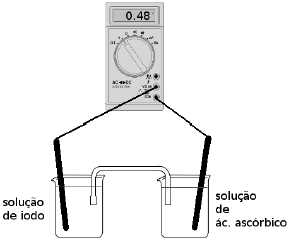
O ácido ascórbico é uma das formas da vitamina C que apresenta propriedade antioxidante. Na indústria de alimentos, ele é largamente utilizado como aditivo para prevenir a oxidação. Uma maneira de analisar a quantidade de ácido ascórbico em bebidas é através de uma reação de oxirredução utilizando iodo. Com base nisso, foi montada uma pilha, conforme ilustração acima, contendo eletrodos inertes de platina ligados a um voltímetro. Foram mantidas condições padrão (298 K, 1 atm e 1 mol L-1) para o experimento, e no instante em que se fechou o circuito, conectando-se os fios ao voltímetro, o valor de potencial medido foi de 0,48 V.
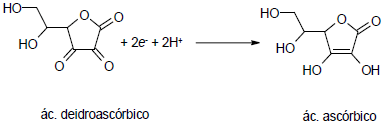
Sabendo que o potencial padrão de redução de iodo a iodeto é de E 0 = 0,54 V, o potencial padrão da reação abaixo é:
Provas
Questão presente nas seguintes provas
Em um triângulo retângulo, o maior e o menor lado medem, respectivamente, 12 cm e 4 cm.
Qual é a área desse triângulo?
Provas
Questão presente nas seguintes provas
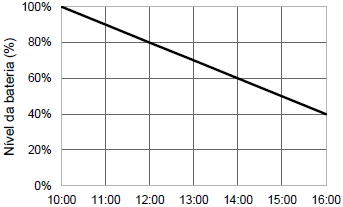
O gráfico acima representa o consumo de bateria de um celular entre as 10 h e as 16 h de um determinado dia.
Supondo que o consumo manteve o mesmo padrão até a bateria se esgotar, a que horas o nível da bateria atingiu 10%?
Provas
Questão presente nas seguintes provas
Cadernos
Caderno Container