Foram encontradas 90 questões.
Leia o texto para responder às questões de números 61 a 70.
2010 census shows Brazil’s inequalities remain
November 17, 2011
By Joe Leahy in São Paulo
Brazil has a long way to go to become a more egalitarian society in spite of significant advances over the past decade, when millions of poor joined the ranks of the middle classes, the country’s 2010 census shows.
Among the most glaring inequalities, the figures found that 25 per cent of the population still lived on an average monthly income per capita of up to R$188 ($106) and half the population on up to R$375. This was compared to the minimum wage in 2010 of R$510. “The results of Census 2010 show that income inequality is still very strong in Brazil, despite the declining trend observed in recent years,” the government data bureau, the Brazilian Institute of Geography and Statistics – known as the IBGE – said.
Once notorious for its rich/poor divide, Brazil has made great strides over the past decade. The rise of a new middle class, which is attracting a flurry of international investment as multinationals from car companies to snackfood producers compete to grab a share of the market, was made possible by increases in the minimum wage, improved welfare benefits and stable economic management.
In particular, successive governments were able to put an end to runaway inflation, which eroded the value of the wages and savings of lower income earners while benefiting those rich enough to buy property or save in dollars.
According to a study by the Getúlio Vargas Foundation, an academic institution, an estimated 33m people have risen to the ranks of the so-called “new middle classes” or above since 2003. Today, 105.5m Brazilians out of a total population of 190m are members of this group, earning between R$1,200 and R$5,174 per household.
But the census indicates tens of millions of people have yet to catch up or have been left behind completely. Discrepancies between races are among the greatest. The average monthly income of whites was R$1,538 and Asians R$1,574, nearly double that of blacks and those of mixed race with R$834 and R$845 respectively, and more than twice as much as indigenous people with R$735.
Whites were also living longer while blacks and those of mixed race accounted for a higher proportion of people below 40 years. “Whites have a higher proportion of elderly people – over 65 years and especially over 80 years of age – which is probably linked to differences in living conditions and access to healthcare, and unequal distribution of income,” the IBGE said.
The same pattern was represented in levels of illiteracy. Although the national rate of illiteracy among the population aged 15 years or older had fallen from 13.63 per cent in 2000 to 9.6 per cent in 2010, it was still as high as 28 per cent in some medium-sized municipalities in the poorer north-east. Illiteracy among blacks was at 14.4 per cent and among those of mixed race 13 per cent in 2010, nearly triple that of whites at 5.9 per cent.
(www.ft.com/intl/cms/s/0/71352352-112c-11e1-ad22- 00144feabdc0.html#axzz1wrL3w1LE)
Provas

Leia o texto para responder às questões de números 61 a 70.
2010 census shows Brazil’s inequalities remain
November 17, 2011
By Joe Leahy in São Paulo
Brazil has a long way to go to become a more egalitarian society in spite of significant advances over the past decade, when millions of poor joined the ranks of the middle classes, the country’s 2010 census shows.
Among the most glaring inequalities, the figures found that 25 per cent of the population still lived on an average monthly income per capita of up to R$188 ($106) and half the population on up to R$375. This was compared to the minimum wage in 2010 of R$510. “The results of Census 2010 show that income inequality is still very strong in Brazil, despite the declining trend observed in recent years,” the government data bureau, the Brazilian Institute of Geography and Statistics – known as the IBGE – said.
Once notorious for its rich/poor divide, Brazil has made great strides over the past decade. The rise of a new middle class, which is attracting a flurry of international investment as multinationals from car companies to snackfood producers compete to grab a share of the market, was made possible by increases in the minimum wage, improved welfare benefits and stable economic management.
In particular, successive governments were able to put an end to runaway inflation, which eroded the value of the wages and savings of lower income earners while benefiting those rich enough to buy property or save in dollars.
According to a study by the Getúlio Vargas Foundation, an academic institution, an estimated 33m people have risen to the ranks of the so-called “new middle classes” or above since 2003. Today, 105.5m Brazilians out of a total population of 190m are members of this group, earning between R$1,200 and R$5,174 per household.
But the census indicates tens of millions of people have yet to catch up or have been left behind completely. Discrepancies between races are among the greatest. The average monthly income of whites was R$1,538 and Asians R$1,574, nearly double that of blacks and those of mixed race with R$834 and R$845 respectively, and more than twice as much as indigenous people with R$735.
Whites were also living longer while blacks and those of mixed race accounted for a higher proportion of people below 40 years. “Whites have a higher proportion of elderly people – over 65 years and especially over 80 years of age – which is probably linked to differences in living conditions and access to healthcare, and unequal distribution of income,” the IBGE said.
The same pattern was represented in levels of illiteracy. Although the national rate of illiteracy among the population aged 15 years or older had fallen from 13.63 per cent in 2000 to 9.6 per cent in 2010, it was still as high as 28 per cent in some medium-sized municipalities in the poorer north-east. Illiteracy among blacks was at 14.4 per cent and among those of mixed race 13 per cent in 2010, nearly triple that of whites at 5.9 per cent.
(www.ft.com/intl/cms/s/0/71352352-112c-11e1-ad22- 00144feabdc0.html#axzz1wrL3w1LE)
According to the text,
Provas
Leia o texto para responder às questões de números 61 a 70.
2010 census shows Brazil’s inequalities remain
November 17, 2011
By Joe Leahy in São Paulo
Brazil has a long way to go to become a more egalitarian society in spite of significant advances over the past decade, when millions of poor joined the ranks of the middle classes, the country’s 2010 census shows.
Among the most glaring inequalities, the figures found that 25 per cent of the population still lived on an average monthly income per capita of up to R$188 ($106) and half the population on up to R$375. This was compared to the minimum wage in 2010 of R$510. “The results of Census 2010 show that income inequality is still very strong in Brazil, despite the declining trend observed in recent years,” the government data bureau, the Brazilian Institute of Geography and Statistics – known as the IBGE – said.
Once notorious for its rich/poor divide, Brazil has made great strides over the past decade. The rise of a new middle class, which is attracting a flurry of international investment as multinationals from car companies to snackfood producers compete to grab a share of the market, was made possible by increases in the minimum wage, improved welfare benefits and stable economic management.
In particular, successive governments were able to put an end to runaway inflation, which eroded the value of the wages and savings of lower income earners while benefiting those rich enough to buy property or save in dollars.
According to a study by the Getúlio Vargas Foundation, an academic institution, an estimated 33m people have risen to the ranks of the so-called “new middle classes” or above since 2003. Today, 105.5m Brazilians out of a total population of 190m are members of this group, earning between R$1,200 and R$5,174 per household.
But the census indicates tens of millions of people have yet to catch up or have been left behind completely. Discrepancies between races are among the greatest. The average monthly income of whites was R$1,538 and Asians R$1,574, nearly double that of blacks and those of mixed race with R$834 and R$845 respectively, and more than twice as much as indigenous people with R$735.
Whites were also living longer while blacks and those of mixed race accounted for a higher proportion of people below 40 years. “Whites have a higher proportion of elderly people – over 65 years and especially over 80 years of age – which is probably linked to differences in living conditions and access to healthcare, and unequal distribution of income,” the IBGE said.
The same pattern was represented in levels of illiteracy. Although the national rate of illiteracy among the population aged 15 years or older had fallen from 13.63 per cent in 2000 to 9.6 per cent in 2010, it was still as high as 28 per cent in some medium-sized municipalities in the poorer north-east. Illiteracy among blacks was at 14.4 per cent and among those of mixed race 13 per cent in 2010, nearly triple that of whites at 5.9 per cent.
(www.ft.com/intl/cms/s/0/71352352-112c-11e1-ad22- 00144feabdc0.html#axzz1wrL3w1LE)
Segundo o texto, o Brasil
Provas
Leia os textos I e II para responder às questões de números 58 a 60.
Texto I
Mais de 8 mil quilômetros de costa. Quatro milhões e meio de quilômetros quadrados de território marinho. Enormes reservatórios naturais de carbono. Um leito oceânico recheado de petróleo, gás e outras riquezas minerais. A maior biodiversidade de espécies marinhas do Atlântico Sul.
A aquisição do Alpha Crucis – um navio oceanográfico de 64 metros e 972 toneladas, comprado pela Fundação de Amparo à Pesquisa do Estado de São Paulo (Fapesp) e pela USP – simboliza uma mudança de paradigma não só para a oceanografia brasileira, mas na maneira como o país olha para o mar de uma maneira geral. Um fenômeno motivado em grande parte nos últimos anos pela descoberta das reservas de petróleo e gás do pré-sal, em águas extremamente profundas e distantes da costa.
Segundo o diretor do Instituto Oceanográfico da USP, Michel Mahiques, a mudança começou ainda antes, com a propagação do conceito da Amazônia Azul – um slogan criado pela Marinha para valorizar as riquezas biológicas e minerais do mar brasileiro. “Temos de pensar nas questões geopolíticas também. Quem tem mais conhecimento leva vantagem.”
(Novo navio de pesquisa da USP chega para revolucionar as ciências no mar. O Estado de S.Paulo, 27.05.2012. Adaptado)
Texto II
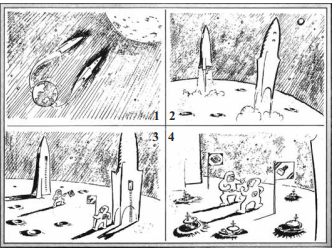
(Don Kindler, Human nature. Picture Prompts, 1981)
Assinale a alternativa cuja frase apresenta pontuação correta.
Provas
Leia os textos I e II para responder às questões de números 58 a 60.
Texto I
Mais de 8 mil quilômetros de costa. Quatro milhões e meio de quilômetros quadrados de território marinho. Enormes reservatórios naturais de carbono. Um leito oceânico recheado de petróleo, gás e outras riquezas minerais. A maior biodiversidade de espécies marinhas do Atlântico Sul.
A aquisição do Alpha Crucis – um navio oceanográfico de 64 metros e 972 toneladas, comprado pela Fundação de Amparo à Pesquisa do Estado de São Paulo (Fapesp) e pela USP – simboliza uma mudança de paradigma não só para a oceanografia brasileira, mas na maneira como o país olha para o mar de uma maneira geral. Um fenômeno motivado em grande parte nos últimos anos pela descoberta das reservas de petróleo e gás do pré-sal, em águas extremamente profundas e distantes da costa.
Segundo o diretor do Instituto Oceanográfico da USP, Michel Mahiques, a mudança começou ainda antes, com a propagação do conceito da Amazônia Azul – um slogan criado pela Marinha para valorizar as riquezas biológicas e minerais do mar brasileiro. “Temos de pensar nas questões geopolíticas também. Quem tem mais conhecimento leva vantagem.”
(Novo navio de pesquisa da USP chega para revolucionar as ciências no mar. O Estado de S.Paulo, 27.05.2012. Adaptado)
Texto II
(Don Kindler, Human nature. Picture Prompts, 1981)
Provas
Leia os textos I e II para responder às questões de números 58 a 60.
Texto I
Mais de 8 mil quilômetros de costa. Quatro milhões e meio de quilômetros quadrados de território marinho. Enormes reservatórios naturais de carbono. Um leito oceânico recheado de petróleo, gás e outras riquezas minerais. A maior biodiversidade de espécies marinhas do Atlântico Sul.
A aquisição do Alpha Crucis – um navio oceanográfico de 64 metros e 972 toneladas, comprado pela Fundação de Amparo à Pesquisa do Estado de São Paulo (Fapesp) e pela USP – simboliza uma mudança de paradigma não só para a oceanografia brasileira, mas na maneira como o país olha para o mar de uma maneira geral. Um fenômeno motivado em grande parte nos últimos anos pela descoberta das reservas de petróleo e gás do pré-sal, em águas extremamente profundas e distantes da costa.
Segundo o diretor do Instituto Oceanográfico da USP, Michel Mahiques, a mudança começou ainda antes, com a propagação do conceito da Amazônia Azul – um slogan criado pela Marinha para valorizar as riquezas biológicas e minerais do mar brasileiro. “Temos de pensar nas questões geopolíticas também. Quem tem mais conhecimento leva vantagem.”
(Novo navio de pesquisa da USP chega para revolucionar as ciências no mar. O Estado de S.Paulo, 27.05.2012. Adaptado)
Texto II
(Don Kindler, Human nature. Picture Prompts, 1981)
O texto II representa uma crítica à seguinte ideia contida no texto I:
Provas
Leia o texto para responder às questões de números 55 a 57.
Quero eu na maneira de um provençal
fazer agora um cantar de amor
e quererei muito aí louvar minha senhora,
a quem boas qualidades e formosura não faltam,
nem bondade, e ainda vos direi isto:
tanto a fez Deus perfeita de bem
que mais que todas as do mundo vale.
(Dom Diniz. In: Poesia e prosa medievais. Lisboa: Ulisseia, s/d)
Sobre o amor cortês no Trovadorismo, afirma-se que era
I. um código amoroso composto de regras;
II. idealizado, e a dama constituía um ser inalcançável;
III. manifestado por um vassalo que submetia a dama a seus caprichos.
Está correto o que se afirma em
Provas
Leia o texto para responder às questões de números 55 a 57.
Quero eu na maneira de um provençal
fazer agora um cantar de amor
e quererei muito aí louvar minha senhora,
a quem boas qualidades e formosura não faltam,
nem bondade, e ainda vos direi isto:
tanto a fez Deus perfeita de bem
que mais que todas as do mundo vale.
(Dom Diniz. In: Poesia e prosa medievais. Lisboa: Ulisseia, s/d)
Provas
Leia o texto para responder às questões de números 55 a 57.
Quero eu na maneira de um provençal
fazer agora um cantar de amor
e quererei muito aí louvar minha senhora,
a quem boas qualidades e formosura não faltam,
nem bondade, e ainda vos direi isto:
tanto a fez Deus perfeita de bem
que mais que todas as do mundo vale.
(Dom Diniz. In: Poesia e prosa medievais. Lisboa: Ulisseia, s/d)
Provas
Leia o texto para responder às questões de números 51 a 54.
Tenho em grande conta a eficácia das medidas legislativas, administrativas e policiais que diretamente e indiretamente tendem a civilizar a sociedade. Estas reflexões tendem unicamente a mostrar que a ação da polícia é sempre eficaz para a moralização dos costumes.
Até agora ela não se tinha voltado para os cinemas.
Não posso auxiliar a nossa polícia legal, porquanto desde muito que não vou a cinematógrafos, mas todas essas fitas americanas são brutas histórias de raptos, com salteadores. Apesar disso tudo, é na assistência delas que nasce muito amor condenado. O cadastro policial registra isso com muita fidelidade e frequência. “Foi”, diz uma raptada, “no Cinema X que conheci F. Ele me acompanhou, até.”
O amor, ao que parece, é como o mundo, nasce das trevas; e o cinema não funciona à luz do sol, nem à da eletricidade, nem à da lua que, no velho romantismo das falecidas Elviras, Grazielas e outras, lhe era tão favorável.
(Lima Barreto, “Amor, cinema e telefone”. Crônicas. Cia. das Letras)
Em – Não posso auxiliar a nossa polícia legal, porquanto desde muito que não vou a cinematógrafos... –, a conjunção destacada pode ser substituída, sem prejuízo de sentido, por
Provas
Caderno Container