Foram encontradas 86 questões.
Em um experimento, os tubos de ensaio 1 e 2 receberam soluções de diferentes concentrações do mesmo soluto. Uma célula animal foi mergulhada na solução do tubo 1 e uma célula vegetal foi mergulhada na solução do tubo 2. O gráfico mostra as concentrações relativas das soluções nos tubos 1 e 2 e do citoplasma das células animal e vegetal contidas nos respectivos tubos.

Após duas horas, verificou-se que a célula animal e a célula vegetal estavam, respectivamente,
Provas

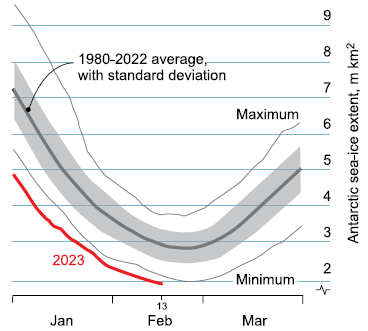
At the beginning of March 1898, a Belgian research ship became stuck in the ice of Antarctica’s Bellingshausen sea. The Belgica ship and its crew — which included Roald Amundsen, who later became the first man to reach the South Pole — remained there for a year. Scientists aboard Polarstern, a German research ship currently in the same place, have a very different view: in the beginning of February 2023, the expedition leader said he had never seen the sea so destituted of ice. In 2023, on February 13th, sea ice across the Antarctic as a whole reached 1.91 million square kilometres (m km2), the lowest level since satellite records began in 1979.
The world is now, on average, 1.0-1.3 ºC hotter than it was before the Industrial Revolution. However, that change has not occurred evenly: the poles are warming faster than regions in the middle of the globe.
Sea-ice extent around Antarctica was relatively stable until 2014. It has been declining sharply since then. One study by a climatologist at America’s National Aeronautics and Space Administration (NASA) considers that between 2014 and 2017 Antarctic sea ice receded three times as quickly as during any comparable period in the Arctic. Antarctic sea ice shrinks to a minimum during late February and early March, during the southern hemisphere’s summer. It hit record lows in 2022 and again now in 2023.
These changes have prompted much research into how global warming is affecting Antarctica. The biggest concern is over the enormous West Antarctic ice sheet, which is smaller but less stable than its eastern counterpart. Scientists say that it risks collapse if it melts beyond a certain point, which could result in a global sea-level rise of up to three metres. It is unlikely to happen any time soon, but increasing evidence of instability in Antarctica’s ice sheets is cause for concern.
(www.economist.com, 20.02.2023. Adaptado.)
No trecho do quarto parágrafo “if it melts beyond a certain point”, o termo sublinhado refere-se a
Provas
At the beginning of March 1898, a Belgian research ship became stuck in the ice of Antarctica’s Bellingshausen sea. The Belgica ship and its crew — which included Roald Amundsen, who later became the first man to reach the South Pole — remained there for a year. Scientists aboard Polarstern, a German research ship currently in the same place, have a very different view: in the beginning of February 2023, the expedition leader said he had never seen the sea so destituted of ice. In 2023, on February 13th, sea ice across the Antarctic as a whole reached 1.91 million square kilometres (m km2), the lowest level since satellite records began in 1979.
The world is now, on average, 1.0-1.3 ºC hotter than it was before the Industrial Revolution. However, that change has not occurred evenly: the poles are warming faster than regions in the middle of the globe.
Sea-ice extent around Antarctica was relatively stable until 2014. It has been declining sharply since then. One study by a climatologist at America’s National Aeronautics and Space Administration (NASA) considers that between 2014 and 2017 Antarctic sea ice receded three times as quickly as during any comparable period in the Arctic. Antarctic sea ice shrinks to a minimum during late February and early March, during the southern hemisphere’s summer. It hit record lows in 2022 and again now in 2023.
These changes have prompted much research into how global warming is affecting Antarctica. The biggest concern is over the enormous West Antarctic ice sheet, which is smaller but less stable than its eastern counterpart. Scientists say that it risks collapse if it melts beyond a certain point, which could result in a global sea-level rise of up to three metres. It is unlikely to happen any time soon, but increasing evidence of instability in Antarctica’s ice sheets is cause for concern.
(www.economist.com, 20.02.2023. Adaptado.)
O trecho do texto que está representado no gráfico é:
Provas
At the beginning of March 1898, a Belgian research ship became stuck in the ice of Antarctica’s Bellingshausen sea. The Belgica ship and its crew — which included Roald Amundsen, who later became the first man to reach the South Pole — remained there for a year. Scientists aboard Polarstern, a German research ship currently in the same place, have a very different view: in the beginning of February 2023, the expedition leader said he had never seen the sea so destituted of ice. In 2023, on February 13th, sea ice across the Antarctic as a whole reached 1.91 million square kilometres (m km2), the lowest level since satellite records began in 1979.
The world is now, on average, 1.0-1.3 ºC hotter than it was before the Industrial Revolution. However, that change has not occurred evenly: the poles are warming faster than regions in the middle of the globe.
Sea-ice extent around Antarctica was relatively stable until 2014. It has been declining sharply since then. One study by a climatologist at America’s National Aeronautics and Space Administration (NASA) considers that between 2014 and 2017 Antarctic sea ice receded three times as quickly as during any comparable period in the Arctic. Antarctic sea ice shrinks to a minimum during late February and early March, during the southern hemisphere’s summer. It hit record lows in 2022 and again now in 2023.
These changes have prompted much research into how global warming is affecting Antarctica. The biggest concern is over the enormous West Antarctic ice sheet, which is smaller but less stable than its eastern counterpart. Scientists say that it risks collapse if it melts beyond a certain point, which could result in a global sea-level rise of up to three metres. It is unlikely to happen any time soon, but increasing evidence of instability in Antarctica’s ice sheets is cause for concern.
(www.economist.com, 20.02.2023. Adaptado.)
O trecho do segundo parágrafo “that change has not occurred evenly: the poles are warming faster than regions in the middle of the globe” consiste de duas partes. A segunda parte estabelece
Provas
At the beginning of March 1898, a Belgian research ship became stuck in the ice of Antarctica’s Bellingshausen sea. The Belgica ship and its crew — which included Roald Amundsen, who later became the first man to reach the South Pole — remained there for a year. Scientists aboard Polarstern, a German research ship currently in the same place, have a very different view: in the beginning of February 2023, the expedition leader said he had never seen the sea so destituted of ice. In 2023, on February 13th, sea ice across the Antarctic as a whole reached 1.91 million square kilometres (m km2), the lowest level since satellite records began in 1979.
The world is now, on average, 1.0-1.3 ºC hotter than it was before the Industrial Revolution. However, that change has not occurred evenly: the poles are warming faster than regions in the middle of the globe.
Sea-ice extent around Antarctica was relatively stable until 2014. It has been declining sharply since then. One study by a climatologist at America’s National Aeronautics and Space Administration (NASA) considers that between 2014 and 2017 Antarctic sea ice receded three times as quickly as during any comparable period in the Arctic. Antarctic sea ice shrinks to a minimum during late February and early March, during the southern hemisphere’s summer. It hit record lows in 2022 and again now in 2023.
These changes have prompted much research into how global warming is affecting Antarctica. The biggest concern is over the enormous West Antarctic ice sheet, which is smaller but less stable than its eastern counterpart. Scientists say that it risks collapse if it melts beyond a certain point, which could result in a global sea-level rise of up to three metres. It is unlikely to happen any time soon, but increasing evidence of instability in Antarctica’s ice sheets is cause for concern.
(www.economist.com, 20.02.2023. Adaptado.)
No trecho do segundo parágrafo “However, that change has not occurred evenly”, o termo sublinhado pode ser substituído, sem alteração de sentido, por
Provas
At the beginning of March 1898, a Belgian research ship became stuck in the ice of Antarctica’s Bellingshausen sea. The Belgica ship and its crew — which included Roald Amundsen, who later became the first man to reach the South Pole — remained there for a year. Scientists aboard Polarstern, a German research ship currently in the same place, have a very different view: in the beginning of February 2023, the expedition leader said he had never seen the sea so destituted of ice. In 2023, on February 13th, sea ice across the Antarctic as a whole reached 1.91 million square kilometres (m km2), the lowest level since satellite records began in 1979.
The world is now, on average, 1.0-1.3 ºC hotter than it was before the Industrial Revolution. However, that change has not occurred evenly: the poles are warming faster than regions in the middle of the globe.
Sea-ice extent around Antarctica was relatively stable until 2014. It has been declining sharply since then. One study by a climatologist at America’s National Aeronautics and Space Administration (NASA) considers that between 2014 and 2017 Antarctic sea ice receded three times as quickly as during any comparable period in the Arctic. Antarctic sea ice shrinks to a minimum during late February and early March, during the southern hemisphere’s summer. It hit record lows in 2022 and again now in 2023.
These changes have prompted much research into how global warming is affecting Antarctica. The biggest concern is over the enormous West Antarctic ice sheet, which is smaller but less stable than its eastern counterpart. Scientists say that it risks collapse if it melts beyond a certain point, which could result in a global sea-level rise of up to three metres. It is unlikely to happen any time soon, but increasing evidence of instability in Antarctica’s ice sheets is cause for concern.
(www.economist.com, 20.02.2023. Adaptado.)
The first paragraph informs that
Provas
At the beginning of March 1898, a Belgian research ship became stuck in the ice of Antarctica’s Bellingshausen sea. The Belgica ship and its crew — which included Roald Amundsen, who later became the first man to reach the South Pole — remained there for a year. Scientists aboard Polarstern, a German research ship currently in the same place, have a very different view: in the beginning of February 2023, the expedition leader said he had never seen the sea so destituted of ice. In 2023, on February 13th, sea ice across the Antarctic as a whole reached 1.91 million square kilometres (m km2), the lowest level since satellite records began in 1979.
The world is now, on average, 1.0-1.3 ºC hotter than it was before the Industrial Revolution. However, that change has not occurred evenly: the poles are warming faster than regions in the middle of the globe.
Sea-ice extent around Antarctica was relatively stable until 2014. It has been declining sharply since then. One study by a climatologist at America’s National Aeronautics and Space Administration (NASA) considers that between 2014 and 2017 Antarctic sea ice receded three times as quickly as during any comparable period in the Arctic. Antarctic sea ice shrinks to a minimum during late February and early March, during the southern hemisphere’s summer. It hit record lows in 2022 and again now in 2023.
These changes have prompted much research into how global warming is affecting Antarctica. The biggest concern is over the enormous West Antarctic ice sheet, which is smaller but less stable than its eastern counterpart. Scientists say that it risks collapse if it melts beyond a certain point, which could result in a global sea-level rise of up to three metres. It is unlikely to happen any time soon, but increasing evidence of instability in Antarctica’s ice sheets is cause for concern.
(www.economist.com, 20.02.2023. Adaptado.)
The text mainly intends to show that
Provas
Em uma progressão aritmética de razão positiva, o primeiro termo é 12, a diferença entre os termos a9 e a2 é 126, e a soma do 100º termo com o 200º termo é igual a 283x + 11. O valor de x é
Provas
Uma das arestas de um paralelepípedo reto-retângulo mede 20 cm e uma de suas faces tem perímetro igual a 36 cm. Se o volume desse paralelepípedo é 1 120 cm3, sua área total é
Provas
Na figura, o quadrado EFGI tem área 16 cm2. O triângulo AEF é retângulo em E e tem área 6 cm2; o retângulo FBHG tem área 12 cm2; o trapézio CGIJ é retângulo em G e em I e tem área 12 cm2; e o paralelogramo EIDK tem área 16 cm2.
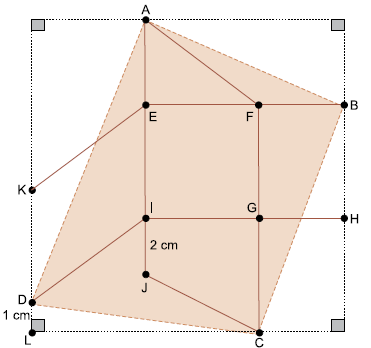
Sabendo que o triângulo DLC é retângulo em L, a área do quadrilátero ABCD é
Provas
Caderno Container