Magna Concursos

Foram encontradas 60 questões.

O texto seguinte servirá de base para responder a questão.
Driven by pre-salt, oil becomes Brazil's top export Revenues
The discovery of the pre-salt was so significant for Brazil's oil production potential that it led the government to change the regime that authorized companies to explore the submerged resources. 
As a result, the pre-salt areas are governed by the sharing regime. Under this model, surplus oil production—the balance after covering costs—is divided between the company and the Brazilian government. During the auction that authorizes exploration, the company offering the highest share of profits to the federal government is granted the right to explore.
This is distinct from the concession model, which applies to the post-salt period. In this system, the risk of investment and exploration lies with the concessionaire, who becomes the owner of all the oil and gas that may be discovered. In return, the company pays royalties and special participation fees, particularly for large production fields, in addition to a signature bonus upon winning the auction.
New frontiers
Enunciado 4942485-1
With the pre-salt expected to reach its peak in the 2030s, Brazil's oil industry, led by Petrobras, is shifting its focus to new oil frontiers that are believed to hold significant production potential.
One such frontier is the so-called equatorial margin, located off Brazil's northern coast, where exploration is pending a favorable decision from the Brazilian Institute for the Environment and Renewable Natural Resources (Ibama), an agency under the Ministry of the Environment and Climate Change.
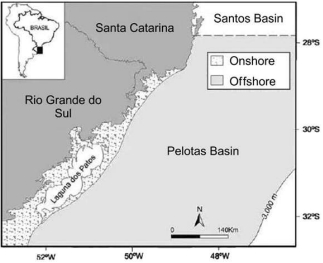
Another promising region is the Pelotas Basin, located off Brazil's southern coast. The growing interest in this area is fueled by the discovery of oil wells in Uruguay and off the coasts of Namibia and South Africa. Experts suggest that the geological conditions in these regions are similar, as the continents were once joined tens of millions of years ago. 
According to Petrobras, the company plans to invest $79 billion in exploring new oil and gas frontiers by 2029. Of this amount, 40 percent will be allocated to the South and Southeast regions, 38 percent to the equatorial margin, with the remainder directed towards other countries. 
From MOURA, Bruno de Freitas. Driven by pre-salt, oil becomes Brazil's top export. Rio de Janeiro, Agência Brasil, Jan 18th,2025. Accessed on February 21st, 2025
Verb +ing can be used as an adjective, as a progressive verb, a noun and an adverb, like in the examples: the winning team, I'm taking my brother to the airport tonight, People make a good living by local standards and She ran out of the room crying, respectively. The extract that presents the −ing form as an adverb is:
 

Provas

Questão presente nas seguintes provas
O texto seguinte servirá de base para responder a questão.
Driven by pre-salt, oil becomes Brazil's top export Revenues
The discovery of the pre-salt was so significant for Brazil's oil production potential that it led the government to change the regime that authorized companies to explore the submerged resources. 
As a result, the pre-salt areas are governed by the sharing regime. Under this model, surplus oil production—the balance after covering costs—is divided between the company and the Brazilian government. During the auction that authorizes exploration, the company offering the highest share of profits to the federal government is granted the right to explore.
This is distinct from the concession model, which applies to the post-salt period. In this system, the risk of investment and exploration lies with the concessionaire, who becomes the owner of all the oil and gas that may be discovered. In return, the company pays royalties and special participation fees, particularly for large production fields, in addition to a signature bonus upon winning the auction.
New frontiers
Enunciado 4942484-1
With the pre-salt expected to reach its peak in the 2030s, Brazil's oil industry, led by Petrobras, is shifting its focus to new oil frontiers that are believed to hold significant production potential.
One such frontier is the so-called equatorial margin, located off Brazil's northern coast, where exploration is pending a favorable decision from the Brazilian Institute for the Environment and Renewable Natural Resources (Ibama), an agency under the Ministry of the Environment and Climate Change.
Another promising region is the Pelotas Basin, located off Brazil's southern coast. The growing interest in this area is fueled by the discovery of oil wells in Uruguay and off the coasts of Namibia and South Africa. Experts suggest that the geological conditions in these regions are similar, as the continents were once joined tens of millions of years ago. 
According to Petrobras, the company plans to invest $79 billion in exploring new oil and gas frontiers by 2029. Of this amount, 40 percent will be allocated to the South and Southeast regions, 38 percent to the equatorial margin, with the remainder directed towards other countries. 
From MOURA, Bruno de Freitas. Driven by pre-salt, oil becomes Brazil's top export. Rio de Janeiro, Agência Brasil, Jan 18th,2025. Accessed on February 21st, 2025
Choose the option, which the passive would be a better alternative, rather than the active form:
 

Provas

Questão presente nas seguintes provas
O texto seguinte servirá de base para responder a questão.
Driven by pre-salt, oil becomes Brazil's top export Revenues
The discovery of the pre-salt was so significant for Brazil's oil production potential that it led the government to change the regime that authorized companies to explore the submerged resources. 
As a result, the pre-salt areas are governed by the sharing regime. Under this model, surplus oil production—the balance after covering costs—is divided between the company and the Brazilian government. During the auction that authorizes exploration, the company offering the highest share of profits to the federal government is granted the right to explore.
This is distinct from the concession model, which applies to the post-salt period. In this system, the risk of investment and exploration lies with the concessionaire, who becomes the owner of all the oil and gas that may be discovered. In return, the company pays royalties and special participation fees, particularly for large production fields, in addition to a signature bonus upon winning the auction.
New frontiers
Enunciado 4942483-1
With the pre-salt expected to reach its peak in the 2030s, Brazil's oil industry, led by Petrobras, is shifting its focus to new oil frontiers that are believed to hold significant production potential.
One such frontier is the so-called equatorial margin, located off Brazil's northern coast, where exploration is pending a favorable decision from the Brazilian Institute for the Environment and Renewable Natural Resources (Ibama), an agency under the Ministry of the Environment and Climate Change.
Another promising region is the Pelotas Basin, located off Brazil's southern coast. The growing interest in this area is fueled by the discovery of oil wells in Uruguay and off the coasts of Namibia and South Africa. Experts suggest that the geological conditions in these regions are similar, as the continents were once joined tens of millions of years ago. 
According to Petrobras, the company plans to invest $79 billion in exploring new oil and gas frontiers by 2029. Of this amount, 40 percent will be allocated to the South and Southeast regions, 38 percent to the equatorial margin, with the remainder directed towards other countries. 
From MOURA, Bruno de Freitas. Driven by pre-salt, oil becomes Brazil's top export. Rio de Janeiro, Agência Brasil, Jan 18th,2025. Accessed on February 21st, 2025
The author of text 2 concludes the text with:
 

Provas

Questão presente nas seguintes provas
O texto seguinte servirá de base para responder a questão.
Driven by pre-salt, oil becomes Brazil's top export Revenues
The discovery of the pre-salt was so significant for Brazil's oil production potential that it led the government to change the regime that authorized companies to explore the submerged resources. 
As a result, the pre-salt areas are governed by the sharing regime. Under this model, surplus oil production—the balance after covering costs—is divided between the company and the Brazilian government. During the auction that authorizes exploration, the company offering the highest share of profits to the federal government is granted the right to explore.
This is distinct from the concession model, which applies to the post-salt period. In this system, the risk of investment and exploration lies with the concessionaire, who becomes the owner of all the oil and gas that may be discovered. In return, the company pays royalties and special participation fees, particularly for large production fields, in addition to a signature bonus upon winning the auction.
New frontiers
Enunciado 4942482-1
With the pre-salt expected to reach its peak in the 2030s, Brazil's oil industry, led by Petrobras, is shifting its focus to new oil frontiers that are believed to hold significant production potential.
One such frontier is the so-called equatorial margin, located off Brazil's northern coast, where exploration is pending a favorable decision from the Brazilian Institute for the Environment and Renewable Natural Resources (Ibama), an agency under the Ministry of the Environment and Climate Change.
Another promising region is the Pelotas Basin, located off Brazil's southern coast. The growing interest in this area is fueled by the discovery of oil wells in Uruguay and off the coasts of Namibia and South Africa. Experts suggest that the geological conditions in these regions are similar, as the continents were once joined tens of millions of years ago. 
According to Petrobras, the company plans to invest $79 billion in exploring new oil and gas frontiers by 2029. Of this amount, 40 percent will be allocated to the South and Southeast regions, 38 percent to the equatorial margin, with the remainder directed towards other countries. 
From MOURA, Bruno de Freitas. Driven by pre-salt, oil becomes Brazil's top export. Rio de Janeiro, Agência Brasil, Jan 18th,2025. Accessed on February 21st, 2025
From the sentence The growing interest in this area is fueled by the discovery of oil wells in Uruguay and off the coasts of Namibia and South Africa one can infer that:
 

Provas

Questão presente nas seguintes provas
O texto seguinte servirá de base para responder a questão.
Driven by pre-salt, oil becomes Brazil's top export Revenues
The discovery of the pre-salt was so significant for Brazil's oil production potential that it led the government to change the regime that authorized companies to explore the submerged resources. 
As a result, the pre-salt areas are governed by the sharing regime. Under this model, surplus oil production—the balance after covering costs—is divided between the company and the Brazilian government. During the auction that authorizes exploration, the company offering the highest share of profits to the federal government is granted the right to explore.
This is distinct from the concession model, which applies to the post-salt period. In this system, the risk of investment and exploration lies with the concessionaire, who becomes the owner of all the oil and gas that may be discovered. In return, the company pays royalties and special participation fees, particularly for large production fields, in addition to a signature bonus upon winning the auction.
New frontiers
Enunciado 4942481-1
With the pre-salt expected to reach its peak in the 2030s, Brazil's oil industry, led by Petrobras, is shifting its focus to new oil frontiers that are believed to hold significant production potential.
One such frontier is the so-called equatorial margin, located off Brazil's northern coast, where exploration is pending a favorable decision from the Brazilian Institute for the Environment and Renewable Natural Resources (Ibama), an agency under the Ministry of the Environment and Climate Change.
Another promising region is the Pelotas Basin, located off Brazil's southern coast. The growing interest in this area is fueled by the discovery of oil wells in Uruguay and off the coasts of Namibia and South Africa. Experts suggest that the geological conditions in these regions are similar, as the continents were once joined tens of millions of years ago. 
According to Petrobras, the company plans to invest $79 billion in exploring new oil and gas frontiers by 2029. Of this amount, 40 percent will be allocated to the South and Southeast regions, 38 percent to the equatorial margin, with the remainder directed towards other countries. 
From MOURA, Bruno de Freitas. Driven by pre-salt, oil becomes Brazil's top export. Rio de Janeiro, Agência Brasil, Jan 18th,2025. Accessed on February 21st, 2025
Read the statements below:
I.The implemented sharing system consists in the company offering the government the largest percentage of oil has the right to extract.
II.Pre-salt areas are divided between companies, as well  as the revenues.
III.The Brazilian government owns those companies.
IV.The risk of investment lies on the company in the concession model.
Select the correct alternative:
 

Provas

Questão presente nas seguintes provas

O texto seguinte servirá de base para responder à questão.

Downstream: Refining and Marketing

While refining is a complex process, the goal is straightforward: to take crude oil, which is virtually unusable in its natural state, and transform it into petroleum products used for a variety of purposes such as heating homes, fueling vehicles and making petrochemical plastics.
Enunciado 4944347-1

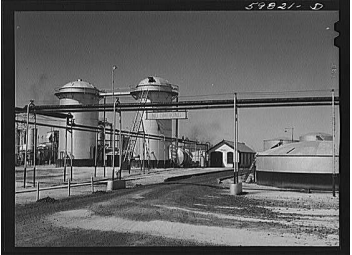
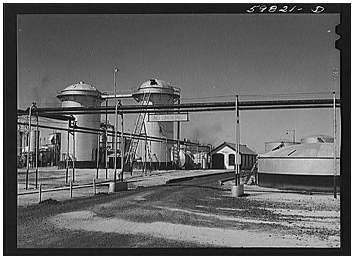
Wolcott, Marion Post. Barnsdall oil refinery. Kansas, 1941.

A number of processes are involved in refining depending on the wanted end product. Hydrotreating is used to remove unwanted elements, such as sulphur and nitrogen from hydrocarbons; cracking breaks molecules into smaller fragments to produce gasoline and other lighter hydrocarbons. The gases produced by cracking are used to create other products like synthetic rubber and plastics. When making gasoline, refiners need high octane numbers to prevent engine knocking. Despite knowing the dangers of lead, tetraethyl lead was added to gasoline in the United States in the 1920s in order to increase the octane. Since the U.S. government banned lead in vehicle gasoline in 1996 as part of the U.S. Clean Air Act, refineries use alkylation and reforming to develop high-octane gasoline.

(From Oil and Gas Industry: A Research Guide, Library of Congress https://guides.loc.gov/oil-and-gas-industry/downstream, accessed on February 19th, 2025)

Select the correct alternative regarding oil prospecting in Brazil:
 

Provas

Questão presente nas seguintes provas
O texto seguinte servirá de base para responder a questão.

Downstream: Refining and Marketing

While refining is a complex process, the goal is straightforward: to take crude oil, which is virtually unusable in its natural state, and transform it into petroleum products used for a variety of purposes such as heating homes, fueling vehicles and making petrochemical plastics.
Enunciado 4942479-1

Wolcott, Marion Post. Barnsdall oil refinery. Kansas, 1941.
A number of processes are involved in refining depending on the wanted end product. Hydrotreating is used to remove unwanted elements, such as sulphur and nitrogen from hydrocarbons; cracking breaks molecules into smaller fragments to produce gasoline and other lighter hydrocarbons. The gases produced by cracking are used to create other products like synthetic rubber and plastics. When making gasoline, refiners need high octane numbers to prevent engine knocking. Despite knowing the dangers of lead, tetraethyl lead was added to gasoline in the United States in the 1920s in order to increase the octane. Since the U.S. government banned lead in vehicle gasoline in 1996 as part of the U.S. Clean

Air Act, refineries use alkylation and reforming to develop high-octane gasoline.
(From Oil and Gas Industry: A Research Guide, Library of Congress https://guides.loc.gov/oil-and-gas-industry/downstream, accessed on February 19th, 2025)
Identify Downstream: Refining and Marketing type of text:
 

Provas

Questão presente nas seguintes provas
O texto seguinte servirá de base para responder a questão.

Downstream: Refining and Marketing

While refining is a complex process, the goal is straightforward: to take crude oil, which is virtually unusable in its natural state, and transform it into petroleum products used for a variety of purposes such as heating homes, fueling vehicles and making petrochemical plastics.
Enunciado 4942478-1

Wolcott, Marion Post. Barnsdall oil refinery. Kansas, 1941.
A number of processes are involved in refining depending on the wanted end product. Hydrotreating is used to remove unwanted elements, such as sulphur and nitrogen from hydrocarbons; cracking breaks molecules into smaller fragments to produce gasoline and other lighter hydrocarbons. The gases produced by cracking are used to create other products like synthetic rubber and plastics. When making gasoline, refiners need high octane numbers to prevent engine knocking. Despite knowing the dangers of lead, tetraethyl lead was added to gasoline in the United States in the 1920s in order to increase the octane. Since the U.S. government banned lead in vehicle gasoline in 1996 as part of the U.S. Clean

Air Act, refineries use alkylation and reforming to develop high-octane gasoline.
(From Oil and Gas Industry: A Research Guide, Library of Congress https://guides.loc.gov/oil-and-gas-industry/downstream, accessed on February 19th, 2025)
Which of the following impurity is not present in crude oil:
 

Provas

Questão presente nas seguintes provas
O texto seguinte servirá de base para responder a questão.

Downstream: Refining and Marketing

While refining is a complex process, the goal is straightforward: to take crude oil, which is virtually unusable in its natural state, and transform it into petroleum products used for a variety of purposes such as heating homes, fueling vehicles and making petrochemical plastics.
Enunciado 4942477-1

Wolcott, Marion Post. Barnsdall oil refinery. Kansas, 1941.
A number of processes are involved in refining depending on the wanted end product. Hydrotreating is used to remove unwanted elements, such as sulphur and nitrogen from hydrocarbons; cracking breaks molecules into smaller fragments to produce gasoline and other lighter hydrocarbons. The gases produced by cracking are used to create other products like synthetic rubber and plastics. When making gasoline, refiners need high octane numbers to prevent engine knocking. Despite knowing the dangers of lead, tetraethyl lead was added to gasoline in the United States in the 1920s in order to increase the octane. Since the U.S. government banned lead in vehicle gasoline in 1996 as part of the U.S. Clean

Air Act, refineries use alkylation and reforming to develop high-octane gasoline.
(From Oil and Gas Industry: A Research Guide, Library of Congress https://guides.loc.gov/oil-and-gas-industry/downstream, accessed on February 19th, 2025)
Phrasal verbs are expressions made up of a verb with a preposition or adverb or both, that together act as a completely new verb with a meaning separate from those of the original words.
Identify the appropriate phrasal verb, which covers the same meaning of to increase in (...) tetraethyl lead was added to gasoline in the United States in the 1920s in order to increase the octane: 
 

Provas

Questão presente nas seguintes provas
O texto seguinte servirá de base para responder a questão.

Downstream: Refining and Marketing

While refining is a complex process, the goal is straightforward: to take crude oil, which is virtually unusable in its natural state, and transform it into petroleum products used for a variety of purposes such as heating homes, fueling vehicles and making petrochemical plastics.
Enunciado 4942476-1

Wolcott, Marion Post. Barnsdall oil refinery. Kansas, 1941.
A number of processes are involved in refining depending on the wanted end product. Hydrotreating is used to remove unwanted elements, such as sulphur and nitrogen from hydrocarbons; cracking breaks molecules into smaller fragments to produce gasoline and other lighter hydrocarbons. The gases produced by cracking are used to create other products like synthetic rubber and plastics. When making gasoline, refiners need high octane numbers to prevent engine knocking. Despite knowing the dangers of lead, tetraethyl lead was added to gasoline in the United States in the 1920s in order to increase the octane. Since the U.S. government banned lead in vehicle gasoline in 1996 as part of the U.S. Clean

Air Act, refineries use alkylation and reforming to develop high-octane gasoline.
(From Oil and Gas Industry: A Research Guide, Library of Congress https://guides.loc.gov/oil-and-gas-industry/downstream, accessed on February 19th, 2025)
"By 1996, with the establishment of new federal standards of air pollutants, tetraethyl ______________ to gasoline in the U.S." is suitably filled in with:
 

Provas

Questão presente nas seguintes provas