Magna Concursos

Foram encontradas 30 questões.

360954 Ano: 2018
Disciplina: Inglês (Língua Inglesa)
Banca: Pref. Arapiraca-AL
Orgão: Pref. Arapiraca-AL
Provas:

Use the right words to complete the sentences, but, when, where, and, then:


1. This is the house…………….. I live in.

2. Learning a foreign language is important ……………..it can help you find a good job.

3. I usually go to the beach …………………. I'm very stressed.

4. The weather is wonderful, ………………… we can go to the beach.

5. I like wine …………………I don't like beer.


Choose the correct alternative:


Provas

Questão presente nas seguintes provas
360953 Ano: 2018
Disciplina: Inglês (Língua Inglesa)
Banca: Pref. Arapiraca-AL
Orgão: Pref. Arapiraca-AL
Provas:

Choose the best alternative:

My mother asked me if I had already had dinner.


Provas

Questão presente nas seguintes provas
360952 Ano: 2018
Disciplina: Inglês (Língua Inglesa)
Banca: Pref. Arapiraca-AL
Orgão: Pref. Arapiraca-AL
Provas:

Text: WHO’S KILLING BRAZIL’S STREET CHILDREN?

Kids under 18 in Brazil…..........in numbers not found anywhere in the world apart from countries openly at war. Last year’s estimated 1.000 child killing actually represented an improvement: the average annual figure for the previous three years was more than 1.500. Brazilian’s horror has inspired the biggest surge of social activism since the 1970’s. But the killings continue. Wellington Barbosa never had a chance. The 14-year-old street kid was walking down a busy Rio de Janeiro avenue with his half-sister and her boyfriend one recent afternoon when a man with a green shirt shot to kill him.

Choose the correct answer:


Provas

Questão presente nas seguintes provas
360951 Ano: 2018
Disciplina: Inglês (Língua Inglesa)
Banca: Pref. Arapiraca-AL
Orgão: Pref. Arapiraca-AL
Provas:
READ THE FOLLOWING TEXT CAREFULLY, AND THEN CHOOSE THE ALTERNATIVE THAT BEST COMPLETES THE STATEMENTS BELOW, ACCORDING TO THE TEXT.
Mrs Parker died suddenly in October. She and Mr Parker lived in a Victorian house next to ours, and Mr Parker was my piano teacher. He commuted to Wall Street, where he was a securities analyst, but he had studied at Juilliard and gave lessons on the side – for the pleasure of it, not for money. His only students were me and the church organist.
The word “tragic” was mentioned in connection with her death. She and Mr Parker were in the middle of their middle age, and neither of them had ever been seriously ill. It was heart failure, and unexpected. My parents went to see Mr Parker as soon as they got the news, since they took their responsibilities as neighbours seriously, and two days later they took me to pay a formal condolence call.
I loved the Parkers’ house. It was a Victorian house, and was shaped like a wedding cake. The living-room was round, and all the walls curved. The third floor was a tower. Every five years the house was painted chocolate brown, which faded gradually to the colour of weak tea. The front-wall window was a stained-glass picture of a fat baby holding a bunch of roses.
On Wednesday afternoons, Mr Parker came home on an early train, and I had my lesson. Mr Parker’s teaching method never varied. He never scolded or corrected. The first fifteen minutes were devoted to a warm-up in which I could play anything I liked. Then Mr Parker played the lesson of the week. His playing was terrifically precise, but his eyes became dreamy and unfocused. Then I played the same lesson, and after that we worked on the difficult passages, but basically he wanted me to hear my mistakes. After that, we sat in the solarium and discussed the next week’s lesson. Mr Parker usually played a record and talked in detail about the composer, his life and times. Mrs Parker used to leave us a tray of cookies and lemonade, cold in the summer and hot in the winter. When the cookies were gone, the lesson was over and I left, passing the Victorian child in the hallway.
(COLWIN, Laurie. Mr Parker. In: PIERCE, Tina and COCHRANE, Edward (eds.). Twentieth century English short stories. London: Bell & Hyman, 1979, p. 48-9. Adapted.)
The verbal tense in “He had studied at Juilliard” is
 

Provas

Questão presente nas seguintes provas
360950 Ano: 2018
Disciplina: Inglês (Língua Inglesa)
Banca: Pref. Arapiraca-AL
Orgão: Pref. Arapiraca-AL
Provas:

Choose the best alternative:

The teacher asked them how long they had been studying English.


Provas

Questão presente nas seguintes provas
360949 Ano: 2018
Disciplina: Inglês (Língua Inglesa)
Banca: Pref. Arapiraca-AL
Orgão: Pref. Arapiraca-AL
Provas:
Text: Several decades ago I absolutely detested grammar, English, and related subjects. As priorities go, this was at the very bottom of the list of subjects and, as one would expect, my grades reflected this preference. In later years, however, circumstances led me throughout 49 of our states and much of Western Europe. This exposure to various cultures, traditions, and languages has brought about a much greater appreciation of our languages and its evolution. I have almost become obsessed with this subject now and have collected quite a few texts on language and etymology, to say nothing of hundreds of articles clipped from papers and periodicals. The piece by Wen Smith, "It's Only Me", which appeared in the Sept./Oct. issue, is the type of article that turns me on, and it immediately became a piece of my collection. The author's excellent approach to the proper use of just a few words, enhanced by the artwork, almost makes this a classic work by itself. I hope that this will become the first of many such articles, for it can only serve to increase the interest and understanding of our rich linguistic heritage for thousands of your readers.
True or False?
1. brought about (2nd paragraph) means fez surgir. 2. turns me on (4th paragraph) means me interessa. 3. issue (4th paragraph) means item. 4. The author's excellent approach (4th paragraph) means o autor tem uma ótima aprovação. 5. a classic work by itself (4th paragraph) means um clássico por si só.
Choose the correct alternative:
 

Provas

Questão presente nas seguintes provas

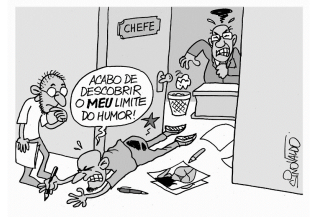
Atenção: considere a charge abaixo para responder a questão:
enunciado 360935-1

Fonte: http://www.jornalnh.com.br/_conteudo/2015/01/noticias/regiao/119937-humor-e-redacao-do-enem-em-destaque-nas-charges-de-tacho-esinovaldo.html

Pode-se verificar que a charge de Sinovaldo e o texto “Humor é coisa séria” de Martha Medeiros materializam um dos parâmetros da textualidade, a saber: a intertextualidade. Ambos os textos enfatizam a relação existente entre humor e limite. Levando em consideração os dois textos, é CORRETO afirmar que:
 

Provas

Questão presente nas seguintes provas

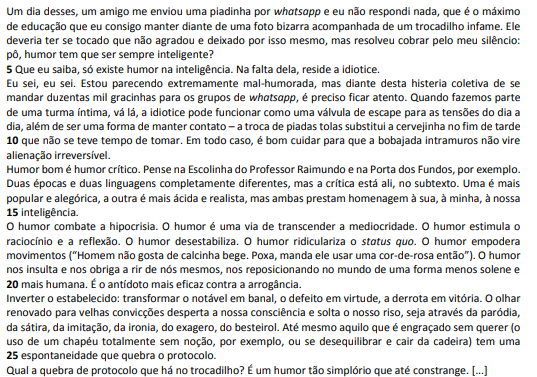
Atenção: A questão refere-se ao texto que segue:

Humor é coisa séria!
enunciado 360934-1

MEDEIROS, Martha. RevistaVersar.

(Disponível: https://www.revistaversar.com.br/index.php/2017/11/24/martha-medeiros-humor-e-coisa-seria)

Sem prejuízo das ideias do texto, as palavras “bobajada” (linha 10) e “subtexto”(linha 13) poderiam ser substituídas, respectivamente, por:
 

Provas

Questão presente nas seguintes provas
Marque a opção que completa CORRETA e respectivamente as lacunas das frases, no que tange à concordância nominal:
I- _________ estão várias orientações referentes à prova. II- São problemas _________ para um dia. III- Várias observações pertinentes ao assunto vão _________.
 

Provas

Questão presente nas seguintes provas
Na linguagem cotidiana, algumas palavras podem ser utilizadas em muitos contextos, por exemplo, o verbo “fazer”, que em muitas situações poderia ser substituído por termos mais específicos, como: “realizar”, “elaborar”, “produzir”. No texto, a autora emprega o verbo “ter” no seguinte trecho “Até mesmo aquilo que é engraçado sem querer (...) tem uma espontaneidade que quebra o protocolo.” Em relação ao uso da referida forma verbal, considere as três substituições indicadas abaixo:
I- “obtém uma espontaneidade que quebra o protocolo.” II- “gera uma espontaneidade que quebra o protocolo.” III- “provoca uma espontaneidade que quebra o protocolo.”

A substituição, com equivalência de sentido, é CORRETA em:
 

Provas

Questão presente nas seguintes provas