Foram encontradas 50 questões.
Blogs, twitter, orkut e outros buracos
Não estou no “twitter”, não sei o que é o “twitter”, jamais entrarei nesse terreno baldio e, incrivelmente, tenho 26 mil “seguidores” no “twitter”. Quem me pôs lá? Quem foi o canalha que usou meu nome? Jamais saberei. Vivemos no poço escuro da web. Ou buscamos a exposição total para ser “celebridade” ou usamos esse anonimato irresponsável com nome dos outros. Tem gente que fala para mim: “Faz um blog, faz um blog!” Logo eu, que já sou um blog vivo, tagarelando na TV, rádio e jornais… Jamais farei um blog, esse nome que parece um coaxar de sapo-boi. Quero o passado. Quero o lápis na orelha do quitandeiro, quero o gato do armazém dormindo no saco de batatas, quero o telefone preto, de disco, que não dá linha, em vez dos gemidinhos dos celulares incessantes.
Comunicar o quê? Ninguém tem nada a dizer. Olho as opiniões, as discussões “online” e só vejo besteira, frases de 140 caracteres para nada dizer. Vivemos a grande invasão dos lugares-comuns, dos uivos de medíocres ecoando asnices para ocultar sua solidão deprimente.
O que espanta é a velocidade da luz para a lentidão dos pensamentos, uma movimentação “em rede” para raciocínios lineares. A boa e velha burrice continua intocada, agora disfarçada pelo charme da rapidez. Antigamente, os burros eram humildes; se esgueiravam pelos cantos, ouvindo, amargurados, os inteligentes deitando falação. Agora não; é a revolução dos idiotas online.
Quero sossego, mas querem me expandir, esticar meus braços em tentáculos digitais, meus olhos no “google”, (“goggles” – olhos arregalados) em órbitas giratórias, querem que eu seja ubíquo, quando desejo caminhar na condição de pobre bicho bípede; não quero tudo saber, ao contrário, quero esquecer; sinto que estão criando desejos que não tenho, fomes que perdi.
O leitor perguntará: “Por que este ódio todo, bom Jabor?” Claro que acho a revolução digital a coisa mais importante dos séculos. Mas estou com raiva por causa dos textos apócrifos que continuam enfiando na Internet com meu nome.
Já reclamei aqui desses textos, mas tenho de me repetir. Todo dia surge uma nova besteira, com dezenas de e-mails me elogiando pelo que eu “não” fiz. Vou indo pela rua e três senhoras me abordam – “Teu artigo na Internet é genial! Principalmente quando você escreve: ‘As mulheres são tão cheirosinhas; elas fazem biquinho e deitam no teu ombro…’”
“Não fui eu…”, respondo. Elas não ouvem e continuam: “Modéstia sua! Finalmente alguém diz a verdade sobre as mulheres! Mandei isso para mil amigas! Adoraram aquela parte: ‘Tenho horror à mulher perfeitinha. Acho ótimo celulite…’” Repito que não é meu, mas elas (em geral barangas) replicam: “Ah… É teu melhor texto…” – e vão embora, rebolando, felizes.
Sei que a Internet democratiza, dando acesso a todos para se expressar. Mas a democracia também libera a idiotia. Deviam inventar um “antispam” para bobagens.
(JABOR, Arnaldo. In:WWW.estadao.com.br - 3/11/2009 - com adaptações.)
Assinale a única opção que está de acordo com a estrutura do texto:
Provas
Questão presente nas seguintes provas

1354770
Ano: 2009
Disciplina: Inglês (Língua Inglesa)
Banca: BIO-RIO
Orgão: Pref. Barra Mansa-RJ
Disciplina: Inglês (Língua Inglesa)
Banca: BIO-RIO
Orgão: Pref. Barra Mansa-RJ
Provas:
READ TEXT III AND ANSWER QUESTION.
Reading Materials: Simplified vs. Authentic?
Many foreign language students, certainly those in Japan, can already read in their first language, and may even have the habit of regular reading. The main barrier to foreign language reading for such students is exactly that: the foreign language. The students are in a Catch-22 situation. They cannot understand enough of the foreign language to make sense of most written material, and yet they must read the foreign language in order to develop reading fluency. One suggestion that has been made (e.g., by Brian Tomlinson, 1994) is to postpone reading until students have at least an intermediate-level grasp of the foreign language. Such a policy ignores the role that reading can play in foreign language acquisition, particularly in the all-important learning of new words. Students can benefit by making reading a part of their foreign language study from the beginning (see Paul Nation's "The Language Learning Benefits of Extensive Reading" in this issue). For less than advanced students, the language barrier usually reduces reading to slow, painful decoding with a dictionary - - which is, of course, not really reading at all. The obvious answer is for students to read foreign language materials designed to be appropriate to their level of language proficiency. This, however, has become heresy since the advent of communicative language teaching in the 1970s. One of the great contributions of CLT has been the "authenticizing" of language instruction. Just as the use of real language for real purposes replaced much of the stilted, step-by-step focus-on-form that characterized traditional language teaching, so was it suggested that students read authentic texts written by and for native speakers. As was demonstrated in papers such as "Simplification" by John Honeyfield (1977), artificial, simplified texts for language learners lack features of authentic texts, and so simplified texts were considered a less-than-useful preparation for students learning to read in the real world.
(from http://www.jaltpublications. org/tlt/files/97/may/extensive.html)
In the text, the word “policy” implies:
Provas
Questão presente nas seguintes provas
1354763
Ano: 2009
Disciplina: Inglês (Língua Inglesa)
Banca: BIO-RIO
Orgão: Pref. Barra Mansa-RJ
Disciplina: Inglês (Língua Inglesa)
Banca: BIO-RIO
Orgão: Pref. Barra Mansa-RJ
Provas:
READ TEXT IV AND ANSWER QUESTION.
Learning Vocabulary – A Practical Approach
Which words should you learn? You will hear and read many new words. It will be difficult to remember all of them. Therefore, you will have to pick out the words that you most want to learn.
Which words should I learn?
You need to think about how useful a word may be to you. Some words may be suited to more casual and informal types of discourse, whereas others may more often occur in more formal and serious types of discourse. Try to consider how frequently a word or expression is used and in which sort of context it would be used. This can help you decide whether it is worth your time and effort to learn a word. Vocabulary words do not always occur alone. You need to take note of whether certain words are often used with other words in what we could call “fixed expressions” or “collocations”.
Observing words in context is the best way to learn new vocabulary. However, it could be difficult to decide just which words to make an effort to learn. Words can fall into two categories for learners of English and English first language speakers alike: passive vocabulary and active
vocabulary. Of course, there is some gray area where these two categories are concerned. We can also refer to passive and active vocabulary as receptive and productive.
What your purpose is in learning English will determine how much effort you should give to incorporating certain words into your active and productive vocabulary. Try to understand the contextual nature of vocabulary. How is a word used? Why is it used? Where is it used? When is it used?
(http://www.usingenglish.com/files/pdf/learningvocabulary.pdf)
The text refers to a “gray area” where identifying the categories is:
Provas
Questão presente nas seguintes provas
Blogs, twitter, orkut e outros buracos
Não estou no “twitter”, não sei o que é o “twitter”, jamais entrarei nesse terreno baldio e, incrivelmente, tenho 26 mil “seguidores” no “twitter”. Quem me pôs lá? Quem foi o canalha que usou meu nome? Jamais saberei. Vivemos no poço escuro da web. Ou buscamos a exposição total para ser “celebridade” ou usamos esse anonimato irresponsável com nome dos outros. Tem gente que fala para mim: “Faz um blog, faz um blog!” Logo eu, que já sou um blog vivo, tagarelando na TV, rádio e jornais… Jamais farei um blog, esse nome que parece um coaxar de sapo-boi. Quero o passado. Quero o lápis na orelha do quitandeiro, quero o gato do armazém dormindo no saco de batatas, quero o telefone preto, de disco, que não dá linha, em vez dos gemidinhos dos celulares incessantes.
Comunicar o quê? Ninguém tem nada a dizer. Olho as opiniões, as discussões “online” e só vejo besteira, frases de 140 caracteres para nada dizer. Vivemos a grande invasão dos lugares-comuns, dos uivos de medíocres ecoando asnices para ocultar sua solidão deprimente.
O que espanta é a velocidade da luz para a lentidão dos pensamentos, uma movimentação “em rede” para raciocínios lineares. A boa e velha burrice continua intocada, agora disfarçada pelo charme da rapidez. Antigamente, os burros eram humildes; se esgueiravam pelos cantos, ouvindo, amargurados, os inteligentes deitando falação. Agora não; é a revolução dos idiotas online.
Quero sossego, mas querem me expandir, esticar meus braços em tentáculos digitais, meus olhos no “google”, (“goggles” – olhos arregalados) em órbitas giratórias, querem que eu seja ubíquo, quando desejo caminhar na condição de pobre bicho bípede; não quero tudo saber, ao contrário, quero esquecer; sinto que estão criando desejos que não tenho, fomes que perdi.
O leitor perguntará: “Por que este ódio todo, bom Jabor?” Claro que acho a revolução digital a coisa mais importante dos séculos. Mas estou com raiva por causa dos textos apócrifos que continuam enfiando na Internet com meu nome.
Já reclamei aqui desses textos, mas tenho de me repetir. Todo dia surge uma nova besteira, com dezenas de e-mails me elogiando pelo que eu “não” fiz. Vou indo pela rua e três senhoras me abordam – “Teu artigo na Internet é genial! Principalmente quando você escreve: ‘As mulheres são tão cheirosinhas; elas fazem biquinho e deitam no teu ombro…’”
“Não fui eu…”, respondo. Elas não ouvem e continuam: “Modéstia sua! Finalmente alguém diz a verdade sobre as mulheres! Mandei isso para mil amigas! Adoraram aquela parte: ‘Tenho horror à mulher perfeitinha. Acho ótimo celulite…’” Repito que não é meu, mas elas (em geral barangas) replicam: “Ah… É teu melhor texto…” – e vão embora, rebolando, felizes.
Sei que a Internet democratiza, dando acesso a todos para se expressar. Mas a democracia também libera a idiotia. Deviam inventar um “antispam” para bobagens.
(JABOR, Arnaldo. In:WWW.estadao.com.br - 3/11/2009 - com adaptações.)
Considere as afirmativas:
I - Segundo o autor, há uma desproporção entre a velocidade com que se difundem ideias no meio digital e a qualidade dessas ideias.
II - No mundo virtual, como no real, a democracia permite comportamentos contra os quais não se tem controle.
III - O autor demonstra irritação com a velocidade com que seus textos são divulgados na internet, sem haver tempo para reflexões sobre os assuntos abordados.
Assinale a alternativa correta:
Provas
Questão presente nas seguintes provas
1354401
Ano: 2009
Disciplina: Inglês (Língua Inglesa)
Banca: BIO-RIO
Orgão: Pref. Barra Mansa-RJ
Disciplina: Inglês (Língua Inglesa)
Banca: BIO-RIO
Orgão: Pref. Barra Mansa-RJ
Provas:
READ TEXT II AND ANSWER QUESTION:
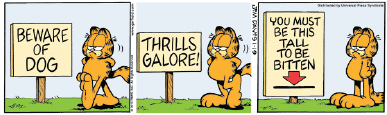
(http://www.gocomics.com/garfield/)
According to this comic strip, the dog seems to be:
Provas
Questão presente nas seguintes provas
Blogs, twitter, orkut e outros buracos
Não estou no “twitter”, não sei o que é o “twitter”, jamais entrarei nesse terreno baldio!$ ^{(C)} !$ e, incrivelmente, tenho 26 mil “seguidores” no “twitter”. Quem me pôs lá? Quem foi o canalha que usou meu nome? Jamais saberei. Vivemos no poço escuro!$ ^{(A)} !$ da web. Ou buscamos a exposição total para ser “celebridade” ou usamos esse anonimato irresponsável com nome dos outros. Tem gente que fala para mim: “Faz um blog, faz um blog!” Logo eu, que já sou um blog vivo, tagarelando na TV, rádio e jornais… Jamais farei um blog, esse nome que parece um coaxar de sapo-boi. Quero o passado. Quero o lápis na orelha do quitandeiro, quero o gato do armazém dormindo no saco de batatas, quero o telefone preto, de disco, que não dá linha, em vez dos gemidinhos dos celulares!$ ^{(D)} !$ incessantes.
Comunicar o quê? Ninguém tem nada a dizer. Olho as opiniões, as discussões “online” e só vejo besteira, frases de 140 caracteres para nada dizer. Vivemos a grande invasão dos lugares-comuns, dos uivos de medíocres ecoando asnices para ocultar sua solidão deprimente.
O que espanta é a velocidade da luz para a lentidão dos pensamentos, uma movimentação “em rede” para raciocínios lineares. A boa e velha burrice continua intocada, agora disfarçada pelo charme da rapidez. Antigamente, os burros eram humildes; se esgueiravam pelos cantos, ouvindo, amargurados, os inteligentes deitando falação. Agora não; é a revolução dos idiotas online.
Quero sossego, mas querem me expandir, esticar meus braços em tentáculos digitais!$ ^{(E)} !$, meus olhos no “google”, (“goggles” – olhos arregalados) em órbitas giratórias, querem que eu seja ubíquo, quando desejo caminhar na condição de pobre bicho bípede; não quero tudo saber, ao contrário, quero esquecer; sinto que estão criando desejos que não tenho, fomes que perdi.
O leitor perguntará: “Por que este ódio todo, bom Jabor?” Claro que acho a revolução digital a coisa mais importante dos séculos. Mas estou com raiva por causa dos textos apócrifos que continuam enfiando na Internet com meu nome.
Já reclamei aqui desses textos, mas tenho de me repetir. Todo dia surge uma nova besteira, com dezenas de e-mails me elogiando pelo que eu “não” fiz. Vou indo pela rua e três senhoras me abordam – “Teu artigo na Internet é genial! Principalmente quando você escreve: ‘As mulheres são tão cheirosinhas; elas fazem biquinho e deitam no teu ombro…’”
“Não fui eu…”, respondo. Elas não ouvem e continuam: “Modéstia sua! Finalmente alguém diz a verdade sobre as mulheres! Mandei isso para mil amigas! Adoraram aquela parte: ‘Tenho horror à mulher perfeitinha!$ ^{(B)} !$. Acho ótimo celulite…’” Repito que não é meu, mas elas (em geral barangas) replicam: “Ah… É teu melhor texto…” – e vão embora, rebolando, felizes.
Sei que a Internet democratiza, dando acesso a todos para se expressar. Mas a democracia também libera a idiotia. Deviam inventar um “antispam” para bobagens.
(JABOR, Arnaldo. In:WWW.estadao.com.br - 3/11/2009 - com adaptações.)
No texto, NÃO tem emprego figurado a expressão:
Provas
Questão presente nas seguintes provas
1353420
Ano: 2009
Disciplina: Inglês (Língua Inglesa)
Banca: BIO-RIO
Orgão: Pref. Barra Mansa-RJ
Disciplina: Inglês (Língua Inglesa)
Banca: BIO-RIO
Orgão: Pref. Barra Mansa-RJ
Provas:
READ TEXT III AND ANSWER QUESTION.
Reading Materials: Simplified vs. Authentic?
Many foreign language students, certainly those in Japan, can already read in their first language, and may even have the habit of regular reading. The main barrier to foreign language reading for such students is exactly that: the foreign language. The students are in a Catch-22 situation. They cannot understand enough of the foreign language to make sense of most written material, and yet they must read the foreign language in order to develop reading fluency. One suggestion that has been made (e.g., by Brian Tomlinson, 1994) is to postpone reading until students have at least an intermediate-level grasp of the foreign language. Such a policy ignores the role that reading can play in foreign language acquisition, particularly in the all-important learning of new words. Students can benefit by making reading a part of their foreign language study from the beginning (see Paul Nation's "The Language Learning Benefits of Extensive Reading" in this issue). For less than advanced students, the language barrier usually reduces reading to slow, painful decoding with a dictionary - - which is, of course, not really reading at all. The obvious answer is for students to read foreign language materials designed to be appropriate to their level of language proficiency. This, however, has become heresy since the advent of communicative language teaching in the 1970s. One of the great contributions of CLT has been the "authenticizing" of language instruction. Just as the use of real language for real purposes replaced much of the stilted, step-by-step focus-on-form that characterized traditional language teaching, so was it suggested that students read authentic texts written by and for native speakers. As was demonstrated in papers such as "Simplification" by John Honeyfield (1977), artificial, simplified texts for language learners lack features of authentic texts, and so simplified texts were considered a less-than-useful preparation for students learning to read in the real world.
(from http://www.jaltpublications. org/tlt/files/97/may/extensive.html)
Yet in “and yet they must read the foreign language” can be replaced by:
Provas
Questão presente nas seguintes provas
1353001
Ano: 2009
Disciplina: Inglês (Língua Inglesa)
Banca: BIO-RIO
Orgão: Pref. Barra Mansa-RJ
Disciplina: Inglês (Língua Inglesa)
Banca: BIO-RIO
Orgão: Pref. Barra Mansa-RJ
Provas:
READ TEXT I AND ANSWER QUESTION.
A language in transition
As the world is in transition, so the English language is itself taking new forms. This, of course, has always been true: English has changed substantially in the 1500 years or so of its use, reflecting patterns of contact with other languages and the changing communication needs of people. But in many parts of the world, as English is taken into the fabric of social life, it acquires a momentum and vitality of its own, developing in ways which reflect local culture and languages, while diverging increasingly from the kind of English spoken in Britain or North America.
English is also used for more purposes than ever before. Everywhere it is at the leading edge of technological and scientific development, new thinking in economics and management, new literatures and entertainment genres. These give rise to new vocabularies, grammatical forms and ways of speaking and writing. Nowhere is the effect of this expansion of English into new domains seen more clearly than in communication on the Internet and the development of ‘net English’.
But the language is, in another way, at a critical moment in its global career: within a decade or so, the number of people who speak English as a second language will exceed the number of native speakers. The implications of this are likely to be far reaching: the centre of authority regarding the language will shift from native speakers as they become minority stakeholders in the global resource. Their literature and television may no longer provide the focal point to a global English language culture, their teachers no longer form the unchallenged authoritative models for learners.
(http://www.officiallanguages.gc.ca/docs/f/Future_of_English.pdf)
According to the author, English will:
Provas
Questão presente nas seguintes provas
1352675
Ano: 2009
Disciplina: Inglês (Língua Inglesa)
Banca: BIO-RIO
Orgão: Pref. Barra Mansa-RJ
Disciplina: Inglês (Língua Inglesa)
Banca: BIO-RIO
Orgão: Pref. Barra Mansa-RJ
Provas:
READ TEXT I AND ANSWER QUESTION.
A language in transition
As the world is in transition, so the English language is itself taking new forms. This, of course, has always been true: English has changed substantially in the 1500 years or so of its use, reflecting patterns of contact with other languages and the changing communication needs of people. But in many parts of the world, as English is taken into the fabric of social life, it acquires a momentum and vitality of its own, developing in ways which reflect local culture and languages, while diverging increasingly from the kind of English spoken in Britain or North America.
English is also used for more purposes than ever before. Everywhere it is at the leading edge of technological and scientific development, new thinking in economics and management, new literatures and entertainment genres. These give rise to new vocabularies, grammatical forms and ways of speaking and writing. Nowhere is the effect of this expansion of English into new domains seen more clearly than in communication on the Internet and the development of ‘net English’.
But the language is, in another way, at a critical moment in its global career: within a decade or so, the number of people who speak English as a second language will exceed the number of native speakers. The implications of this are likely to be far reaching: the centre of authority regarding the language will shift from native speakers as they become minority stakeholders in the global resource. Their literature and television may no longer provide the focal point to a global English language culture, their teachers no longer form the unchallenged authoritative models for learners.
(http://www.officiallanguages.gc.ca/docs/f/Future_of_English.pdf)
The sentence that carries the same inversion as in “Nowhere is the effect of this expansion” is:
Provas
Questão presente nas seguintes provas
1351979
Ano: 2009
Disciplina: Inglês (Língua Inglesa)
Banca: BIO-RIO
Orgão: Pref. Barra Mansa-RJ
Disciplina: Inglês (Língua Inglesa)
Banca: BIO-RIO
Orgão: Pref. Barra Mansa-RJ
Provas:
READ TEXT III AND ANSWER QUESTION.
Reading Materials: Simplified vs. Authentic?
Many foreign language students, certainly those in Japan, can already read in their first language, and may even have the habit of regular reading. The main barrier to foreign language reading for such students is exactly that: the foreign language. The students are in a Catch-22 situation. They cannot understand enough of the foreign language to make sense of most written material, and yet they must read the foreign language in order to develop reading fluency. One suggestion that has been made (e.g., by Brian Tomlinson, 1994) is to postpone reading until students have at least an intermediate-level grasp of the foreign language. Such a policy ignores the role that reading can play in foreign language acquisition, particularly in the all-important learning of new words. Students can benefit by making reading a part of their foreign language study from the beginning (see Paul Nation's "The Language Learning Benefits of Extensive Reading" in this issue). For less than advanced students, the language barrier usually reduces reading to slow, painful decoding with a dictionary - - which is, of course, not really reading at all. The obvious answer is for students to read foreign language materials designed to be appropriate to their level of language proficiency. This, however, has become heresy since the advent of communicative language teaching in the 1970s. One of the great contributions of CLT has been the "authenticizing" of language instruction. Just as the use of real language for real purposes replaced much of the stilted, step-by-step focus-on-form that characterized traditional language teaching, so was it suggested that students read authentic texts written by and for native speakers. As was demonstrated in papers such as "Simplification" by John Honeyfield (1977), artificial, simplified texts for language learners lack features of authentic texts, and so simplified texts were considered a less-than-useful preparation for students learning to read in the real world.
(from http://www.jaltpublications. org/tlt/files/97/may/extensive.html)
According to the text students should begin reading in a foreign language:
Provas
Questão presente nas seguintes provas
Cadernos
Caderno Container