Foram encontradas 696 questões.
Disciplina: Inglês (Língua Inglesa)
Banca: URCA
Orgão: Pref. Farias Brito-CE
- Based on the poem, answer questions 33, 34 and 35.
I'm nobody! Are you nobody too?
(Emily Dickinson)
I'm nobody! Who are you?
Are you Blank I too?
Then there´s a pair of us – don´t tell
They´d banish us, you know.
How dreary be Blank II!
How public, like a frog.
To tell your name the livelong day
To an admiring bog!
http://www.onlineliterature.com/dickinson/448/ Acessed on 02/08/2014
The conditional sentence They´d banish us represents:
Provas

Disciplina: Inglês (Língua Inglesa)
Banca: URCA
Orgão: Pref. Farias Brito-CE
- Based on the comic strip, answer questions 32.
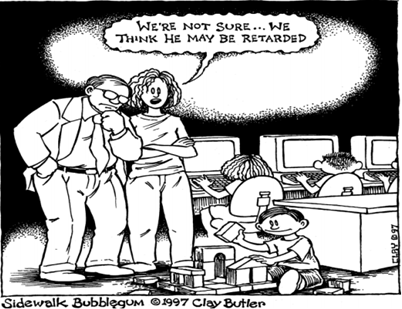
http://www.sidewalkbubblegum.com/category/comicsaboutschoolseducationindoctrination/ Acessed on 02/08/2014
Based on the comic strip, the verb may means:
Provas
Disciplina: Inglês (Língua Inglesa)
Banca: URCA
Orgão: Pref. Farias Brito-CE
- Based on the comic strip, answer questions 30 and 31.

http://www.weaponsofmathdestruction.com/wmd.cfm?comicID=89 Acessed on 02/08/2014
Choose the option that contains verbs with the meaning of slow down:
Provas
Disciplina: Inglês (Língua Inglesa)
Banca: URCA
Orgão: Pref. Farias Brito-CE
- Based on the comic strip, answer questions 30 and 31.
http://www.weaponsofmathdestruction.com/wmd.cfm?comicID=89 Acessed on 02/08/2014
The text means:
Provas
Disciplina: Inglês (Língua Inglesa)
Banca: URCA
Orgão: Pref. Farias Brito-CE
- Based on the text below answer questions 19 to 29.
The wrong way to teach grammar (Part II)
Michelle Navarre Cleary
These students are victims of the mistaken belief that grammar lessons must come before writing, rather than grammar being something that is best learned through writing. I saw the high cost of this phenomenon firsthand at the urban community college where I taught writing for eight years, an institution where more than 90 percent of students failed to complete a twoyear degree within three years. A primary culprit: the required developmental writing classes that focused on traditional grammar instruction. Again and again, I witnessed aspiration gave way to discouragement. In this sevencollege system, some 80 percent of the students test into such classes where they can spend up to a year before being asked to write more than a paragraph. Nationally, over half of university and college students in developmental classes drop out before going any further. Essentially, they leave before having begun college.
Happily, there are solutions. Just as we teach children how to ride bikes by putting them on a bicycle, we need to teach students how to write grammatically by letting them write. Once students get ideas they care about onto the page, they are ready for instruction including grammar instruction that will help communicate those ideas. We know that grammar instruction that works includes teaching students strategies for revising and editing, providing targeted lessons on problems that students immediately apply to their own writing, and having students play with sentences like Legos, combining basic sentences into more complex ones. Often, surprisingly little formal grammar instruction is needed. Researcher Marcia Hurlow has shown that many errors “disappear” from student writing when students focus on their ideas and stop “trying to ‘sound correct.’”
There are also less immediately apparent costs to having generations of learners who associate writing only with correctness. Invariably, when people learn that I teach writing, they offer their “grammar confessions.” Sheepishly, they tell me that they “never really learned grammar,” and sadly, it also often comes out that they avoid writing. I have interviewed an executive who locked herself in her office and called her son when she had to write reports, and I have had parents describe writing their child’s paper because the kid was paralyzed with writing anxiety. I have even had people tell me that they passed up job opportunities because they required writing.
Adapted from: http://www.theatlantic.com/education/archive/2014/02/thewrongwaytoteachgrammar/284014/. Acessed on 02/08/2014.
If someone passed up job opportunities he or she:
Provas
Disciplina: Inglês (Língua Inglesa)
Banca: URCA
Orgão: Pref. Farias Brito-CE
- Based on the text below answer questions 19 to 29.
The wrong way to teach grammar (Part II)
Michelle Navarre Cleary
These students are victims of the mistaken belief that grammar lessons must come before writing, rather than grammar being something that is best learned through writing. I saw the high cost of this phenomenon firsthand at the urban community college where I taught writing for eight years, an institution where more than 90 percent of students failed to complete a twoyear degree within three years. A primary culprit: the required developmental writing classes that focused on traditional grammar instruction. Again and again, I witnessed aspiration gave way to discouragement. In this sevencollege system, some 80 percent of the students test into such classes where they can spend up to a year before being asked to write more than a paragraph. Nationally, over half of university and college students in developmental classes drop out before going any further. Essentially, they leave before having begun college.
Happily, there are solutions. Just as we teach children how to ride bikes by putting them on a bicycle, we need to teach students how to write grammatically by letting them write. Once students get ideas they care about onto the page, they are ready for instruction including grammar instruction that will help communicate those ideas. We know that grammar instruction that works includes teaching students strategies for revising and editing, providing targeted lessons on problems that students immediately apply to their own writing, and having students play with sentences like Legos, combining basic sentences into more complex ones. Often, surprisingly little formal grammar instruction is needed. Researcher Marcia Hurlow has shown that many errors “disappear” from student writing when students focus on their ideas and stop “trying to ‘sound correct.’”
There are also less immediately apparent costs to having generations of learners who associate writing only with correctness. Invariably, when people learn that I teach writing, they offer their “grammar confessions.” Sheepishly, they tell me that they “never really learned grammar,” and sadly, it also often comes out that they avoid writing. I have interviewed an executive who locked herself in her office and called her son when she had to write reports, and I have had parents describe writing their child’s paper because the kid was paralyzed with writing anxiety. I have even had people tell me that they passed up job opportunities because they required writing.
Adapted from: http://www.theatlantic.com/education/archive/2014/02/thewrongwaytoteachgrammar/284014/. Acessed on 02/08/2014.
What event happened first in the sentence I have interviewed an executive who locked herself in her office and called her son when she had to write reports.?
Provas
Disciplina: Inglês (Língua Inglesa)
Banca: URCA
Orgão: Pref. Farias Brito-CE
- Based on the text below answer questions 19 to 29.
The wrong way to teach grammar (Part II)
Michelle Navarre Cleary
These students are victims of the mistaken belief that grammar lessons must come before writing, rather than grammar being something that is best learned through writing. I saw the high cost of this phenomenon firsthand at the urban community college where I taught writing for eight years, an institution where more than 90 percent of students failed to complete a twoyear degree within three years. A primary culprit: the required developmental writing classes that focused on traditional grammar instruction. Again and again, I witnessed aspiration gave way to discouragement. In this sevencollege system, some 80 percent of the students test into such classes where they can spend up to a year before being asked to write more than a paragraph. Nationally, over half of university and college students in developmental classes drop out before going any further. Essentially, they leave before having begun college.
Happily, there are solutions. Just as we teach children how to ride bikes by putting them on a bicycle, we need to teach students how to write grammatically by letting them write. Once students get ideas they care about onto the page, they are ready for instruction including grammar instruction that will help communicate those ideas. We know that grammar instruction that works includes teaching students strategies for revising and editing, providing targeted lessons on problems that students immediately apply to their own writing, and having students play with sentences like Legos, combining basic sentences into more complex ones. Often, surprisingly little formal grammar instruction is needed. Researcher Marcia Hurlow has shown that many errors “disappear” from student writing when students focus on their ideas and stop “trying to ‘sound correct.’”
There are also less immediately apparent costs to having generations of learners who associate writing only with correctness. Invariably, when people learn that I teach writing, they offer their “grammar confessions.” Sheepishly, they tell me that they “never really learned grammar,” and sadly, it also often comes out that they avoid writing. I have interviewed an executive who locked herself in her office and called her son when she had to write reports, and I have had parents describe writing their child’s paper because the kid was paralyzed with writing anxiety. I have even had people tell me that they passed up job opportunities because they required writing.
Adapted from: http://www.theatlantic.com/education/archive/2014/02/thewrongwaytoteachgrammar/284014/. Acessed on 02/08/2014.
In the clause who locked herself in her office, the pronouns WHO, HERSELF and HER are, respectively:
Provas
Disciplina: Inglês (Língua Inglesa)
Banca: URCA
Orgão: Pref. Farias Brito-CE
- Based on the text below answer questions 19 to 29.
The wrong way to teach grammar (Part II)
Michelle Navarre Cleary
These students are victims of the mistaken belief that grammar lessons must come before writing, rather than grammar being something that is best learned through writing. I saw the high cost of this phenomenon firsthand at the urban community college where I taught writing for eight years, an institution where more than 90 percent of students failed to complete a twoyear degree within three years. A primary culprit: the required developmental writing classes that focused on traditional grammar instruction. Again and again, I witnessed aspiration gave way to discouragement. In this sevencollege system, some 80 percent of the students test into such classes where they can spend up to a year before being asked to write more than a paragraph. Nationally, over half of university and college students in developmental classes drop out before going any further. Essentially, they leave before having begun college.
Happily, there are solutions. Just as we teach children how to ride bikes by putting them on a bicycle, we need to teach students how to write grammatically by letting them write. Once students get ideas they care about onto the page, they are ready for instruction including grammar instruction that will help communicate those ideas. We know that grammar instruction that works includes teaching students strategies for revising and editing, providing targeted lessons on problems that students immediately apply to their own writing, and having students play with sentences like Legos, combining basic sentences into more complex ones. Often, surprisingly little formal grammar instruction is needed. Researcher Marcia Hurlow has shown that many errors “disappear” from student writing when students focus on their ideas and stop “trying to ‘sound correct.’”
There are also less immediately apparent costs to having generations of learners who associate writing only with correctness. Invariably, when people learn that I teach writing, they offer their “grammar confessions.” Sheepishly, they tell me that they “never really learned grammar,” and sadly, it also often comes out that they avoid writing. I have interviewed an executive who locked herself in her office and called her son when she had to write reports, and I have had parents describe writing their child’s paper because the kid was paralyzed with writing anxiety. I have even had people tell me that they passed up job opportunities because they required writing.
Adapted from: http://www.theatlantic.com/education/archive/2014/02/thewrongwaytoteachgrammar/284014/. Acessed on 02/08/2014.
The clause that they avoid writing in the past perfect would be:
Provas
Disciplina: Inglês (Língua Inglesa)
Banca: URCA
Orgão: Pref. Farias Brito-CE
- Based on the text below answer questions 19 to 29.
The wrong way to teach grammar (Part II)
Michelle Navarre Cleary
These students are victims of the mistaken belief that grammar lessons must come before writing, rather than grammar being something that is best learned through writing. I saw the high cost of this phenomenon firsthand at the urban community college where I taught writing for eight years, an institution where more than 90 percent of students failed to complete a twoyear degree within three years. A primary culprit: the required developmental writing classes that focused on traditional grammar instruction. Again and again, I witnessed aspiration gave way to discouragement. In this sevencollege system, some 80 percent of the students test into such classes where they can spend up to a year before being asked to write more than a paragraph. Nationally, over half of university and college students in developmental classes drop out before going any further. Essentially, they leave before having begun college.
Happily, there are solutions. Just as we teach children how to ride bikes by putting them on a bicycle, we need to teach students how to write grammatically by letting them write. Once students get ideas they care about onto the page, they are ready for instruction including grammar instruction that will help communicate those ideas. We know that grammar instruction that works includes teaching students strategies for revising and editing, providing targeted lessons on problems that students immediately apply to their own writing, and having students play with sentences like Legos, combining basic sentences into more complex ones. Often, surprisingly little formal grammar instruction is needed. Researcher Marcia Hurlow has shown that many errors “disappear” from student writing when students focus on their ideas and stop “trying to ‘sound correct.’”
There are also less immediately apparent costs to having generations of learners who associate writing only with correctness. Invariably, when people learn that I teach writing, they offer their “grammar confessions.” Sheepishly, they tell me that they “never really learned grammar,” and sadly, it also often comes out that they avoid writing. I have interviewed an executive who locked herself in her office and called her son when she had to write reports, and I have had parents describe writing their child’s paper because the kid was paralyzed with writing anxiety. I have even had people tell me that they passed up job opportunities because they required writing.
Adapted from: http://www.theatlantic.com/education/archive/2014/02/thewrongwaytoteachgrammar/284014/. Acessed on 02/08/2014.
The pronoun ones refers to:
Provas
Disciplina: Inglês (Língua Inglesa)
Banca: URCA
Orgão: Pref. Farias Brito-CE
- Based on the text below answer questions 19 to 29.
The wrong way to teach grammar (Part II)
Michelle Navarre Cleary
These students are victims of the mistaken belief that grammar lessons must come before writing, rather than grammar being something that is best learned through writing. I saw the high cost of this phenomenon firsthand at the urban community college where I taught writing for eight years, an institution where more than 90 percent of students failed to complete a twoyear degree within three years. A primary culprit: the required developmental writing classes that focused on traditional grammar instruction. Again and again, I witnessed aspiration gave way to discouragement. In this sevencollege system, some 80 percent of the students test into such classes where they can spend up to a year before being asked to write more than a paragraph. Nationally, over half of university and college students in developmental classes drop out before going any further. Essentially, they leave before having begun college.
Happily, there are solutions. Just as we teach children how to ride bikes by putting them on a bicycle, we need to teach students how to write grammatically by letting them write. Once students get ideas they care about onto the page, they are ready for instruction including grammar instruction that will help communicate those ideas. We know that grammar instruction that works includes teaching students strategies for revising and editing, providing targeted lessons on problems that students immediately apply to their own writing, and having students play with sentences like Legos, combining basic sentences into more complex ones. Often, surprisingly little formal grammar instruction is needed. Researcher Marcia Hurlow has shown that many errors “disappear” from student writing when students focus on their ideas and stop “trying to ‘sound correct.’”
There are also less immediately apparent costs to having generations of learners who associate writing only with correctness. Invariably, when people learn that I teach writing, they offer their “grammar confessions.” Sheepishly, they tell me that they “never really learned grammar,” and sadly, it also often comes out that they avoid writing. I have interviewed an executive who locked herself in her office and called her son when she had to write reports, and I have had parents describe writing their child’s paper because the kid was paralyzed with writing anxiety. I have even had people tell me that they passed up job opportunities because they required writing.
Adapted from: http://www.theatlantic.com/education/archive/2014/02/thewrongwaytoteachgrammar/284014/. Acessed on 02/08/2014.
Further comes from the adjective ________ and it means________.
Provas
Caderno Container