The Popa langur, named after its home on Mount Popa, is critically endangered with
numbers down to about 200 individuals.
Langurs are a group of leaf-eating monkeys that are found across south east Asia.
The newly described animal is known for its distinctive spectacle-like eye patches and
greyish-coloured fur. It is at risk from habitat loss and hunting.
Scientists have long suspected there might be a new species in Myanmar, based on DNA
extracted from the droppings of wild monkeys, but evidence has been hard to find.
(Adaptado de https://www.bbc.com/news/science-environment-54894681)
No texto, a frase “greyish-coloured fur” significa:
The Popa langur, named after its home on Mount Popa, is critically endangered with
numbers down to about 200 individuals.
Langurs are a group of leaf-eating monkeys that are found across south east Asia.
The newly described animal is known for its distinctive spectacle-like eye patches and
greyish-coloured fur. It is at risk from habitat loss and hunting.
Scientists have long suspected there might be a new species in Myanmar, based on DNA
extracted from the droppings of wild monkeys, but evidence has been hard to find.
(Adaptado de https://www.bbc.com/news/science-environment-54894681)
O negativo da frase “Scientists have long suspected” é:
The Popa langur, named after its home on Mount Popa, is critically endangered with
numbers down to about 200 individuals.
Langurs are a group of leaf-eating monkeys that are found across south east Asia.
The newly described animal is known for its distinctive spectacle-like eye patches and
greyish-coloured fur. It is at risk from habitat loss and hunting.
Scientists have long suspected there might be a new species in Myanmar, based on DNA
extracted from the droppings of wild monkeys, but evidence has been hard to find.
(Adaptado de https://www.bbc.com/news/science-environment-54894681)
“Consiste no encontro de palavras que formem outra de sentido torpe, ridículo ou desagradável.
Em algumas situações, é resultante da junção da sílaba terminal de um vocábulo com a palavra
ou parte da palavra imediata.”
(Fonte adaptada: Rodrigo Bezerra; Nova Gramática da Língua Portuguesa para Concursos)
INSTRUÇÕES: A questão diz respeito ao Texto. Leia-o atentamente
antes de respondê-la.
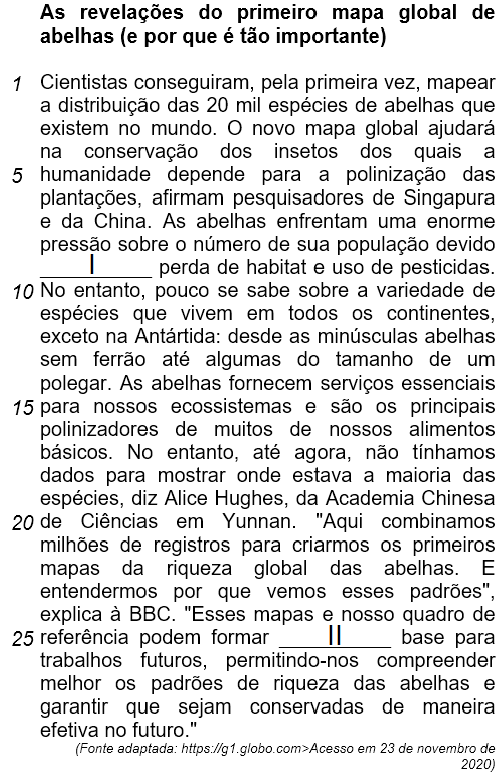
Com base nas possíveis regências que o verbo “existir”, empregado no Texto na linha 3, pode
assumir, assinale a alternativa em que ele esteja desempenhando função de verbo de ligação:
INSTRUÇÕES: A questão diz respeito ao Texto. Leia-o atentamente
antes de respondê-la.
Sobre a concordância do trecho abaixo, assinale a alternativa correta:
“Cientistas conseguiram, pela primeira vez, mapear a distribuição das 20 mil espécies de abelhas
que existem no mundo.” (linhas 1 a 3)
INSTRUÇÕES: A questão diz respeito ao Texto. Leia-o atentamente
antes de respondê-la.
“No entanto, pouco se sabe sobre a variedade de espécies...” (linhas 10 e 11). Sobre a
colocação pronominal, analise o termo destacado e, em seguida, assinale a alternativa correta: