Foram encontradas 40 questões.
Considere as proposições a, b, c e D a seguir:
a: Luiz Inácio Lula da Silva foi presidente do Brasil.
b: A capital do Rio de Janeiro é São Paulo.
c: A Terra é plana.
D: (a ∧ ~b) ↔ c
Pode-se afirmar que:
Provas

Provas
Cada uma das três primeiras colocadas de uma corrida estava usando boné e tênis. As cores dos tênis eram marrom, azul e verde, não necessariamente nessa ordem. As cores dos bonés eram rosa, vermelho e amarelo, não necessariamente nessa ordem. Além disso, sabe-se que:
- uma das atletas estava usando tênis verde e boné amarelo
- a 2ª colocada não estava de tênis verde
- a 3ª colocada estava de tênis azul e não estava de boné vermelho
É CORRETO afirmar que a
Provas
Considere as três proposições a seguir.
1. Maria Clara é mais velha que Roberto.
2. Gabriel é mais velho que Maria Clara.
3. Roberto é mais velho que Gabriel.
Se as duas primeiras proposições forem verdadeiras, é possível CONCLUIR que
Provas
- Lógica ProposicionalContingência, Contradição e Tautologia
- Lógica ProposicionalEquivalências Lógicas
- Lógica ProposicionalNegação de Proposições CompostasLeis de De Morgan
- Lógica ProposicionalProposições
Classifique cada uma das afirmativas a seguir como verdadeira (V) ou falsa (F).
( ) Toda proposição tem somente um valor lógico.
( ) Se a negação da proposição P é tautológica, então P é uma contingência.
( ) O valor lógico de qualquer proposição composta depende unicamente dos valores lógicos das proposições simples que a compõem.
( ) A bicondicional p ↔ q e a conjunção ( p → q ) ∧ ( q → p ) nem sempre são equivalentes.
Marque a alternativa que contém a sequência CORRETA de preenchimento dos parênteses.
Provas
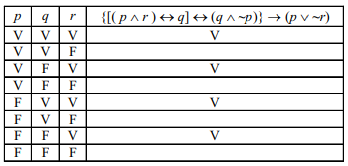
Sejam p e r duas proposições verdadeiras e q uma proposição falsa. Qual o valor lógico da proposição abaixo?
P : [ ( p → q ) → ( r ∧ ~ p ) ] ↔ ~ q
Provas
Provas
Disciplina: Inglês (Língua Inglesa)
Banca: UEPB
Orgão: Pref. Monte Horebe-PB
Which of the following statements is CORRECT?
Provas
Disciplina: Inglês (Língua Inglesa)
Banca: UEPB
Orgão: Pref. Monte Horebe-PB
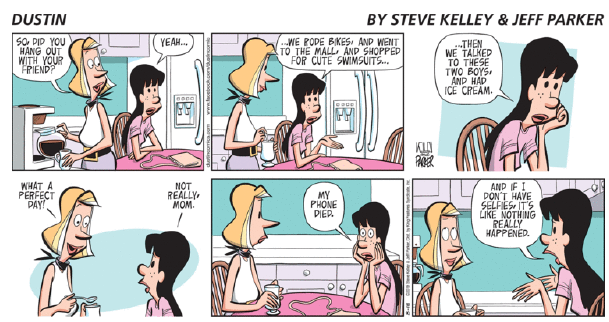
Source: AZCENTRAL Daily Comics http://comics.azcentral.com/slideshow?comic=Dustin&feature_id=Dustin
According to the comics, it is CORRECT to say that:
Provas
Disciplina: Inglês (Língua Inglesa)
Banca: UEPB
Orgão: Pref. Monte Horebe-PB
BABIES CAN LINK LANGUAGE AND ETHNICITY
A recent study from Canada's University of British Columbia (UBC) suggests that eleven-month-old infants can learn to associate the language they hear with ethnicity.
The research, published by Developmental Psychobiology, found that 11-month-old infants looked more at the faces of people of Asian descent compared to those of Caucasian descent when hearing Cantonese but not when hearing Spanish.
“Our findings suggest that by 11 months, infants are making connections between languages and ethnicities based on the individuals they encounter in their environments. In learning about language, infants are doing more than picking up sounds and sentences—they also learn about the speakers of language,” said Lillian May, a psychology lecturer at UBC who was lead author of the study.
The research was done in Vancouver, where approximately nine percent of the population can speak Cantonese.
The researchers played English-learning infants of Caucasian ancestry sentences in both English and Cantonese and showed them pictures of people of Caucasian descent, and of Asian descent. When the infants heard Cantonese, they looked more at the Asian faces than when they were hearing English. When they heard English, they looked equally to Asian and Caucasian faces.
“This indicates that they have already learned that in Vancouver, both Caucasians and Asians are likely to speak English, but only Asians are likely to speak Cantonese,” noted UBC psychology professor Janet Werker, the study's senior author.
The researchers showed the same pictures to the infants while playing Spanish, to see whether they were inclined to associate any unfamiliar language with any unfamiliar ethnicity. However, in that test the infants looked equally to Asian and Caucasian faces. This suggests young infants pick up on specific language-ethnicity pairings based on the faces and languages they encounter.
“Babies are learning so much about language—even about its social use—long before they produce their first word,” said Werker. “The link between speaker characteristics and language is something no one has to teach babies. They learn it all on their own.” “The ability to link language and ethnicity might help babies with language acquisition. We are now probing this possibility. For example, does a bilingual Chinese-English baby expect Chinese words from a Southeast Asian speaker and English words from a Caucasian speaker? Our preliminary results indicate that indeed, babies are using their expectations about language and ethnicity as another source of information in language learning,” added Werker.
Source: “Babies can link language and ethnicity”.
Language Magazine <https://www.languagemagazine.com/2019/06/28/babiescan- link-language-and-ethnicity/> Language Magazine, June 28, 2019
“ However, in that test the infants looked equally to Asian and Caucasian faces.” What is the meaning of the expression however?
Provas
Caderno Container