Foram encontradas 504 questões.
Sally's rejection of the teaching profession is typical of her in college. Many of them, in fact, didn't even to finish the course but left once they found themselves jobs in business, often earning more than their parents.
Provas

"I would never work as a teacher after I - never!" Sally's whole face expressed repugnance at the idea of being permanently a classroom with a lot of pupils. "They wouldn't even listen to me"
Provas
When considering learner autonomy and teacher development, Jeremy Harmer says that:
"However good a teacher may be, students will never learn a language or anything else unless they aim to learn outside as well as during class time. This is because language is too complex and varied for there to be enough time for students to learn all they need to in a classroom. (...) As David Nunan suggests, not everything can be taught in class (Nunan 1988a:3), but even if it could a teacher will not always be around if and when students wish to use the language in real life (Cotterall 1995:220).
To compensate for the limits of classroom time and to counter the passivity that is an enemy of true learning, students need to develop their own learning strategies, so that as far as possible they become autonomous learners. This does not always happen automatically. Attitudes to self-directed learning are frequently conditioned by the educational culture in which students have studied or are studying (...)" (p.335). We can infer that:
Provas
Jeremy Harmer says that: "
The use of videotapes has been a common feature in language teaching for many years(...). To some people videotape is merely a glorified version of audiotape (...). But there are many reasons why video can add a special, extra dimension to the learning experience (...). One of the main advantages of video is that students do not just hear language, they see it too. Thus we can observe how intonation can match facial expression (...). Video uniquely allows students a look at situations far beyond their classrooms. This is especially useful if they want to see, for example, typical British 'body language' when inviting someone out (...)". (p.282). The best alternative is:
Provas
Douglas Brown in his book Principles of Language Learning and Teaching says that: " The Input Hypothesis, a major offshoot of Krashen's Monitor Model, claims that an important "condition for language acquisition to occur is that the acquirer understand (via hearing or reading) input language that contains structure 'a bit beyond' his or her current level of competence (1981a:100). (...) An important part of the Input Hypothesis is Krashen's recommendation that speaking not be taught directly or very soon in the language classroom. Speech will "emerge" once the acquirer has built up enough comprehensible input. Krashen further claims that the best acquisition will occur in environments where anxiety is low and defensiveness is absent". (p.280) We can infer that:
Provas
As far as motivation is concerned, Jeremy Harmer says that:
"At its most basic level, motivation is some kind of internal drive which pushes someone to do things in order to achieve something. As H Douglas Brown points out, a cognitive view of motivation includes factors such as the need for exploration, activity, stimulation, new knowledge, and ego enhancement (Brown 2000: 160-166). (...)
Marion Williams and Richard Burden suggest that motivation is a 'state of cognitive arousal' which provokes a 'decision to act' as a result of which there is 'sustained intellectual and/or physical effort' so that the person can achieve some 'previously set goal' (Williams and Burden 1997: 120). They go on to point out that the strength of that motivation will depend on how much value the individual places on the outcome he or she wishes to achieve". We can infer that:
Provas
Jeremy Harmer in his book The Practice of English Language Teaching says:
"Developmental errors: for a long time now researchers in child language development have been aware of the phenomenon of 'over-generalisation'. This is best described as a situation where a child who starts by saying Daddy went, They came, etc. perfectly correctly suddenly starts saying *Daddy goed and *They comed. (...) Foreign language students make the same kind of 'developmental' errors as well". (p. 100). We can infer that:
Provas
Read the following passage and choose the option that best answers the questions 01 to 05.
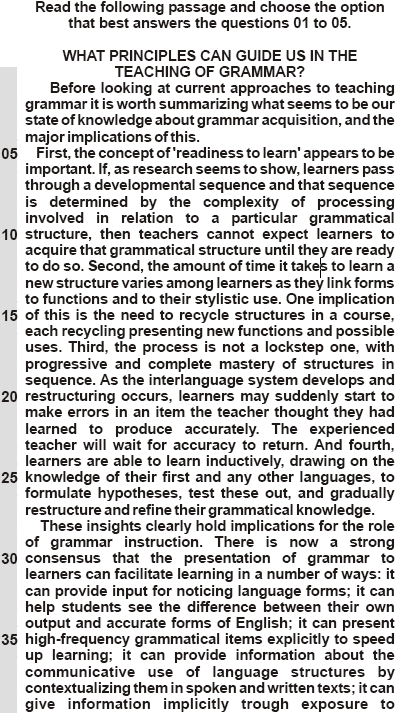

"The concept of 'readiness to learn'" (line 5) implies that:
Provas
Leia o comentário de Martin Woollacott, feito em 1997, e publicado no livro Globalização: as conseqüências humanas, de Zygmunt Bauman.
"O conglomerado sueco-suíço Ase Brown Boveri anunciou que reduziria sua força de trabalho na Europa ocidental em 57000 pessoas e criaria mais empregos na Ásia. A Eletrolux, em seguida, anunciou que reduzirá a sua força de trabalho global em 11 por cento, sobretudo na Europa e na América do Norte. A Pilkington Glass também anunciou cortes significativos. Em apenas dez dias, três empresas européias cortaram empregos em escala suficiente para se equiparar aos números mencionados nas propostas dos novos governos francês e britânico para a criação de empregos".
A partir da leitura do texto pode-se concluir que:
Provas
Observe a charge abaixo:
(Jornal do Brasil, 14/11/1995.)
Considerando os termos "Primeiro Mundo", "Segundo Mundo" e "Terceiro Mundo", pode-se afirmar que:
I - países comunistas desenvolvidos formam o "Primeiro Mundo";
II - países capitalistas e comunistas desenvolvidos formam o "Primeiro Mundo";
III - estados pós-coloniais que surgiram após a Segunda Guerra Mundial (1939 - 1945), junto com a maior parte da América Latina, foram agrupados no "Terceiro Mundo";
IV - países comunistas não desenvolvidos formam o "Segundo Mundo";
V - a classificação dos países em "Primeiro, Segundo e Terceiro Mundo" ocorreu a partir do processo de globalização econômica, iniciado nos anos de 1970.
É correto o que se afirma em:
Provas
Caderno Container