Foram encontradas 180 questões.
Durante o desenvolvimento inicial do corpo das Angiospermas, ocorre a sobreposição de dois padrões: um
apical-basal, responsável pelo crescimento em extensão, e o outro radial, constituído por três sistemas de
tecidos. Sobre estes, marque a alternativa incorreta:
Provas
Questão presente nas seguintes provas

Os gases poluentes são aqueles produzidos, principalmente, pela queima de: combustíveis fósseis
(gasolina e óleo diesel), resíduos orgânicos (lixos) e vegetação florestal. Estes gases presentes na atmosfera
são responsáveis:
Provas
Questão presente nas seguintes provas
Os combustíveis fósseis são, por definição, o grupo de recursos naturais disponíveis na natureza utilizados
para a produção de energia por meio de sua combustão. Esses combustíveis são formados por:
Provas
Questão presente nas seguintes provas
2711827
Ano: 2023
Disciplina: Literatura Brasileira e Estrangeira
Banca: UniRV
Orgão: Pref. Rio Verde-GO
Disciplina: Literatura Brasileira e Estrangeira
Banca: UniRV
Orgão: Pref. Rio Verde-GO
O problema e sua definição
Todos os diversos campos da atividade humana estão ligados ao uso da linguagem. Compreende-se perfeitamente que o caráter e as formas desse uso sejam tão multiformes quanto os campos da atividade
humana, o que, é claro, não contradiz a unidade nacional de uma língua. O emprego da língua efetua-se
em forma de enunciados (orais e escritos) concretos e únicos, proferidos pelos integrantes desse ou daquele
campo da atividade humana. Esses enunciados refletem as condições específicas e as finalidades de cada referido campo não só por seu conteúdo (temático) e pelo estilo da linguagem, ou seja, pela seleção dos
recursos lexicais, fraseológicos e gramaticais da língua mas, acima de tudo, por sua construção
composicional. Todos esses três elementos – o conteúdo temático, o estilo e a construção composicional –
estão indissoluvelmente ligados no todo do enunciado e são igualmente determinados pela especificidade
de um determinado campo da comunicação. Evidentemente, cada enunciado particular é individual, mas
cada campo de utilização da língua elabora seus tipos relativamente estáveis de enunciados, os quais
denominamos gêneros do discurso.
A riqueza e a diversidade dos gêneros do discurso são infinitas porque são inesgotáveis as
possibilidades da multiforme atividade humana e porque em cada campo dessa atividade é integral o
repertório de gênero do discurso, que cresce e se diferencia à medida que se desenvolve e se complexifica
um determinado campo. Cabe salientar em especial a extrema heterogeneidade dos gêneros do discurso
(orais e escritos), nos quais devemos incluir as breves réplicas do diálogo do cotidiano (saliente-se que a
diversidade das modalidades de diálogo do cotidiano é extraordinariamente grande em função do seu tema,
da situação e da composição dos participantes), o relato do dia a dia, a carta (em todas as suas diversas
formas), o comando militar lacônico padronizado, a ordem desdobrada e detalhada, o repertório bastante
vário (padronizado na maioria dos casos) dos documentos oficiais e o diversificado universo das
manifestações publicísticas (no amplo sentido do termo: sociais, políticas): mas aí também devemos incluir
as variadas formas das manifestações científicas e todos os gêneros literários (do provérbio ao romance de
muitos volumes). [...]
BAKHTIN, Mikhail. Os gêneros do discurso. In: –––. Estética da criação verbal, 6 ed. São Paulo: Martins Fontes, 2011
Provas
Questão presente nas seguintes provas
2711826
Ano: 2023
Disciplina: Literatura Brasileira e Estrangeira
Banca: UniRV
Orgão: Pref. Rio Verde-GO
Disciplina: Literatura Brasileira e Estrangeira
Banca: UniRV
Orgão: Pref. Rio Verde-GO
Barcos de Papel
Quando a chuva cessava e um vento fino Franzia a tarde tímida e lavada, Eu saía a brincar, pela calçada, Nos meus tempos felizes de menino.
Fazia, de papel, toda uma armada; E, estendendo o meu braço pequenino, Eu soltava os barquinhos, sem destino, Ao longo das sarjetas, na enxurrada...
Fiquei moço. E hoje sei, pensando neles, Que não são barcos de ouro os meus ideais: São feitos de papel, são como aqueles,
Perfeitamente, exatamente iguais... — Que os meus barquinhos, lá se foram eles! Foram-se embora e não voltaram mais!
ALMEIDA, Guilherme de. Disponível em: <https://www.academia.org.br/abl/cgi/cgilua.exe/sys/start.htm%3Fsid%3D186/textos escolhidos>.Acesso em: 24 mar. 2023.
No contexto literário, o gênero lírico apresenta diversas formas poéticas, numa combinação intrincada de subjetividade, musicalidade, sentimentos e emoções, evidenciando uma linguagem figurada e carregada de significados. No caso específico do poema acima, é possível afirmar que:
Quando a chuva cessava e um vento fino Franzia a tarde tímida e lavada, Eu saía a brincar, pela calçada, Nos meus tempos felizes de menino.
Fazia, de papel, toda uma armada; E, estendendo o meu braço pequenino, Eu soltava os barquinhos, sem destino, Ao longo das sarjetas, na enxurrada...
Fiquei moço. E hoje sei, pensando neles, Que não são barcos de ouro os meus ideais: São feitos de papel, são como aqueles,
Perfeitamente, exatamente iguais... — Que os meus barquinhos, lá se foram eles! Foram-se embora e não voltaram mais!
ALMEIDA, Guilherme de. Disponível em: <https://www.academia.org.br/abl/cgi/cgilua.exe/sys/start.htm%3Fsid%3D186/textos escolhidos>.Acesso em: 24 mar. 2023.
No contexto literário, o gênero lírico apresenta diversas formas poéticas, numa combinação intrincada de subjetividade, musicalidade, sentimentos e emoções, evidenciando uma linguagem figurada e carregada de significados. No caso específico do poema acima, é possível afirmar que:
Provas
Questão presente nas seguintes provas
What Is Linguistic Diversity?
What is language diversity? Language diversity, or linguistic diversity, is a broad term used to
describe the differences between different languages and the ways that people communicate with each
other. Language is one of the features of humanity that sets the species apart from others on Earth, as far
as scientists are aware. Languages are necessarily systematic, meaning that they are bound by rules. This
mechanism has been instrumental in allowing humans to communicate with each other and form complex
cultures and civilizations. Understanding what linguistic diversity is, how it applies on a worldwide scale,
and how it applies in education can help create a more thorough and lasting understanding of the study of
culture in general and the place of language in human life. [...]
Examples of Linguistic Diversity
In terms of variety of languages, there are many examples of linguistic diversity around the world.
Linguistic diversity is sometimes measured using a language diversity index, of which there are several.
These tools examine the likelihood of two given people in a country or region speaking the same native
language. If virtually everyone in a country speaks the same language, the diversity index will approach 0.
If there is a very high degree of native language diversity, the index will approach 1. Countries with a low
diversity index include Britain, Brazil, Australia, and Japan, all of which have an index score of 0.2 or less.
Diversity is also quite low in the U.S., hovering somewhere between 0.2 and 0.4. Countries with a very
high diversity index include South Africa (which has 11 official languages), India, and Papua New Guinea.
All of these countries have an index score of 0.8 or higher.
High levels of linguistic diversity often indicate that a country has one or more of the following:
• A very large population
• Many ethnic groups
• Many historical and current trade routes
• A history of being colonized
• Many mountains and other isolating geographical features
Countries deal with high levels of linguistic diversity in different ways. In some places, a single
language emerges as the lingua franca or common language. In other places, languages are combined to
form pidgins and creoles, usually in places where people had to learn to communicate very quickly.
One small island called South Goulburn, located off the coast of Australia, has an unusual way of
dealing with and maintaining linguistic diversity. On that island, the population of around 500 people keep
nine languages alive and thriving. Many of those are indigenous Australian languages with very few
speakers. On South Goulburn, it is considered somewhat taboo to speak a second language, as languages
are closely bound up with personal and cultural identity. Everyone on the island understands some or all
12
of the nine languages, but speak only their own, expecting others to respond in their own languages. This
is a phenomenon called receptive multilingualism.
Disponível em: study.com/learn/lesson/linguisticdiversity.html#:~:text=Language%20diversity%2C%20or%20linguistic%20diversity,far%20as%20scientists%20are%20aw
I – Países com baixa diversidade linguística apresentam índice de diversidade linguística próximo de zero. II – O texto cita uma ilha onde nove línguas são faladas. Neste local, um habitante inicia um diálogo em sua língua e espera-se que o seu interlocutor responda usando seu próprio idioma, que é diferente da língua do habitante que começa a conversa. III – Países que foram colonizados podem apresentar alto grau de diversidade linguística, que é o caso do Brasil.
Provas
Questão presente nas seguintes provas
What Is Linguistic Diversity?
What is language diversity? Language diversity, or linguistic diversity, is a broad term used to
describe the differences between different languages and the ways that people communicate with each
other. Language is one of the features of humanity that sets the species apart from others on Earth, as far
as scientists are aware. Languages are necessarily systematic, meaning that they are bound by rules. This
mechanism has been instrumental in allowing humans to communicate with each other and form complex
cultures and civilizations. Understanding what linguistic diversity is, how it applies on a worldwide scale,
and how it applies in education can help create a more thorough and lasting understanding of the study of
culture in general and the place of language in human life. [...]
Examples of Linguistic Diversity
In terms of variety of languages, there are many examples of linguistic diversity around the world.
Linguistic diversity is sometimes measured using a language diversity index, of which there are several.
These tools examine the likelihood of two given people in a country or region speaking the same native
language. If virtually everyone in a country speaks the same language, the diversity index will approach 0.
If there is a very high degree of native language diversity, the index will approach 1. Countries with a low
diversity index include Britain, Brazil, Australia, and Japan, all of which have an index score of 0.2 or less.
Diversity is also quite low in the U.S., hovering somewhere between 0.2 and 0.4. Countries with a very
high diversity index include South Africa (which has 11 official languages), India, and Papua New Guinea.
All of these countries have an index score of 0.8 or higher.
High levels of linguistic diversity often indicate that a country has one or more of the following:
• A very large population
• Many ethnic groups
• Many historical and current trade routes
• A history of being colonized
• Many mountains and other isolating geographical features
Countries deal with high levels of linguistic diversity in different ways. In some places, a single
language emerges as the lingua franca or common language. In other places, languages are combined to
form pidgins and creoles, usually in places where people had to learn to communicate very quickly.
One small island called South Goulburn, located off the coast of Australia, has an unusual way of
dealing with and maintaining linguistic diversity. On that island, the population of around 500 people keep
nine languages alive and thriving. Many of those are indigenous Australian languages with very few
speakers. On South Goulburn, it is considered somewhat taboo to speak a second language, as languages
are closely bound up with personal and cultural identity. Everyone on the island understands some or all
12
of the nine languages, but speak only their own, expecting others to respond in their own languages. This
is a phenomenon called receptive multilingualism.
Disponível em: study.com/learn/lesson/linguisticdiversity.html#:~:text=Language%20diversity%2C%20or%20linguistic%20diversity,far%20as%20scientists%20are%20aw
Provas
Questão presente nas seguintes provas
What Is Linguistic Diversity?
What is language diversity? Language diversity, or linguistic diversity, is a broad term used to
describe the differences between different languages and the ways that people communicate with each
other. Language is one of the features of humanity that sets the species apart from others on Earth, as far
as scientists are aware. Languages are necessarily systematic, meaning that they are bound by rules. This
mechanism has been instrumental in allowing humans to communicate with each other and form complex
cultures and civilizations. Understanding what linguistic diversity is, how it applies on a worldwide scale,
and how it applies in education can help create a more thorough and lasting understanding of the study of
culture in general and the place of language in human life. [...]
Examples of Linguistic Diversity
In terms of variety of languages, there are many examples of linguistic diversity around the world.
Linguistic diversity is sometimes measured using a language diversity index, of which there are several.
These tools examine the likelihood of two given people in a country or region speaking the same native
language. If virtually everyone in a country speaks the same language, the diversity index will approach 0.
If there is a very high degree of native language diversity, the index will approach 1. Countries with a low
diversity index include Britain, Brazil, Australia, and Japan, all of which have an index score of 0.2 or less.
Diversity is also quite low in the U.S., hovering somewhere between 0.2 and 0.4. Countries with a very
high diversity index include South Africa (which has 11 official languages), India, and Papua New Guinea.
All of these countries have an index score of 0.8 or higher.
High levels of linguistic diversity often indicate that a country has one or more of the following:
• A very large population
• Many ethnic groups
• Many historical and current trade routes
• A history of being colonized
• Many mountains and other isolating geographical features
Countries deal with high levels of linguistic diversity in different ways. In some places, a single
language emerges as the lingua franca or common language. In other places, languages are combined to
form pidgins and creoles, usually in places where people had to learn to communicate very quickly.
One small island called South Goulburn, located off the coast of Australia, has an unusual way of
dealing with and maintaining linguistic diversity. On that island, the population of around 500 people keep
nine languages alive and thriving. Many of those are indigenous Australian languages with very few
speakers. On South Goulburn, it is considered somewhat taboo to speak a second language, as languages
are closely bound up with personal and cultural identity. Everyone on the island understands some or all
12
of the nine languages, but speak only their own, expecting others to respond in their own languages. This
is a phenomenon called receptive multilingualism.
Disponível em: study.com/learn/lesson/linguisticdiversity.html#:~:text=Language%20diversity%2C%20or%20linguistic%20diversity,far%20as%20scientists%20are%20aw
Provas
Questão presente nas seguintes provas
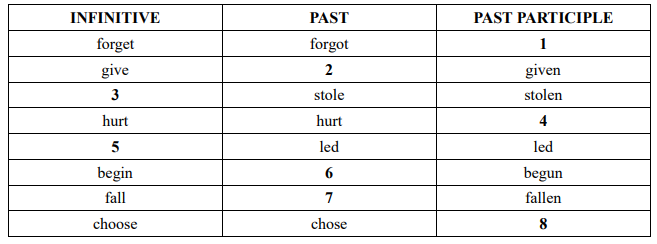
Assinale a alternativa que completa a tabela abaixo com a forma verbal correta:
Provas
Questão presente nas seguintes provas
Assinale a alternativa que completa o período abaixo com coesão e coerência:
The marketing director from our factory in New York has not arrived yet, …
The marketing director from our factory in New York has not arrived yet, …
Provas
Questão presente nas seguintes provas
Cadernos
Caderno Container