Foram encontradas 300 questões.
Disciplina: Inglês (Língua Inglesa)
Banca: Avança SP
Orgão: Pref. São Miguel Arcanjo-SP
Read the text below to answer question
“To read these books, in this way, as an exercise in self-knowledge, carries certain risks. Risks that are both personal and political. Risks that every student of Political Philosophy has known. These risks spring from the fact that philosophy teaches us, and unsettles us, by confronting us with what we already know. There is an irony: the difficulty of this course consists in the fact that it teaches what you already know. It works by taking what we know from familiar unquestioned settings, and making it strange. [...] Philosophy estranges us from the familiar, not by supplying new information, but by inviting and provoking a new way of seeing.
But, and here is the risk, once the familiar turns strange, it is never quite the same again. Self-knowledge is like lost innocence; however unsettling you find it, it can never be 'unthought' or 'unknown'. What makes this enterprise difficult, but also riveting, is that Moral and Political Philosophy is a story, and you don't know where the story would lead, but you do know that the story is about You.”
Text taken from: “Justice: What's the Right Thing to Do?” Introduction Class ― Michael Sandel
Provas

Disciplina: Inglês (Língua Inglesa)
Banca: Avança SP
Orgão: Pref. São Miguel Arcanjo-SP
Read the text below to answer question
“To read these books, in this way, as an exercise in self-knowledge, carries certain risks. Risks that are both personal and political. Risks that every student of Political Philosophy has known. These risks spring from the fact that philosophy teaches us, and unsettles us, by confronting us with what we already know. There is an irony: the difficulty of this course consists in the fact that it teaches what you already know. It works by taking what we know from familiar unquestioned settings, and making it strange. [...] Philosophy estranges us from the familiar, not by supplying new information, but by inviting and provoking a new way of seeing.
But, and here is the risk, once the familiar turns strange, it is never quite the same again. Self-knowledge is like lost innocence; however unsettling you find it, it can never be 'unthought' or 'unknown'. What makes this enterprise difficult, but also riveting, is that Moral and Political Philosophy is a story, and you don't know where the story would lead, but you do know that the story is about You.”
Text taken from: “Justice: What's the Right Thing to Do?” Introduction Class ― Michael Sandel
Provas
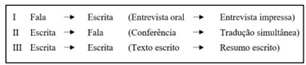
São verdadeiras as relações:
Provas
I – Tipos textuais – realizações linguísticas concretas definidas por propriedades sociocomunicativas.
II – Gêneros textuais – constituem textos empiricamente realizados cumprindo funções em situações comunicativas.
III – Tipos textuais – designações teóricas dos tipos: narração, argumentação, descrição, injunção e exposição.
IV – Gêneros textuais – sua nomeação abrange um conjunto aberto e praticamente ilimitado de designações concretas determinadas pelo canal, estilo, conteúdo, composição e função.
É falso o que se afirma em:
Provas
I – situação comunicativa
II – interlocutores (quem escreve/ para quem escreve)
III – finalidade ou propósito (escrever para quê)
IV – unidades de sentido, dividindo o texto em parágrafos, tópicos e subtópicos
É verdadeiro o que se afirma em:
Provas
I – Expressão de linguagem com foco no autor: atividade de captação de ideias do autor, sem levar em conta as experiências e os conhecimentos do leitor.
II – Instrumento de comunicação com foco no texto: atividade de decodificação, reconhecimento das estruturas do texto.
III – Foco na interação (autor/ texto/ leitor): atividade de produção de sentidos.
É verdadeiro o que se afirma em:
Provas
Para atender a essa multiplicidade de modalidades e usos da língua escrita e da língua oral, e tendo sempre o texto como centro, a BNCC de Língua Portuguesa está organizada em cinco eixos organizadores, comuns ao longo do ensino fundamental. Nesse sentido, destaque o eixo que para os outros componentes curriculares é instrumento e, em Língua Portuguesa, é tema central.
Provas
Provas
Provas
Em observância ao texto anterior, completando corretamente a reflexão proposta, analise as afirmativas abaixo:
I – ler e escrever conforme a norma culta.
II – expressar-se apropriadamente em situações de interação oral de forma similar as que caracterizam seu universo imediato.
III – refletir sobre os fenômenos da linguagem, particularmente os que tocam a questão da variação linguística, combatendo a estigmatização, discriminação e preconceitos relativos ao uso da língua.
É pertinente o que se afirma em:
Provas
Caderno Container