Foram encontradas 485 questões.
Sob o ponto de vista contábil, o termo Capital pode encontrar vários sentidos. Correlacione a coluna da esquerda com a da direita, sobre aspectos do Capital Social:
I - Capital autorizado.
II - Capital subscrito.
III - Capital não subscrito.
IV - Capital integralizado.
( ) corresponde à parcela do capital autorizado que não foi colocado em circulação.
( ) é dado pelo estatuto social (art. 168 da Lei nº 6.404/76), permitindo o aumento do capital independentemente da reforma estatutária.
( ) valor efetivamente entregue pelos sócios para cumprimento total ou parcial da obrigação assumida quando da subscrição.
( ) parcela do capital autorizado que encontra colocação.
Assinale a alternativa que contém a sequência CORRETA, de cima para baixo:
Provas

Leia as afirmações a seguir:
I. A Contabilidade é uma ciência social factual que tem por objetivo o estudo das variações ocorridas no patrimônio das entidades.
II. O objeto formal da Contabilidade é o estudo do patrimônio das entidades em seus aspectos qualitativos e quantitativos.
III. O objetivo da contabilidade pode ser entendido como o de fornecer informação como suporte à tomada de decisão, limitando-se aos usuários internos das entidades.
Assinale a alternativa CORRETA:
Provas
Directions: Choose the CORRECT alternative to answer questions 21 to 30
In the Future, We Will All Talk to Computers
Posted By Ben Bajarin on October 17, 2011
APPLE
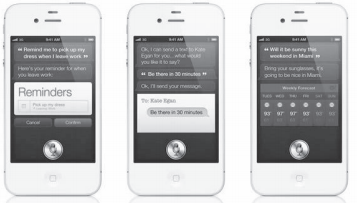
When Apple showed the world Siri, I believe they showed us the next major man-to-machine user interface.
The idea _____ talking to computers is nothing new. It has, of course, been featured in sci-fi novels, movies and TV shows for years now. The challenge had always been bringing it to the mass market. This is what Apple plans to do with Siri on the iPhone 4S.
This technology has been in development ______ quite a while and is getting progressively better. Besides bringing it to the mass market, another challenge has been making it useful by going beyond simple dictation. One of the most impressive elements of Siri is not just the ability to do voice-to-text dictation, but its ability to turn natural-language directives into action.
What I mean by that is that I can use my voice to say, “Remind me to feed my goats when I get home.” Because Siri is trained to know where my house is and the iPhone 4S has GPS, the second I drive into my driveway, I get a reminder that tells me to feed the goats. I live ______ a farm and this is quite handy for me.
It’s a valuable proposition to be able to use voice commands to create calendar items, search the web, get abstract information like how many feet are ______ a mile, search local information, set alarms, check the weather, and much more. This can be done because Siri is tied to some very powerful databases.
What is fascinating is that as I have been using Siri, the experience actually feels more like a conversation than me ordering my iPhone to do things. This is because when you use your voice to create an action, Siri asks you relevant questions in order to make sure it takes the correct action.
For example, the first time I told it to call my dad, Siri asked, “What is your father’s name?” I responded “Tim” and Siri said, “Do you want me to remember that Tim Bajarin is your father?” I answered yes and Siri acknowledged that it would remember that Tim Bajarin is my father.
Another example was when I was in an unfamiliar part of a city. I brought up the voice prompt and asked, “How do I get home?” Because I had set Siri up to know my home location, it then quickly gave me directions to my house using Google Maps.
Experiences like this cause you to realize that we are only just starting to scratch the surface of using our voices to interact with personal computers.
Adapted from:
http://techland.time.com/2011/10/17/in-the-future-we-will-all-talk-to-computers/#ixzz1jxHsxtDv
Acessed on 2012/01/19 at 2:00 pm
In the ninth paragraph the words of Ben Bajarin indicate that:
Provas
Directions: Choose the CORRECT alternative to answer questions 21 to 30
In the Future, We Will All Talk to Computers
Posted By Ben Bajarin on October 17, 2011
APPLE
When Apple showed the world Siri, I believe they showed us the next major man-to-machine user interface.
The idea _____ talking to computers is nothing new. It has, of course, been featured in sci-fi novels, movies and TV shows for years now. The challenge had always been bringing it to the mass market. This is what Apple plans to do with Siri on the iPhone 4S.
This technology has been in development ______ quite a while and is getting progressively better. Besides bringing it to the mass market, another challenge has been making it useful by going beyond simple dictation. One of the most impressive elements of Siri is not just the ability to do voice-to-text dictation, but its ability to turn natural-language directives into action.
What I mean by that is that I can use my voice to say, “Remind me to feed my goats when I get home.” Because Siri is trained to know where my house is and the iPhone 4S has GPS, the second I drive into my driveway, I get a reminder that tells me to feed the goats. I live ______ a farm and this is quite handy for me.
It’s a valuable proposition to be able to use voice commands to create calendar items, search the web, get abstract information like how many feet are ______ a mile, search local information, set alarms, check the weather, and much more. This can be done because Siri is tied to some very powerful databases.
What is fascinating is that as I have been using Siri, the experience actually feels more like a conversation than me ordering my iPhone to do things. This is because when you use your voice to create an action, Siri asks you relevant questions in order to make sure it takes the correct action.
For example, the first time I told it to call my dad, Siri asked, “What is your father’s name?” I responded “Tim” and Siri said, “Do you want me to remember that Tim Bajarin is your father?” I answered yes and Siri acknowledged that it would remember that Tim Bajarin is my father.
Another example was when I was in an unfamiliar part of a city. I brought up the voice prompt and asked, “How do I get home?” Because I had set Siri up to know my home location, it then quickly gave me directions to my house using Google Maps.
Experiences like this cause you to realize that we are only just starting to scratch the surface of using our voices to interact with personal computers.
Adapted from:
http://techland.time.com/2011/10/17/in-the-future-we-will-all-talk-to-computers/#ixzz1jxHsxtDv
Acessed on 2012/01/19 at 2:00 pm
Check the correct Passive Voice for the sentence “… I had set Siri up to know my home location…”:
Provas
Directions: Choose the CORRECT alternative to answer questions 21 to 30
In the Future, We Will All Talk to Computers
Posted By Ben Bajarin on October 17, 2011
APPLE
When Apple showed the world Siri, I believe they showed us the next major man-to-machine user interface.
The idea _____ talking to computers is nothing new. It has, of course, been featured in sci-fi novels, movies and TV shows for years now. The challenge had always been bringing it to the mass market. This is what Apple plans to do with Siri on the iPhone 4S.
This technology has been in development ______ quite a while and is getting progressively better. Besides bringing it to the mass market, another challenge has been making it useful by going beyond simple dictation. One of the most impressive elements of Siri is not just the ability to do voice-to-text dictation, but its ability to turn natural-language directives into action.
What I mean by that is that I can use my voice to say, “Remind me to feed my goats when I get home.” Because Siri is trained to know where my house is and the iPhone 4S has GPS, the second I drive into my driveway, I get a reminder that tells me to feed the goats. I live ______ a farm and this is quite handy for me.
It’s a valuable proposition to be able to use voice commands to create calendar items, search the web, get abstract information like how many feet are ______ a mile, search local information, set alarms, check the weather, and much more. This can be done because Siri is tied to some very powerful databases.
What is fascinating is that as I have been using Siri, the experience actually feels more like a conversation than me ordering my iPhone to do things. This is because when you use your voice to create an action, Siri asks you relevant questions in order to make sure it takes the correct action.
For example, the first time I told it to call my dad, Siri asked, “What is your father’s name?” I responded “Tim” and Siri said, “Do you want me to remember that Tim Bajarin is your father?” I answered yes and Siri acknowledged that it would remember that Tim Bajarin is my father.
Another example was when I was in an unfamiliar part of a city. I brought up the voice prompt and asked, “How do I get home?” Because I had set Siri up to know my home location, it then quickly gave me directions to my house using Google Maps.
Experiences like this cause you to realize that we are only just starting to scratch the surface of using our voices to interact with personal computers.
Adapted from:
http://techland.time.com/2011/10/17/in-the-future-we-will-all-talk-to-computers/#ixzz1jxHsxtDv
Acessed on 2012/01/19 at 2:00 pm
Mark the correct Question Tag for the sentence: “In the future, we will all talk to computers”,___________________? :
Provas
Directions: Choose the CORRECT alternative to answer questions 21 to 30
In the Future, We Will All Talk to Computers
Posted By Ben Bajarin on October 17, 2011
APPLE
When Apple showed the world Siri, I believe they showed us the next major man-to-machine user interface.
The idea _____ talking to computers is nothing new. It has, of course, been featured in sci-fi novels, movies and TV shows for years now. The challenge had always been bringing it to the mass market. This is what Apple plans to do with Siri on the iPhone 4S.
This technology has been in development ______ quite a while and is getting progressively better. Besides bringing it to the mass market, another challenge has been making it useful by going beyond simple dictation. One of the most impressive elements of Siri is not just the ability to do voice-to-text dictation, but its ability to turn natural-language directives into action.
What I mean by that is that I can use my voice to say, “Remind me to feed my goats when I get home.” Because Siri is trained to know where my house is and the iPhone 4S has GPS, the second I drive into my driveway, I get a reminder that tells me to feed the goats. I live ______ a farm and this is quite handy for me.
It’s a valuable proposition to be able to use voice commands to create calendar items, search the web, get abstract information like how many feet are ______ a mile, search local information, set alarms, check the weather, and much more. This can be done because Siri is tied to some very powerful databases.
What is fascinating is that as I have been using Siri, the experience actually feels more like a conversation than me ordering my iPhone to do things. This is because when you use your voice to create an action, Siri asks you relevant questions in order to make sure it takes the correct action.
For example, the first time I told it to call my dad, Siri asked, “What is your father’s name?” I responded “Tim” and Siri said, “Do you want me to remember that Tim Bajarin is your father?” I answered yes and Siri acknowledged that it would remember that Tim Bajarin is my father.
Another example was when I was in an unfamiliar part of a city. I brought up the voice prompt and asked, “How do I get home?” Because I had set Siri up to know my home location, it then quickly gave me directions to my house using Google Maps.
Experiences like this cause you to realize that we are only just starting to scratch the surface of using our voices to interact with personal computers.
Adapted from:
http://techland.time.com/2011/10/17/in-the-future-we-will-all-talk-to-computers/#ixzz1jxHsxtDv
Acessed on 2012/01/19 at 2:00 pm
According to Ben Bajarin:
Provas
Directions: Choose the CORRECT alternative to answer questions 21 to 30
In the Future, We Will All Talk to Computers
Posted By Ben Bajarin on October 17, 2011
APPLE
When Apple showed the world Siri, I believe they showed us the next major man-to-machine user interface.
The idea _____ talking to computers is nothing new. It has, of course, been featured in sci-fi novels, movies and TV shows for years now. The challenge had always been bringing it to the mass market. This is what Apple plans to do with Siri on the iPhone 4S.
This technology has been in development ______ quite a while and is getting progressively better. Besides bringing it to the mass market, another challenge has been making it useful by going beyond simple dictation. One of the most impressive elements of Siri is not just the ability to do voice-to-text dictation, but its ability to turn natural-language directives into action.
What I mean by that is that I can use my voice to say, “Remind me to feed my goats when I get home.” Because Siri is trained to know where my house is and the iPhone 4S has GPS, the second I drive into my driveway, I get a reminder that tells me to feed the goats. I live ______ a farm and this is quite handy for me.
It’s a valuable proposition to be able to use voice commands to create calendar items, search the web, get abstract information like how many feet are ______ a mile, search local information, set alarms, check the weather, and much more. This can be done because Siri is tied to some very powerful databases.
What is fascinating is that as I have been using Siri, the experience actually feels more like a conversation than me ordering my iPhone to do things. This is because when you use your voice to create an action, Siri asks you relevant questions in order to make sure it takes the correct action.
For example, the first time I told it to call my dad, Siri asked, “What is your father’s name?” I responded “Tim” and Siri said, “Do you want me to remember that Tim Bajarin is your father?” I answered yes and Siri acknowledged that it would remember that Tim Bajarin is my father.
Another example was when I was in an unfamiliar part of a city. I brought up the voice prompt and asked, “How do I get home?” Because I had set Siri up to know my home location, it then quickly gave me directions to my house using Google Maps.
Experiences like this cause you to realize that we are only just starting to scratch the surface of using our voices to interact with personal computers.
Adapted from:
http://techland.time.com/2011/10/17/in-the-future-we-will-all-talk-to-computers/#ixzz1jxHsxtDv
Acessed on 2012/01/19 at 2:00 pm
Mark the alternative that completes the following sentences:
I. “The idea _______ talking to computers is nothing new.”
II. “This technology has been in development ______ quite a while and is getting progressively better.”
III. “I live ______ a farm and this is quite handy for me.”
IV. “…search the web, get abstract information like how many feet are _______ a mile, search local information, set alarms, check the weather, and much more.”
Provas
Directions: Choose the CORRECT alternative to answer questions 21 to 30
In the Future, We Will All Talk to Computers
Posted By Ben Bajarin on October 17, 2011
APPLE
When Apple showed the world Siri, I believe they showed us the next major man-to-machine user interface.
The idea _____ talking to computers is nothing new. It has, of course, been featured in sci-fi novels, movies and TV shows for years now. The challenge had always been bringing it to the mass market. This is what Apple plans to do with Siri on the iPhone 4S.
This technology has been in development ______ quite a while and is getting progressively better. Besides bringing it to the mass market, another challenge has been making it useful by going beyond simple dictation. One of the most impressive elements of Siri is not just the ability to do voice-to-text dictation, but its ability to turn natural-language directives into action.
What I mean by that is that I can use my voice to say, “Remind me to feed my goats when I get home.” Because Siri is trained to know where my house is and the iPhone 4S has GPS, the second I drive into my driveway, I get a reminder that tells me to feed the goats. I live ______ a farm and this is quite handy for me.
It’s a valuable proposition to be able to use voice commands to create calendar items, search the web, get abstract information like how many feet are ______ a mile, search local information, set alarms, check the weather, and much more. This can be done because Siri is tied to some very powerful databases.
What is fascinating is that as I have been using Siri, the experience actually feels more like a conversation than me ordering my iPhone to do things. This is because when you use your voice to create an action, Siri asks you relevant questions in order to make sure it takes the correct action.
For example, the first time I told it to call my dad, Siri asked, “What is your father’s name?” I responded “Tim” and Siri said, “Do you want me to remember that Tim Bajarin is your father?” I answered yes and Siri acknowledged that it would remember that Tim Bajarin is my father.
Another example was when I was in an unfamiliar part of a city. I brought up the voice prompt and asked, “How do I get home?” Because I had set Siri up to know my home location, it then quickly gave me directions to my house using Google Maps.
Experiences like this cause you to realize that we are only just starting to scratch the surface of using our voices to interact with personal computers.
Adapted from:
http://techland.time.com/2011/10/17/in-the-future-we-will-all-talk-to-computers/#ixzz1jxHsxtDv
Acessed on 2012/01/19 at 2:00 pm
The pronoun it in the sentence “…Siri asks you relevant questions in order to make sure it takes the correct action.” refers to:
Provas
Directions: Choose the CORRECT alternative to answer questions 21 to 30
In the Future, We Will All Talk to Computers
Posted By Ben Bajarin on October 17, 2011
APPLE
When Apple showed the world Siri, I believe they showed us the next major man-to-machine user interface.
The idea _____ talking to computers is nothing new. It has, of course, been featured in sci-fi novels, movies and TV shows for years now. The challenge had always been bringing it to the mass market. This is what Apple plans to do with Siri on the iPhone 4S.
This technology has been in development ______ quite a while and is getting progressively better. Besides bringing it to the mass market, another challenge has been making it useful by going beyond simple dictation. One of the most impressive elements of Siri is not just the ability to do voice-to-text dictation, but its ability to turn natural-language directives into action.
What I mean by that is that I can use my voice to say, “Remind me to feed my goats when I get home.” Because Siri is trained to know where my house is and the iPhone 4S has GPS, the second I drive into my driveway, I get a reminder that tells me to feed the goats. I live ______ a farm and this is quite handy for me.
It’s a valuable proposition to be able to use voice commands to create calendar items, search the web, get abstract information like how many feet are ______ a mile, search local information, set alarms, check the weather, and much more. This can be done because Siri is tied to some very powerful databases.
What is fascinating is that as I have been using Siri, the experience actually feels more like a conversation than me ordering my iPhone to do things. This is because when you use your voice to create an action, Siri asks you relevant questions in order to make sure it takes the correct action.
For example, the first time I told it to call my dad, Siri asked, “What is your father’s name?” I responded “Tim” and Siri said, “Do you want me to remember that Tim Bajarin is your father?” I answered yes and Siri acknowledged that it would remember that Tim Bajarin is my father.
Another example was when I was in an unfamiliar part of a city. I brought up the voice prompt and asked, “How do I get home?” Because I had set Siri up to know my home location, it then quickly gave me directions to my house using Google Maps.
Experiences like this cause you to realize that we are only just starting to scratch the surface of using our voices to interact with personal computers.
Adapted from:
http://techland.time.com/2011/10/17/in-the-future-we-will-all-talk-to-computers/#ixzz1jxHsxtDv
Acessed on 2012/01/19 at 2:00 pm
According to the text, all the following statements are true, except:
Provas
Directions: Choose the CORRECT alternative to answer questions 21 to 30
In the Future, We Will All Talk to Computers
Posted By Ben Bajarin on October 17, 2011
APPLE
When Apple showed the world Siri, I believe they showed us the next major man-to-machine user interface.
The idea _____ talking to computers is nothing new. It has, of course, been featured in sci-fi novels, movies and TV shows for years now. The challenge had always been bringing it to the mass market. This is what Apple plans to do with Siri on the iPhone 4S.
This technology has been in development ______ quite a while and is getting progressively better. Besides bringing it to the mass market, another challenge has been making it useful by going beyond simple dictation. One of the most impressive elements of Siri is not just the ability to do voice-to-text dictation, but its ability to turn natural-language directives into action.
What I mean by that is that I can use my voice to say, “Remind me to feed my goats when I get home.” Because Siri is trained to know where my house is and the iPhone 4S has GPS, the second I drive into my driveway, I get a reminder that tells me to feed the goats. I live ______ a farm and this is quite handy for me.
It’s a valuable proposition to be able to use voice commands to create calendar items, search the web, get abstract information like how many feet are ______ a mile, search local information, set alarms, check the weather, and much more. This can be done because Siri is tied to some very powerful databases.
What is fascinating is that as I have been using Siri, the experience actually feels more like a conversation than me ordering my iPhone to do things. This is because when you use your voice to create an action, Siri asks you relevant questions in order to make sure it takes the correct action.
For example, the first time I told it to call my dad, Siri asked, “What is your father’s name?” I responded “Tim” and Siri said, “Do you want me to remember that Tim Bajarin is your father?” I answered yes and Siri acknowledged that it would remember that Tim Bajarin is my father.
Another example was when I was in an unfamiliar part of a city. I brought up the voice prompt and asked, “How do I get home?” Because I had set Siri up to know my home location, it then quickly gave me directions to my house using Google Maps.
Experiences like this cause you to realize that we are only just starting to scratch the surface of using our voices to interact with personal computers.
Adapted from:
http://techland.time.com/2011/10/17/in-the-future-we-will-all-talk-to-computers/#ixzz1jxHsxtDv
Acessed on 2012/01/19 at 2:00 pm
In the third paragraph the author tells us that:
Provas
Caderno Container