Foram encontradas 39 questões.
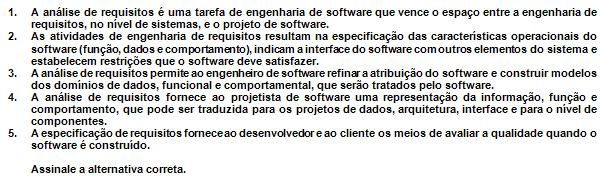
Sobre os fundamentos da Análise de Negócios e Levantamento de Requisitos, considere as afirmativas abaixo:
Provas

Em relação ao Microsoft Windows, considere as seguintes afirmativas:

Provas
Em relação ao conceito de Redes de Computadores e Intranet, considere as seguintes afirmativas:

Provas
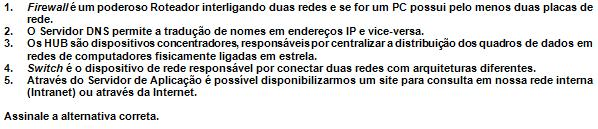
Sobre os fundamentos de redes de computadores, leia as afirmativas abaixo:
Provas
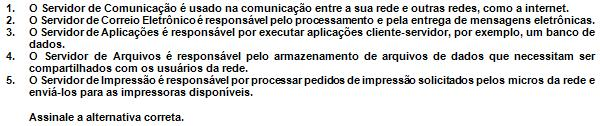
Sobre os fundamentos de redes de computadores, leia as afirmações abaixo.
Provas
A Análise de Requisitos de Software tem a meta de entender o software no contexto do sistema e revisar o escopo do software que foi usado para gerar as estimativas de planejamento, podendo ser dividida em 5 áreas de esforço. Numere a coluna da direita com base no nº da etapa da coluna da esquerda:

Assinale a alternativa que apresenta a ordem correta, de cima para baixo, das 5 áreas de esforço mencionadas.
Provas
Engineering and the Industrial Revolution
The first phase of modern engineering emerged in the Scientific Revolution. Galileo`s Two New Sciences, which seeks systematic explanations and adopts a scientific approach to practical problems, is a landmark regarded by many engineer historians as the beginning of structural analysis, the mathematical representation and design of building structures. This phase of engineering lasted through the First Industrial Revolution, when machines, increasingly powered by steam engines, started to replace muscles in most production. While pulling off the revolution, traditional artisans transformed themselves to modern professionals. The French, more rationalistic oriented, spearheaded civil engineering with emphasis on mathematics and developed university engineering education under the sponsorship of their government. The British, more empirically oriented, pioneered mechanical engineering and autonomous professional societies under the laissez-faire attitude of their government. Gradually, practical thinking became sicentific in addition to intuitive, as engineers developed mathematical analysis and controlled experiments. Technical training shifted from apprenticeship to university education. Information flowed more quickly in organized meetings and journal publications as professional societies emerged.
(www.creating technology.org/history.htm)
According to the text, during the Scientific Revolution:
Provas
Engineering and the Industrial Revolution
The first phase of modern engineering emerged in the Scientific Revolution. Galileo`s Two New Sciences, which seeks systematic explanations and adopts a scientific approach to practical problems, is a landmark regarded by many engineer historians as the beginning of structural analysis, the mathematical representation and design of building structures. This phase of engineering lasted through the First Industrial Revolution, when machines, increasingly powered by steam engines, started to replace muscles in most production. While pulling off the revolution, traditional artisans transformed themselves to modern professionals. The French, more rationalistic oriented, spearheaded civil engineering with emphasis on mathematics and developed university engineering education under the sponsorship of their government. The British, more empirically oriented, pioneered mechanical engineering and autonomous professional societies under the laissez-faire attitude of their government. Gradually, practical thinking became sicentific in addition to intuitive, as engineers developed mathematical analysis and controlled experiments. Technical training shifted from apprenticeship to university education. Information flowed more quickly in organized meetings and journal publications as professional societies emerged.
(www.creating technology.org/history.htm)
Consider the following afirmatives:

Provas
Engineering and the Industrial Revolution
The first phase of modern engineering emerged in the Scientific Revolution. Galileo`s Two New Sciences, which seeks systematic explanations and adopts a scientific approach to practical problems, is a landmark regarded by many engineer historians as the beginning of structural analysis, the mathematical representation and design of building structures. This phase of engineering lasted through the First Industrial Revolution, when machines, increasingly powered by steam engines, started to replace muscles in most production. While pulling off the revolution, traditional artisans transformed themselves to modern professionals. The French, more rationalistic oriented, spearheaded civil engineering with emphasis on mathematics and developed university engineering education under the sponsorship of their government. The British, more empirically oriented, pioneered mechanical engineering and autonomous professional societies under the laissez-faire attitude of their government. Gradually, practical thinking became sicentific in addition to intuitive, as engineers developed mathematical analysis and controlled experiments. Technical training shifted from apprenticeship to university education. Information flowed more quickly in organized meetings and journal publications as professional societies emerged.
(www.creating technology.org/history.htm)
According to the text, an important change in the first phase of modern engineering was:
Provas
Engineering and the Industrial Revolution
The first phase of modern engineering emerged in the Scientific Revolution. Galileo`s Two New Sciences, which seeks systematic explanations and adopts a scientific approach to practical problems, is a landmark regarded by many engineer historians as the beginning of structural analysis, the mathematical representation and design of building structures. This phase of engineering lasted through the First Industrial Revolution, when machines, increasingly powered by steam engines, started to replace muscles in most production. While pulling off the revolution, traditional artisans transformed themselves to modern professionals. The French, more rationalistic oriented, spearheaded civil engineering with emphasis on mathematics and developed university engineering education under the sponsorship of their government. The British, more empirically oriented, pioneered mechanical engineering and autonomous professional societies under the laissez-faire attitude of their government. Gradually, practical thinking became sicentific in addition to intuitive, as engineers developed mathematical analysis and controlled experiments. Technical training shifted from apprenticeship to university education. Information flowed more quickly in organized meetings and journal publications as professional societies emerged.
(www.creating technology.org/history.htm)
According to the text, a landmark in engineering is:
Provas
Caderno Container