Foram encontradas 39 questões.
Engineering and the Industrial Revolution
The first phase of modern engineering emerged in the Scientific Revolution. Galileo`s Two New Sciences, which seeks systematic explanations and adopts a scientific approach to practical problems, is a landmark regarded by many engineer historians as the beginning of structural analysis, the mathematical representation and design of building structures. This phase of engineering lasted through the First Industrial Revolution, when machines, increasingly powered by steam engines, started to replace muscles in most production. While pulling off the revolution, traditional artisans transformed themselves to modern professionals. The French, more rationalistic oriented, spearheaded civil engineering with emphasis on mathematics and developed university engineering education under the sponsorship of their government. The British, more empirically oriented, pioneered mechanical engineering and autonomous professional societies under the laissez-faire attitude of their government. Gradually, practical thinking became sicentific in addition to intuitive, as engineers developed mathematical analysis and controlled experiments. Technical training shifted from apprenticeship to university education. Information flowed more quickly in organized meetings and journal publications as professional societies emerged.
(www.creating technology.org/history.htm)
Place a mark in the alternative which CANNOT be inferred from the sentence: "Information flowed more quickly in organized meetings and journal publications as professional societies emerged."
Provas

Em determinado setor de uma empresa trabalham 75 funcionários, 16% dos quais estão em estágio probatório e os outros são efetivos. Se mais 5 funcionários efetivos forem colocados naquele setor, a porcentagem de efetivos no total funcionários passará a ser
Provas
- GeometriaGeometria PlanaTriângulos
- TrigonometriaTrigonometria no triângulo retânguloRazões trigonométricas dos ângulos notáveis
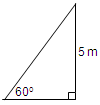
Uma rampa em 60º com a horizontal será construída unindo o nível do solo a um ponto a 5 m de altura na parede vertical. Dentre os itens abaixo, assinale aquele que corresponde ao valor mais próximo do comprimento da rampa. (Considere os valores aproximados: sen 60º 0,866, cos 60º 0,5 e tan 60º 1,732)
Provas
Engineering and the Industrial Revolution
The first phase of modern engineering emerged in the Scientific Revolution. Galileo`s Two New Sciences, which seeks systematic explanations and adopts a scientific approach to practical problems, is a landmark regarded by many engineer historians as the beginning of structural analysis, the mathematical representation and design of building structures. This phase of engineering lasted through the First Industrial Revolution, when machines, increasingly powered by steam engines, started to replace muscles in most production. While pulling off the revolution, traditional artisans transformed themselves to modern professionals. The French, more rationalistic oriented, spearheaded civil engineering with emphasis on mathematics and developed university engineering education under the sponsorship of their government. The British, more empirically oriented, pioneered mechanical engineering and autonomous professional societies under the laissez-faire attitude of their government. Gradually, practical thinking became sicentific in addition to intuitive, as engineers developed mathematical analysis and controlled experiments. Technical training shifted from apprenticeship to university education. Information flowed more quickly in organized meetings and journal publications as professional societies emerged.
(www.creating technology.org/history.htm)
According to the text, during the Scientific Revolution:
Provas
Engineering and the Industrial Revolution
The first phase of modern engineering emerged in the Scientific Revolution. Galileo`s Two New Sciences, which seeks systematic explanations and adopts a scientific approach to practical problems, is a landmark regarded by many engineer historians as the beginning of structural analysis, the mathematical representation and design of building structures. This phase of engineering lasted through the First Industrial Revolution, when machines, increasingly powered by steam engines, started to replace muscles in most production. While pulling off the revolution, traditional artisans transformed themselves to modern professionals. The French, more rationalistic oriented, spearheaded civil engineering with emphasis on mathematics and developed university engineering education under the sponsorship of their government. The British, more empirically oriented, pioneered mechanical engineering and autonomous professional societies under the laissez-faire attitude of their government. Gradually, practical thinking became sicentific in addition to intuitive, as engineers developed mathematical analysis and controlled experiments. Technical training shifted from apprenticeship to university education. Information flowed more quickly in organized meetings and journal publications as professional societies emerged.
(www.creating technology.org/history.htm)
Consider the following afirmatives:

Provas
Engineering and the Industrial Revolution
The first phase of modern engineering emerged in the Scientific Revolution. Galileo`s Two New Sciences, which seeks systematic explanations and adopts a scientific approach to practical problems, is a landmark regarded by many engineer historians as the beginning of structural analysis, the mathematical representation and design of building structures. This phase of engineering lasted through the First Industrial Revolution, when machines, increasingly powered by steam engines, started to replace muscles in most production. While pulling off the revolution, traditional artisans transformed themselves to modern professionals. The French, more rationalistic oriented, spearheaded civil engineering with emphasis on mathematics and developed university engineering education under the sponsorship of their government. The British, more empirically oriented, pioneered mechanical engineering and autonomous professional societies under the laissez-faire attitude of their government. Gradually, practical thinking became sicentific in addition to intuitive, as engineers developed mathematical analysis and controlled experiments. Technical training shifted from apprenticeship to university education. Information flowed more quickly in organized meetings and journal publications as professional societies emerged.
(www.creating technology.org/history.htm)
According to the text, an important change in the first phase of modern engineering was:
Provas
Engineering and the Industrial Revolution
The first phase of modern engineering emerged in the Scientific Revolution. Galileo`s Two New Sciences, which seeks systematic explanations and adopts a scientific approach to practical problems, is a landmark regarded by many engineer historians as the beginning of structural analysis, the mathematical representation and design of building structures. This phase of engineering lasted through the First Industrial Revolution, when machines, increasingly powered by steam engines, started to replace muscles in most production. While pulling off the revolution, traditional artisans transformed themselves to modern professionals. The French, more rationalistic oriented, spearheaded civil engineering with emphasis on mathematics and developed university engineering education under the sponsorship of their government. The British, more empirically oriented, pioneered mechanical engineering and autonomous professional societies under the laissez-faire attitude of their government. Gradually, practical thinking became sicentific in addition to intuitive, as engineers developed mathematical analysis and controlled experiments. Technical training shifted from apprenticeship to university education. Information flowed more quickly in organized meetings and journal publications as professional societies emerged.
(www.creating technology.org/history.htm)
According to the text, a landmark in engineering is:
Provas
Considere as quatro afirmações seguintes: Ou Alexandre será geólogo, ou José será músico ou Marco será biólogo. Se César for atleta, então José será músico. Se Marco for biólogo, então César será atleta. José não será músico. Conclui-se que:
Provas
Em uma pesquisa de mercado, foram consultadas 234 pessoas sobre a preferência relativa a dois jornais da cidade. O resultado da pesquisa revelou que 39 daquelas pessoas não lêem jornal, 113 lêem o jornal A e 95 lêem o jornal B. Qual é o número de pessoas que lêem ambos os jornais é?
Provas
Com base no texto "Fluente em inglês deixa de ter 'vantagem econômica'", considere as afirmativas abaixo:

Provas
Caderno Container