Magna Concursos

Foram encontradas 1.510 questões.

784818 Ano: 2017
Disciplina: Inglês (Língua Inglesa)
Banca: CESPE / CEBRASPE
Orgão: SEE-DF
Text 19A3AAA
The transfer of patterns from the native language is undoubtedly one of the major sources of errors in learner language. However, there are other causes for errors too, one of which is overgeneralization of target-language rules. For example, research has shown that second-language learners from different first-language backgrounds often make the same kinds of errors when learning a particular second language. In such cases, second-language errors are evidence of the learners’ efforts to discover the structure of the target language itself rather than attempts to transfer patterns from their first language. Interestingly, some of these errors are remarkably similar to the kinds of errors made by first language learners.
These observations are a strong indication that second language learning is not simply a process of putting second-language words into first-language sentences. Research has also shown that aspects of the second language which are different from the first language will not necessarily be acquired later or with more difficulty than those aspects which are similar.
On the other hand, when errors are caused by the overextension of some partial similarity between the first and second languages, these errors may be difficult to overcome. This may be particularly problematic if learners are frequently in contact with other learners who make the same errors.
Lightbown, P. & Spada, N. How languages are learned. Oxford: Oxford University Press, 1999, p. 165 (adapted).

Judge the following item according to text 19A3AAA.

The text defends that the more different a grammar structure in the second language is, the longer a learner will take to acquire it.


Provas

Questão presente nas seguintes provas
784817 Ano: 2017
Disciplina: Inglês (Língua Inglesa)
Banca: CESPE / CEBRASPE
Orgão: SEE-DF
Text 19A3AAA
The transfer of patterns from the native language is undoubtedly one of the major sources of errors in learner language. However, there are other causes for errors too, one of which is overgeneralization of target-language rules. For example, research has shown that second-language learners from different first-language backgrounds often make the same kinds of errors when learning a particular second language. In such cases, second-language errors are evidence of the learners’ efforts to discover the structure of the target language itself rather than attempts to transfer patterns from their first language. Interestingly, some of these errors are remarkably similar to the kinds of errors made by first language learners.
These observations are a strong indication that second language learning is not simply a process of putting second-language words into first-language sentences. Research has also shown that aspects of the second language which are different from the first language will not necessarily be acquired later or with more difficulty than those aspects which are similar.
On the other hand, when errors are caused by the overextension of some partial similarity between the first and second languages, these errors may be difficult to overcome. This may be particularly problematic if learners are frequently in contact with other learners who make the same errors.
Lightbown, P. & Spada, N. How languages are learned. Oxford: Oxford University Press, 1999, p. 165 (adapted).

Judge the following item according to text 19A3AAA.

Students learn errors from other students.


Provas

Questão presente nas seguintes provas
784816 Ano: 2017
Disciplina: Inglês (Língua Inglesa)
Banca: CESPE / CEBRASPE
Orgão: SEE-DF
Text 19A3AAA
The transfer of patterns from the native language is undoubtedly one of the major sources of errors in learner language. However, there are other causes for errors too, one of which is overgeneralization of target-language rules. For example, research has shown that second-language learners from different first-language backgrounds often make the same kinds of errors when learning a particular second language. In such cases, second-language errors are evidence of the learners’ efforts to discover the structure of the target language itself rather than attempts to transfer patterns from their first language. Interestingly, some of these errors are remarkably similar to the kinds of errors made by first language learners.
These observations are a strong indication that second language learning is not simply a process of putting second-language words into first-language sentences. Research has also shown that aspects of the second language which are different from the first language will not necessarily be acquired later or with more difficulty than those aspects which are similar.
On the other hand, when errors are caused by the overextension of some partial similarity between the first and second languages, these errors may be difficult to overcome. This may be particularly problematic if learners are frequently in contact with other learners who make the same errors.
Lightbown, P. & Spada, N. How languages are learned. Oxford: Oxford University Press, 1999, p. 165 (adapted).

Judge the following item according to text 19A3AAA.

Overextension is one type of overgeneralization error.


Provas
Questão presente nas seguintes provas
784815 Ano: 2017
Disciplina: Inglês (Língua Inglesa)
Banca: CESPE / CEBRASPE
Orgão: SEE-DF

Enunciado 784815-1

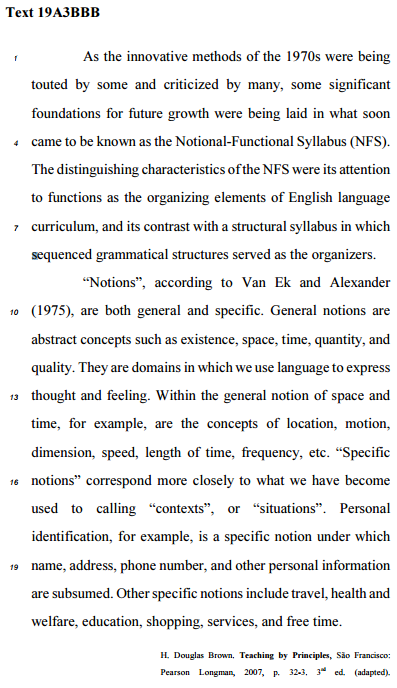
Judge the following item according to text 19A3BBB.

In the first paragraph, both “innovative” (l.1) and “characteristics” (l.5) are pronounced with the primary stress on the first syllable


Provas

Questão presente nas seguintes provas
784814 Ano: 2017
Disciplina: Inglês (Língua Inglesa)
Banca: CESPE / CEBRASPE
Orgão: SEE-DF

Enunciado 784814-1

Judge the following item according to text 19A3BBB.

In the first paragraph, “As” is a conjunction used to convey time.


Provas

Questão presente nas seguintes provas
784813 Ano: 2017
Disciplina: Inglês (Língua Inglesa)
Banca: CESPE / CEBRASPE
Orgão: SEE-DF

Enunciado 784813-1

Judge the following item according to text 19A3BBB.

In the second paragraph, the word “subsumed” (.20) means included.


Provas

Questão presente nas seguintes provas
784812 Ano: 2017
Disciplina: Inglês (Língua Inglesa)
Banca: CESPE / CEBRASPE
Orgão: SEE-DF

Enunciado 784812-1

Judge the following item according to text 19A3BBB.

It is correct to replace “calling” with call in the phrase “used to calling” (l.17).


Provas

Questão presente nas seguintes provas
784811 Ano: 2017
Disciplina: Inglês (Língua Inglesa)
Banca: CESPE / CEBRASPE
Orgão: SEE-DF

Enunciado 784811-1

Judge the following item according to text 19A3BBB.

In the first paragraph, the word “touted” (l.2) means questioned.


Provas
Questão presente nas seguintes provas
784810 Ano: 2017
Disciplina: Inglês (Língua Inglesa)
Banca: CESPE / CEBRASPE
Orgão: SEE-DF

Enunciado 784810-1

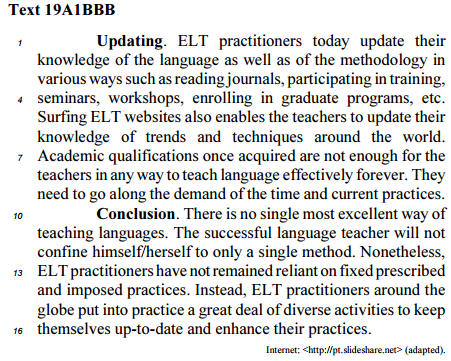
Based on the text 19A1BBB, judge the following item.

It can be concluded from the text that current times call for action, change and diversity in language teaching.


Provas

Questão presente nas seguintes provas
784809 Ano: 2017
Disciplina: Inglês (Língua Inglesa)
Banca: CESPE / CEBRASPE
Orgão: SEE-DF

Enunciado 784809-1

Based on the text 19A1BBB, judge the following item.

The word “Instead” (l.14) can be correctly replaced by Moreover.


Provas

Questão presente nas seguintes provas