Foram encontradas 70 questões.
How space technology is bringing
green wins for transport
1 Space technology is developing fast, and, with
every advance, it is becoming more accessible to
industry. Today, satellite communications (satcoms)
and space-based data are underpinning new ways
of operating that boost both sustainability and
profitability. Some projects are still in the planning
stages, offering great promise for the future. However,
others are already delivering practical results.
2 The benefits of space technology broadly fall
into two categories: connectivity that can reach into
situations where terrestrial technologies struggle to
deliver and the deep, unique insights delivered by
Earth Observation (EO) data. Both depend on access
to satellite networks, particularly medium earth orbit
(MEO) and low earth orbit (LEO) satellites that offer
low-latency connectivity and frequently updated data.
Right now, the satellite supplier market is booming,
driving down the cost of access to satellites. Suppliers
are increasingly tailoring their services to emerging
customer needs and the potential applications are
incredible – as a look at the transportation sector
shows.
3 Satellite technology is a critical part of
revolutionizing connectivity on trains. The Satellites
for Digitalization of Railways (SODOR) project will
provide low latency, highly reliable connectivity that,
combined with monitoring sensors, will mean near realtime data guides operational decisions. This insight
will help trains run more efficiently with fewer delays
for passengers. Launching this year, SODOR will help
operators reduce emissions by using the network
more efficiently, allowing preventative maintenance
and extending the lifetime of some existing trains. It
will also make rail travel more attractive and help shift
more passengers from road to rail (that typically emits
even less CO2
per passenger than electric cars do).
4 Satellite data and communications will also play
a fundamental role in shaping a sustainable future
for road vehicles. Right now, the transport sector
contributes around 14% of the UK’s greenhouse gas
emissions, of which 91% is from road vehicles – and
this needs to change.
5 A future where Electric Vehicles (EV) dominate
will need a smart infrastructure to monitor and control
the electricity network, managing highly variable
supply and demand, as well as a large network of
EV charging points. EO data will be critical in future
forecasting models for wind and solar production, to
help manage a consistent flow of green energy.
6 Satellite communications will also be pivotal. As
more wind and solar installations join the electricity
network – often in remote locations – satcoms will step in to deliver highly reliable connectivity where 4G
struggles to reach. It will underpin a growing network
of EV charging points, connecting each point to the
internet for operational management purposes, for
billing and access app functionality and for the users’
comfort, they may access the system wherever they
are.
7 Satellite technology will increasingly be a part of
the vehicles themselves, particularly when automated
driving becomes more mainstream. It will be essential
for every vehicle to have continuous connectivity to
support real-time software patches, map updates
and inter-vehicle communications. Already, satellites
provide regular software updates to vehicles and
enhanced safety through an in-car emergency call
service.
8 At our company, we have been deeply embedded
in the space engineering for more than 40 years – and
we continue to be involved with the state-of-the-art
technologies and use cases. We have a strong track
record of translating these advances into practical
benefits for our customers that make sense on both a
business and a sustainability level.
Available at: https://www.cgi.com/uk/en-gb/blog/space/how-space-technology-is-bringing-green-wins-to-transport. Retrieved on
April 25, 2023. Adapted.
Provas
Questão presente nas seguintes provas

How space technology is bringing
green wins for transport
1 Space technology is developing fast, and, with
every advance, it is becoming more accessible to
industry. Today, satellite communications (satcoms)
and space-based data are underpinning new ways
of operating that boost both sustainability and
profitability. Some projects are still in the planning
stages, offering great promise for the future. However,
others are already delivering practical results.
2 The benefits of space technology broadly fall
into two categories: connectivity that can reach into
situations where terrestrial technologies struggle to
deliver and the deep, unique insights delivered by
Earth Observation (EO) data. Both depend on access
to satellite networks, particularly medium earth orbit
(MEO) and low earth orbit (LEO) satellites that offer
low-latency connectivity and frequently updated data.
Right now, the satellite supplier market is booming,
driving down the cost of access to satellites. Suppliers
are increasingly tailoring their services to emerging
customer needs and the potential applications are
incredible – as a look at the transportation sector
shows.
3 Satellite technology is a critical part of
revolutionizing connectivity on trains. The Satellites
for Digitalization of Railways (SODOR) project will
provide low latency, highly reliable connectivity that,
combined with monitoring sensors, will mean near realtime data guides operational decisions. This insight
will help trains run more efficiently with fewer delays
for passengers. Launching this year, SODOR will help
operators reduce emissions by using the network
more efficiently, allowing preventative maintenance
and extending the lifetime of some existing trains. It
will also make rail travel more attractive and help shift
more passengers from road to rail (that typically emits
even less CO2
per passenger than electric cars do).
4 Satellite data and communications will also play
a fundamental role in shaping a sustainable future
for road vehicles. Right now, the transport sector
contributes around 14% of the UK’s greenhouse gas
emissions, of which 91% is from road vehicles – and
this needs to change.
5 A future where Electric Vehicles (EV) dominate
will need a smart infrastructure to monitor and control
the electricity network, managing highly variable
supply and demand, as well as a large network of
EV charging points. EO data will be critical in future
forecasting models for wind and solar production, to
help manage a consistent flow of green energy.
6 Satellite communications will also be pivotal. As
more wind and solar installations join the electricity
network – often in remote locations – satcoms will step in to deliver highly reliable connectivity where 4G
struggles to reach. It will underpin a growing network
of EV charging points, connecting each point to the
internet for operational management purposes, for
billing and access app functionality and for the users’
comfort, they may access the system wherever they
are.
7 Satellite technology will increasingly be a part of
the vehicles themselves, particularly when automated
driving becomes more mainstream. It will be essential
for every vehicle to have continuous connectivity to
support real-time software patches, map updates
and inter-vehicle communications. Already, satellites
provide regular software updates to vehicles and
enhanced safety through an in-car emergency call
service.
8 At our company, we have been deeply embedded
in the space engineering for more than 40 years – and
we continue to be involved with the state-of-the-art
technologies and use cases. We have a strong track
record of translating these advances into practical
benefits for our customers that make sense on both a
business and a sustainability level.
Available at: https://www.cgi.com/uk/en-gb/blog/space/how-space-technology-is-bringing-green-wins-to-transport. Retrieved on
April 25, 2023. Adapted.
Provas
Questão presente nas seguintes provas
How space technology is bringing
green wins for transport
1 Space technology is developing fast, and, with
every advance, it is becoming more accessible to
industry. Today, satellite communications (satcoms)
and space-based data are underpinning new ways
of operating that boost both sustainability and
profitability. Some projects are still in the planning
stages, offering great promise for the future. However,
others are already delivering practical results.
2 The benefits of space technology broadly fall
into two categories: connectivity that can reach into
situations where terrestrial technologies struggle to
deliver and the deep, unique insights delivered by
Earth Observation (EO) data. Both depend on access
to satellite networks, particularly medium earth orbit
(MEO) and low earth orbit (LEO) satellites that offer
low-latency connectivity and frequently updated data.
Right now, the satellite supplier market is booming,
driving down the cost of access to satellites. Suppliers
are increasingly tailoring their services to emerging
customer needs and the potential applications are
incredible – as a look at the transportation sector
shows.
3 Satellite technology is a critical part of
revolutionizing connectivity on trains. The Satellites
for Digitalization of Railways (SODOR) project will
provide low latency, highly reliable connectivity that,
combined with monitoring sensors, will mean near realtime data guides operational decisions. This insight
will help trains run more efficiently with fewer delays
for passengers. Launching this year, SODOR will help
operators reduce emissions by using the network
more efficiently, allowing preventative maintenance
and extending the lifetime of some existing trains. It
will also make rail travel more attractive and help shift
more passengers from road to rail (that typically emits
even less CO2
per passenger than electric cars do).
4 Satellite data and communications will also play
a fundamental role in shaping a sustainable future
for road vehicles. Right now, the transport sector
contributes around 14% of the UK’s greenhouse gas
emissions, of which 91% is from road vehicles – and
this needs to change.
5 A future where Electric Vehicles (EV) dominate
will need a smart infrastructure to monitor and control
the electricity network, managing highly variable
supply and demand, as well as a large network of
EV charging points. EO data will be critical in future
forecasting models for wind and solar production, to
help manage a consistent flow of green energy.
6 Satellite communications will also be pivotal. As
more wind and solar installations join the electricity
network – often in remote locations – satcoms will step in to deliver highly reliable connectivity where 4G
struggles to reach. It will underpin a growing network
of EV charging points, connecting each point to the
internet for operational management purposes, for
billing and access app functionality and for the users’
comfort, they may access the system wherever they
are.
7 Satellite technology will increasingly be a part of
the vehicles themselves, particularly when automated
driving becomes more mainstream. It will be essential
for every vehicle to have continuous connectivity to
support real-time software patches, map updates
and inter-vehicle communications. Already, satellites
provide regular software updates to vehicles and
enhanced safety through an in-car emergency call
service.
8 At our company, we have been deeply embedded
in the space engineering for more than 40 years – and
we continue to be involved with the state-of-the-art
technologies and use cases. We have a strong track
record of translating these advances into practical
benefits for our customers that make sense on both a
business and a sustainability level.
Available at: https://www.cgi.com/uk/en-gb/blog/space/how-space-technology-is-bringing-green-wins-to-transport. Retrieved on
April 25, 2023. Adapted.
Provas
Questão presente nas seguintes provas
How space technology is bringing
green wins for transport
1 Space technology is developing fast, and, with
every advance, it is becoming more accessible to
industry. Today, satellite communications (satcoms)
and space-based data are underpinning new ways
of operating that boost both sustainability and
profitability. Some projects are still in the planning
stages, offering great promise for the future. However,
others are already delivering practical results.
2 The benefits of space technology broadly fall
into two categories: connectivity that can reach into
situations where terrestrial technologies struggle to
deliver and the deep, unique insights delivered by
Earth Observation (EO) data. Both depend on access
to satellite networks, particularly medium earth orbit
(MEO) and low earth orbit (LEO) satellites that offer
low-latency connectivity and frequently updated data.
Right now, the satellite supplier market is booming,
driving down the cost of access to satellites. Suppliers
are increasingly tailoring their services to emerging
customer needs and the potential applications are
incredible – as a look at the transportation sector
shows.
3 Satellite technology is a critical part of
revolutionizing connectivity on trains. The Satellites
for Digitalization of Railways (SODOR) project will
provide low latency, highly reliable connectivity that,
combined with monitoring sensors, will mean near realtime data guides operational decisions. This insight
will help trains run more efficiently with fewer delays
for passengers. Launching this year, SODOR will help
operators reduce emissions by using the network
more efficiently, allowing preventative maintenance
and extending the lifetime of some existing trains. It
will also make rail travel more attractive and help shift
more passengers from road to rail (that typically emits
even less CO2
per passenger than electric cars do).
4 Satellite data and communications will also play
a fundamental role in shaping a sustainable future
for road vehicles. Right now, the transport sector
contributes around 14% of the UK’s greenhouse gas
emissions, of which 91% is from road vehicles – and
this needs to change.
5 A future where Electric Vehicles (EV) dominate
will need a smart infrastructure to monitor and control
the electricity network, managing highly variable
supply and demand, as well as a large network of
EV charging points. EO data will be critical in future
forecasting models for wind and solar production, to
help manage a consistent flow of green energy.
6 Satellite communications will also be pivotal. As
more wind and solar installations join the electricity
network – often in remote locations – satcoms will step in to deliver highly reliable connectivity where 4G
struggles to reach. It will underpin a growing network
of EV charging points, connecting each point to the
internet for operational management purposes, for
billing and access app functionality and for the users’
comfort, they may access the system wherever they
are.
7 Satellite technology will increasingly be a part of
the vehicles themselves, particularly when automated
driving becomes more mainstream. It will be essential
for every vehicle to have continuous connectivity to
support real-time software patches, map updates
and inter-vehicle communications. Already, satellites
provide regular software updates to vehicles and
enhanced safety through an in-car emergency call
service.
8 At our company, we have been deeply embedded
in the space engineering for more than 40 years – and
we continue to be involved with the state-of-the-art
technologies and use cases. We have a strong track
record of translating these advances into practical
benefits for our customers that make sense on both a
business and a sustainability level.
Available at: https://www.cgi.com/uk/en-gb/blog/space/how-space-technology-is-bringing-green-wins-to-transport. Retrieved on
April 25, 2023. Adapted.
Provas
Questão presente nas seguintes provas
How space technology is bringing
green wins for transport
1 Space technology is developing fast, and, with
every advance, it is becoming more accessible to
industry. Today, satellite communications (satcoms)
and space-based data are underpinning new ways
of operating that boost both sustainability and
profitability. Some projects are still in the planning
stages, offering great promise for the future. However,
others are already delivering practical results.
2 The benefits of space technology broadly fall
into two categories: connectivity that can reach into
situations where terrestrial technologies struggle to
deliver and the deep, unique insights delivered by
Earth Observation (EO) data. Both depend on access
to satellite networks, particularly medium earth orbit
(MEO) and low earth orbit (LEO) satellites that offer
low-latency connectivity and frequently updated data.
Right now, the satellite supplier market is booming,
driving down the cost of access to satellites. Suppliers
are increasingly tailoring their services to emerging
customer needs and the potential applications are
incredible – as a look at the transportation sector
shows.
3 Satellite technology is a critical part of
revolutionizing connectivity on trains. The Satellites
for Digitalization of Railways (SODOR) project will
provide low latency, highly reliable connectivity that,
combined with monitoring sensors, will mean near realtime data guides operational decisions. This insight
will help trains run more efficiently with fewer delays
for passengers. Launching this year, SODOR will help
operators reduce emissions by using the network
more efficiently, allowing preventative maintenance
and extending the lifetime of some existing trains. It
will also make rail travel more attractive and help shift
more passengers from road to rail (that typically emits
even less CO2
per passenger than electric cars do).
4 Satellite data and communications will also play
a fundamental role in shaping a sustainable future
for road vehicles. Right now, the transport sector
contributes around 14% of the UK’s greenhouse gas
emissions, of which 91% is from road vehicles – and
this needs to change.
5 A future where Electric Vehicles (EV) dominate
will need a smart infrastructure to monitor and control
the electricity network, managing highly variable
supply and demand, as well as a large network of
EV charging points. EO data will be critical in future
forecasting models for wind and solar production, to
help manage a consistent flow of green energy.
6 Satellite communications will also be pivotal. As
more wind and solar installations join the electricity
network – often in remote locations – satcoms will step in to deliver highly reliable connectivity where 4G
struggles to reach. It will underpin a growing network
of EV charging points, connecting each point to the
internet for operational management purposes, for
billing and access app functionality and for the users’
comfort, they may access the system wherever they
are.
7 Satellite technology will increasingly be a part of
the vehicles themselves, particularly when automated
driving becomes more mainstream. It will be essential
for every vehicle to have continuous connectivity to
support real-time software patches, map updates
and inter-vehicle communications. Already, satellites
provide regular software updates to vehicles and
enhanced safety through an in-car emergency call
service.
8 At our company, we have been deeply embedded
in the space engineering for more than 40 years – and
we continue to be involved with the state-of-the-art
technologies and use cases. We have a strong track
record of translating these advances into practical
benefits for our customers that make sense on both a
business and a sustainability level.
Available at: https://www.cgi.com/uk/en-gb/blog/space/how-space-technology-is-bringing-green-wins-to-transport. Retrieved on
April 25, 2023. Adapted.
Provas
Questão presente nas seguintes provas
How space technology is bringing
green wins for transport
1 Space technology is developing fast, and, with
every advance, it is becoming more accessible to
industry. Today, satellite communications (satcoms)
and space-based data are underpinning new ways
of operating that boost both sustainability and
profitability. Some projects are still in the planning
stages, offering great promise for the future. However,
others are already delivering practical results.
2 The benefits of space technology broadly fall
into two categories: connectivity that can reach into
situations where terrestrial technologies struggle to
deliver and the deep, unique insights delivered by
Earth Observation (EO) data. Both depend on access
to satellite networks, particularly medium earth orbit
(MEO) and low earth orbit (LEO) satellites that offer
low-latency connectivity and frequently updated data.
Right now, the satellite supplier market is booming,
driving down the cost of access to satellites. Suppliers
are increasingly tailoring their services to emerging
customer needs and the potential applications are
incredible – as a look at the transportation sector
shows.
3 Satellite technology is a critical part of
revolutionizing connectivity on trains. The Satellites
for Digitalization of Railways (SODOR) project will
provide low latency, highly reliable connectivity that,
combined with monitoring sensors, will mean near realtime data guides operational decisions. This insight
will help trains run more efficiently with fewer delays
for passengers. Launching this year, SODOR will help
operators reduce emissions by using the network
more efficiently, allowing preventative maintenance
and extending the lifetime of some existing trains. It
will also make rail travel more attractive and help shift
more passengers from road to rail (that typically emits
even less CO2
per passenger than electric cars do).
4 Satellite data and communications will also play
a fundamental role in shaping a sustainable future
for road vehicles. Right now, the transport sector
contributes around 14% of the UK’s greenhouse gas
emissions, of which 91% is from road vehicles – and
this needs to change.
5 A future where Electric Vehicles (EV) dominate
will need a smart infrastructure to monitor and control
the electricity network, managing highly variable
supply and demand, as well as a large network of
EV charging points. EO data will be critical in future
forecasting models for wind and solar production, to
help manage a consistent flow of green energy.
6 Satellite communications will also be pivotal. As
more wind and solar installations join the electricity
network – often in remote locations – satcoms will step in to deliver highly reliable connectivity where 4G
struggles to reach. It will underpin a growing network
of EV charging points, connecting each point to the
internet for operational management purposes, for
billing and access app functionality and for the users’
comfort, they may access the system wherever they
are.
7 Satellite technology will increasingly be a part of
the vehicles themselves, particularly when automated
driving becomes more mainstream. It will be essential
for every vehicle to have continuous connectivity to
support real-time software patches, map updates
and inter-vehicle communications. Already, satellites
provide regular software updates to vehicles and
enhanced safety through an in-car emergency call
service.
8 At our company, we have been deeply embedded
in the space engineering for more than 40 years – and
we continue to be involved with the state-of-the-art
technologies and use cases. We have a strong track
record of translating these advances into practical
benefits for our customers that make sense on both a
business and a sustainability level.
Available at: https://www.cgi.com/uk/en-gb/blog/space/how-space-technology-is-bringing-green-wins-to-transport. Retrieved on
April 25, 2023. Adapted.
Provas
Questão presente nas seguintes provas
How space technology is bringing
green wins for transport
1 Space technology is developing fast, and, with
every advance, it is becoming more accessible to
industry. Today, satellite communications (satcoms)
and space-based data are underpinning new ways
of operating that boost both sustainability and
profitability. Some projects are still in the planning
stages, offering great promise for the future. However,
others are already delivering practical results.
2 The benefits of space technology broadly fall
into two categories: connectivity that can reach into
situations where terrestrial technologies struggle to
deliver and the deep, unique insights delivered by
Earth Observation (EO) data. Both depend on access
to satellite networks, particularly medium earth orbit
(MEO) and low earth orbit (LEO) satellites that offer
low-latency connectivity and frequently updated data.
Right now, the satellite supplier market is booming,
driving down the cost of access to satellites. Suppliers
are increasingly tailoring their services to emerging
customer needs and the potential applications are
incredible – as a look at the transportation sector
shows.
3 Satellite technology is a critical part of
revolutionizing connectivity on trains. The Satellites
for Digitalization of Railways (SODOR) project will
provide low latency, highly reliable connectivity that,
combined with monitoring sensors, will mean near realtime data guides operational decisions. This insight
will help trains run more efficiently with fewer delays
for passengers. Launching this year, SODOR will help
operators reduce emissions by using the network
more efficiently, allowing preventative maintenance
and extending the lifetime of some existing trains. It
will also make rail travel more attractive and help shift
more passengers from road to rail (that typically emits
even less CO2
per passenger than electric cars do).
4 Satellite data and communications will also play
a fundamental role in shaping a sustainable future
for road vehicles. Right now, the transport sector
contributes around 14% of the UK’s greenhouse gas
emissions, of which 91% is from road vehicles – and
this needs to change.
5 A future where Electric Vehicles (EV) dominate
will need a smart infrastructure to monitor and control
the electricity network, managing highly variable
supply and demand, as well as a large network of
EV charging points. EO data will be critical in future
forecasting models for wind and solar production, to
help manage a consistent flow of green energy.
6 Satellite communications will also be pivotal. As
more wind and solar installations join the electricity
network – often in remote locations – satcoms will step in to deliver highly reliable connectivity where 4G
struggles to reach. It will underpin a growing network
of EV charging points, connecting each point to the
internet for operational management purposes, for
billing and access app functionality and for the users’
comfort, they may access the system wherever they
are.
7 Satellite technology will increasingly be a part of
the vehicles themselves, particularly when automated
driving becomes more mainstream. It will be essential
for every vehicle to have continuous connectivity to
support real-time software patches, map updates
and inter-vehicle communications. Already, satellites
provide regular software updates to vehicles and
enhanced safety through an in-car emergency call
service.
8 At our company, we have been deeply embedded
in the space engineering for more than 40 years – and
we continue to be involved with the state-of-the-art
technologies and use cases. We have a strong track
record of translating these advances into practical
benefits for our customers that make sense on both a
business and a sustainability level.
Available at: https://www.cgi.com/uk/en-gb/blog/space/how-space-technology-is-bringing-green-wins-to-transport. Retrieved on
April 25, 2023. Adapted.
Provas
Questão presente nas seguintes provas
Um empréstimo no valor de R$ 200 mil foi realizado em
janeiro de 2023, a uma taxa de juro de 10% ao ano, no
regime de juros compostos. O plano de pagamentos da
dívida, apresentado na Tabela a seguir, é composto por
3 parcelas, a serem pagas, respectivamente, após exatos
1, 2 e 3 anos a partir da data do empréstimo.
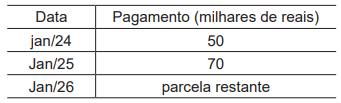
Para liquidar a dívida, a quantia, em milhares de reais, que mais se aproxima do valor da terceira parcela, é igual a
Para liquidar a dívida, a quantia, em milhares de reais, que mais se aproxima do valor da terceira parcela, é igual a
Provas
Questão presente nas seguintes provas
Um levantamento realizado pela direção da empresa W
Transportes mostrou que o ciclo de vida médio dos clientes corporativos de serviços de transportes é de 6 anos.
Se o objetivo da direção é que o valor da relação comercial de cada cliente corporativo seja, no mínimo, de R$ 300.000,00, qual deve ser o montante mínimo de negócios mensais de cada cliente da empresa?
Se o objetivo da direção é que o valor da relação comercial de cada cliente corporativo seja, no mínimo, de R$ 300.000,00, qual deve ser o montante mínimo de negócios mensais de cada cliente da empresa?
Provas
Questão presente nas seguintes provas
Uma empresa distribui, em média, 500 ventiladores por dia,
com um desvio padrão de 100 unidades. O fornecedor entrega, em média, 500 ventiladores a cada 10 dias, com um
desvio padrão de 2 dias. Essa empresa quer ter produtos
em estoque para manter um nível de serviço de 95%.
A empresa usa, como fórmula do estoque de segurança,
a seguinte equação:
SS = z x (μD x σL)2 + (μL x σD)2
Onde:
• SS é o estoque de segurança;
• z é o fator de segurança, que depende do nível de serviço desejado;
• μD é a demanda média diária;
• σD é o desvio padrão da demanda diária;
• μL é o tempo médio de entrega; e
• σL é o desvio padrão do tempo de entrega.
O valor de z, para um nível de confiança de 95%, é dado pela distribuição normal e é igual a z = 1,65.
Nesse cenário, quantos ventiladores deverão ser mantidos no estoque de segurança?
SS = z x (μD x σL)2 + (μL x σD)2
Onde:
• SS é o estoque de segurança;
• z é o fator de segurança, que depende do nível de serviço desejado;
• μD é a demanda média diária;
• σD é o desvio padrão da demanda diária;
• μL é o tempo médio de entrega; e
• σL é o desvio padrão do tempo de entrega.
O valor de z, para um nível de confiança de 95%, é dado pela distribuição normal e é igual a z = 1,65.
Nesse cenário, quantos ventiladores deverão ser mantidos no estoque de segurança?
Provas
Questão presente nas seguintes provas
Cadernos
Caderno Container