Foram encontradas 60 questões.
Texto I
Cachorro Velho aproximou do rosto a borda da cuia e cheirou. O aroma do café adoçado com mel lhe entrou em cheio, reconfortando-o.
Sempre cheirava primeiro. Já era um costume, um ritual aprendido com os anos. Uniu os lábios grossos e bebeu um gole. O líquido desceu numa onda ardente até seu estômago.
Texto II
O feitor tocou o sino e todos se aproximaram do pátio central. O sol da manhã era suave e o vento trazia, quase imperceptível, o cheiro enjoativo da moenda.
Os ajudantes do feitor entregavam às mulheres umas batas de tecido cru, com bolsos grandes, e lenços coloridos. Os homens receberam camisas grossas e calças para o trabalho no campo.
Texto III
Rodeava o engenho um denso manto verde. Troncos de todos os formatos, folhas de cores variadas, flores com todos os perfumes.
CÁRDENAS, Teresa. Cachorro Velho. Rio de Janeiro: Palhas, 2010. p. 07, 51, 61.
Na trama, a caracterização dos personagens de Aroni e Ulundi são indicativas de uma visão
Provas

Texto I
Cachorro Velho aproximou do rosto a borda da cuia e cheirou. O aroma do café adoçado com mel lhe entrou em cheio, reconfortando-o.
Sempre cheirava primeiro. Já era um costume, um ritual aprendido com os anos. Uniu os lábios grossos e bebeu um gole. O líquido desceu numa onda ardente até seu estômago.
Texto II
O feitor tocou o sino e todos se aproximaram do pátio central. O sol da manhã era suave e o vento trazia, quase imperceptível, o cheiro enjoativo da moenda.
Os ajudantes do feitor entregavam às mulheres umas batas de tecido cru, com bolsos grandes, e lenços coloridos. Os homens receberam camisas grossas e calças para o trabalho no campo.
Texto III
Rodeava o engenho um denso manto verde. Troncos de todos os formatos, folhas de cores variadas, flores com todos os perfumes.
CÁRDENAS, Teresa. Cachorro Velho. Rio de Janeiro: Palhas, 2010. p. 07, 51, 61.
Os fragmentos assinalam um procedimento linguístico relevante na narrativa de Cachorro Velho. Trata-se da
Provas
How a young student’s innovative idea hopes to boost response times for EMTs
By Woody Brown on June 1, 2015
Drones have been at the forefront of the national conversation for years now. As the components needed to create them grow smaller and more affordable, many companies and organizations have started exploring the potential that drones could have to improve our daily lives. Whether by delivering a product with unprecedented speed or taking photographs and video from new heights, drones have many capabilities, most of which we have yet to discover. One young man, however, has envisioned a new way to use drones that could save thousands of lives.
One of the greatest obstacles facing first responders and emergency medical technicians [EMTs] when it comes to the difficult business of saving lives is time. Think of your daily commute: people in the United States spend an average of 25.5 minutes traveling one-way to work every day. In bumperto- bumper traffic, blaring sirens and flashing lights are often not enough to clear a fast path for an ambulance to reach someone in need. During cardiac arrest, there are, at most, a few minutes to save a person’s life. After that, the mortality rate rises steeply. With stakes this high, every second counts.
Alec Momont, a graduate student in engineering at Delft University of Technology in the Netherlands, recognized this problem and saw a way to significantly reduce deaths that result from delayed emergency care. What if ambulances could fly? Or rather, what if we could make a drone that functioned like a stripped-down, lightweight automatic external defibrillator [AED]? AEDs, which can be found in schools, sports arenas and many government buildings, are significantly more effective than cardiopulmonary resuscitation [CPR] at preventing fatalities resulting from cardiac arrest. CPR can be helpful, but an AED is better, and very few people have AEDs in their cars or homes.
As his master’s degree project, Momont built a prototype of this lifesaving drone. It contained an AED, a microphone and speakers. The average travel time, according to him, could be cut by 90 percent. Here’s how it works: In the event of cardiac arrest, a paramedic would respond to a call by flying the drone at a speed of 60 mph to the scene of the emergency. The paramedic would then give instructions to someone near the victim, who would position the AED. Once in place, the AED would operate automatically. The paramedic would be able to see through the camera whether or not the pads on the AED have been correctly positioned, and how the victim responds.
A dramatized video released by Momont’s university demonstrates all of this functionality. In it, a young woman calls emergency services in a panic because her father has had a heart attack. A calm-voiced EMT answers and guides her through the surprisingly simple process of finding and using the drone. Fewer than two minutes after she makes the call, her father sits up and hugs her.
The ambulance drone can increase the chances of surviving cardiac arrest from eight percent to 80 percent, Momont says in the video. The drone’s ability to travel as the crow flies frees it from infrastructural limitations that currently impede road-bound ambulances. “Using advanced production techniques such as 3D printed microstructures and carbon fiber frame construction, we were able to achieve a very lightweight design,” Momont says. “The result is an integrated solution that is clear in its orientation and friendly in appearance.”
Momont’s aim is to rapidly expand the existing framework of emergency services by constructing many of these drones over the next five years. Expenses are low: each drone is relatively cheap to make, about $18,600. By comparison, a typical ambulance costs more than $100,000, and a ride in one usually costs more than $1,000.
The ambulance drones can even fly autonomously (though legislation in many countries does not permit this yet). Several emergency service providers have already expressed interest. If the technology continues to receive financial support from other parties in the healthcare industry, Momont’s dream could very easily become a reality.
We live in a world where drones have, so far, been used mostly in armed conflict. Momont, however, has a different vision. In the near future that he describes, tens of thousands of needless deaths will be prevented with his ingenious invention. That is certainly welcome news, especially in the United States, which deals with skyrocketing numbers of heart-related ailments and disabilities. “Let’s use drones for a good purpose,” Momont says. “Let us use drones to save lives.”
Adapted from: <http://www.verizonwireless.com/news/article/2015/05/ambulance-dronescould- save-thousands-of-lives.html>. Access on: 03 Oct. 2016.
The following statements are based on the information presented in the text:
I- Life-saving drones are more economically viable than ordinary ambulances.
II- As ambulance drones are lightweight, they can fly autonomously.
III- Drones reach an average speed of 60mph, because their frame is made of carbon fiber.
IV- Once drones are able to travel as the crow flies, they can escape from the traffic jams and arrive fast at the emergency scene.
The correct statements are
Provas
How a young student’s innovative idea hopes to boost response times for EMTs
By Woody Brown on June 1, 2015
Drones have been at the forefront of the national conversation for years now. As the components needed to create them grow smaller and more affordable, many companies and organizations have started exploring the potential that drones could have to improve our daily lives. Whether by delivering a product with unprecedented speed or taking photographs and video from new heights, drones have many capabilities, most of which we have yet to discover. One young man, however, has envisioned a new way to use drones that could save thousands of lives.
One of the greatest obstacles facing first responders and emergency medical technicians [EMTs] when it comes to the difficult business of saving lives is time. Think of your daily commute: people in the United States spend an average of 25.5 minutes traveling one-way to work every day. In bumperto- bumper traffic, blaring sirens and flashing lights are often not enough to clear a fast path for an ambulance to reach someone in need. During cardiac arrest, there are, at most, a few minutes to save a person’s life. After that, the mortality rate rises steeply. With stakes this high, every second counts.
Alec Momont, a graduate student in engineering at Delft University of Technology in the Netherlands, recognized this problem and saw a way to significantly reduce deaths that result from delayed emergency care. What if ambulances could fly? Or rather, what if we could make a drone that functioned like a stripped-down, lightweight automatic external defibrillator [AED]? AEDs, which can be found in schools, sports arenas and many government buildings, are significantly more effective than cardiopulmonary resuscitation [CPR] at preventing fatalities resulting from cardiac arrest. CPR can be helpful, but an AED is better, and very few people have AEDs in their cars or homes.
As his master’s degree project, Momont built a prototype of this lifesaving drone. It contained an AED, a microphone and speakers. The average travel time, according to him, could be cut by 90 percent. Here’s how it works: In the event of cardiac arrest, a paramedic would respond to a call by flying the drone at a speed of 60 mph to the scene of the emergency. The paramedic would then give instructions to someone near the victim, who would position the AED. Once in place, the AED would operate automatically. The paramedic would be able to see through the camera whether or not the pads on the AED have been correctly positioned, and how the victim responds.
A dramatized video released by Momont’s university demonstrates all of this functionality. In it, a young woman calls emergency services in a panic because her father has had a heart attack. A calm-voiced EMT answers and guides her through the surprisingly simple process of finding and using the drone. Fewer than two minutes after she makes the call, her father sits up and hugs her.
The ambulance drone can increase the chances of surviving cardiac arrest from eight percent to 80 percent, Momont says in the video. The drone’s ability to travel as the crow flies frees it from infrastructural limitations that currently impede road-bound ambulances. “Using advanced production techniques such as 3D printed microstructures and carbon fiber frame construction, we were able to achieve a very lightweight design,” Momont says. “The result is an integrated solution that is clear in its orientation and friendly in appearance.”
Momont’s aim is to rapidly expand the existing framework of emergency services by constructing many of these drones over the next five years. Expenses are low: each drone is relatively cheap to make, about $18,600. By comparison, a typical ambulance costs more than $100,000, and a ride in one usually costs more than $1,000.
The ambulance drones can even fly autonomously (though legislation in many countries does not permit this yet). Several emergency service providers have already expressed interest. If the technology continues to receive financial support from other parties in the healthcare industry, Momont’s dream could very easily become a reality.
We live in a world where drones have, so far, been used mostly in armed conflict. Momont, however, has a different vision. In the near future that he describes, tens of thousands of needless deaths will be prevented with his ingenious invention. That is certainly welcome news, especially in the United States, which deals with skyrocketing numbers of heart-related ailments and disabilities. “Let’s use drones for a good purpose,” Momont says. “Let us use drones to save lives.”
Adapted from: <http://www.verizonwireless.com/news/article/2015/05/ambulance-dronescould- save-thousands-of-lives.html>. Access on: 03 Oct. 2016.
The main purpose of this text is to
Provas
How a young student’s innovative idea hopes to boost response times for EMTs
By Woody Brown on June 1, 2015
Drones have been at the forefront of the national conversation for years now. As the components needed to create them grow smaller and more affordable, many companies and organizations have started exploring the potential that drones could have to improve our daily lives. Whether by delivering a product with unprecedented speed or taking photographs and video from new heights, drones have many capabilities, most of which we have yet to discover. One young man, however, has envisioned a new way to use drones that could save thousands of lives.
One of the greatest obstacles facing first responders and emergency medical technicians [EMTs] when it comes to the difficult business of saving lives is time. Think of your daily commute: people in the United States spend an average of 25.5 minutes traveling one-way to work every day. In bumperto- bumper traffic, blaring sirens and flashing lights are often not enough to clear a fast path for an ambulance to reach someone in need. During cardiac arrest, there are, at most, a few minutes to save a person’s life. After that, the mortality rate rises steeply. With stakes this high, every second counts.
Alec Momont, a graduate student in engineering at Delft University of Technology in the Netherlands, recognized this problem and saw a way to significantly reduce deaths that result from delayed emergency care. What if ambulances could fly? Or rather, what if we could make a drone that functioned like a stripped-down, lightweight automatic external defibrillator [AED]? AEDs, which can be found in schools, sports arenas and many government buildings, are significantly more effective than cardiopulmonary resuscitation [CPR] at preventing fatalities resulting from cardiac arrest. CPR can be helpful, but an AED is better, and very few people have AEDs in their cars or homes.
As his master’s degree project, Momont built a prototype of this lifesaving drone. It contained an AED, a microphone and speakers. The average travel time, according to him, could be cut by 90 percent. Here’s how it works: In the event of cardiac arrest, a paramedic would respond to a call by flying the drone at a speed of 60 mph to the scene of the emergency. The paramedic would then give instructions to someone near the victim, who would position the AED. Once in place, the AED would operate automatically. The paramedic would be able to see through the camera whether or not the pads on the AED have been correctly positioned, and how the victim responds.
A dramatized video released by Momont’s university demonstrates all of this functionality. In it, a young woman calls emergency services in a panic because her father has had a heart attack. A calm-voiced EMT answers and guides her through the surprisingly simple process of finding and using the drone. Fewer than two minutes after she makes the call, her father sits up and hugs her.
The ambulance drone can increase the chances of surviving cardiac arrest from eight percent to 80 percent, Momont says in the video. The drone’s ability to travel as the crow flies frees it from infrastructural limitations that currently impede road-bound ambulances. “Using advanced production techniques such as 3D printed microstructures and carbon fiber frame construction, we were able to achieve a very lightweight design,” Momont says. “The result is an integrated solution that is clear in its orientation and friendly in appearance.”
Momont’s aim is to rapidly expand the existing framework of emergency services by constructing many of these drones over the next five years. Expenses are low: each drone is relatively cheap to make, about $18,600. By comparison, a typical ambulance costs more than $100,000, and a ride in one usually costs more than $1,000.
The ambulance drones can even fly autonomously (though legislation in many countries does not permit this yet). Several emergency service providers have already expressed interest. If the technology continues to receive financial support from other parties in the healthcare industry, Momont’s dream could very easily become a reality.
We live in a world where drones have, so far, been used mostly in armed conflict. Momont, however, has a different vision. In the near future that he describes, tens of thousands of needless deaths will be prevented with his ingenious invention. That is certainly welcome news, especially in the United States, which deals with skyrocketing numbers of heart-related ailments and disabilities. “Let’s use drones for a good purpose,” Momont says. “Let us use drones to save lives.”
Adapted from: <http://www.verizonwireless.com/news/article/2015/05/ambulance-dronescould- save-thousands-of-lives.html>. Access on: 03 Oct. 2016.
The use of CAN in paragraphs 3 and 6 reveals the idea of
Provas
How a young student’s innovative idea hopes to boost response times for EMTs
By Woody Brown on June 1, 2015
Drones have been at the forefront of the national conversation for years now. As the components needed to create them grow smaller and more affordable, many companies and organizations have started exploring the potential that drones could have to improve our daily lives. Whether by delivering a product with unprecedented speed or taking photographs and video from new heights, drones have many capabilities, most of which we have yet to discover. One young man, however, has envisioned a new way to use drones that could save thousands of lives.
One of the greatest obstacles facing first responders and emergency medical technicians [EMTs] when it comes to the difficult business of saving lives is time. Think of your daily commute: people in the United States spend an average of 25.5 minutes traveling one-way to work every day. In bumperto- bumper traffic, blaring sirens and flashing lights are often not enough to clear a fast path for an ambulance to reach someone in need. During cardiac arrest, there are, at most, a few minutes to save a person’s life. After that, the mortality rate rises steeply. With stakes this high, every second counts.
Alec Momont, a graduate student in engineering at Delft University of Technology in the Netherlands, recognized this problem and saw a way to significantly reduce deaths that result from delayed emergency care. What if ambulances could fly? Or rather, what if we could make a drone that functioned like a stripped-down, lightweight automatic external defibrillator [AED]? AEDs, which can be found in schools, sports arenas and many government buildings, are significantly more effective than cardiopulmonary resuscitation [CPR] at preventing fatalities resulting from cardiac arrest. CPR can be helpful, but an AED is better, and very few people have AEDs in their cars or homes.
As his master’s degree project, Momont built a prototype of this lifesaving drone. It contained an AED, a microphone and speakers. The average travel time, according to him, could be cut by 90 percent. Here’s how it works: In the event of cardiac arrest, a paramedic would respond to a call by flying the drone at a speed of 60 mph to the scene of the emergency. The paramedic would then give instructions to someone near the victim, who would position the AED. Once in place, the AED would operate automatically. The paramedic would be able to see through the camera whether or not the pads on the AED have been correctly positioned, and how the victim responds.
A dramatized video released by Momont’s university demonstrates all of this functionality. In it, a young woman calls emergency services in a panic because her father has had a heart attack. A calm-voiced EMT answers and guides her through the surprisingly simple process of finding and using the drone. Fewer than two minutes after she makes the call, her father sits up and hugs her.
The ambulance drone can increase the chances of surviving cardiac arrest from eight percent to 80 percent, Momont says in the video. The drone’s ability to travel as the crow flies frees it from infrastructural limitations that currently impede road-bound ambulances. “Using advanced production techniques such as 3D printed microstructures and carbon fiber frame construction, we were able to achieve a very lightweight design,” Momont says. “The result is an integrated solution that is clear in its orientation and friendly in appearance.”
Momont’s aim is to rapidly expand the existing framework of emergency services by constructing many of these drones over the next five years. Expenses are low: each drone is relatively cheap to make, about $18,600. By comparison, a typical ambulance costs more than $100,000, and a ride in one usually costs more than $1,000.
The ambulance drones can even fly autonomously (though legislation in many countries does not permit this yet). Several emergency service providers have already expressed interest. If the technology continues to receive financial support from other parties in the healthcare industry, Momont’s dream could very easily become a reality.
We live in a world where drones have, so far, been used mostly in armed conflict. Momont, however, has a different vision. In the near future that he describes, tens of thousands of needless deaths will be prevented with his ingenious invention. That is certainly welcome news, especially in the United States, which deals with skyrocketing numbers of heart-related ailments and disabilities. “Let’s use drones for a good purpose,” Momont says. “Let us use drones to save lives.”
Adapted from: <http://www.verizonwireless.com/news/article/2015/05/ambulance-dronescould- save-thousands-of-lives.html>. Access on: 03 Oct. 2016.
The word that functions as an adjective in the text is
Provas
How a young student’s innovative idea hopes to boost response times for EMTs
By Woody Brown on June 1, 2015
Drones have been at the forefront of the national conversation for years now. As the components needed to create them grow smaller and more affordable, many companies and organizations have started exploring the potential that drones could have to improve our daily lives. Whether by delivering a product with unprecedented speed or taking photographs and video from new heights, drones have many capabilities, most of which we have yet to discover. One young man, however, has envisioned a new way to use drones that could save thousands of lives.
One of the greatest obstacles facing first responders and emergency medical technicians [EMTs] when it comes to the difficult business of saving lives is time. Think of your daily commute: people in the United States spend an average of 25.5 minutes traveling one-way to work every day. In bumperto- bumper traffic, blaring sirens and flashing lights are often not enough to clear a fast path for an ambulance to reach someone in need. During cardiac arrest, there are, at most, a few minutes to save a person’s life. After that, the mortality rate rises steeply. With stakes this high, every second counts.
Alec Momont, a graduate student in engineering at Delft University of Technology in the Netherlands, recognized this problem and saw a way to significantly reduce deaths that result from delayed emergency care. What if ambulances could fly? Or rather, what if we could make a drone that functioned like a stripped-down, lightweight automatic external defibrillator [AED]? AEDs, which can be found in schools, sports arenas and many government buildings, are significantly more effective than cardiopulmonary resuscitation [CPR] at preventing fatalities resulting from cardiac arrest. CPR can be helpful, but an AED is better, and very few people have AEDs in their cars or homes.
As his master’s degree project, Momont built a prototype of this lifesaving drone. It contained an AED, a microphone and speakers. The average travel time, according to him, could be cut by 90 percent. Here’s how it works: In the event of cardiac arrest, a paramedic would respond to a call by flying the drone at a speed of 60 mph to the scene of the emergency. The paramedic would then give instructions to someone near the victim, who would position the AED. Once in place, the AED would operate automatically. The paramedic would be able to see through the camera whether or not the pads on the AED have been correctly positioned, and how the victim responds.
A dramatized video released by Momont’s university demonstrates all of this functionality. In it, a young woman calls emergency services in a panic because her father has had a heart attack. A calm-voiced EMT answers and guides her through the surprisingly simple process of finding and using the drone. Fewer than two minutes after she makes the call, her father sits up and hugs her.
The ambulance drone can increase the chances of surviving cardiac arrest from eight percent to 80 percent, Momont says in the video. The drone’s ability to travel as the crow flies frees it from infrastructural limitations that currently impede road-bound ambulances. “Using advanced production techniques such as 3D printed microstructures and carbon fiber frame construction, we were able to achieve a very lightweight design,” Momont says. “The result is an integrated solution that is clear in its orientation and friendly in appearance.”
Momont’s aim is to rapidly expand the existing framework of emergency services by constructing many of these drones over the next five years. Expenses are low: each drone is relatively cheap to make, about $18,600. By comparison, a typical ambulance costs more than $100,000, and a ride in one usually costs more than $1,000.
The ambulance drones can even fly autonomously (though legislation in many countries does not permit this yet). Several emergency service providers have already expressed interest. If the technology continues to receive financial support from other parties in the healthcare industry, Momont’s dream could very easily become a reality.
We live in a world where drones have, so far, been used mostly in armed conflict. Momont, however, has a different vision. In the near future that he describes, tens of thousands of needless deaths will be prevented with his ingenious invention. That is certainly welcome news, especially in the United States, which deals with skyrocketing numbers of heart-related ailments and disabilities. “Let’s use drones for a good purpose,” Momont says. “Let us use drones to save lives.”
Adapted from: <http://www.verizonwireless.com/news/article/2015/05/ambulance-dronescould- save-thousands-of-lives.html>. Access on: 03 Oct. 2016.
Mark T (true) and F (false) for the correlations between pronouns and their referents in the text.
a) ( ) it (paragraph 5) – video.
b) ( ) who (paragraph 4) – victim.
c) ( ) them (paragraph 1) – drones.
d) ( ) which (paragraph 1) – capabilities.
The correct sequence is
Provas
How a young student’s innovative idea hopes to boost response times for EMTs
By Woody Brown on June 1, 2015
Drones have been at the forefront of the national conversation for years now. As the components needed to create them grow smaller and more affordable, many companies and organizations have started exploring the potential that drones could have to improve our daily lives. Whether by delivering a product with unprecedented speed or taking photographs and video from new heights, drones have many capabilities, most of which we have yet to discover. One young man, however, has envisioned a new way to use drones that could save thousands of lives.
One of the greatest obstacles facing first responders and emergency medical technicians [EMTs] when it comes to the difficult business of saving lives is time. Think of your daily commute: people in the United States spend an average of 25.5 minutes traveling one-way to work every day. In bumperto- bumper traffic, blaring sirens and flashing lights are often not enough to clear a fast path for an ambulance to reach someone in need. During cardiac arrest, there are, at most, a few minutes to save a person’s life. After that, the mortality rate rises steeply. With stakes this high, every second counts.
Alec Momont, a graduate student in engineering at Delft University of Technology in the Netherlands, recognized this problem and saw a way to significantly reduce deaths that result from delayed emergency care. What if ambulances could fly? Or rather, what if we could make a drone that functioned like a stripped-down, lightweight automatic external defibrillator [AED]? AEDs, which can be found in schools, sports arenas and many government buildings, are significantly more effective than cardiopulmonary resuscitation [CPR] at preventing fatalities resulting from cardiac arrest. CPR can be helpful, but an AED is better, and very few people have AEDs in their cars or homes.
As his master’s degree project, Momont built a prototype of this lifesaving drone. It contained an AED, a microphone and speakers. The average travel time, according to him, could be cut by 90 percent. Here’s how it works: In the event of cardiac arrest, a paramedic would respond to a call by flying the drone at a speed of 60 mph to the scene of the emergency. The paramedic would then give instructions to someone near the victim, who would position the AED. Once in place, the AED would operate automatically. The paramedic would be able to see through the camera whether or not the pads on the AED have been correctly positioned, and how the victim responds.
A dramatized video released by Momont’s university demonstrates all of this functionality. In it, a young woman calls emergency services in a panic because her father has had a heart attack. A calm-voiced EMT answers and guides her through the surprisingly simple process of finding and using the drone. Fewer than two minutes after she makes the call, her father sits up and hugs her.
The ambulance drone can increase the chances of surviving cardiac arrest from eight percent to 80 percent, Momont says in the video. The drone’s ability to travel as the crow flies frees it from infrastructural limitations that currently impede road-bound ambulances. “Using advanced production techniques such as 3D printed microstructures and carbon fiber frame construction, we were able to achieve a very lightweight design,” Momont says. “The result is an integrated solution that is clear in its orientation and friendly in appearance.”
Momont’s aim is to rapidly expand the existing framework of emergency services by constructing many of these drones over the next five years. Expenses are low: each drone is relatively cheap to make, about $18,600. By comparison, a typical ambulance costs more than $100,000, and a ride in one usually costs more than $1,000.
The ambulance drones can even fly autonomously (though legislation in many countries does not permit this yet). Several emergency service providers have already expressed interest. If the technology continues to receive financial support from other parties in the healthcare industry, Momont’s dream could very easily become a reality.
We live in a world where drones have, so far, been used mostly in armed conflict. Momont, however, has a different vision. In the near future that he describes, tens of thousands of needless deaths will be prevented with his ingenious invention. That is certainly welcome news, especially in the United States, which deals with skyrocketing numbers of heart-related ailments and disabilities. “Let’s use drones for a good purpose,” Momont says. “Let us use drones to save lives.”
Adapted from: <http://www.verizonwireless.com/news/article/2015/05/ambulance-dronescould- save-thousands-of-lives.html>. Access on: 03 Oct. 2016.
The word which is used as a modifier in the correspondent paragraphs is
Provas
Considere o seguinte sistema:
!$ \begin{cases} 3^y-2^x=1 \\3·2^{x-1}+6=2·3^y\end{cases} !$
Na solução desse sistema, tem-se !$ x !$ = !$ a !$ e !$ y !$ = !$ b !$. Assim, o valor da expressão !$ \dfrac{(a-3b)(b-a)}{3(b+a)} é !$
Provas
Observe as figuras.
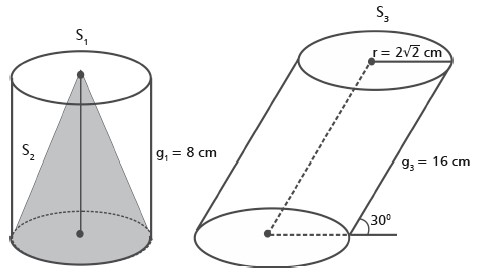
Nas figuras acima, tem-se um cilindro circular equilátero (S1), circunscrevendo um cone (S2), e um cilindro circular oblíquo (S3). A razão determinada pelo volume de S3 com a superfície total de S2 é
Provas
Caderno Container