Foram encontradas 290 questões.
É correto afirmar que a glicogenose
decorre
Provas
Questão presente nas seguintes provas

É correto afirmar que o infarto é
Provas
Questão presente nas seguintes provas
A amiloidose caracteriza-se por
deposição
Provas
Questão presente nas seguintes provas
A febre amarela que acomete primatas
não humanos ocasiona principalmente
Provas
Questão presente nas seguintes provas
As lesões decorrentes da estomatite
vesicular são macroscopicamente semelhantes
às da
Provas
Questão presente nas seguintes provas
Os termos sarcoma e carcinoma
designam, respectivamente, a neoplasia
Provas
Questão presente nas seguintes provas
How the Human Body Changes in Space
For years, TRISH (The Translational Research
Institute for Space Health) has supported
research projects and studies that aim to solve
the challenges of human exploration in space. It
is important that we know, first, the risks to
human health during space travel.
Understanding some of these risks (see below)
is essential for a successful return to the moon
in NASA’s Artemis missions.
Muscles
Astronauts experience decreased muscle
mass, strength, and endurance because
moving around requires reduced work from the
legs and back. As a result, the muscles can
begin to weaken or atrophy. To help combat
this, astronauts aboard the International Space
Station (ISS) have a strict exercise regime.
Neurological
In space missions, astronauts can experience
disorientation, space motion sickness, and a
loss of sense of direction, making completion of
even basic tasks difficult. In an emergency,
decreased sensorimotor function and postural
stability could be dangerous.
Cardiovascular
In space, astronauts may face decreases in
blood volume and aerobic capacity, while also
experiencing increased arrhythmias. Although
the cardiovascular system functions well in
space, the body does not require as much work
from the heart (still a muscle, after all) in
microgravity. This could lead to deconditioning
and a decrease in the size of the heart.
Available at: https://www.bcm.edu/academiccenters/space-medicine. Access: 30 Dec. 2023. Adapted.
Provas
Questão presente nas seguintes provas
How the Human Body Changes in Space
For years, TRISH (The Translational Research
Institute for Space Health) has supported
research projects and studies that aim to solve
the challenges of human exploration in space. It
is important that we know, first, the risks to
human health during space travel.
Understanding some of these risks (see below)
is essential for a successful return to the moon
in NASA’s Artemis missions.
Muscles
Astronauts experience decreased muscle
mass, strength, and endurance because
moving around requires reduced work from the
legs and back. As a result, the muscles can
begin to weaken or atrophy. To help combat
this, astronauts aboard the International Space
Station (ISS) have a strict exercise regime.
Neurological
In space missions, astronauts can experience
disorientation, space motion sickness, and a
loss of sense of direction, making completion of
even basic tasks difficult. In an emergency,
decreased sensorimotor function and postural
stability could be dangerous.
Cardiovascular
In space, astronauts may face decreases in
blood volume and aerobic capacity, while also
experiencing increased arrhythmias. Although
the cardiovascular system functions well in
space, the body does not require as much work
from the heart (still a muscle, after all) in
microgravity. This could lead to deconditioning
and a decrease in the size of the heart.
Available at: https://www.bcm.edu/academiccenters/space-medicine. Access: 30 Dec. 2023. Adapted.
Provas
Questão presente nas seguintes provas
TEXTO:
“A alimentação é 75% de um projeto de
longevidade”
Luiz Cesar Pimentel e Fábio César dos Santos
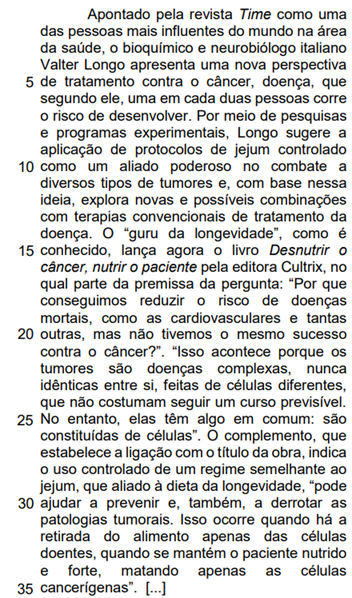
(Entrevista Valter Longo, Revista Isto É 2853 16/10/2024, p.4)
Provas
Questão presente nas seguintes provas
TEXTO:
“A alimentação é 75% de um projeto de
longevidade”
Luiz Cesar Pimentel e Fábio César dos Santos
(Entrevista Valter Longo, Revista Isto É 2853 16/10/2024, p.4)
O pronome relativo “que”, sublinhado no fragmento acima, é uma forma coesiva que retoma:
Provas
Questão presente nas seguintes provas
Cadernos
Caderno Container