Foram encontradas 720 questões.
O intervalo entre dois sons é a razão entre suas frequências, quando o intervalo é igual a dois chamamos de
Provas
Questão presente nas seguintes provas

Qual das alternativas abaixo a NR-18 determina para trabalhos em telhados?
Provas
Questão presente nas seguintes provas
For question below, listen to the radio interview “60-Second Ideas to Improve the World” and answer accordingly.
Why do the speakers conclude that the policy for criminals adopted by past communities would not work nowadays?
Provas
Questão presente nas seguintes provas
Uma pessoa com audição normal não ouve um som com frequência de
Provas
Questão presente nas seguintes provas
- Gerenciamento de Redes
- Protocolos e ServiçosConfiguração de RedeDHCP: Dynamic Host Configuration Protocol
- TCP/IPIPv4
O comando ipconfig, digitado em uma janela de comandos MS-DOS do Windows XP, com o parâmetro /renew
Provas
Questão presente nas seguintes provas
Read the text and answer the question.
Who is a native speaker of English?
Jack Scholes
In 2006 the British Council published English Next – Why global English may mean the end of ‘English’ as a Foreign Language’ by David Graddol. This booklet is free of charge from the British Council and can also be read and downloaded for free from the British Council website – www.britishcouncil.org.br/elt.
Graddol’s research shows that “Global English has led to a crisis of terminology. The distinctions betwee ‘native speaker’, ‘second-language speaker’, and ‘foreign-language user’ have become blurred. One of the most familiar ways of representing the global community of English speakers is in terms of three circles. (figure 1)
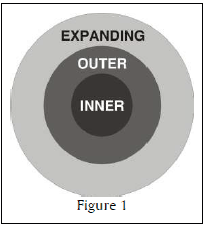
The ‘inner’ circle represents the native speakers; the ‘outer circle’ consists of second-language speakers in countries like India. The ‘expanding circle’ was the ever-increasing number of people learning English as a foreign language!$ ^{(I)} !$. The three circles were first described in this way by the sociolinguist Braj Kachru in 1985. By 1997, such a model was already failing to capture the increasing importance of the outer circle, and the degree to which ‘foreign language’ learners in some countries – especially Europe – were becoming more like second language users.
In a globalized world, the traditional definition of ‘second-language user’ (as one who uses the language for communication within his own country) no longer makes sense. Also, there is an increasing need to distinguish between proficiencies in English, rather than a speaker’s bilingual status!$ ^{(III)} !$. Kachru himself has recently proposed (figure 2) that the ‘inner circle’ is now better conceived of as the group of highly proficient 0speakers of English – those who have ‘functional nativenesss’ regardless of how they learned or use the language.
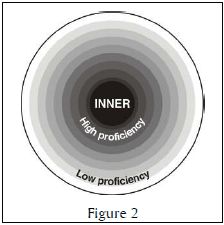
I particularly like the term ‘functional nativenesss’, and this is how I would like to describe my level of proficiency in Portuguese. I also believe that this should be the realistic aim of anyone learning any foreign language.
But why is it so difficult to achieve this ‘functional nativeness’? There are, of course, many reasons but undoubtedly, one of the biggest challenges of becoming a fluent, native-like speaker of another language is having an in-depth knowledge of common, everyday words and phrases and an ability to understand them!$ ^{(II)} !$ and use them correctly and appropriately, especially the ones!$ ^{(IV)} !$ that reflect deeply rooted socio-cultural aspects of the language and which are often difficult or impossible to translate.
So, when we are asked, “What’s the English word for rodízio”, or “How do you say quebrar o galho in English, the simple answer is, “There is no word in English for rodízio and there is no direct translation for quebrar o galho. Our aim as English teachers should be to enable learners to communicate effectively, achieve native-like fluency more quickly and also learn to appreciate the fascinating richness of another language and culture.
(Adapted from New Routes, Sept. 2008)
Read the sentences.
I) In ”…of people learning English as a foreign language.” the underlined word can be substituted by like without any change in meaning.
II) In “…an ability to understand them …” the underlined word refers to “challenges.”
III) In “Also, there is an increasing need to distinguish between proficiencies in English, rather than a speaker’s bilingual status.” the underlined expression may be substituted by instead of with no change in meaning.
IV) In “…especially the ones….” the underlined word refers to “words and phrases”.
The correct ones are
Provas
Questão presente nas seguintes provas
Pode ser considerada como um sério risco para a conservação de um bem cultural, uma vez que o seu acúmulo pode reter umidade, criar condições propícias para o desenvolvimento de microorganismos e facilitar a infestação de insetos e de poluentes, causando degradação de um bem cultural.
Provas
Questão presente nas seguintes provas
A função mail da linguagem PHP permite o envio de e-mails via scripts PHP. O parâmetro que define o destinatário do e-mail é
Provas
Questão presente nas seguintes provas
Considere a criação das seguintes tabelas em um banco de dados para responder a questão.
Banco de Dados: Acadêmico
Comando para criação das Tabelas:
create table curso (
codcurso int,
nomecurso char(40),
primary key (codcurso)
);
create table disciplina (
coddisciplina int,
nomedisciplina char(50),
primary key (coddisciplina)
);
create table aluno (
codaluno int,
nomealuno char(40),
codcurso int,
primary key (codaluno),
foreign key (codcurso) references curso(codcurso)
);
create table matricula (
periodo int,
codaluno int,
coddisciplina int,
primary key (periodo,codaluno,coddisciplina),
foreign key (codaluno) references aluno (codaluno),
foreign key (coddisciplina) references disciplina (coddisciplina)
);
Com relação às tabelas do banco de dados Acadêmico (descrito anteriormente), o comando para alterar o nome do aluno cujo código é 10 para "José da Silva Souza" é
Provas
Questão presente nas seguintes provas
Resina vegetal, entre o incolor e o amarelo pálido, obtida no sudeste asiático. É uma das resinas naturais mais importantes na fabricação de vernizes.
Provas
Questão presente nas seguintes provas
Cadernos
Caderno Container