Foram encontradas 720 questões.
Qual o padrão de frequência de amostragem e quantização em um CD?
Provas
Questão presente nas seguintes provas

É o tipo de retoque intermediário entre o “retoque ilusionista” e a “reintegração pictórica” total. É feito com linhas verticais, precisas, justapostas, e de cores puras, que não são perceptíveis à distância, pois o olho humano faz a mistura óptica. Esse tipo de retoque chama-se:
Provas
Questão presente nas seguintes provas
Na fórmula dos Nutrientes Digestíveis Totais (NDT), o extrato etéreo digestível é multiplicado por
Provas
Questão presente nas seguintes provas
Read the text and answer the question.
Who is a native speaker of English?
Jack Scholes
In 2006 the British Council published English Next – Why global English may mean the end of ‘English’ as a Foreign Language’ by David Graddol. This booklet is free of charge from the British Council and can also be read and downloaded for free from the British Council website – www.britishcouncil.org.br/elt.
Graddol’s research shows that “Global English has led to a crisis of terminology. The distinctions betwee ‘native speaker’, ‘second-language speaker’, and ‘foreign-language user’ have become blurred. One of the most familiar ways of representing the global community of English speakers is in terms of three circles. (figure 1)
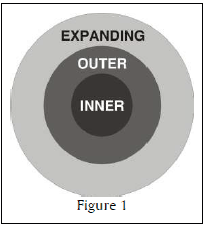
The ‘inner’ circle represents the native speakers; the ‘outer circle’ consists of second-language speakers in countries like India. The ‘expanding circle’ was the ever-increasing number of people learning English as a foreign language. The three circles were first described in this way by the sociolinguist Braj Kachru in 1985. By 1997, such a model was already failing to capture the increasing importance of the outer circle, and the degree to which ‘foreign language’ learners in some countries – especially Europe – were becoming more like second language users.
In a globalized world, the traditional definition of ‘second-language user’ (as one who uses the language for communication within his own country) no longer makes sense. Also, there is an increasing need to distinguish between proficiencies in English, rather than a speaker’s bilingual status. Kachru himself has recently proposed (figure 2) that the ‘inner circle’ is now better conceived of as the group of highly proficient 0speakers of English – those who have ‘functional nativenesss’ regardless of how they learned or use the language.
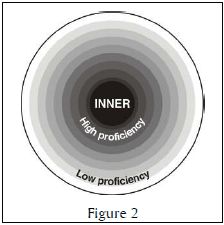
I particularly like the term ‘functional nativenesss’, and this is how I would like to describe my level of proficiency in Portuguese. I also believe that this should be the realistic aim of anyone learning any foreign language.
But why is it so difficult to achieve this ‘functional nativeness’? There are, of course, many reasons but undoubtedly, one of the biggest challenges of becoming a fluent, native-like speaker of another language is having an in-depth knowledge of common, everyday words and phrases and an ability to understand them and use them correctly and appropriately, especially the ones that reflect deeply rooted socio-cultural aspects of the language and which are often difficult or impossible to translate.
So, when we are asked, “What’s the English word for rodízio”, or “How do you say quebrar o galho in English, the simple answer is, “There is no word in English for rodízio and there is no direct translation for quebrar o galho. Our aim as English teachers should be to enable learners to communicate effectively, achieve native-like fluency more quickly and also learn to appreciate the fascinating richness of another language and culture.
(Adapted from New Routes, Sept. 2008)
According to the text, it would be INCORRECT to say that
Provas
Questão presente nas seguintes provas
Se uma pessoa está conversando e a intensidade de sua voz passa de 40 dB para 60 dB, a energia dispendida aumenta
Provas
Questão presente nas seguintes provas
Considere o texto abaixo para responder a questão.
Beatriz trabalhava como cortadora de moldes em uma confecção de roupas. Preocupada com problemas de saúde de um de seus filhos, distraiu-se e cortou com gravidade o seu dedo polegar. Depois de medicada no ambulatório da empresa, foi dispensada do trabalho neste dia.
O acidente ocorrido com Beatriz tem como causa?
Provas
Questão presente nas seguintes provas
O phantom power é utilizado para
Provas
Questão presente nas seguintes provas
Tanino e gossipol são fatores antinutricionais encontrados, respectivamente, no/na
Provas
Questão presente nas seguintes provas
O valor RMS de uma onda senoidal é
Provas
Questão presente nas seguintes provas
Analise as afirmativas abaixo sobre as condições ambientais dos locais de trabalho onde as atividades requeiram esforço intelectual e atenção constante.
I) A umidade relativa do ar não deverá ser inferior a 40%.
II) A velocidade do ar não deverá ser superior a 0,75 m por segundo.
III) O índice de temperatura efetiva deverá situar-se entre 20 e 26 °C.
IV) A iluminação geral deverá ser distribuída de forma uniforme e difusa.
V) A medição do nível de iluminamento, quando não definido o campo de trabalho, será um plano horizontal a 0,85 m do piso.
Estão corretas apenas as afirmativas:
Provas
Questão presente nas seguintes provas
Cadernos
Caderno Container