Foram encontradas 720 questões.
Um sinal digital amostrado em 20 bits possui uma faixa dinâmica aproximada de
Provas
Questão presente nas seguintes provas

A diferença entre os microfones à capacitor puros e os à eletreto é:
Provas
Questão presente nas seguintes provas
Em relação à Comunicação de Acidente de Trabalho - CAT, assinale a opção que apresenta, respectivamente, em quantas vias ela é emitida e qual via é encaminhada ao sindicato de classe do trabalhador.
Provas
Questão presente nas seguintes provas
A linguagem PHP possui uma interface para desenvolvimento de aplicações shell (ou no terminal/linha de comando). O nome da interface é
Provas
Questão presente nas seguintes provas
Read the text and answer the question.
Who is a native speaker of English?
Jack Scholes
In 2006 the British Council published English Next – Why global English may mean the end of ‘English’ as a Foreign Language’ by David Graddol. This booklet is free of charge from the British Council and can also be read and downloaded for free from the British Council website – www.britishcouncil.org.br/elt.
Graddol’s research shows that “Global English has led to a crisis of terminology. The distinctions betwee ‘native speaker’, ‘second-language speaker’, and ‘foreign-language user’ have become blurred. One of the most familiar ways of representing the global community of English speakers is in terms of three circles. (figure 1)
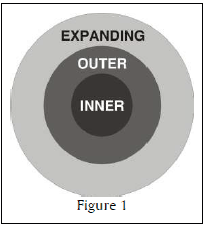
The ‘inner’ circle represents the native speakers; the ‘outer circle’ consists of second-language speakers in countries like India. The ‘expanding circle’ was the ever-increasing number of people learning English as a foreign language. The three circles were first described in this way by the sociolinguist Braj Kachru in 1985. By 1997, such a model was already failing to capture the increasing importance of the outer circle, and the degree to which ‘foreign language’ learners in some countries – especially Europe – were becoming more like second language users.
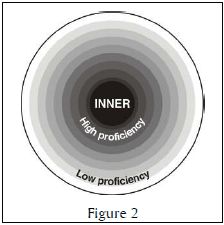
In a globalized world, the traditional definition of ‘second-language user’ (as one who uses the language for communication within his own country) no longer makes sense. Also, there is an increasing need to distinguish between proficiencies in English, rather than a speaker’s bilingual status. Kachru himself has recently proposed (figure 2) that the ‘inner circle’ is now better conceived of as the group of highly proficient 0speakers of English – those who have ‘functional nativenesss’ regardless of how they learned or use the language.
I particularly like the term ‘functional nativenesss’, and this is how I would like to describe my level of proficiency in Portuguese. I also believe that this should be the realistic aim of anyone learning any foreign language.
But why is it so difficult to achieve this ‘functional nativeness’? There are, of course, many reasons but undoubtedly, one of the biggest challenges of becoming a fluent, native-like speaker of another language is having an in-depth knowledge of common, everyday words and phrases and an ability to understand them and use them correctly and appropriately, especially the ones that reflect deeply rooted socio-cultural aspects of the language and which are often difficult or impossible to translate.
So, when we are asked, “What’s the English word for rodízio”, or “How do you say quebrar o galho in English, the simple answer is, “There is no word in English for rodízio and there is no direct translation for quebrar o galho. Our aim as English teachers should be to enable learners to communicate effectively, achieve native-like fluency more quickly and also learn to appreciate the fascinating richness of another language and culture.
(Adapted from New Routes, Sept. 2008)
In “But why is it so difficult to achieve this functional nativeness?”, the connective but gives the idea of
Provas
Questão presente nas seguintes provas
No ambiente de trabalho foi medido o ruído contínuo de 90 dB(A), para atender ao Anexo 1 da NR 15 - Atividades e Operações Insalubres. Nessa perspectiva, o tempo máximo permitido de exposição do trabalhador é
Provas
Questão presente nas seguintes provas
Quais os três elementos básicos que caracterizam o som?
Provas
Questão presente nas seguintes provas
Read the text and answer the question.
Who is a native speaker of English?
Jack Scholes
In 2006 the British Council published English Next – Why global English may mean the end of ‘English’ as a Foreign Language’ by David Graddol. This booklet is free of charge from the British Council and can also be read and downloaded for free from the British Council website – www.britishcouncil.org.br/elt.
Graddol’s research shows that “Global English has led to a crisis of terminology. The distinctions betwee ‘native speaker’, ‘second-language speaker’, and ‘foreign-language user’ have become blurred. One of the most familiar ways of representing the global community of English speakers is in terms of three circles. (figure 1)
The ‘inner’ circle represents the native speakers; the ‘outer circle’ consists of second-language speakers in countries like India. The ‘expanding circle’ was the ever-increasing number of people learning English as a foreign language. The three circles were first described in this way by the sociolinguist Braj Kachru in 1985. By 1997, such a model was already failing to capture the increasing importance of the outer circle, and the degree to which ‘foreign language’ learners in some countries – especially Europe – were becoming more like second language users.
In a globalized world, the traditional definition of ‘second-language user’ (as one who uses the language for communication within his own country) no longer makes sense. Also, there is an increasing need to distinguish between proficiencies in English, rather than a speaker’s bilingual status. Kachru himself has recently proposed (figure 2) that the ‘inner circle’ is now better conceived of as the group of highly proficient 0speakers of English – those who have ‘functional nativenesss’ regardless of how they learned or use the language.
I particularly like the term ‘functional nativenesss’, and this is how I would like to describe my level of proficiency in Portuguese. I also believe that this should be the realistic aim of anyone learning any foreign language.
But why is it so difficult to achieve this ‘functional nativeness’? There are, of course, many reasons but undoubtedly, one of the biggest challenges of becoming a fluent, native-like speaker of another language is having an in-depth knowledge of common, everyday words and phrases and an ability to understand them and use them correctly and appropriately, especially the ones that reflect deeply rooted socio-cultural aspects of the language and which are often difficult or impossible to translate.
So, when we are asked, “What’s the English word for rodízio”, or “How do you say quebrar o galho in English, the simple answer is, “There is no word in English for rodízio and there is no direct translation for quebrar o galho. Our aim as English teachers should be to enable learners to communicate effectively, achieve native-like fluency more quickly and also learn to appreciate the fascinating richness of another language and culture.
(Adapted from New Routes, Sept. 2008)
The word blurred in “… have become blurred…” can be adequately substituted for
Provas
Questão presente nas seguintes provas
Omnidirecional é um microfone caracterizado por
Provas
Questão presente nas seguintes provas
Para atender ao previsto na NR 26 – Sinalização de Segurança – as canalizações destinadas à água e ao ar comprimido devem ser pintadas, respectivamente, nas cores
Provas
Questão presente nas seguintes provas
Cadernos
Caderno Container