Foram encontradas 1.080 questões.
Para responder a questão, leia o texto a seguir.
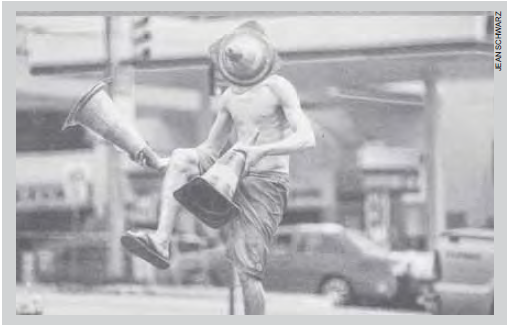
Fonte: Tulio Milman, Informe Especial, Zero Hora, Porto Alegre, 15/10/2011.
MICROTÉDIO
O ritmo da Capital é tão frenético, que nem o tempo do sinal passa em branco. Uma olhada no celular, uma rápida mensagem de texto, um mergulho no porta-luvas.
É preciso preencher cada segundo.
E se alguém nos ajuda, ainda mais com arte, mesmo que improvisada, merece aplauso. E algumas moedas.
Tudo muito rápido, antes que o verde liberte a ansiosa plateia.
A imagem ilustra uma cena comum nos centros urbanos brasileiros. A essa imagem associa-se um texto verbal que é desenvolvido com a intenção principal de
Provas

Para responder a questão, considere a imagem a seguir.
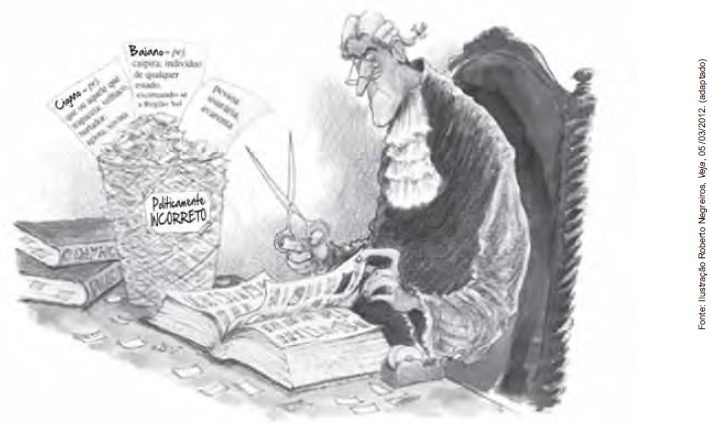
Na ilustração, o dicionário aparece como o objeto afetado pela ação do juiz. Uma das formas de expressar linguisticamente essa ideia é o emprego da voz passiva, como em:
Provas
Em um painel de conectores(patchbay), há uma regra geral para entradas(in) e saídas(out). Baseando-se nessa afirmação, assinale a alternativa correta.
Provas
Mulher de 47 anos, em pós-menopausa, fumante de 30 cigarros/dia, apresenta queixa de voz grave com 1 ano de evolução e piora progressiva. Qual seria o principal achado em seu exame de videolaringoscopia e consequente diagnóstico?
Provas
Para responder a questão, leia o texto a seguir.
Body acoustics can turn your arm into a touchscreen
By Paul Marks | March, 2010
Finding the keypad on your cellphone or music player a bit cramped? Maybe your forearm could be more accommodating. It could become part of a skin-based interface that effectively turns your body into a touchscreen.
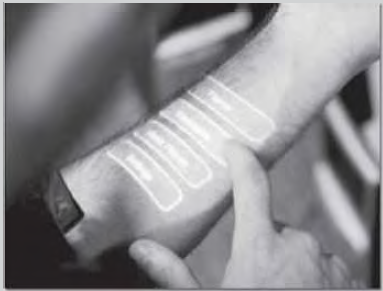
Bodily interface (Image: ACM)
Called Skinput, the system is a marriage of two technologies: the ability to detect the ultralow-frequency sound produced by tapping the skin with a finger, and the microchip-sized "pico" projectors now found in some cellphones.
The system beams a keyboard or menu onto the user's forearm and hand from a projector housed in an armband. An acoustic detector, also in the armband, then calculates which part of the display you want to activate.
But how does the system know which icon, button or finger you tapped? Chris Harrison at Carnegie Mellon University in Pittsburgh, Pennsylvania, working with Dan Morris and Desney Tan at Microsoft's research lab in Redmond, Washington, exploit the way our skin, musculature and skeleton combine to make distinctive sounds when we tap on different parts of the arm, palm, fingers and thumb.
Bone machine
They have identified various locations on the forearm and hand that produce characteristic acoustic patterns when tapped. The acoustic detector in the armband contains five piezoelectric cantilevers, each weighted to respond to certain bands of sound frequencies. Different combinations of the sensors are activated to differing degrees depending on where the arm is tapped.
Twenty volunteers tested the system and most found it easy to navigate through icons on the forearm and tap fingers to actuate commands.
“Skinput works very well for a series of gestures, even when the body is in motion, “the researchers say, with subjects able to deftly scroll through menus whether they moved up and down or flicked across their arm.
The system could use wireless technology like Bluetooth to transmit commands to many types of device – including phones, iPods and even PCs. The researchers will present their work in April at the ACM Computer- Human Interaction meeting in Atlanta, Georgia.
Body control
Pranav Mistry of the Media Lab at the Massachusetts Institute of Technology warns that users will have to position the armband very precisely so the projection always appears in the right place.
Nevertheless, Skinput looks a promising idea, says Michael Liebschner, director of the Bio-Innovations Lab at Baylor College of Medicine in Houston, Texas, who has worked on bone acoustic conduction technology for gadget-to-gadget transmission.
“This sounds a very feasible approach to using the body itself as an input device," he says. "When you are immersed in a virtual game using a head-mounted 3D display, you cannot just take it off to fiddle around with control buttons. This will make things much easier.”
Fonte: http://www newscientist.com
Assinale a alternativa que expressa o objetivo principal do texto.
Provas
Com relação a motores de combustão interna a pistões, é CORRETA a afirmação:
Provas
Para responder a questão, leia o texto IV.
TEXTO IV
“Non-communicable diseases (NCDs) have become a major health priority in Brazil-72% of all deaths were attributable to NCDs in 2007. They are also the main source of disease burden, with neuropsychiatric disorders being the single largest contributor. Morbidity and mortality due to NCDs are greatest in the poor population. Although the crude NCD mortality increased 5% between 1996 and 2007, age-standardised mortality declined by 20%. Declines were primarily for cardiovascular and chronic respiratory diseases, in association with the successful implementation of health policies that lead to decreases in smoking and the expansion of access to primary health care. Of note, however, the prevalence of diabetes and hypertension is rising in parallel with that of excess weight; these increases are associated with unfavourable changes of diet and physical activity. Brazil has implemented major policies for the prevention of NCDs, and its age-adjusted NCD mortality is falling by 1-8% per year. However, the unfavourable trends for most major risk factors pose an enormous challenge and call for additional and timely action and policies, especially those of a legislative and regulatory nature and those providing cost-effective chronic care for individuals affected by NCDs”.
Fonte: SCHMIDT, M. I. et al. The Lancet, vol.377, jun. 2011.
No texto, o vocábulo “Although” pode ser substituído, sem perda de sentido, por
Provas
Para responder a questão, leia o texto a seguir.
Body acoustics can turn your arm into a touchscreen
By Paul Marks | March, 2010
Finding the keypad on your cellphone or music player a bit cramped? Maybe your forearm could be more accommodating. It could become part of a skin-based interface that effectively turns your body into a touchscreen.
Bodily interface (Image: ACM)
Called Skinput, the system is a marriage of two technologies: the ability to detect the ultralow-frequency sound produced by tapping the skin with a finger, and the microchip-sized "pico" projectors now found in some cellphones.
The system beams a keyboard or menu onto the user's forearm and hand from a projector housed in an armband. An acoustic detector, also in the armband, then calculates which part of the display you want to activate.
But how does the system know which icon, button or finger you tapped? Chris Harrison at Carnegie Mellon University in Pittsburgh, Pennsylvania, working with Dan Morris and Desney Tan at Microsoft's research lab in Redmond, Washington, exploit the way our skin, musculature and skeleton combine to make distinctive sounds when we tap on different parts of the arm, palm, fingers and thumb.
Bone machine
They have identified various locations on the forearm and hand that produce characteristic acoustic patterns when tapped. The acoustic detector in the armband contains five piezoelectric cantilevers, each weighted to respond to certain bands of sound frequencies. Different combinations of the sensors are activated to differing degrees depending on where the arm is tapped.
Twenty volunteers tested the system and most found it easy to navigate through icons on the forearm and tap fingers to actuate commands.
“Skinput works very well for a series of gestures, even when the body is in motion, “the researchers say, with subjects able to deftly scroll through menus whether they moved up and down or flicked across their arm.
The system could use wireless technology like Bluetooth to transmit commands to many types of device – including phones, iPods and even PCs. The researchers will present their work in April at the ACM Computer- Human Interaction meeting in Atlanta, Georgia.
Body control
Pranav Mistry of the Media Lab at the Massachusetts Institute of Technology warns that users will have to position the armband very precisely so the projection always appears in the right place.
Nevertheless, Skinput looks a promising idea, says Michael Liebschner, director of the Bio-Innovations Lab at Baylor College of Medicine in Houston, Texas, who has worked on bone acoustic conduction technology for gadget-to-gadget transmission.
“This sounds a very feasible approach to using the body itself as an input device," he says. "When you are immersed in a virtual game using a head-mounted 3D display, you cannot just take it off to fiddle around with control buttons. This will make things much easier.”
Fonte: http://www newscientist.com
Considere os seguintes segmentos:
I - “Twenty volunteers tested the system…”
II - “Skinput works very well for a series of gestures…”
III - “The researchers will present their work inApril…”
IV. “‘This sounds a very feasible approach…”
Os tempos verbais usados em cada segmento citado são, respectivamente,
Provas
Para responder a questão, leia o Texto V.
TEXTO V
Psychology 215 – Section 36260
Introduction to Sport Psychology
Spring 2012 – 03/19 to 05/10/2012
Scottsdale Community College
Instructor: Pat Abbot, Psy. D
E-mail: patrícia.abbott@scmail.maricopa.edu
Please read this syllabus carefully as it contains detailed information that you will need to be
successful in this course.
Text: Foundations of Sport and Exercise Psychology, 5th edition
Authors: Robert Weinberg and Daniel Gould
Year : 2011
Whether you purchase the book or the e-Book, please take advantage of the ancillary materials
available on the Human Kinetics web site, particularly the study guide.
This is fast-paced course consisting of just 7 weeks plus finals week. There is great deal of material to cover and this will require a considerable time commitment on your part to do well in the course. You should plan12-15 hours of week for reading and assignment completion. Although the course is on-line, it is not self-paced. There are time restrictions for the start and end of most assignments and quizzes. This will help you to keep up with the course rather than leaving assignments to the last week.
Fonte: ABOTT, P. Catálogo de Curso do Scottsdale Community College, maio 2012.
O título do livro mencionado Foundations of Sport and Exercise Psychology deve ser traduzido como
Provas
A educação no Brasil, a partir da LDB 9394/96, estruturou-se por modalidades. Assinale a alternativa que contém modalidades da educação escolar brasileira.
Provas
Caderno Container