Foram encontradas 45.349 questões.
Disciplina: Inglês (Língua Inglesa)
Banca: Consulplan
Orgão: Pref. Vermelho Novo-MG
Observe the image below:
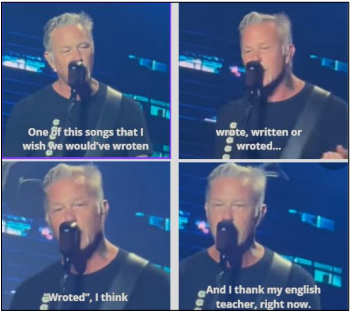
(Available on: https://www.youtube.com/ . Accessed on: may 2025. Adapted.)
The singer humorously misuses the past form of the irregular verb “to write”. The correct use of the irregular verb “to write” in the past participle form is:
Provas

Disciplina: Inglês (Língua Inglesa)
Banca: Consulplan
Orgão: Pref. Vermelho Novo-MG
Observe the image below:

(Available on: https://pt-static.z-dn.net/files/. Accessed on: may 2025.)
Based on the image showing the comparison of definite articles in French, Italian, Spanish, German, Portuguese, and English, which of the following statements about the use of articles in English is most accurate?
Provas
Disciplina: Inglês (Língua Inglesa)
Banca: Consulplan
Orgão: Pref. Vermelho Novo-MG
Lucas: I’m “going to” visit my grandmother this weekend. We’ve already bought the bus tickets.
Julia: That’s nice!
Lucas: Oh no, I forgot my umbrella. It looks like it’s “going to” rain soon.
Julia: Don’t worry. “I’ll” lend you mine.
Based on the conversation, the alternative that best explains the correct use of “going to” and “will” is:
Provas
Disciplina: Inglês (Língua Inglesa)
Banca: UEPB
Orgão: Pref. Nova Palmeira-PB
The integration of new technologies in English language classrooms has revolutionized teaching and learning processes, enabling more interactive and engaging lessons. Digital tools such as language-learning apps, interactive whiteboards, and online resources provide students with diverse and flexible opportunities to practice English both in and out of the classroom. According to Warschauer and Healey (1998), these resources help accommodate different learning styles and needs, facilitating student-centered learning that encourages autonomy and active engagement with the language. Furthermore, teachers can tailor their materials to be more relevant and accessible, enhancing students' motivation and interest in language acquisition.
Another significant advancement is the use of artificial intelligence (AI) and adaptive learning platforms, which can analyze students' progress and tailor activities accordingly. Platforms like Duolingo and Babbel utilize algorithms to personalize lessons based on individual performance, ensuring that students are consistently challenged at the right level (Godwin-Jones, 2019). This targeted approach allows students to improve at their own pace, addressing specific weaknesses and reinforcing strengths. Moreover, virtual and augmented reality technologies are increasingly employed to create immersive language experiences. By simulating real-life situations, these tools enable students to practice language skills in authentic contexts, which helps increase their confidence and fluency.
Finally , new technologies also enable a global approach to language learning, connecting students with peers and native speakers worldwide through video conferencing and social media. Platforms like Zoom and Skype allow students to engage in live conversations, enhancing their listening and speaking skills in real-time. According to Sykes et al. (2008), such interactions promote intercultural understanding and give students a practical application for their language skills, which can increase both their motivation and proficiency. As technology continues to evolve, its role in English language classrooms will undoubtedly expand, fostering an environment where students can learn more effectively and creatively. Godwin-Jones, R. (2019). Emerging Technologies: The Evolution and Impact of Language-Learning Apps. *Language Learning & Technology*, 23(2), 5–17. Sykes, J. M., Oskoz, A., & Thorne, S. L. (2008). Web 2.0, Synthetic Immersive Environments, and the Future of Language Education. *CALICO Journal*, 25(3), 528–546.
Warschauer, M., & Healey, D. (1998). Computers and Language Learning: An Overview. *Language Teaching*, 31(2), 57–71.
According to the text, how do artificial intelligence (AI) and adaptive learning platforms contribute to the learning process in English language classrooms?
Provas
Disciplina: Inglês (Língua Inglesa)
Banca: UEPB
Orgão: Pref. Nova Palmeira-PB
Dr Mithen explains how he believes human speech developed so long ago in his new book called, "The Language Puzzle". He says our brain quickly increased in size just over 1.5 million years ago. This increase changed the structure of our brain. An area called the frontal lobe developed. This is the part of the brain that produces language. Another important change was the development of our vocal tract. This is where we produce sound, and therefore speech. Mithen said speech allowed humans to spread around the world. It meant humans could do three important things. They could think of and plan future actions, and they could pass on knowledge. Mithen said language "changed the human story profoundly".
https://www.independent.co.uk/news/science/archaeology/human-language-study-origins-speaking-b2514451.html
https://uk.news.yahoo.com/celebrity/humans-speaking-lot-longer-originally-145649872.html
https://sciworthy.com/how-did-humans-learn-to-speak/
According to Dr. Steven Mithen, what was the most significant consequence of the development of human speech for early humans?
Provas
Disciplina: Inglês (Língua Inglesa)
Banca: UEPB
Orgão: Pref. Nova Palmeira-PB
Provas
Disciplina: Inglês (Língua Inglesa)
Banca: UEPB
Orgão: Pref. Nova Palmeira-PB
- Gramática - Língua InglesaVerbos | Verbs
- Gramática - Língua InglesaOrações condicionais | Conditional Clauses
Provas
Disciplina: Inglês (Língua Inglesa)
Banca: UEPB
Orgão: Pref. Nova Palmeira-PB
Provas
Disciplina: Inglês (Língua Inglesa)
Banca: UEPB
Orgão: Pref. Nova Palmeira-PB
- Gramática - Língua InglesaAdvérbios e conjunções | Adverbs and conjunctions
- Gramática - Língua InglesaPalavras conectivas | Connective words
Provas
Disciplina: Inglês (Língua Inglesa)
Banca: UEPB
Orgão: Pref. Nova Palmeira-PB
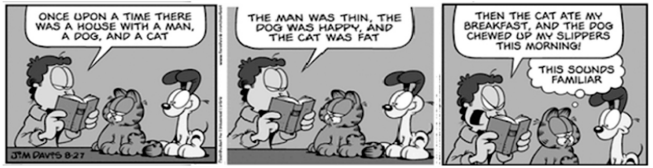
Garfield, Jim Davis 2011 Paws, Incall Rights Reserved / Dist Universal Ucuck
In the comic strip, what is the main point being humorously highlighted by Garfield's reaction in the last panel?
Provas
Caderno Container