Foram encontradas 45.388 questões.
Read the following extract to answer question.
A friend of mine who is an orchestral conductor was
asking me (early in our acquaintance) about what I did for
a living. When I told him that apart from other activities, I
wrote books about how to teach English he said ‘Books in
the plural? Surely once you’ve written one, there’s nothing
more to say!’ I wanted to reply that he had just argued himself
out of a job (I mean, how many performances of Beethoven
symphonies have there been in the twenty-first century
alone?), but someone else laughed at his question, another
musician made a different comment, the conversation moved
on, and so Martin-the-conductor’s flippant enquiry evaporated
in the convivial atmosphere of a British pub.
But his question was a good one. Surely we know how
to teach languages? After all, people have been doing it
successfully for two thousand years or more, and some
aspects of teaching in the past have probably not changed
that much. But other things have, and continue to change.
Which is (I suppose) why every time I re-examine past
assumptions about teaching, I find myself questioning and
reinterpreting things I thought were fixed. And of course, I am
not alone in this. We all do it all the time – or at least we do if
we haven’t closed our minds off from the possibility of change
and renewal.
Language teaching, perhaps more than many other
activities, reflects the times it takes place in. Language is
about communication, after all, and perhaps that is why
philosophies and techniques for learning languages seem to
develop and change in tune with the societies which give rise
to them. Teaching and learning are very human activities; they
are social just as much as they are (in our case) linguistic.
But it’s not just society that changes and evolves. The
last decades have seen what feels like unprecedented
technological change. The Internet has seen to that, and
other educational technology has not lagged behind. And it’s
exciting stuff. I’ve tried to reflect that excitement and newness
in parts of this new edition.
(Jeremy Harmer, How to teach English. Adaptado)
Provas
Questão presente nas seguintes provas

Read the following cartoon:
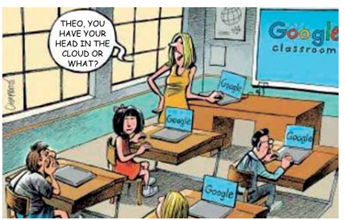
(Patrick Chappatte. Disponível em: https://larrycuban.wordpress. com/2023/01/26/)
Humor in the comic derives from the fact that
(Patrick Chappatte. Disponível em: https://larrycuban.wordpress. com/2023/01/26/)
Humor in the comic derives from the fact that
Provas
Questão presente nas seguintes provas
Mark the item which CORRECTLY translates the sentence
below into Portuguese.
Her parents were proud of how sensible she was when she chose to spend the afternoon studying at the library instead of going to the party.
Her parents were proud of how sensible she was when she chose to spend the afternoon studying at the library instead of going to the party.
Provas
Questão presente nas seguintes provas
Which of the following sentences uses an adverb of
place?
Provas
Questão presente nas seguintes provas
Depending on the preposition you use to fill in the blank
in “I am looking ____ the dog”, the meaning of the sentence
changes completely. Analyze the sentences below and mark
the CORRECT item.
I. “I’m looking at the dog” means you are seeing the dog.
II. “I’m looking after the dog” means you don’t know where the dog is.
III. “I’m looking for the dog” means you are taking care of the dog.
I. “I’m looking at the dog” means you are seeing the dog.
II. “I’m looking after the dog” means you don’t know where the dog is.
III. “I’m looking for the dog” means you are taking care of the dog.
Provas
Questão presente nas seguintes provas
Harper Lee’s “To Kill a Mockingbird” presents diverse
social issues, but mainly:
Provas
Questão presente nas seguintes provas
Mark the item which CORRECTLY displays the tense and
aspect of the underlined verbs.
I have helped my neighbor too much this week.
I have helped my neighbor too much this week.
Provas
Questão presente nas seguintes provas
Mark the item which CORRECTLY displays the tense and
aspect of the underlined verbs.
I had helped my neighbor clean his attic before I fixed his car.
I had helped my neighbor clean his attic before I fixed his car.
Provas
Questão presente nas seguintes provas
What does the phrasal verb below mean in the following
sentence?
They set off on their road trip early this morning.
They set off on their road trip early this morning.
Provas
Questão presente nas seguintes provas
What does the phrasal verb below mean in the following
sentence?
Charlie couldn’t put up with their whining anymore.
Charlie couldn’t put up with their whining anymore.
Provas
Questão presente nas seguintes provas
Cadernos
Caderno Container