Foram encontradas 45.388 questões.
Disciplina: Inglês (Língua Inglesa)
Banca: VUNESP
Orgão: Pref. Aparecida-SP
Leia o texto a seguir para responder às questões de números 26 a 35.
Noam Chomsky, the revered and reviled genius once famously described as “the most important intellectual alive”, turned 95 on December 6, 2023. He is a monumental figure in modern linguistics, and only a slightly lesser deity in psychology, philosophy and political activism.
His work establishing cognitive science as a discipline is so fundamental to the rise of Artificial Intelligence (AI) that it’s rarely acknowledged anymore. Amid the ongoing alarm that language-simulating machines could become a net negative for humanity, one wonders whether that keeps him up at night.
His stardom came in 1959 with his legendary review of B. F. Skinner’s Verbal Behaviour. Skinner, a psychologist and behaviorist, was enjoying the limelight in psychology circles with his theory of “operant conditioning” to encourage certain behaviours. For instance, a gold star awarded by a teacher for good behavior will encourage more of it from students. He tried to expand this idea into linguistics by breaking language down into components that are supposedly acquired via operant conditioning.
Chomsky completely disagreed with the idea and showed how useful it could be to examine the mind instead of just behavior in language-related areas like anthropology, psychology and neuroscience.
It’s not hard to see how Chomsky’s ideas of generative grammar and deep structure go hand in hand with today’s generative AI and deep learning. Without them, experts couldn’t have delved so deeply into neural networks. They wouldn’t have understood language well enough to even begin. His approach is a thread that has connected generations of AI researchers.
Still, about language-simulating machines becoming a threat, that does not keep him up at night. He seems to regard AI as a secondary worry compared with climate change.
(theconversation.com. Adaptado)
O sintagma nominal é um grupo de palavras cujo núcleo é um substantivo ou nome.
Identifique o núcleo do sintagma nominal no trecho – Chomsky’s ideas of generative grammar and deep structure – (5º parágrafo).
Provas

Disciplina: Inglês (Língua Inglesa)
Banca: VUNESP
Orgão: Pref. Aparecida-SP
Leia o texto a seguir para responder às questões de números 26 a 35.
Noam Chomsky, the revered and reviled genius once famously described as “the most important intellectual alive”, turned 95 on December 6, 2023. He is a monumental figure in modern linguistics, and only a slightly lesser deity in psychology, philosophy and political activism.
His work establishing cognitive science as a discipline is so fundamental to the rise of Artificial Intelligence (AI) that it’s rarely acknowledged anymore. Amid the ongoing alarm that language-simulating machines could become a net negative for humanity, one wonders whether that keeps him up at night.
His stardom came in 1959 with his legendary review of B. F. Skinner’s Verbal Behaviour. Skinner, a psychologist and behaviorist, was enjoying the limelight in psychology circles with his theory of “operant conditioning” to encourage certain behaviours. For instance, a gold star awarded by a teacher for good behavior will encourage more of it from students. He tried to expand this idea into linguistics by breaking language down into components that are supposedly acquired via operant conditioning.
Chomsky completely disagreed with the idea and showed how useful it could be to examine the mind instead of just behavior in language-related areas like anthropology, psychology and neuroscience.
It’s not hard to see how Chomsky’s ideas of generative grammar and deep structure go hand in hand with today’s generative AI and deep learning. Without them, experts couldn’t have delved so deeply into neural networks. They wouldn’t have understood language well enough to even begin. His approach is a thread that has connected generations of AI researchers.
Still, about language-simulating machines becoming a threat, that does not keep him up at night. He seems to regard AI as a secondary worry compared with climate change.
(theconversation.com. Adaptado)
Behaviorism became the basis for some second language teaching practices. One example is
Provas
Disciplina: Inglês (Língua Inglesa)
Banca: VUNESP
Orgão: Pref. Aparecida-SP
Leia o texto a seguir para responder às questões de números 26 a 35.
Noam Chomsky, the revered and reviled genius once famously described as “the most important intellectual alive”, turned 95 on December 6, 2023. He is a monumental figure in modern linguistics, and only a slightly lesser deity in psychology, philosophy and political activism.
His work establishing cognitive science as a discipline is so fundamental to the rise of Artificial Intelligence (AI) that it’s rarely acknowledged anymore. Amid the ongoing alarm that language-simulating machines could become a net negative for humanity, one wonders whether that keeps him up at night.
His stardom came in 1959 with his legendary review of B. F. Skinner’s Verbal Behaviour. Skinner, a psychologist and behaviorist, was enjoying the limelight in psychology circles with his theory of “operant conditioning” to encourage certain behaviours. For instance, a gold star awarded by a teacher for good behavior will encourage more of it from students. He tried to expand this idea into linguistics by breaking language down into components that are supposedly acquired via operant conditioning.
Chomsky completely disagreed with the idea and showed how useful it could be to examine the mind instead of just behavior in language-related areas like anthropology, psychology and neuroscience.
It’s not hard to see how Chomsky’s ideas of generative grammar and deep structure go hand in hand with today’s generative AI and deep learning. Without them, experts couldn’t have delved so deeply into neural networks. They wouldn’t have understood language well enough to even begin. His approach is a thread that has connected generations of AI researchers.
Still, about language-simulating machines becoming a threat, that does not keep him up at night. He seems to regard AI as a secondary worry compared with climate change.
(theconversation.com. Adaptado)
Casos de cognatos e falsos cognatos são comumente vistos entre português e inglês.
Assinale a alternativa cuja palavra em destaque é um falso cognato no contexto.
Provas
Disciplina: Inglês (Língua Inglesa)
Banca: VUNESP
Orgão: Pref. Aparecida-SP
Leia o texto a seguir para responder às questões de números 26 a 35.
Noam Chomsky, the revered and reviled genius once famously described as “the most important intellectual alive”, turned 95 on December 6, 2023. He is a monumental figure in modern linguistics, and only a slightly lesser deity in psychology, philosophy and political activism.
His work establishing cognitive science as a discipline is so fundamental to the rise of Artificial Intelligence (AI) that it’s rarely acknowledged anymore. Amid the ongoing alarm that language-simulating machines could become a net negative for humanity, one wonders whether that keeps him up at night.
His stardom came in 1959 with his legendary review of B. F. Skinner’s Verbal Behaviour. Skinner, a psychologist and behaviorist, was enjoying the limelight in psychology circles with his theory of “operant conditioning” to encourage certain behaviours. For instance, a gold star awarded by a teacher for good behavior will encourage more of it from students. He tried to expand this idea into linguistics by breaking language down into components that are supposedly acquired via operant conditioning.
Chomsky completely disagreed with the idea and showed how useful it could be to examine the mind instead of just behavior in language-related areas like anthropology, psychology and neuroscience.
It’s not hard to see how Chomsky’s ideas of generative grammar and deep structure go hand in hand with today’s generative AI and deep learning. Without them, experts couldn’t have delved so deeply into neural networks. They wouldn’t have understood language well enough to even begin. His approach is a thread that has connected generations of AI researchers.
Still, about language-simulating machines becoming a threat, that does not keep him up at night. He seems to regard AI as a secondary worry compared with climate change.
(theconversation.com. Adaptado)
The fragment from the 5th paragraph – … experts couldn’t have delved so deeply into neural networks. – can be rewritten, with no change in meaning, as
Provas
Disciplina: Inglês (Língua Inglesa)
Banca: VUNESP
Orgão: Pref. Aparecida-SP
Leia o texto a seguir para responder às questões de números 26 a 35.
Noam Chomsky, the revered and reviled genius once famously described as “the most important intellectual alive”, turned 95 on December 6, 2023. He is a monumental figure in modern linguistics, and only a slightly lesser deity in psychology, philosophy and political activism.
His work establishing cognitive science as a discipline is so fundamental to the rise of Artificial Intelligence (AI) that it’s rarely acknowledged anymore. Amid the ongoing alarm that language-simulating machines could become a net negative for humanity, one wonders whether that keeps him up at night.
His stardom came in 1959 with his legendary review of B. F. Skinner’s Verbal Behaviour. Skinner, a psychologist and behaviorist, was enjoying the limelight in psychology circles with his theory of “operant conditioning” to encourage certain behaviours. For instance, a gold star awarded by a teacher for good behavior will encourage more of it from students. He tried to expand this idea into linguistics by breaking language down into components that are supposedly acquired via operant conditioning.
Chomsky completely disagreed with the idea and showed how useful it could be to examine the mind instead of just behavior in language-related areas like anthropology, psychology and neuroscience.
It’s not hard to see how Chomsky’s ideas of generative grammar and deep structure go hand in hand with today’s generative AI and deep learning. Without them, experts couldn’t have delved so deeply into neural networks. They wouldn’t have understood language well enough to even begin. His approach is a thread that has connected generations of AI researchers.
Still, about language-simulating machines becoming a threat, that does not keep him up at night. He seems to regard AI as a secondary worry compared with climate change.
(theconversation.com. Adaptado)
De acordo com o texto, é correto afirmar que Noam Chomsky
Provas
Disciplina: Inglês (Língua Inglesa)
Banca: COTEC
Orgão: Pref. Santo Hipólito-MG
Provas
Disciplina: Inglês (Língua Inglesa)
Banca: COTEC
Orgão: Pref. Santo Hipólito-MG
Provas
Disciplina: Inglês (Língua Inglesa)
Banca: COTEC
Orgão: Pref. Santo Hipólito-MG
INSTRUCTION: Read the comic strip below to answer question.
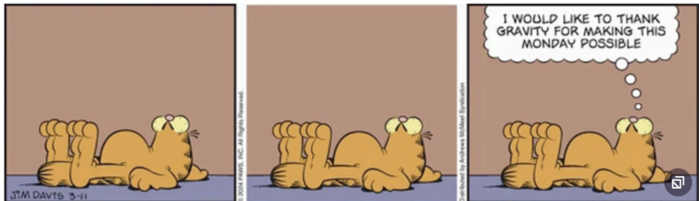
Disponível em: http://pt.jikos.cz/garfield/2024/3/. Acesso em: 10 out. 2024.
What is the best translation for the term “would like”?
Provas
Disciplina: Inglês (Língua Inglesa)
Banca: COTEC
Orgão: Pref. Santo Hipólito-MG
Analyze strips I, II and II below:
I 
Disponível em: https://garfield-comic-strips.fandom.com/wiki/2024. Acesso em: 10 out. 2024.
II 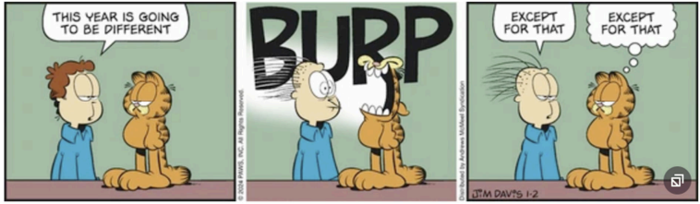
Disponível em: https://garfield-comic-strips.fandom.com/wiki/2024. Acesso em: 10 out. 2024.
III 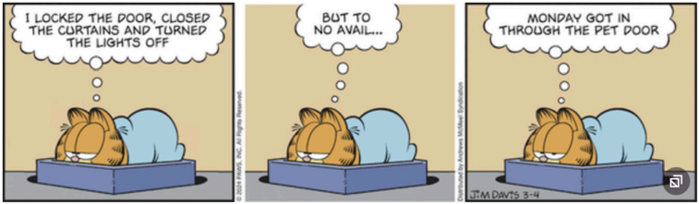
Disponível em: http://pt.jikos.cz/garfield/2024/3/. Acesso em: 10 out. 2024.
What verb tenses are in strips I, II and III, respectively?
Provas
Disciplina: Inglês (Língua Inglesa)
Banca: COTEC
Orgão: Pref. Santo Hipólito-MG
1. There’s a bug _____ your face. 2. We love to travel ____ the summer. 3. His birthday is ____ June. 4. Our flight arrived ____ nine o’clock. 5. The girls play tennis ____ Mondays.
Select the alternative that presents the words that correctly fill in the gaps, considering the sentences from top to bottom.
Provas
Caderno Container