Foram encontradas 45.388 questões.
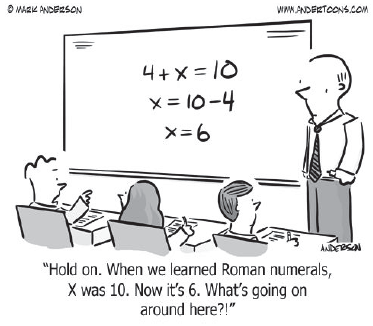
Disponível em https://andertoons.com/math/cartoon/7359/.
Contribui para o efeito de comicidade do cartum a
Provas

Os versos a seguir pertencem à canção Fall on Me, da banda norte-americana R.E.M., lançada em 1986.
“There's a problem, feathers, iron
Bargain buildings, weights and pulleys
Feathers hit the ground before the weight can leave the air”
Bill Berry, Peter Buck, Mike Mills e Michael Stipe.
A qual episódio (real ou hipotético) da história da física o trecho da música faz alusão?
Provas
TEXTO PARA A QUESTÃO.
“Quick, quick, tell me something awful
Like you are a poet trapped inside the body of a finance guy
Tell me all your secrets, all you'll ever be is
My eternal consolation prize
You see, I was a debutante in another life, but
Now I seem to be scared to go outside
If comfort is a construct, I don't believe in good luck
Now that I know what's what
I hate it here so I will go to secret gardens in my mind
People need a key to get to, the only one is mine
I read about it in a book when I was a precocious child
No mid-sized city hopes and small-town fears
I'm there most of the year 'cause I hate it here
I hate it here
My friends used to play a game where
We would pick a decade
We wished we could live in instead of this
I'd say the 1830s but without all the racists
And getting married off for the highest bid
Everyone would look down 'cause it wasn't fun now
Seems like it was never even fun back then
Nostalgia is a mind's trick
If I'd been there, I'd hate it
It was freezing in the palace”
“I hate it here”, Taylor Swift, do álbum The Tortured Poets Department, 2024 (Adaptado).
No texto, a percepção de “conforto como construto” indica que o eu lírico vê o conforto como
Provas
TEXTO PARA A QUESTÃO.
“Quick, quick, tell me something awful
Like you are a poet trapped inside the body of a finance guy
Tell me all your secrets, all you'll ever be is
My eternal consolation prize
You see, I was a debutante in another life, but
Now I seem to be scared to go outside
If comfort is a construct, I don't believe in good luck
Now that I know what's what
I hate it here so I will go to secret gardens in my mind
People need a key to get to, the only one is mine
I read about it in a book when I was a precocious child
No mid-sized city hopes and small-town fears
I'm there most of the year 'cause I hate it here
I hate it here
My friends used to play a game where
We would pick a decade
We wished we could live in instead of this
I'd say the 1830s but without all the racists
And getting married off for the highest bid
Everyone would look down 'cause it wasn't fun now
Seems like it was never even fun back then
Nostalgia is a mind's trick
If I'd been there, I'd hate it
It was freezing in the palace”
“I hate it here”, Taylor Swift, do álbum The Tortured Poets Department, 2024 (Adaptado).
Na letra da música, o verso “Like you are a poet trapped inside the body of a finance guy”
Provas
TEXTO PARA A QUESTÃO.
Climate change is messing with time
“The melting of polar ice due to global warming is affecting Earth’s rotation and could impact on precision timekeeping, according to a recent study.
The planet is not about to jerk to a halt, nor speed up so rapidly that everyone gets flung into space. But timekeeping is an exact science in a highly technological society, which is why global authorities more than half a century ago felt compelled by the slight changes in Earth’s rotation to invent the concept of the ‘leap second’.
Climate change makes these calculations even more complicated: Soon it may be necessary to insert a ‘negative leap second’ into the calendar to get the planet’s rotation in sync with Coordinated Universal Time.
Timekeeping is based on an astronomical basis. Earth is a type of a clock. In simpler times, the planet would spin one full revolution on its axis, and everyone would call it a day.
But Earth doesn’t spin at a perfectly constant speed. Our planet is in a complicated gravitational dance with the moon, the sun, the oceanic tides, Earth’s own atmosphere and the motion of the planet’s solid inner core.
The planet’s fluctuating spin rate is carefully tracked by the International Earth Rotation and Reference Systems Service. In the early 1970s, Earth was clearly slowing down in its rotation, and a gap was forming between atomic time and astronomical time. Thus, was born the ‘leap second’ to adjust for the fact that the ‘day’ was getting a bit longer.
The melting of the ice caps in Antarctica and Greenland shifts mass — meltwater — toward the equator. That process increases the equatorial bulge of the planet. Meanwhile, at the poles, the land that had been pressed down by ice rises, and Earth becomes more spherical.
According to the study, although the core is causing the planet to spin faster, the planetary shape changes caused by a warming climate are slowing that process. Absent this effect, the overall acceleration of the planet’s rotation might require timekeepers to insert a ‘negative leap second’ at the end of 2026. Because of climate change, that might not be necessary until 2029.”
Disponível em https://www.washingtonpost.com/science/2024/03/27/ (Adaptado).
Conforme o texto, os fenômenos naturais que desempenham papel significativo na complexa interação gravitacional que afeta a rotação da Terra são
Provas
TEXTO PARA A QUESTÃO.
Climate change is messing with time
“The melting of polar ice due to global warming is affecting Earth’s rotation and could impact on precision timekeeping, according to a recent study.
The planet is not about to jerk to a halt, nor speed up so rapidly that everyone gets flung into space. But timekeeping is an exact science in a highly technological society, which is why global authorities more than half a century ago felt compelled by the slight changes in Earth’s rotation to invent the concept of the ‘leap second’.
Climate change makes these calculations even more complicated: Soon it may be necessary to insert a ‘negative leap second’ into the calendar to get the planet’s rotation in sync with Coordinated Universal Time.
Timekeeping is based on an astronomical basis. Earth is a type of a clock. In simpler times, the planet would spin one full revolution on its axis, and everyone would call it a day.
But Earth doesn’t spin at a perfectly constant speed. Our planet is in a complicated gravitational dance with the moon, the sun, the oceanic tides, Earth’s own atmosphere and the motion of the planet’s solid inner core.
The planet’s fluctuating spin rate is carefully tracked by the International Earth Rotation and Reference Systems Service. In the early 1970s, Earth was clearly slowing down in its rotation, and a gap was forming between atomic time and astronomical time. Thus, was born the ‘leap second’ to adjust for the fact that the ‘day’ was getting a bit longer.
The melting of the ice caps in Antarctica and Greenland shifts mass — meltwater — toward the equator. That process increases the equatorial bulge of the planet. Meanwhile, at the poles, the land that had been pressed down by ice rises, and Earth becomes more spherical.
According to the study, although the core is causing the planet to spin faster, the planetary shape changes caused by a warming climate are slowing that process. Absent this effect, the overall acceleration of the planet’s rotation might require timekeepers to insert a ‘negative leap second’ at the end of 2026. Because of climate change, that might not be necessary until 2029.”
Disponível em https://www.washingtonpost.com/science/2024/03/27/ (Adaptado).
Segundo o texto, o processo de derretimento das calotas polares
Provas
“justice, each getting what he or she is due. Formal justice is the impartial and consistent application of principles, whether or not the principles themselves are just. Substantive justice is closely associated with rights, i.e., with what individuals can legitimately demand of one another or what they can legitimately demand of their government (e.g., with respect to the protection of liberty or the promotion of equality).
Retributive justice concerns when and why punishment is justified. Debate continues over whether punishment is justified as retribution for past wrongdoing or because it deters future wrongdoing. Those who stress retribution as the justification for punishment usually believe human beings have libertarian free will, while those who stress deterrence usually accept determinism.
At least since Aristotle, justice has commonly been identified both with obeying law and with treating everyone with fairness. But if law is, and justice is not, entirely a matter of convention, then justice cannot be identified with obeying law.”
The Cambridge Dictionary of Philosophy. General Editor Robert Audi, Cambridge, U.K.: C.U.P., 1999. p.456.
Conforme o verbete, a justiça substantiva pode ser definida como a
Provas
Leia o texto a seguir e responda às questões 51, 52 e 53.
Is tech making learning foreign languages obsolete?
I wouldn't exactly say my French has been going well. A few decades after I left behind my high school language requirement, I decided recently it was time to take another crack. But while my travels over the last few years have made me as grateful for Google Translate as I am to be a native English speaker — they've also made me painfully, embarrassedly aware of how uniquely monolingual so many Americans (1) ____________.
New technology in the form of Apps and tools offering real-time translation have simplified the world so much that we don't really need to learn other languages anymore. Perhaps we can compare it to what the calculator (2) ____________ for math equations. Why then am I doing it? Even if in theory I could with great and focused effort someday become not entirely embarrassing in my French, there's still the question of why bother.
"When you make the effort to learn another person's language, you demonstrate respect." Arturs Penha, the Chief Security Officer (CSO) of the translation service Skrivanek, acknowledges that "Technology has revolutionized communication, enabling us to bridge linguistic barriers more easily than ever before,” but he also makes the case for the human touch. "Learning a language goes beyond mere communication," he says. "It fosters empathy, cultural appreciation, and a sense of belonging.”
“When you make the effort to learn another person's language, you demonstrate respect for their culture and a willingness to engage on a deeper level. I speak four different languages." Peha adds, "I can genuinely say that people talk and treat me very differently when I communicate with them in their native language compared to when I use a lingua franca or rely on a translation App." Al (Artificial Intelligence) and Apps have made translation easier and more accurate than ever, but won't replace the value of the real thing.
Adapted from https:/www.salon.com/2024/02/10/is-tech-making-learning-foreign-languages-obsolete/
Choose the alternative with verbs that correctly and respectively complete gaps (1) and (2).
Provas
Leia o texto a seguir e responda às questões 48, 49 e 50.
The Army leadership code
Our Army needs to move with the times. The operating environment is increasingly uncertain, complex and dispersed. Leadership has never been more challenging. This intent (1) ___________ how we will meet this challenge in war and in peace, with our approach to both being as similar as possible. It is to be read and (2) ___________ by all soldiers at every level. Our war fighting doctrine is based on mutual trust between leaders and those they lead. Leaders have a duty to provide the guidance, including resources that allow subordinates to use their initiative and judgment, whereas subordinates have a duty to act with loyalty and discipline.
This is a culture that empowers all leaders at every level. This enables us to (3) ___________ an enemy in the most chaotic and demanding circumstances. We want to unlock the potential of every soldier. Leaders must empower their subordinates routinely because this will give them the confidence to act boldly and independently on the battlefield. Leaders must know those they lead, understand them, and place the care of their subordinates at the forefront of all that they do.
This means leaders must tolerate risk and accept honest mistakes as a natural part of leader development. Micromanagement has no place on the battlefield and in peacetime either. This is not about encouraging soldiers to be reckless or to gamble; it is about accepting errors in the pursuit of calculated risk taking, boldness and initiative. In return, we expect all soldiers to live by our values, to approach every day with an open-minded attitude that sees the potential in everyone, refuses to allow unacceptable behaviour, and seizes the opportunities that mission command offers.
The world is changing rapidly, and external factors, such as global conflict, are causing long-term effects on the Army and its leadership. Nevertheless, it is critical that we remark that some things have not changed and should not change. The values that have long governed the Army have served as a cornerstone for years. Furthermore, those values define who we are and make us different.
Adapted from www.army.mod.uk and www.moore.army.mil
According to the text, choose the correct statement.
Provas
Leia o texto a seguir e responda às questões 48, 49 e 50.
The Army leadership code
Our Army needs to move with the times. The operating environment is increasingly uncertain, complex and dispersed. Leadership has never been more challenging. This intent (1) ___________ how we will meet this challenge in war and in peace, with our approach to both being as similar as possible. It is to be read and (2) ___________ by all soldiers at every level. Our war fighting doctrine is based on mutual trust between leaders and those they lead. Leaders have a duty to provide the guidance, including resources that allow subordinates to use their initiative and judgment, whereas subordinates have a duty to act with loyalty and discipline.
This is a culture that empowers all leaders at every level. This enables us to (3) ___________ an enemy in the most chaotic and demanding circumstances. We want to unlock the potential of every soldier. Leaders must empower their subordinates routinely because this will give them the confidence to act boldly and independently on the battlefield. Leaders must know those they lead, understand them, and place the care of their subordinates at the forefront of all that they do.
This means leaders must tolerate risk and accept honest mistakes as a natural part of leader development. Micromanagement has no place on the battlefield and in peacetime either. This is not about encouraging soldiers to be reckless or to gamble; it is about accepting errors in the pursuit of calculated risk taking, boldness and initiative. In return, we expect all soldiers to live by our values, to approach every day with an open-minded attitude that sees the potential in everyone, refuses to allow unacceptable behaviour, and seizes the opportunities that mission command offers.
The world is changing rapidly, and external factors, such as global conflict, are causing long-term effects on the Army and its leadership. Nevertheless, it is critical that we remark that some things have not changed and should not change. The values that have long governed the Army have served as a cornerstone for years. Furthermore, those values define who we are and make us different.
Adapted from www.army.mod.uk and www.moore.army.mil
Choose the alternative with synonyms that correctly and respectively substitute nevertheless and furthermore (paragraph 4).
Provas
Caderno Container