Foram encontradas 45.388 questões.
Disciplina: Inglês (Língua Inglesa)
Banca: Verbena
Orgão: Pref. Turvânia-GO
Leia o texto para responder à questão.
This activity can be set up without the trainees opening their books
1. You need one copy of the text below for each pair of trainees. Stick the copies around the room. One person in each pair should run to the text, read a chunk, go back to their partner and dictate it. The listener should write down what they hear and the runner should go back for the next part. The winners are the first pair to finish. As pairs finish, take a copy of the text off the wall and ask them to compare what they have written with the original. Pairs who finish early can consider the question at the end of the text.
You get a text message, you read it and you text back. You read an interesting newspaper story and you tell someone about it. You go to a lecture and you take notes. And you pass on some juicy gossip that you just heard. So, outside the classroom, language skills are not always used in isolation. They tend to be combined. Think back so the last lesson you taught. Were any skills combined?
2. Allow the trainees a little time to gather their ideas before reporting back in open class.
THORNBURY, S.; WATKINS, P. The CELTA Course: Trainer's Manual, Cambridge University Press - ELT, 2007. p. 67.
No contexto do trecho, a expressão “language skills” refere-se às habilidades de
Provas

Disciplina: Inglês (Língua Inglesa)
Banca: Verbena
Orgão: Pref. Turvânia-GO
Leia o texto para responder à questão.
This activity can be set up without the trainees opening their books
1. You need one copy of the text below for each pair of trainees. Stick the copies around the room. One person in each pair should run to the text, read a chunk, go back to their partner and dictate it. The listener should write down what they hear and the runner should go back for the next part. The winners are the first pair to finish. As pairs finish, take a copy of the text off the wall and ask them to compare what they have written with the original. Pairs who finish early can consider the question at the end of the text.
You get a text message, you read it and you text back. You read an interesting newspaper story and you tell someone about it. You go to a lecture and you take notes. And you pass on some juicy gossip that you just heard. So, outside the classroom, language skills are not always used in isolation. They tend to be combined. Think back so the last lesson you taught. Were any skills combined?
2. Allow the trainees a little time to gather their ideas before reporting back in open class.
THORNBURY, S.; WATKINS, P. The CELTA Course: Trainer's Manual, Cambridge University Press - ELT, 2007. p. 67.
O objetivo da atividade descrita no texto é fazer com que os professores em formação
Provas
Disciplina: Inglês (Língua Inglesa)
Banca: Verbena
Orgão: Pref. Turvânia-GO
A teacher who recognizes the importance of social interactions, cultural contexts, and the active participation of learners in their language development, as well as promotes collaborative learning and the negotiation of meaning through interactive activities, is believed to hold the
Provas
Disciplina: Inglês (Língua Inglesa)
Banca: Verbena
Orgão: Pref. Turvânia-GO
Leia os Textos 1 e 2 para responder à questão.
Texto 1
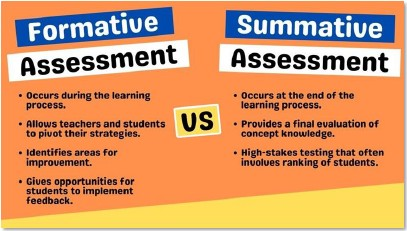
Disponível em: <https://helpfulprofessor.com/wp-content/uploads/2022/02/Formative-vs-summative-assessment.jpg> Acesso em: 26 nov. 2023.
Texto 2
Assessment carried out by teachers during the learning process with the aim of using the results to improve instruction is known as formative assessment. Assessment at the end of a course, term, or school year - often for purposes of providing aggregated information on programme outcomes to educational authorities - is referred to as summative assessment.
GEOFF, B. Assessment. In: CARTER, R.; NUNAN, D. (Eds.) The Cambridge Guide to Teaching English to Speakers of Other Languages. Cambridge: Cambridge University Press, p. 137, 2001.
Considering the structural elements of both texts,
Provas
Disciplina: Inglês (Língua Inglesa)
Banca: Verbena
Orgão: Pref. Turvânia-GO
Leia os Textos 1 e 2 para responder à questão.
Texto 1
Disponível em: <https://helpfulprofessor.com/wp-content/uploads/2022/02/Formative-vs-summative-assessment.jpg> Acesso em: 26 nov. 2023.
Texto 2
Assessment carried out by teachers during the learning process with the aim of using the results to improve instruction is known as formative assessment. Assessment at the end of a course, term, or school year - often for purposes of providing aggregated information on programme outcomes to educational authorities - is referred to as summative assessment.
GEOFF, B. Assessment. In: CARTER, R.; NUNAN, D. (Eds.) The Cambridge Guide to Teaching English to Speakers of Other Languages. Cambridge: Cambridge University Press, p. 137, 2001.
Considering the descriptions, an example of an activity that represents the summative type of assessment would be one where
Provas
Disciplina: Inglês (Língua Inglesa)
Banca: Verbena
Orgão: Pref. Turvânia-GO
Leia o texto para responder à questão.

Disponível em: <https://www.ladysmithnews.com/opinion/cartoons/image_aef85b4c-e446-11ed-8df9-8bace82e6099.html> Acesso em: 26 nov. 2023.
The word “better” in “Anything you can do, I can do better” is
Provas
Disciplina: Inglês (Língua Inglesa)
Banca: Verbena
Orgão: Pref. Turvânia-GO
Leia o texto para responder à questão.
Disponível em: <https://www.ladysmithnews.com/opinion/cartoons/image_aef85b4c-e446-11ed-8df9-8bace82e6099.html> Acesso em: 26 nov. 2023.
A partir da leitura do texto, infere-se que os sistemas de inteligência artificial
Provas
Disciplina: Inglês (Língua Inglesa)
Banca: FADESP
Orgão: Pref. Capanema-PA
Provas
Disciplina: Inglês (Língua Inglesa)
Banca: FADESP
Orgão: Pref. Capanema-PA
“The professional of Teaching English as a Foreign Language”
Author: Anderson Francisco Guimarães Maia
According to the National Foreign Language Center (2012), over one eighth of
the world’s population is currently studying English as a foreign language (EFL) in over
seventy countries. Statistics also show these figures have increased 52% in the past two
decades and estimate that 1,5 billion people will be using the English language as the
main means of communication in the next twenty years.
This growing need for global communication brings the field of teaching English
as foreign language (TEFL) .to a .much higher. level of professionalism. The concept of
professional, however, might vary in different contexts. A professional is a worker whose
expertise involves not only skill and knowledge but also exercise of highly sophisticated
judgment, and whose accreditation necessitates extensive study, often university-based,
as well as practical experience. According to this definition, one must perform a threefold
task in order to be considered a professional EFL teacher: (1) fulfill entry requirements
and standards, (2) obtain specialized knowledge through both academic and practical
experience, and (3) build a career in the field of education.
Global and local standards for both English language teaching and teachers have
been continuously developed through the proliferation of academic programs, legislation,
professional journals, magazines, conferences, and professional organizations. However,
several other individuals are actively involved in the EFL teaching field, but they cannot
be considered actual professionals. These individuals are considered lays, amateurs,
technicians, or academics. The diferences between actual professionals and other
individuals are outlined below.
Professional vs lay.
The lay population of EFL workers includes individuals who do not have the
specific skills, knowledge, and conventions that professionals do. They usually do not
belong to any professional group, but know enough English to be considered “capable”
of teaching others. Their teaching activities often include tutoring, conversation classes,
or other undemanding settings to which very little pedagogical knowledge is needed.
Professional vs amateur.
The amateur EFL teacher is the individual who ventures into the field with very
minimum skills and pedagogical knowledge. The amateur is not committed to ongoing
development and lacks particular training. This type of teacher usually experiments with
his classes and tries out new trends for fun or even the love of it. Professional standards
are not a concern to amateur teachers. They do not comply with compulsory examinations
and nationally or internationally recognized qualifications. It is true though that several
EFL teachers begin as amateurs in language institutions after minimum pre-service
training. It is also true that gifted amateurs might outperform uncommitted professionals.
Real and committed EFL professional teachers, however, develop better and better
practices over the course of time as opposed to amateurs who are usually not committed
to continuous development.
Professional vs. technician.
A technician who teaches EFL is “trained” to perform a specific educational
activity and certain acts with skill. A technician can be considered partly professional and
partly amateur. On one hand, a technician is a professional as he or she performs regular
teaching routines and has enough pedagogical and linguistic knowledge to meet specific
needs in a non-academic setting. On the other hand, the technician is an amateur as he
or she lacks the ability to understand principles that underlie actions. This inability leads
to automatized actions as the technician does not understand language acquisition
processes or pedagogical theory. For instance, a technician might be “trained” to teach
new grammar rules by introducing them within the context of a conversation. He or she
can use that technique for several years and have it automatized without any
understanding of inductive and deductive approaches to grammar teaching.
Professional vs academic.
The academic holds deep knowledge about language and teaching and can be
defined as a researcher, lecturer, and writer whose primary setting is a university.
Although many academics would define themselves as professionals, true professionals
are immediate agents of real- world change and academics are primarily occupied in
thinking and researching. The academic’s job is to refine thinking through research and
the professional’s job is to improve actual teaching and find out what works.
Teaching English to young learners is a challenge in terms of motivation. Choose the alternative that depicts best practices in motivation-fostering of kindergarteners within the communicative approach.
Provas
Disciplina: Inglês (Língua Inglesa)
Banca: FADESP
Orgão: Pref. Capanema-PA
“The professional of Teaching English as a Foreign Language”
Author: Anderson Francisco Guimarães Maia
According to the National Foreign Language Center (2012), over one eighth of
the world’s population is currently studying English as a foreign language (EFL) in over
seventy countries. Statistics also show these figures have increased 52% in the past two
decades and estimate that 1,5 billion people will be using the English language as the
main means of communication in the next twenty years.
This growing need for global communication brings the field of teaching English
as foreign language (TEFL) .to a .much higher. level of professionalism. The concept of
professional, however, might vary in different contexts. A professional is a worker whose
expertise involves not only skill and knowledge but also exercise of highly sophisticated
judgment, and whose accreditation necessitates extensive study, often university-based,
as well as practical experience. According to this definition, one must perform a threefold
task in order to be considered a professional EFL teacher: (1) fulfill entry requirements
and standards, (2) obtain specialized knowledge through both academic and practical
experience, and (3) build a career in the field of education.
Global and local standards for both English language teaching and teachers have
been continuously developed through the proliferation of academic programs, legislation,
professional journals, magazines, conferences, and professional organizations. However,
several other individuals are actively involved in the EFL teaching field, but they cannot
be considered actual professionals. These individuals are considered lays, amateurs,
technicians, or academics. The diferences between actual professionals and other
individuals are outlined below.
Professional vs lay.
The lay population of EFL workers includes individuals who do not have the
specific skills, knowledge, and conventions that professionals do. They usually do not
belong to any professional group, but know enough English to be considered “capable”
of teaching others. Their teaching activities often include tutoring, conversation classes,
or other undemanding settings to which very little pedagogical knowledge is needed.
Professional vs amateur.
The amateur EFL teacher is the individual who ventures into the field with very
minimum skills and pedagogical knowledge. The amateur is not committed to ongoing
development and lacks particular training. This type of teacher usually experiments with
his classes and tries out new trends for fun or even the love of it. Professional standards
are not a concern to amateur teachers. They do not comply with compulsory examinations
and nationally or internationally recognized qualifications. It is true though that several
EFL teachers begin as amateurs in language institutions after minimum pre-service
training. It is also true that gifted amateurs might outperform uncommitted professionals.
Real and committed EFL professional teachers, however, develop better and better
practices over the course of time as opposed to amateurs who are usually not committed
to continuous development.
Professional vs. technician.
A technician who teaches EFL is “trained” to perform a specific educational
activity and certain acts with skill. A technician can be considered partly professional and
partly amateur. On one hand, a technician is a professional as he or she performs regular
teaching routines and has enough pedagogical and linguistic knowledge to meet specific
needs in a non-academic setting. On the other hand, the technician is an amateur as he
or she lacks the ability to understand principles that underlie actions. This inability leads
to automatized actions as the technician does not understand language acquisition
processes or pedagogical theory. For instance, a technician might be “trained” to teach
new grammar rules by introducing them within the context of a conversation. He or she
can use that technique for several years and have it automatized without any
understanding of inductive and deductive approaches to grammar teaching.
Professional vs academic.
The academic holds deep knowledge about language and teaching and can be
defined as a researcher, lecturer, and writer whose primary setting is a university.
Although many academics would define themselves as professionals, true professionals
are immediate agents of real- world change and academics are primarily occupied in
thinking and researching. The academic’s job is to refine thinking through research and
the professional’s job is to improve actual teaching and find out what works.
Choose the alternative that reflects how poetry can be used to teach writing skills to young learners.
Provas
Caderno Container