Foram encontradas 45.349 questões.
Provas

Analyze the underlined sentences:
I. “Scientists have delivered a final warning on the climate crisis, as rising greenhouse gas emissions push the world to the brink of irrevocable damage that only swift and drastic action can avert.”
II. “The comprehensive review of human knowledge of the climate crisis took hundreds of scientists eight years to compile and runs to thousands of pages, but boiled down to one message: act now, or it will be too late.”
Provas
Text 1
Romanticism
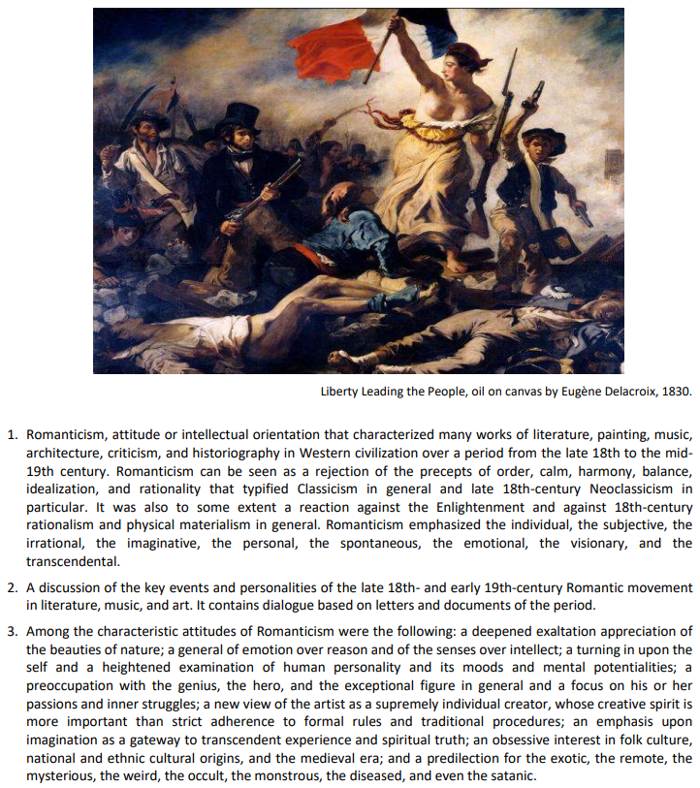
BRITANNICA, The Editors of Encyclopaedia. “Romanticism”. Encyclopedia Britannica, 26 Dec. 2023, https://www.britannica.com/art/Romanticism. Accessed 1 February 2024
Provas
Text 1
Romanticism
BRITANNICA, The Editors of Encyclopaedia. “Romanticism”. Encyclopedia Britannica, 26 Dec. 2023, https://www.britannica.com/art/Romanticism. Accessed 1 February 2024
Analyze the sentences of text 1:
I. “Romanticism emphasized the individual, the subjective, the irrational, the imaginative, the personal, the spontaneous, the emotional, the visionary, and the transcendental”.
II. “A discussion of the key events and personalities of the late 18th- and early 19th-century Romantic movement in literature, music, and art. It contains dialogue based on letters and documents of the period”.
III.”Among the characteristic attitudes of Romanticism were the following: a deepened appreciation of the beauties of nature; a general exaltation of emotion over reason and of the senses over intellect”.
Provas
Text 1
Romanticism
BRITANNICA, The Editors of Encyclopaedia. “Romanticism”. Encyclopedia Britannica, 26 Dec. 2023, https://www.britannica.com/art/Romanticism. Accessed 1 February 2024
Provas
Text 1
Romanticism
BRITANNICA, The Editors of Encyclopaedia. “Romanticism”. Encyclopedia Britannica, 26 Dec. 2023, https://www.britannica.com/art/Romanticism. Accessed 1 February 2024
Provas
Writing is one if the four language skills. It involves producing language rather than receiving it. We can say that writing involves communicating a message by making signs on a page. To write, we need a message and someone to communicate it to. We need to be able to form letters and words, and to join these together to make words, sentences or a series of sentences that link together to communicate that message. (SPRAT, 2005, p.26)
Choose the CORRECT item about teaching writing in a foreign language class.
Provas
THE TEXT BELOW WILL BE USED FOR QUESTIONS 58 AND 59.
“Speakers normally have a communicative purpose and listeners are interested in discovering what that purpose is. However, even if listeners have some idea about the purpose, they must listen in orderto be sure. They cannot be sure, in other words, what it is before they hear what speaker says. [...] We communicate when one of us has an information that another does not have. This is known as an information gap. The aim of a communicative activity in class is to get learners to use the language they are learning to interact in realistic and meaningful ways, usually involving exchanges of information.” (Harmer, 2009, p.48)
Judge as (T) True or (F) False the following characteristics of a communicative activity.
( ) Repeating sentences that the teacher says;
( ) Doing oral grammar drills;
( ) Reading aloud from a coursebook;
( ) Giving instructions so that someone can use a new machine;
( ) Giving a prepared speech;
Choose the CORRECT sequence.
Provas
THE TEXT BELOW WILL BE USED FOR QUESTIONS 58 AND 59.
“Speakers normally have a communicative purpose and listeners are interested in discovering what that purpose is. However, even if listeners have some idea about the purpose, they must listen in orderto be sure. They cannot be sure, in other words, what it is before they hear what speaker says. [...] We communicate when one of us has an information that another does not have. This is known as an information gap. The aim of a communicative activity in class is to get learners to use the language they are learning to interact in realistic and meaningful ways, usually involving exchanges of information.” (Harmer, 2009, p.48)
Read the dialogue below.
A: Excuse me.
B: Yes?
A: Do you have a watch?
B: Yes... Why?
A: | wonder if you could tell me what time it is?
B: Certainly... it's three o'clock.
A: Thank you.
B: Don't mention it.
Based on the dialogue, choose the CORRECT statement about it from the perspective of communicative activities.
Provas
The use of Information Communication Technologies (ICTs) in language teaching has countless benefits. The development in the use of ICT, like language labs, videos, satellite broadcasting, videoconferencing and web seminars have supported the richness and quality of education both on and off campus. It harnessed several views of scholars which established the fact that ICTs are indispensable tools that facilitate the teaching and learning of the English language. (JAYANTHI & KUMAR, 2016)
Match the headings to their explanations about some of the positive impacts of ICTs on English Language Teaching.
1. Flexible pacing | ( ) ICTs help the teacher to prepare, produce, store and retrieve their materials easily and swiftly. Rich texts, different topics, quizzes, exercises help in saving the teacher's time. |
2. Autonomy | ( ) ICTs are very stimulating because of the diversity of the learning materials, whether they are computer-based, in the web or on CDs; therefore, the student can learn at their own pace. |
3. Authenticity | ( ) Students have the opportunity to choose the element/s of language which they want to focus, on meeting their learning strategies or learning styles. Here, the learner-centered approach is supported by these facilities offered by the ICTs while traditional techniques failed to give such opportunities. |
4. Helping Teachers | ( ) ICTs provide an authentic learning environment, because the learner can interact with other English speakers across the World. |
Choose the CORRECT sequence for the numbers in the right column.
Provas
Caderno Container