Foram encontradas 45.344 questões.
Disciplina: Inglês (Língua Inglesa)
Banca: ADVISE
Orgão: Pref. Serra Raiz-PB
Provas

Disciplina: Inglês (Língua Inglesa)
Banca: ADVISE
Orgão: Pref. Serra Raiz-PB
Provas
Disciplina: Inglês (Língua Inglesa)
Banca: ADVISE
Orgão: Pref. Serra Raiz-PB
- Gramática - Língua InglesaAdjetivos | Adjectives
- Gramática - Língua InglesaAdvérbios e conjunções | Adverbs and conjunctionsAdvérbios de: lugar, modo, tempo e freqüência | Adverbs of: place, manner, time and frequency
- Gramática - Língua InglesaSubstantivos e compostos | Nouns and compounds
Provas
Disciplina: Inglês (Língua Inglesa)
Banca: ADVISE
Orgão: Pref. Serra Raiz-PB
- Gramática - Língua InglesaAdjetivos | AdjectivesComparativo e superlativo de adjetivos | Comparative and superlative
Provas
Disciplina: Inglês (Língua Inglesa)
Banca: ADVISE
Orgão: Pref. Serra Raiz-PB
Provas
Disciplina: Inglês (Língua Inglesa)
Banca: ADVISE
Orgão: Pref. Serra Raiz-PB
Provas
Disciplina: Inglês (Língua Inglesa)
Banca: ADVISE
Orgão: Pref. Serra Raiz-PB
- Gramática - Língua InglesaVerbos | VerbsVerbos modais | Modal verbs
- Gramática - Língua InglesaVerbos | VerbsInfinitivo e gerúndio | Infinitive and gerund
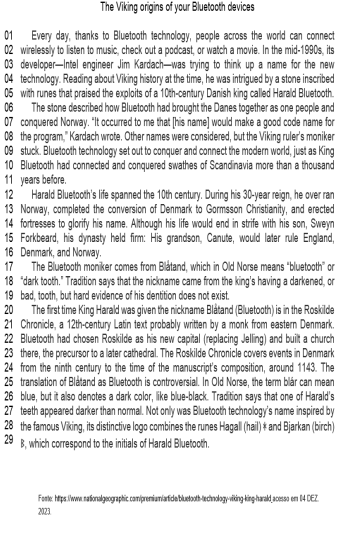
(__) ‘built’ (l.22) is an irregular verb; Past and Participle have the same form;
(__) The verb ‘connect (l.01)’doesn’t have the infinitive mark (to) because it goes after a modal verb; ‘can’ in this case;
(__) The verbs ‘given’ (l.20) and ‘written’ (l.21) are regular because they have the same ending ‘en’.
Provas
Disciplina: Inglês (Língua Inglesa)
Banca: ADVISE
Orgão: Pref. Serra Raiz-PB
Provas
Disciplina: Inglês (Língua Inglesa)
Banca: ADVISE
Orgão: Pref. Serra Raiz-PB
I- The predominant use of connotative terms gives the text a formal character;
II- The use of verbs in the Past promotes cohesion between the ideas presented by the author of the text;
III- The central idea that enables the development of the secondary is a primitive version of technological devices;
IV- The metaphorical text in prose is more dialogical than informative.
Provas
Text CB1A8
The idea of giving rights to animals has long been contentious, but a deeper look into the reasoning behind the philosophy reveals ideas that aren’t all that radical. Animal rights advocates want to distinguish animals from inanimate objects, as they are so often considered by exploitative industries and the law. The animal rights movement strives to make the public aware of the fact that animals are sensitive, emotional, and intelligent beings who deserve dignity and respect. But first, it’s important to understand what the term “animal rights” really means.
Animal rights are moral principles grounded in the belief that non-human animals deserve the ability to live as they wish, without being subjected to the desires of human beings. At the core of animal rights is autonomy, which is another way of saying choice. In many countries, human rights are enshrined to protect certain freedoms, such as the right to expression, freedom from torture, and access to democracy. Of course, these choices are constrained depending on social locations like race, class, and gender, but generally speaking, human rights safeguard the basic tenets of what makes human lives worth living. Animal rights aim to do something similar, only for non-human animals.
Animal rights come into direct opposition with animal exploitation, which includes animals used by humans for a variety of reasons, be it for food, as experimental objects, or even pets. Animal rights can also be violated when it comes to human destruction of animal habitats. This negatively impacts the ability of animals to lead full lives of their choosing.
Internet: <thehumaneleague.org > (adapted).
Considering the ideas and linguistic aspects of the text above, judge the items below.
Lawyers who defend animal rights claim that animals and inanimate objects are different.
Provas
Caderno Container