Foram encontradas 64 questões.
Três cargas elétricas puntiformes \( q_A \), \( q_B \) e \( q_C \) estão fixas, respectivamente, nos vértices A, B e C de um triângulo isósceles, conforme indica a figura abaixo.
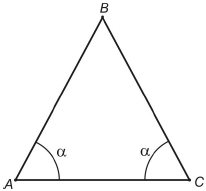
Considerando \( F_A \) o módulo da força elétrica de interação entre as cargas \( q_A \) e \( q_C \); \( F_B \) o módulo da força elétrica de interação entre as cargas \( q_B \) e \( q_C \) e sabendo-se que a força resultante sobre a carga \( q_C \) é perpendicular ao lado AB e aponta para dentro do triângulo, pode-se afirmar, certamente, que a relação entre os valores das cargas elétricas é
Provas
Questão presente nas seguintes provas

Directions: Answer question based on TEXT I.
TEXT I
ETHICS OF WAR
Human beings have been fighting each other since prehistoric times, and people have been discussing the rights and wrongs of it for almost as long.
The Ethics of War starts by assuming that war is a bad thing, and should be avoided if possible, but it recognizes that there can be situations when war may be the lesser evil of several bad choices.
War is a bad thing because it involves deliberately killing or injuring people, and this is a fundamental wrong – an abuse of the victims human rights.
The purpose of war ethics is to help decide what is right or wrong, both for individuals and countries, and to contribute to debates on public policy, and ultimately to government and individual action.
War ethics also leads to the creation of formal codes of war (e.g. the Hague and Geneva conventions), the drafting and implementation of rules of engagement for soldiers, and in the punishment of soldiers and others for war crimes.
The three key questions are:
Is it ever right to go to war?
When is it right to fight?
What is the moral way to conduct a war?
The discussion of the ethics of war goes back to the Greeks and Romans, although neither civilization behaved particularly well in war.
In the Christian tradition war ethics were developed by St Augustine, and later by St Thomas Aquinas and others.
Hugo Grotius (1583-1645), a Dutch philosopher and author of De Jure Belli Ac Pacis (The Rights of War and Peace), wrote down the conditions for a just war that are accepted today.
Cicero argued that there was no acceptable reason for war outside of just revenge or self-defence – in which he included the defence of honor.
He also argued that a war could not be just unless it was publicly declared and unless compensation for the enemy’s offence had first been demanded.
Cicero based his argument on the assumption that nature and human reason influenced a society against war, and that there was a fundamental code of behavior for nations.
Adapted from http://www.bbc.co.uk/ethics/war/. Shtml Acessado em 14/03/2013
Directions: Answer question based on TEXT I.
War ethics’ intention, according to the text, is to show that
Provas
Questão presente nas seguintes provas
TEXTO II
A FAVOR DA DIFERENÇA, CONTRA TODA DESIGUALDADE *
A maioria das pessoas acredita que está isenta de preconceitos. No entanto até sua linguagem contradiz esta crença. De modo especial, o corpo, que deveria ser um elemento de agregação e de comunicação, se torna elemento de discriminação.
Coube-me fazer uma pesquisa com dez adolescentes\( ^{(I)} \) sobre a presença da violência na escola através da palavra. Todos afirmaram que já agrediram e foram agredidos com palavras. Surpreende que os adolescentes veem no corpo um elemento de discriminação. A obesidade, a altura, pequenos defeitos físicos são motivos de preconceito.
Acontece que nossa sociedade seleciona um determinado corpo como modelo\( ^{(B)} \) e quem não obedece a este padrão está fora de cogitação. Num país de pobres que não conseguem ter uma alimentação equilibrada e nem os cuidados mínimos com a saúde, a consequência é a marginalização.
As pessoas com necessidades especiais também são consideradas anormais. É muito comum agredir verbalmente as pessoas chamando-as de retardadas. Até os pobres entram na dança da agressão. Um xingamento comum é o de vileiro ou favelado. E o que dizer dos adolescentes homossexuais?
Diferença x desigualdade
Existe a visão de que a diferença se identifica com a desigualdade\( ^{(III)} \).
Há um padrão de ser humano estandardizado\( ^{(V)} \) e único que deve servir de metro para o julgamento das pessoas. O grande desafio para a educação é descobrir este currículo oculto verdadeiro e forte para enfrentá-lo adequadamente.
Há pessoas que dizem que só a educação é capaz de salvar e desenvolver um país\( ^{(IV)} \). Até aqui todos estão de acordo. Contudo é importante se perguntar qual é o tipo de educação necessária para um país como o Brasil, que tem uma das maiores concentrações de renda do mundo. Há pessoas que tiveram acesso a todos os estudos possíveis e, no entanto, continuam defendendo uma sociedade livre sem ser justa, o que, convenhamos é uma grande possibilidade.
Pesquisa realizada pela Fundação Instituto de Pesquisas Econômicas (Fipe), a pedido do MEC, demonstrou que quanto mais preconceito e práticas discriminatórias existem numa escola, pior é o desempenho de seus estudantes. Foram entrevistadas 18.500 pessoas entre alunos, pais, diretores, professores e funcionários de 501 escolas de todo o Brasil. Do total de estudantes entrevistados, 70% têm menos de 20 anos.
Esta pesquisa revela que praticamente todos os entrevistados (99,3%) têm preconceito em algum nível. Sobre contra quem eles admitem ter preconceito, revelaram: homossexual, deficiente mental, cigano, deficiente físico.
Enquanto a educação não enfrentar essas questões, o que está acontecendo em nossas escolas é apenas uma transmissão de conteúdos, um verniz colorido que não penetra o profundo, a consciência e o coração das pessoas. (...)
SANDRINI, Marcos. Mundo jovem. Realidade brasileira Fevereiro de 2013.
*O texto foi reproduzido na íntegra, respeitando-se todas as construções sintáticas da forma como nele apareceram.
Observe as estruturas sintáticas abaixo.
I. “Coube-me
fazer uma pesquisa com dez adolescentes...”
II. “Acontece
que nossa sociedade seleciona um determinado corpo como modelo...”
III. “Existe
a visão de que a diferença se identifica com a desigualdade.”
IV. “Há pessoas que dizem que só a educação é capaz de salvar e desenvolver um país.”
V. “Há
um padrão de ser humano estandardizado...”
Assinale a alternativa em que o comentário apresentado está de acordo com as regras gramaticais para uma norma padrão da língua.
Provas
Questão presente nas seguintes provas
A circunferência \( λ \) é tangente à reta \( r:y={\large{3 \over 4}}x \) e também é tangente ao eixo das abscissas no ponto de abscissa 6. Dentre as equações abaixo, a que representa uma parábola que contém a origem do plano cartesiano e o centro de \( λ \) é
Provas
Questão presente nas seguintes provas
Sr. José deseja guardar 4 bolas – uma azul, uma branca, uma vermelha e uma preta – em 4 caixas numeradas:
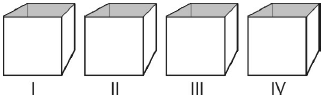
O número de maneiras de Sr. José guardar todas as 4 bolas de forma que uma mesma caixa NÃO contenha mais do que duas bolas, é igual a
Provas
Questão presente nas seguintes provas
- GeometriaGeometria PlanaCircunferências e CírculosÁrea do círculo, do setor circular e do segmento circular
Na figura abaixo, os três círculos têm centro sobre a reta AB e os dois de maior raio têm centro sobre a circunferência de menor raio.
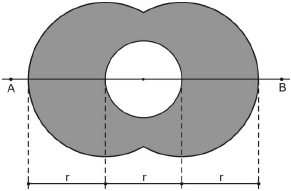
A expressão que fornece o valor da área sombreada é
Provas
Questão presente nas seguintes provas
TEXTO I
A MOÇA E A CALÇA
Foi no Cinema Pax, em Ipanema. O filme em exibição é ruim: “O menino mágico”. Se mágico adulto geralmente é chato, imaginem menino. Mas isso não vem ao caso. O que vem ao caso é a mocinha muito da redondinha, condição que seu traje apertadinho deixava sobejamente clara. A mocinha chegou, comprou a entrada, apanhou, foi até a porta, mas aí o porteiro olhou pra ela e disse que ela não podia entrar\( ^{(A)} \):
_ Não posso por quê?
_ A senhora está de “Saint-Tropez”.
_ E daí?
Daí o porteiro olhou pras exuberâncias físicas dela, sorriu e foi um bocado sincero: _ Por mim a senhora entrava. (Provavelmente completou baixinho... e entrava bem.) Mas o gerente tinha dado ordem de que não podia com aquela calça bossa-nova e, sabe como é... ele tinha que obedecer\( ^{(C)} \), de maneira que sentia muito, mas com aquela calça não.
_ O senhor não vai querer que eu tire a calça. Nós, que estávamos perto, quase respondemos por ele: _ Como não, dona! _ Mas ela não queria resposta. Queria era discutir a legitimidade de suas apertadas calças “Saint-Tropez”. Disse então que suas calças eram tão compridas como outras quaisquer. O cinema Pax é dos padres e talvez por causa desse detalhe é que não pode “Saint-Tropez”. A calça, de fato, era comprida como as outras, mas embaixo. Em cima era curta demais. O umbigo ficava ali, isolado, parecendo até o representante de Cuba em conferências panamericanas.
_ Quer dizer que com minhas calças eu não entro? _ Quis ela saber ainda mais uma vez. E vendo o porteiro balançar a cabeça em sinal negativo, tornou a perguntar: _ E de saia?
De saia podia. Ela então abriu a bolsa, tirou uma saia que estava dentro, toda embrulhadinha (devia ser pra presente). Desembrulhou e vestiu ali mesmo, por cima do pomo da discórdia\( ^{(B)} \). No caso, a calça “Saint- Tropez”. Depois, calmamente, afrouxou a calça e deixou que a dita escorresse saia abaixo. Apanhou, guardou na bolsa e entrou com uma altivez que só vendo\( ^{(D)} \).
Enquanto rasgava o bilhete, o porteiro comentou:
_ Faço votos que ela tenha outra por baixo. Outra calça, naturalmente.
(Stanislaw Ponte Preta)
O texto, embora escrito seguindo as regras da norma padrão culta da língua, apresenta, em várias momentos, estruturas com características de informalidade e coloquialismo. Assinale a alternativa em que o trecho NÃO está de acordo com a afirmativa acima.
Provas
Questão presente nas seguintes provas
Um bloco, de massa 2 kg, desliza sobre um plano inclinado, conforme a figura seguinte.
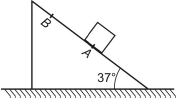
O gráfico v x t abaixo representa a velocidade desse bloco em função do tempo, durante sua subida, desde o ponto A até o ponto B.
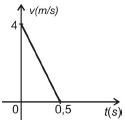
Considere a existência de atrito entre o bloco e o plano inclinado e despreze quaisquer outras formas de resistência ao movimento. Sabendo que o bloco retorna ao ponto A, a velocidade com que ele passa por esse ponto, na descida, em m/s, vale
Provas
Questão presente nas seguintes provas
Directions: Answer question based on TEXT I.
TEXT I
ETHICS OF WAR
Human beings have been fighting each other since prehistoric times, and people have been discussing the rights and wrongs of it for almost as long.
The Ethics of War starts by assuming that war is a bad thing, and should be avoided if possible, but it recognizes that there can be situations when war may be the lesser evil of several bad choices.
War is a bad thing because it involves deliberately killing or injuring people, and this is a fundamental wrong – an abuse of the victims human rights.
The purpose of war ethics is to help decide what is right or wrong, both for individuals and countries, and to contribute to debates on public policy, and ultimately to government and individual action.
War ethics also leads to the creation of formal codes of war (e.g. the Hague and Geneva conventions), the drafting and implementation of rules of engagement for soldiers, and in the punishment of soldiers and others for war crimes.
The three key questions are:
Is it ever right to go to war?
When is it right to fight?
What is the moral way to conduct a war?
The discussion of the ethics of war goes back to the Greeks and Romans, although neither civilization behaved particularly well in war.
In the Christian tradition war ethics were developed by St Augustine, and later by St Thomas Aquinas and others.
Hugo Grotius (1583-1645), a Dutch philosopher and author of De Jure Belli Ac Pacis (The Rights of War and Peace), wrote down the conditions for a just war that are accepted today.
Cicero argued that there was no acceptable reason for war outside of just revenge or self-defence – in which he included the defence of honor.
He also argued that a war could not be just unless it was publicly declared and unless compensation for the enemy’s offence had first been demanded.
Cicero based his argument on the assumption that nature and human reason influenced a society against war, and that there was a fundamental code of behavior for nations.
Adapted from http://www.bbc.co.uk/ethics/war/. Shtml Acessado em 14/03/2013
In the phrase “should be avoided” the modal verb expresses
Provas
Questão presente nas seguintes provas
Directions: Answer question based on TEXT II.
TEXT II
SEPTEMBER 11
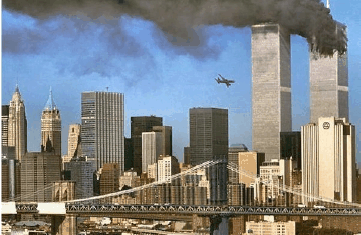
On September 11, 2001, nineteen militants associated with the Islamic extremist group al-Qaeda hijacked four airlines and carried out suicide attacks against targets in the United States. Two of the planes were flown into the towers of the World Trade Center in New York City, a third plane hit the Pentagon just outside Washington, D.C., and the fourth plane crashed in a field in Pennsylvania. Often referred to as 9/11, the attacks resulted in extensive death and destruction, activating major U.S. initiatives to combat terrorism and defining the presidency of George W. Bush. Over three thousand people were killed during the attacks in New York City and Washington, D.C., including more than four hundred police officers and firefighters.
At 8:45 a.m., on a clear Tuesday morning, an American Airlines Boeing 767 loaded with twenty thousand gallons of jet fuel crashed into the north tower of the World Trade Center in New York City. The impact left a wide, burning hole near the 80th floor of the 110- story skyscraper, instantly killing hundreds of people and trapping hundreds more in higher floors. Eighteen minutes after the first plane hit, a second Boeing 767– United Airlines Flight 175–appeared out of the sky, turned sharply toward the World Trade Center and crashed into the south tower near the 60th floor. The collision caused a massive explosion that showered burning fragment over surrounding buildings and the streets below. America was under attack.
The attackers were Islamic terrorists from Saudi Arabia and several other Arab nations. Reportedly financed by Saudi fugitive Osama bin Laden's al-Qaeda terrorist organization, they were acting in retaliation for America's support of Israel, its involvement in the Persian Gulf War and its continued military presence in the Middle East. Some of the terrorists had lived in the United States for more than a year and had taken flying lessons at American commercial flight schools.
As millions watched the events unfolding in New York, American Airlines Flight 77 circled over downtown Washington, D.C., and banged into the west side of the Pentagon military headquarters at 9:45 a.m. Jet fuel from the Boeing 757 caused a devastating inferno that led to the structural collapse of a portion of the giant concrete building. Less than fifteen minutes after the terrorists struck the nerve center of the U.S. military, the horror in New York took a catastrophic turn for the worse when the south tower of the World Trade Center collapsed in a massive cloud of dust and smoke. At 10:30 a.m., the other Trade Center tower collapsed. Close to three thousand people died in the World Trade Center and its vicinity, including an impressive three hundred and forty three firefighters and paramedics, twenty three New York City police officers and thirty seven Port Authority police officers who were struggling to complete an evacuation of the buildings and save the office workers trapped* on higher floors.
Meanwhile, a fourth California-bound plane–United Flight 93–was hijacked about forty minutes after leaving Newark International Airport in New Jersey. Because the plane had been delayed in taking off, passengers on board learned of events in New York and Washington via cell phone calls to the ground. Knowing that the aircraft was not returning to an airport as the hijackers claimed, a group of passengers and flight attendants planned a rebellion. One of the passengers, Thomas Burnett Jr., told his wife over the phone that "I know we're all going to die. There are three of us who are going to do something about it. I love you, honey." Another passenger–Todd Beamer–was heard saying "Are you guys ready? Let's roll" over an open line.
The passengers fought the four hijackers and are suspected to have attacked the cockpit with a fire extinguisher. The plane then flipped over and sped toward the ground, crashing in a rural field in western Pennsylvania at 10:10 a.m. All forty-five people aboard were killed. Within two months, U.S. forces had effectively removed the Taliban from operational power, but the war continued. Osama bin Laden, was finally chased and killed by U.S. forces in Abbottabad, Pakistan.
Adapted from http://www.history.com/topics/9-11-attacks Acessado em 04/04/2013
Glossary:
*Trapped – to be in a bad situation that is difficult to escape.
Mark the right option to complete the statement.
If the plane hadn’t been delayed in taking off, the passengers ............... about the events in New York and Washington.
Provas
Questão presente nas seguintes provas
Cadernos
Caderno Container