Foram encontradas 70 questões.
TEXT I
The Naked Truth: Is New Passenger Scanner a Terrorist Trap or Virtual Strip Search?
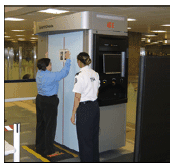
New airport x-ray sees through clothes without revealing details
March 1, 2007
For the next two to three months, passengers randomly selected for additional screening at Phoenix’s Sky Harbor International Airport will have the option of a typical pat down by security personnel or a one-minute, full body scan from a new type of xray machine that allows screeners to see through clothes. The federal government is testing so-called backscatter x-ray machines there, which can detect potentially threatening objects under a person’s clothes by picking up x-rays scattered by materials. (Traditional x-ray machines pick up signals that pass through or are absorbed.)
“It’s using edge detection to detect anomalies,” says Joe Reiss, vice president of marketing at American Science and Engineering (AS&E), the Boston-based manufacturer of the SmartCheck machine. “If you are a suicide bomber and have a vest on, that would appear as clear as day in an image.”
But critics charge the system is an invasion of privacy. “You should not have to go naked to board an aircraft,” says Barry Steinhardt of the American Civil Liberties Union. If full backscatter images were used, screeners would see every detail of each individual scanned. AS&E, however, has built an algorithm into its machine that matches individuals to a general outline of the male or female form. “It looks like the chalk outline of a body rather than the x-ray image of a body,” says Amy Kudwa, a spokesperson for the federal Transportation Security Administration (TSA), which is conducting the trial. “It is a nonintrusive technology; it does not require a pat down.”
The downside is that by removing some of the potentially salacious detail, the developers may have diminished the device’s effectiveness in detecting threats, according to Steinhardt. “The more explicit the image, the better the technology is for actually detecting weapons,” he says. “The more obscured the image, the less realistic the image, the less likelihood it is going to detect contraband.” In other words, he says: “You can have what amounts to a virtual strip search that may have some minor security benefit. Or you can have the illusion of security which will not detect the contraband.”
The machine, however, has passed all tests set for it thus far, Reiss says. “The exact threats are classified. It has been evaluated for detecting certain threats by our engineers and TSA’s and it has performed well.”
(http://www.sciam.com/print_version.cfm?articleID=0AD11209-E7F2-99DF- 30E0585C3218F3D2)
In “You should not have to go naked to board an aircraft…” there is the indication of a(n):
Provas

READ TEXT II AND ANSWER QUESTION:
TEXT II
European airlines to trade emissions allowances
The European Commission is expected to announce on Wednesday that air travel to, from and within Europe will be brought under its existing carbon trading scheme, putting pressure on airlines to curb their greenhouse gas emissions.
According to a leak reported in the Financial Times, the EC will say that emissions caps will apply to flights within the European Union from 2011 and be extended to include international flights from 2012.
EC environment spokesperson Barbara Helfferich told New Scientist that airlines will be asked to apply for emissions allowances through a national authority of their choice.
“For instance, American Airlines could decide that most of its flights fly into Paris and therefore choose French authorities. They would tell the French how many allowances they need to cover their flights and the French would relay that to the European Commission,” explains Helfferich.
The EC will assess these requests much as it assesses National Allocation Plans under the current emissions trading scheme, with a view to gradually reducing air travel emissions allowances.
(http://environment.newscientist.com/article. ns?id=dn10829&feedId=onlinenews_ rss20. March 10, 2007)
Therefore in “and therefore choose French authorities” introduces an idea of:
Provas
TEXT I
The Naked Truth: Is New Passenger Scanner a Terrorist Trap or Virtual Strip Search?
New airport x-ray sees through clothes without revealing details
March 1, 2007
For the next two to three months, passengers randomly selected for additional screening at Phoenix’s Sky Harbor International Airport will have the option of a typical pat down by security personnel or a one-minute, full body scan from a new type of xray machine that allows screeners to see through clothes. The federal government is testing so-called backscatter x-ray machines there, which can detect potentially threatening objects under a person’s clothes by picking up x-rays scattered by materials. (Traditional x-ray machines pick up signals that pass through or are absorbed.)
“It’s using edge detection to detect anomalies,” says Joe Reiss, vice president of marketing at American Science and Engineering (AS&E), the Boston-based manufacturer of the SmartCheck machine. “If you are a suicide bomber and have a vest on, that would appear as clear as day in an image.”
But critics charge the system is an invasion of privacy. “You should not have to go naked to board an aircraft,” says Barry Steinhardt of the American Civil Liberties Union. If full backscatter images were used, screeners would see every detail of each individual scanned. AS&E, however, has built an algorithm into its machine that matches individuals to a general outline of the male or female form. “It looks like the chalk outline of a body rather than the x-ray image of a body,” says Amy Kudwa, a spokesperson for the federal Transportation Security Administration (TSA), which is conducting the trial. “It is a nonintrusive technology; it does not require a pat down.”
The downside is that by removing some of the potentially salacious detail, the developers may have diminished the device’s effectiveness in detecting threats, according to Steinhardt. “The more explicit the image, the better the technology is for actually detecting weapons,” he says. “The more obscured the image, the less realistic the image, the less likelihood it is going to detect contraband.” In other words, he says: “You can have what amounts to a virtual strip search that may have some minor security benefit. Or you can have the illusion of security which will not detect the contraband.”
The machine, however, has passed all tests set for it thus far, Reiss says. “The exact threats are classified. It has been evaluated for detecting certain threats by our engineers and TSA’s and it has performed well.”
(http://www.sciam.com/print_version.cfm?articleID=0AD11209-E7F2-99DF- 30E0585C3218F3D2)
actually in “ for actually detecting weapons” means:
Provas
READ TEXT II AND ANSWER QUESTION:
TEXT II
European airlines to trade emissions allowances
The European Commission is expected to announce on Wednesday that air travel to, from and within Europe will be brought under its existing carbon trading scheme, putting pressure on airlines to curb their greenhouse gas emissions.
According to a leak reported in the Financial Times, the EC will say that emissions caps will apply to flights within the European Union from 2011 and be extended to include international flights from 2012.
EC environment spokesperson Barbara Helfferich told New Scientist that airlines will be asked to apply for emissions allowances through a national authority of their choice.
“For instance, American Airlines could decide that most of its flights fly into Paris and therefore choose French authorities. They would tell the French how many allowances they need to cover their flights and the French would relay that to the European Commission,” explains Helfferich.
The EC will assess these requests much as it assesses National Allocation Plans under the current emissions trading scheme, with a view to gradually reducing air travel emissions allowances.
(http://environment.newscientist.com/article. ns?id=dn10829&feedId=onlinenews_ rss20. March 10, 2007)
gradually in “ with a view to gradually reducing…” means:
Provas
READ TEXT I AND ANSWER QUESTION:
TEXT I
The Naked Truth: Is New Passenger Scanner a Terrorist Trap or Virtual Strip Search?
New airport x-ray sees through clothes without revealing details
March 1, 2007
For the next two to three months, passengers randomly selected for additional screening at Phoenix’s Sky Harbor International Airport will have the option of a typical pat down by security personnel or a one-minute, full body scan from a new type of xray machine that allows screeners to see through clothes. The federal government is testing so-called backscatter x-ray machines there, which can detect potentially threatening objects under a person’s clothes by picking up x-rays scattered by materials. (Traditional x-ray machines pick up signals that pass through or are absorbed.)
“It’s using edge detection to detect anomalies,” says Joe Reiss, vice president of marketing at American Science and Engineering (AS&E), the Boston-based manufacturer of the SmartCheck machine. “If you are a suicide bomber and have a vest on, that would appear as clear as day in an image.”
But critics charge the system is an invasion of privacy. “You should not have to go naked to board an aircraft,” says Barry Steinhardt of the American Civil Liberties Union. If full backscatter images were used, screeners would see every detail of each individual scanned. AS&E, however, has built an algorithm into its machine that matches individuals to a general outline of the male or female form. “It looks like the chalk outline of a body rather than the x-ray image of a body,” says Amy Kudwa, a spokesperson for the federal Transportation Security Administration (TSA), which is conducting the trial. “It is a nonintrusive technology; it does not require a pat down.”
The downside is that by removing some of the potentially salacious detail, the developers may have diminished the device’s effectiveness in detecting threats, according to Steinhardt. “The more explicit the image, the better the technology is for actually detecting weapons,” he says. “The more obscured the image, the less realistic the image, the less likelihood it is going to detect contraband.” In other words, he says: “You can have what amounts to a virtual strip search that may have some minor security benefit. Or you can have the illusion of security which will not detect the contraband.”
The machine, however, has passed all tests set for it thus far, Reiss says. “The exact threats are classified. It has been evaluated for detecting certain threats by our engineers and TSA’s and it has performed well.”
(http://www.sciam.com/print_version.cfm?articleID=0AD11209-E7F2-99DF- 30E0585C3218F3D2)
The title of this text introduces a:
Provas
READ TEXT II AND ANSWER QUESTION:
TEXT II
European airlines to trade emissions allowances
The European Commission is expected to announce on Wednesday that air travel to, from and within Europe will be brought under its existing carbon trading scheme, putting pressure on airlines to curb their greenhouse gas emissions.
According to a leak reported in the Financial Times, the EC will say that emissions caps will apply to flights within the European Union from 2011 and be extended to include international flights from 2012.
EC environment spokesperson Barbara Helfferich told New Scientist that airlines will be asked to apply for emissions allowances through a national authority of their choice.
“For instance, American Airlines could decide that most of its flights fly into Paris and therefore choose French authorities. They would tell the French how many allowances they need to cover their flights and the French would relay that to the European Commission,” explains Helfferich.
The EC will assess these requests much as it assesses National Allocation Plans under the current emissions trading scheme, with a view to gradually reducing air travel emissions allowances.
(http://environment.newscientist.com/article. ns?id=dn10829&feedId=onlinenews_ rss20. March 10, 2007)
According to the text, greenhouse gas emissions should be:
Provas
READ TEXT I AND ANSWER QUESTION:
TEXT I
The Naked Truth: Is New Passenger Scanner a Terrorist Trap or Virtual Strip Search?
New airport x-ray sees through clothes without revealing details
March 1, 2007
For the next two to three months, passengers randomly selected for additional screening at Phoenix’s Sky Harbor International Airport will have the option of a typical pat down by security personnel or a one-minute, full body scan from a new type of xray machine that allows screeners to see through clothes. The federal government is testing so-called backscatter x-ray machines there, which can detect potentially threatening objects under a person’s clothes by picking up x-rays scattered by materials. (Traditional x-ray machines pick up signals that pass through or are absorbed.)
“It’s using edge detection to detect anomalies,” says Joe Reiss, vice president of marketing at American Science and Engineering (AS&E), the Boston-based manufacturer of the SmartCheck machine. “If you are a suicide bomber and have a vest on, that would appear as clear as day in an image.”
But critics charge the system is an invasion of privacy. “You should not have to go naked to board an aircraft,” says Barry Steinhardt of the American Civil Liberties Union. If full backscatter images were used, screeners would see every detail of each individual scanned. AS&E, however, has built an algorithm into its machine that matches individuals to a general outline of the male or female form. “It looks like the chalk outline of a body rather than the x-ray image of a body,” says Amy Kudwa, a spokesperson for the federal Transportation Security Administration (TSA), which is conducting the trial. “It is a nonintrusive technology; it does not require a pat down.”
The downside is that by removing some of the potentially salacious detail, the developers may have diminished the device’s effectiveness in detecting threats, according to Steinhardt. “The more explicit the image, the better the technology is for actually detecting weapons,” he says. “The more obscured the image, the less realistic the image, the less likelihood it is going to detect contraband.” In other words, he says: “You can have what amounts to a virtual strip search that may have some minor security benefit. Or you can have the illusion of security which will not detect the contraband.”
The machine, however, has passed all tests set for it thus far, Reiss says. “The exact threats are classified. It has been evaluated for detecting certain threats by our engineers and TSA’s and it has performed well.”
(http://www.sciam.com/print_version.cfm?articleID=0AD11209-E7F2-99DF- 30E0585C3218F3D2)
The underlined word in “threatening objects” suggests these objects are:
Provas
READ TEXT I AND ANSWER QUESTION:
TEXT I
The Naked Truth: Is New Passenger Scanner a Terrorist Trap or Virtual Strip Search?
New airport x-ray sees through clothes without revealing details
March 1, 2007
For the next two to three months, passengers randomly selected for additional screening at Phoenix’s Sky Harbor International Airport will have the option of a typical pat down by security personnel or a one-minute, full body scan from a new type of xray machine that allows screeners to see through clothes. The federal government is testing so-called backscatter x-ray machines there, which can detect potentially threatening objects under a person’s clothes by picking up x-rays scattered by materials. (Traditional x-ray machines pick up signals that pass through or are absorbed.)
“It’s using edge detection to detect anomalies,” says Joe Reiss, vice president of marketing at American Science and Engineering (AS&E), the Boston-based manufacturer of the SmartCheck machine. “If you are a suicide bomber and have a vest on, that would appear as clear as day in an image.”
But critics charge the system is an invasion of privacy. “You should not have to go naked to board an aircraft,” says Barry Steinhardt of the American Civil Liberties Union. If full backscatter images were used, screeners would see every detail of each individual scanned. AS&E, however, has built an algorithm into its machine that matches individuals to a general outline of the male or female form. “It looks like the chalk outline of a body rather than the x-ray image of a body,” says Amy Kudwa, a spokesperson for the federal Transportation Security Administration (TSA), which is conducting the trial. “It is a nonintrusive technology; it does not require a pat down.”
The downside is that by removing some of the potentially salacious detail, the developers may have diminished the device’s effectiveness in detecting threats, according to Steinhardt. “The more explicit the image, the better the technology is for actually detecting weapons,” he says. “The more obscured the image, the less realistic the image, the less likelihood it is going to detect contraband.” In other words, he says: “You can have what amounts to a virtual strip search that may have some minor security benefit. Or you can have the illusion of security which will not detect the contraband.”
The machine, however, has passed all tests set for it thus far, Reiss says. “The exact threats are classified. It has been evaluated for detecting certain threats by our engineers and TSA’s and it has performed well.”
(http://www.sciam.com/print_version.cfm?articleID=0AD11209-E7F2-99DF- 30E0585C3218F3D2)
When samples are selected “randomly”, they are picked:
Provas
READ TEXT II AND ANSWER QUESTION:
TEXT II
European airlines to trade emissions allowances
The European Commission is expected to announce on Wednesday that air travel to, from and within Europe will be brought under its existing carbon trading scheme, putting pressure on airlines to curb their greenhouse gas emissions.
According to a leak reported in the Financial Times, the EC will say that emissions caps will apply to flights within the European Union from 2011 and be extended to include international flights from 2012.
EC environment spokesperson Barbara Helfferich told New Scientist that airlines will be asked to apply for emissions allowances through a national authority of their choice.
“For instance, American Airlines could decide that most of its flights fly into Paris and therefore choose French authorities. They would tell the French how many allowances they need to cover their flights and the French would relay that to the European Commission,” explains Helfferich.
The EC will assess these requests much as it assesses National Allocation Plans under the current emissions trading scheme, with a view to gradually reducing air travel emissions allowances.
(http://environment.newscientist.com/article. ns?id=dn10829&feedId=onlinenews_ rss20. March 10, 2007)
In the title, the verb makes a reference to something that:
Provas
TEXTO – MAQUIAGEM
Nesta época, no ano passado, começou a se constatar nas prateleiras dos supermercados uma “maquiagem” de produtos. Consistia, basicamente, em reduzir a quantidade de mercadoria embalada, mantendo o preço de venda.
O assunto despertou celeuma entre associações de consumidores, fábricas e autoridades governamentais. O Ministério da Justiça acabou por reagir, multando empresas que, segundo seu entendimento, haviam ludibriado a boa-fé dos consumidores. Um ano depois, pode-se dizer que houve alguma melhora na situação.
Houve alguma confusão acerca do que estava errado na prática da “maquiagem”. Uma empresa tem todo direito de diminuir, quando e quanto quiser, o volume contido na embalagem de seus produtos. O que estava errado na prática da “maquiagem”, e que configura um desrespeito ao Código de Defesa do Consumidor, era que as empresas mudaram os seus produtos sem avisar clara e antecipadamente o consumidor do que estavam fazendo.
Nem todas as “maquiagens” foram desfeitas, mas o resultado daqueles embates, um ano depois, serviu para fortalecer ainda mais a cultura de que o cidadão, enquanto consumidor, tem uma série de direitos que têm de ser respeitados.
Folha de São Paulo, dezembro de 2002
O segundo período do primeiro parágrafo do texto:
Provas
Caderno Container