Foram encontradas 927 questões.
READ TEXT II AND ANSWER QUESTION:
TEXT II
European airlines to trade emissions allowances
The European Commission is expected to announce on Wednesday that air travel to, from and within Europe will be brought under its existing carbon trading scheme, putting pressure on airlines to curb their greenhouse gas emissions.
According to a leak reported in the Financial Times, the EC will say that emissions caps will apply to flights within the European Union from 2011 and be extended to include international flights from 2012.
EC environment spokesperson Barbara Helfferich told New Scientist that airlines will be asked to apply for emissions allowances through a national authority of their choice.
“For instance, American Airlines could decide that most of its flights fly into Paris and therefore choose French authorities. They would tell the French how many allowances they need to cover their flights and the French would relay that to the European Commission,” explains Helfferich.
The EC will assess these requests much as it assesses National Allocation Plans under the current emissions trading scheme, with a view to gradually reducing air travel emissions allowances.
(http://environment.newscientist.com/article. ns?id=dn10829&feedId=onlinenews_ rss20. March 10, 2007)
According to the text, greenhouse gas emissions should be:
Provas

READ TEXT I AND ANSWER QUESTION:
TEXT I
The Naked Truth: Is New Passenger Scanner a Terrorist Trap or Virtual Strip Search?
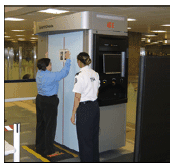
New airport x-ray sees through clothes without revealing details
March 1, 2007
For the next two to three months, passengers randomly selected for additional screening at Phoenix’s Sky Harbor International Airport will have the option of a typical pat down by security personnel or a one-minute, full body scan from a new type of xray machine that allows screeners to see through clothes. The federal government is testing so-called backscatter x-ray machines there, which can detect potentially threatening objects under a person’s clothes by picking up x-rays scattered by materials. (Traditional x-ray machines pick up signals that pass through or are absorbed.)
“It’s using edge detection to detect anomalies,” says Joe Reiss, vice president of marketing at American Science and Engineering (AS&E), the Boston-based manufacturer of the SmartCheck machine. “If you are a suicide bomber and have a vest on, that would appear as clear as day in an image.”
But critics charge the system is an invasion of privacy. “You should not have to go naked to board an aircraft,” says Barry Steinhardt of the American Civil Liberties Union. If full backscatter images were used, screeners would see every detail of each individual scanned. AS&E, however, has built an algorithm into its machine that matches individuals to a general outline of the male or female form. “It looks like the chalk outline of a body rather than the x-ray image of a body,” says Amy Kudwa, a spokesperson for the federal Transportation Security Administration (TSA), which is conducting the trial. “It is a nonintrusive technology; it does not require a pat down.”
The downside is that by removing some of the potentially salacious detail, the developers may have diminished the device’s effectiveness in detecting threats, according to Steinhardt. “The more explicit the image, the better the technology is for actually detecting weapons,” he says. “The more obscured the image, the less realistic the image, the less likelihood it is going to detect contraband.” In other words, he says: “You can have what amounts to a virtual strip search that may have some minor security benefit. Or you can have the illusion of security which will not detect the contraband.”
The machine, however, has passed all tests set for it thus far, Reiss says. “The exact threats are classified. It has been evaluated for detecting certain threats by our engineers and TSA’s and it has performed well.”
(http://www.sciam.com/print_version.cfm?articleID=0AD11209-E7F2-99DF- 30E0585C3218F3D2)
The underlined word in “threatening objects” suggests these objects are:
Provas
READ TEXT I AND ANSWER QUESTION:
TEXT I
The Naked Truth: Is New Passenger Scanner a Terrorist Trap or Virtual Strip Search?
New airport x-ray sees through clothes without revealing details
March 1, 2007
For the next two to three months, passengers randomly selected for additional screening at Phoenix’s Sky Harbor International Airport will have the option of a typical pat down by security personnel or a one-minute, full body scan from a new type of xray machine that allows screeners to see through clothes. The federal government is testing so-called backscatter x-ray machines there, which can detect potentially threatening objects under a person’s clothes by picking up x-rays scattered by materials. (Traditional x-ray machines pick up signals that pass through or are absorbed.)
“It’s using edge detection to detect anomalies,” says Joe Reiss, vice president of marketing at American Science and Engineering (AS&E), the Boston-based manufacturer of the SmartCheck machine. “If you are a suicide bomber and have a vest on, that would appear as clear as day in an image.”
But critics charge the system is an invasion of privacy. “You should not have to go naked to board an aircraft,” says Barry Steinhardt of the American Civil Liberties Union. If full backscatter images were used, screeners would see every detail of each individual scanned. AS&E, however, has built an algorithm into its machine that matches individuals to a general outline of the male or female form. “It looks like the chalk outline of a body rather than the x-ray image of a body,” says Amy Kudwa, a spokesperson for the federal Transportation Security Administration (TSA), which is conducting the trial. “It is a nonintrusive technology; it does not require a pat down.”
The downside is that by removing some of the potentially salacious detail, the developers may have diminished the device’s effectiveness in detecting threats, according to Steinhardt. “The more explicit the image, the better the technology is for actually detecting weapons,” he says. “The more obscured the image, the less realistic the image, the less likelihood it is going to detect contraband.” In other words, he says: “You can have what amounts to a virtual strip search that may have some minor security benefit. Or you can have the illusion of security which will not detect the contraband.”
The machine, however, has passed all tests set for it thus far, Reiss says. “The exact threats are classified. It has been evaluated for detecting certain threats by our engineers and TSA’s and it has performed well.”
(http://www.sciam.com/print_version.cfm?articleID=0AD11209-E7F2-99DF- 30E0585C3218F3D2)
When samples are selected “randomly”, they are picked:
Provas
READ TEXT I AND ANSWER QUESTION:

High Stakes in Language Proficiency
In an effort to reduce accidents involving communication deficiencies, ICAO is requiring pilots, controllers and aeronautical station operators involved in international operations to be tested for their ability to speak and understand English. At stake are careers, industry investment in training and testing — and safety.
Concern about fatal accidents involving inadequate proficiency in the use and comprehension of English in pilot-controller communication has prompted the International Civil Aviation Organization (ICAO) to establish a baseline for language proficiency and requirements for testing. Current requirements are for initial testing to be completed by March 2008.
With the new standards has come the designation of English as the language of international pilotcontroller communication. “English has long played the role of a de facto common language for international aviation,” ICAO said. “The new provisions formalize that role.”
English is the native language or a widely used national language in about 60 countries and is a second language in many more countries, ICAO said. People who speak English as a second language or as a “foreign language” outnumber those who speak English as a first language.
Nevertheless, the designation of English for international radiotelephony (the transmission of speech by radio) has not been without controversy. “Because language is so closely tied to our sense of national and cultural identity, people are naturally sensitive to issues of language use and policy,” said Elizabeth Mathews, a specialist in applied linguistics and leader of an international group — the Proficiency Requirements in Common English Study Group (PRI CESG) — that developed English language proficiency standards for ICAO.
(adapted from http://208.37.5.10/fsd/fsd_jan-feb06.pdfFlight
Safety Foundation • FLIGHT SAFETY DIGE ST • JAnuary–February 2006 on March 9th, 1007)
The opposite of “closely” in “closely tied” is:
Provas
READ TEXT II AND ANSWER QUESTION:
TEXT II
European airlines to trade emissions allowances
The European Commission is expected to announce on Wednesday that air travel to, from and within Europe will be brought under its existing carbon trading scheme, putting pressure on airlines to curb their greenhouse gas emissions.
According to a leak reported in the Financial Times, the EC will say that emissions caps will apply to flights within the European Union from 2011 and be extended to include international flights from 2012.
EC environment spokesperson Barbara Helfferich told New Scientist that airlines will be asked to apply for emissions allowances through a national authority of their choice.
“For instance, American Airlines could decide that most of its flights fly into Paris and therefore choose French authorities. They would tell the French how many allowances they need to cover their flights and the French would relay that to the European Commission,” explains Helfferich.
The EC will assess these requests much as it assesses National Allocation Plans under the current emissions trading scheme, with a view to gradually reducing air travel emissions allowances.
(http://environment.newscientist.com/article. ns?id=dn10829&feedId=onlinenews_ rss20. March 10, 2007)
In the title, the verb makes a reference to something that:
Provas
READ TEXT II AND ANSWER QUESTION
TEXT II
Legal Developments in International Civil Aviation
Much of the law regarding civil aviation has been developed through a combination of domestic laws and international agreements between the United States and other nations. In 1992, the United States Department of Transportation (DOT) introduced the “Open Skies” initiative and began negotiating and entering into modern civil aviation agreements with foreign countries, as well as individual members of the European Union (EU). As a result of a 2002 European Court of Justice ruling that several portions of these “Open Skies” Agreements violated EU law, the United States and the EU have been negotiating a new Open Skies
Agreement. A tentative agreement appears to exist between the parties that if enacted would, among other things, allow every EU and U.S. airline to fly between every city in the European Union and every city in the United States and would permit U.S. and EU airlines to determine the number of flights, their routes, and fares
according to market demand.
Despite this development, there appears to remain several areas of international civil aviation law that the tentative agreementdoes not address. Among them are the issues of foreign ownership and control, participation in the Civil Reserve Air Fleet Program, and cabotage. Presently, U.S. law requires that to operate as an air carrier in the United States, an entity must be a citizen of the United States. To be considered a citizen for civil aviation purposes, an entity must be owned either by an individual U.S. citizen, a partnership of persons who are each U.S. citizens, or a
corporation (1) whose president and at least two-thirds of the board of directors and other managing officers are U.S. citizens, (2) that is under the actual control of U.S. citizens, and (3) has at least 75 percent of its stock owned or controlled by U.S. citizens. Recently, however, the DOT released a Notice of Proposed Rulemaking (NPRM) that would change its interpretation of what constitutes “actual control.” If adopted, this new interpretation could have major implications for U.S. and international civil aviation.
(from //www.fas.org/sgp/crs/misc/RL33255.pdf, March 10, 2007)
The statement “Despite this development” may be considered:
Provas
READ TEXT II AND ANSWER QUESTION
TEXT II
Legal Developments in International Civil Aviation
Much of the law regarding civil aviation has been developed through a combination of domestic laws and international agreements between the United States and other nations. In 1992, the United States Department of Transportation (DOT) introduced the “Open Skies” initiative and began negotiating and entering into modern civil aviation agreements with foreign countries, as well as individual members of the European Union (EU). As a result of a 2002 European Court of Justice ruling that several portions of these “Open Skies” Agreements violated EU law, the United States and the EU have been negotiating a new Open Skies
Agreement. A tentative agreement appears to exist between the parties that if enacted would, among other things, allow every EU and U.S. airline to fly between every city in the European Union and every city in the United States and would permit U.S. and EU airlines to determine the number of flights, their routes, and fares
according to market demand.
Despite this development, there appears to remain several areas of international civil aviation law that the tentative agreementdoes not address. Among them are the issues of foreign ownership and control, participation in the Civil Reserve Air Fleet Program, and cabotage. Presently, U.S. law requires that to operate as an air carrier in the United States, an entity must be a citizen of the United States. To be considered a citizen for civil aviation purposes, an entity must be owned either by an individual U.S. citizen, a partnership of persons who are each U.S. citizens, or a
corporation (1) whose president and at least two-thirds of the board of directors and other managing officers are U.S. citizens, (2) that is under the actual control of U.S. citizens, and (3) has at least 75 percent of its stock owned or controlled by U.S. citizens. Recently, however, the DOT released a Notice of Proposed Rulemaking (NPRM) that would change its interpretation of what constitutes “actual control.” If adopted, this new interpretation could have major implications for U.S. and international civil aviation.
(from //www.fas.org/sgp/crs/misc/RL33255.pdf, March 10, 2007)
either in “either by an individual U.S. citizen” signals to the reader that there will be a(n):
Provas
READ TEXT II AND ANSWER QUESTION
TEXT II
Legal Developments in International Civil Aviation
Much of the law regarding civil aviation has been developed through a combination of domestic laws and international agreements between the United States and other nations. In 1992, the United States Department of Transportation (DOT) introduced the “Open Skies” initiative and began negotiating and entering into modern civil aviation agreements with foreign countries, as well as individual members of the European Union (EU). As a result of a 2002 European Court of Justice ruling that several portions of these “Open Skies” Agreements violated EU law, the United States and the EU have been negotiating a new Open Skies
Agreement. A tentative agreement appears to exist between the parties that if enacted would, among other things, allow every EU and U.S. airline to fly between every city in the European Union and every city in the United States and would permit U.S. and EU airlines to determine the number of flights, their routes, and fares
according to market demand.
Despite this development, there appears to remain several areas of international civil aviation law that the tentative agreementdoes not address. Among them are the issues of foreign ownership and control, participation in the Civil Reserve Air Fleet Program, and cabotage. Presently, U.S. law requires that to operate as an air carrier in the United States, an entity must be a citizen of the United States. To be considered a citizen for civil aviation purposes, an entity must be owned either by an individual U.S. citizen, a partnership of persons who are each U.S. citizens, or a
corporation (1) whose president and at least two-thirds of the board of directors and other managing officers are U.S. citizens, (2) that is under the actual control of U.S. citizens, and (3) has at least 75 percent of its stock owned or controlled by U.S. citizens. Recently, however, the DOT released a Notice of Proposed Rulemaking (NPRM) that would change its interpretation of what constitutes “actual control.” If adopted, this new interpretation could have major implications for U.S. and international civil aviation.
(from //www.fas.org/sgp/crs/misc/RL33255.pdf, March 10, 2007)
The subject of “if enacted” is:
Provas
READ TEXT II AND ANSWER QUESTION
TEXT II
Legal Developments in International Civil Aviation
Much of the law regarding civil aviation has been developed through a combination of domestic laws and international agreements between the United States and other nations. In 1992, the United States Department of Transportation (DOT) introduced the “Open Skies” initiative and began negotiating and entering into modern civil aviation agreements with foreign countries, as well as individual members of the European Union (EU). As a result of a 2002 European Court of Justice ruling that several portions of these “Open Skies” Agreements violated EU law, the United States and the EU have been negotiating a new Open Skies
Agreement. A tentative agreement appears to exist between the parties that if enacted would, among other things, allow every EU and U.S. airline to fly between every city in the European Union and every city in the United States and would permit U.S. and EU airlines to determine the number of flights, their routes, and fares
according to market demand.
Despite this development, there appears to remain several areas of international civil aviation law that the tentative agreementdoes not address. Among them are the issues of foreign ownership and control, participation in the Civil Reserve Air Fleet Program, and cabotage. Presently, U.S. law requires that to operate as an air carrier in the United States, an entity must be a citizen of the United States. To be considered a citizen for civil aviation purposes, an entity must be owned either by an individual U.S. citizen, a partnership of persons who are each U.S. citizens, or a
corporation (1) whose president and at least two-thirds of the board of directors and other managing officers are U.S. citizens, (2) that is under the actual control of U.S. citizens, and (3) has at least 75 percent of its stock owned or controlled by U.S. citizens. Recently, however, the DOT released a Notice of Proposed Rulemaking (NPRM) that would change its interpretation of what constitutes “actual control.” If adopted, this new interpretation could have major implications for U.S. and international civil aviation.
(from //www.fas.org/sgp/crs/misc/RL33255.pdf, March 10, 2007)
According to the text, law in civil aviation is mostly based on:
Provas
READ TEXT II AND ANSWER QUESTION:
TEXT II
AVIATION ENGLISH TEACHING MATERIALS AND
RESOURCES
What kind of aviation English training materials would teachers and trainees like to have when the objective is to reach and maintain operational level in aviation English? We would all like the magic English potion – take two spoonfuls daily for 10 days and Bingo, you’re bilingual. Some of the language training programmes proposed nowadays seem to me to be just as unrealistic. The length of English language training courses has been inexorably whittled down from 4 or more intensive weeks, to a flimsy 2-day module. The word “module” often covers a multitude of cost-cutting sins. Bite sized English courses.
The question I want to consider now is what are appropriate aviation English training materials?
That depends very much on the kind of training envisaged. There are many variables a few of which are:
the trainees the hardware the organisation of the courses in time and space the teachers the money available to pay for training
First let’s look at the trainees
Who are they?
Are they controllers or pilots? Unfortunately it is rare, indeed almost unheard of to have both professional categories together. The advantages in the language classroom of having representatives of both sides of the pilot-controller dialogue would be immense. One would no longer have to ask a participant to take the other’s role in a dialogue, or the other’s point of view in a discussion. However since civilian pilots and controllers usually work for different organisations, the idea seems impracticable….
The main question here is how much experience they have with the world of aviation, and whether they can develop their own materials.
A well-trained teacher can always learn from the aviation environment in which they work – we all started that way. Aviation is a sufficiently interesting subject per se. Teachers with little aviation experience may have a fear of not being credible in particular if they are with trainees new to the job. The teachers think that the trainees think they ought to be experts in aviation. The teacher’s field is the language. In some circumstances team teaching is possible with a language teacher and a subject teacher. This can be very rewarding with each teacher observing the other’s input.
The English teacher should not confuse teaching the language (English) with teaching the subject (Aviation), and I would argue the proficient language teacher should be able to teach professionals in most fields. But you cannot expect a teacher new to aviation to immediately start producing teaching materials... Many students complain about a lack of vocabulary. This may be a false problem. By trying to translate in their heads and find the exact turn of phrase they have in mind, they are inhibiting the use of the words they do know. It’s a way of thinking to accept that you cannot be the complete sophisticated adult person in the language you are learning and to learn to say complex things with the simple words you have at your disposal.
Having said that, the aviation English course does have to teach a solid amount of terminology. This should be contextualised in pictures and/or texts with recordings of the correct pronunciation. It has to be practiced and reviewed more than once. It takes quite a lot of practice to internalise new words. Since most aviation English practice is oral, pronunciation practice should be part of every lesson. Not just the sounds, or phonemes, but also the rhythms. The correct accentuation of longer words is essential for comprehensibility, and an awareness of how the English language puts emphasis on the important words in a phrase and then “swallows” the rest is important for understanding spoken English. One French pilot was blown away by his first contact with real North American English at his hotel when ordering eggs for breakfast. The question “How ye wan yer eggs?” corresponded very little to his idea of the pronunciation of “How do you want your eggs?” What had his English teachers been teaching him all these years? Let me emphasise it is not necessary to speak Oxford, BBC or Boston English. Foreign accents are part of the personality of the speaker – I still speak French with an English, maybe a Scottish accent after more than 30 years. But it is necessary to be understood and to understand. Pronunciation and oral comprehension are very closely related. Someone who pronounces badly will have problems understanding.
(adapted from http://www.bigmag.co.uk/main/static/site/1957/download/14- Robertson.pdf on March 9th, 2007)
A few in “a few of which are” means:
Provas
Caderno Container