Foram encontradas 223 questões.
ECONOMIC GROWTH
As long as the fruits of economic growth are taken in the form of higher income, economic growth will be accompanied by increases in the mean of the income distribution. However, poverty will not necessarily decrease if growth is accompanied by a sufficiently large, offsetting increase in inequality. Unfortunately the impact of growth on inequality is not nearly as clear, either theoretically or empirically, as its impact on the mean of the distribution.
Growth and the distribution of income are the joint results of a complicated set of underlying economic processes, reflected in changes in supplies of and demands for factors of production. Arguments that inequality is necessary for growth or that growth necessarily reduces inequality ignore the process generating growth and inequality simultaneously. Any correlation between these two variables is likely to be spurious - it is not growth per se, but how that growth is achieved, which determines inequality.
Technological change and increases in the supply of labor or capital offer two routes to economic growth. They are, however, not on equal footing. Since the amount of labor or capital cannot be increased indefinitely, only technological change can offer a permanent increase in the rate of growth of output. The two also differ in the ways in which they affect the distribution of income.
Technological change may increase or decrease inequality. The initial impact of technological change is to alter the demands for labor and capital. This in turn changes prices, which may call forth a supply response as workers flow to those jobs for which demand and, hence, wages are greater.
While technological change may increase the demand for all skill classes, this is by no means necessary. The result may be an increase in both economic growth and poverty. For example, a labor-saving technological change may lower the demand for low-skilled workers. The resulting decrease in wages of those at the bottom of the distribution will have two effects - some workers will drop out of the labor force, while others will be induced to gain skills in response to the drop in the relative wages of unskilled workers. Whether or not poverty increases depends on the relative magnitude of these two changes.
DANZIGER, Sheldon, GOTTSCHALK, Peter. Increasing inequality in the United States: what we know and what we don’t. Journal of Post Keynesian Economics, New York, 11(2): 181-182, 1988-89.
In the second paragraph:
Item 3: “changes in supplies” can be understood as “alterações de preços dos suprimentos”.
Provas

Uma economia oligopolizada se comporta nos termos do modelo de Kalecki. Especificamente, o produto real Y se divide entre a parcela !$ { \large 1 \over 1 + m} Y !$ pertence aos trabalhadores e a parcela !$ { \large m \over 1 + m} Y !$ pertencente aos capitalistas. No caso, m é a margem de lucro, determinada pelo grau de oligopólio na economia. Os trabalhadores consomem toda sua renda. A despesa dos capitalistas, que inclui consumo mais investimento é dada por:
!$ c { \large m \over 1 + m} y + A !$
onde A é uma constante positiva, e 0 < c < 1, o que significa que a propensão marginal a consumir dos capitalistas é menor do que 1. Admita que o limite de capacidade de produção da economia seja !$ \overline{Y} !$, e que o governo, através de um órgão tipo CIP, resolva controlar m. Nesse caso:
Item 1: Se a economia estiver operando abaixo de seu limite de capacidade, uma redução de m não alterará o produto Y.
Provas
A respeito da concorrência perfeita.
Item 0: No curto prazo, a firma nunca produzirá com prejuízo.
Provas
ECONOMIC GROWTH
As long as the fruits of economic growth are taken in the form of higher income, economic growth will be accompanied by increases in the mean of the income distribution. However, poverty will not necessarily decrease if growth is accompanied by a sufficiently large, offsetting increase in inequality. Unfortunately the impact of growth on inequality is not nearly as clear, either theoretically or empirically, as its impact on the mean of the distribution.
Growth and the distribution of income are the joint results of a complicated set of underlying economic processes, reflected in changes in supplies of and demands for factors of production. Arguments that inequality is necessary for growth or that growth necessarily reduces inequality ignore the process generating growth and inequality simultaneously. Any correlation between these two variables is likely to be spurious - it is not growth per se, but how that growth is achieved, which determines inequality.
Technological change and increases in the supply of labor or capital offer two routes to economic growth. They are, however, not on equal footing. Since the amount of labor or capital cannot be increased indefinitely, only technological change can offer a permanent increase in the rate of growth of output. The two also differ in the ways in which they affect the distribution of income.
Technological change may increase or decrease inequality. The initial impact of technological change is to alter the demands for labor and capital. This in turn changes prices, which may call forth a supply response as workers flow to those jobs for which demand and, hence, wages are greater.
While technological change may increase the demand for all skill classes, this is by no means necessary. The result may be an increase in both economic growth and poverty. For example, a labor-saving technological change may lower the demand for low-skilled workers. The resulting decrease in wages of those at the bottom of the distribution will have two effects - some workers will drop out of the labor force, while others will be induced to gain skills in response to the drop in the relative wages of unskilled workers. Whether or not poverty increases depends on the relative magnitude of these two changes.
DANZIGER, Sheldon, GOTTSCHALK, Peter. Increasing inequality in the United States: what we know and what we don’t. Journal of Post Keynesian Economics, New York, 11(2): 181-182, 1988-89.
In the second paragraph:
Item 4: “demands for factors of production” can be understood as “garantir os fatores de produção”.
Provas
Determine o valor de !$ \int\limits^{\pi}_0 e^t cos 2t . dt !$ e assinale se a opção abaixo é falsa ou verdadeira.
Item 2: !$ e^{2 \pi} !$.
Provas
Os modelos puros de oligopólio, envolvem:
Item 1: Eventualmente uma firma, dominante e muitas firmas pequenas.
Provas
Tendo em vista um modelo de concorrência monopolística, onde existe forte interdependência nas atitudes da empresa e alta elasticidade de substituição entre os bens produzidos, pode-se afirmar que:
Item 3: A característica distintiva em relação à concorrência perfeita refere-se à diferenciação do produto, que para Chamberlin deveria ser observado sob a ótica da indústria e para Joan Robinson sob a ótica do consumidor.
Provas
Uma economia oligopolizada se comporta nos termos do modelo de Kalecki. Especificamente, o produto real Y se divide entre a parcela !$ { \large 1 \over 1 + m} Y !$ pertence aos trabalhadores e a parcela !$ { \large m \over 1 + m} Y !$ pertencente aos capitalistas. No caso, m é a margem de lucro, determinada pelo grau de oligopólio na economia. Os trabalhadores consomem toda sua renda. A despesa dos capitalistas, que inclui consumo mais investimento é dada por:
!$ c { \large m \over 1 + m} y + A !$
onde A é uma constante positiva, e 0 < c < 1, o que significa que a propensão marginal a consumir dos capitalistas é menor do que 1. Admita que o limite de capacidade de produção da economia seja !$ \overline{Y} !$, e que o governo, através de um órgão tipo CIP, resolva controlar m. Nesse caso:
Item 2: Se a economia estiver operando abaixo de seu limite de capacidade, uma redução de m diminuirá o lucro total dos capitalistas.
Provas
Numa economia os balanços consolidados dos bancos comerciais e do Banco Central são:
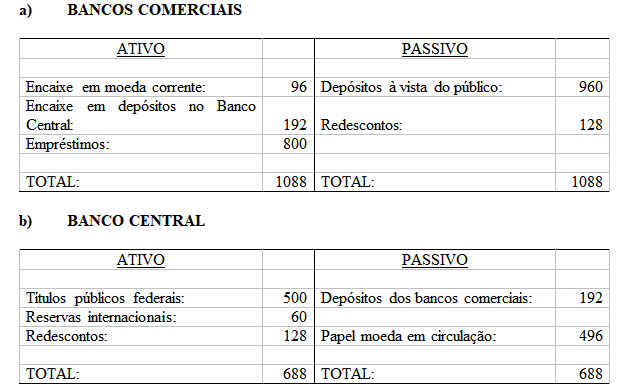
Através dessas informações, classifique, com V ou F a afirmativa abaixo:
Item 3: a dívida interna do governo é igual a 500.
Provas
ECONOMIC GROWTH
As long as the fruits of economic growth are taken in the form of higher income, economic growth will be accompanied by increases in the mean of the income distribution. However, poverty will not necessarily decrease if growth is accompanied by a sufficiently large, offsetting increase in inequality. Unfortunately the impact of growth on inequality is not nearly as clear, either theoretically or empirically, as its impact on the mean of the distribution.
Growth and the distribution of income are the joint results of a complicated set of underlying economic processes, reflected in changes in supplies of and demands for factors of production. Arguments that inequality is necessary for growth or that growth necessarily reduces inequality ignore the process generating growth and inequality simultaneously. Any correlation between these two variables is likely to be spurious - it is not growth per se, but how that growth is achieved, which determines inequality.
Technological change and increases in the supply of labor or capital offer two routes to economic growth. They are, however, not on equal footing. Since the amount of labor or capital cannot be increased indefinitely, only technological change can offer a permanent increase in the rate of growth of output. The two also differ in the ways in which they affect the distribution of income.
Technological change may increase or decrease inequality. The initial impact of technological change is to alter the demands for labor and capital. This in turn changes prices, which may call forth a supply response as workers flow to those jobs for which demand and, hence, wages are greater.
While technological change may increase the demand for all skill classes, this is by no means necessary. The result may be an increase in both economic growth and poverty. For example, a labor-saving technological change may lower the demand for low-skilled workers. The resulting decrease in wages of those at the bottom of the distribution will have two effects - some workers will drop out of the labor force, while others will be induced to gain skills in response to the drop in the relative wages of unskilled workers. Whether or not poverty increases depends on the relative magnitude of these two changes.
DANZIGER, Sheldon, GOTTSCHALK, Peter. Increasing inequality in the United States: what we know and what we don’t. Journal of Post Keynesian Economics, New York, 11(2): 181-182, 1988-89.
As seen in the fifth paragraph:
Item 1: “skill classes” mean “classes dirigentes”.
Provas
Caderno Container