Foram encontradas 312 questões.
Sejam X1, X2, ... , Xm e Y1, Y2, ... , Yn variáveis aleatórias independentes tais que !$ Xi~N(μ, σ^2) !$ e !$ Y_j~N(v, t^2) !$. Podemos afirmar que:
Item 3: Só podemos usar o teste F para a hipótese H0: !$ σ^2 = t^2 !$ quando sabemos de antemão que !$ μ = v !$.
Provas

Indique se a afirmativa é verdadeira ou falsa:
Item 4: No !$ \Re^2 !$, a inclinação da reta que passa nos pontos !$ (-1, 3) !$ e !$ (0,0) !$ é igual à 3.
Provas
"Thorstein Veblen and Post-Darwinian Economics".
By
Geoffrey M. Hodgson. Economics and Evolution. Chapter 9, pp 123-24.
Polity Press,1993.
In a famous article originally published in 1898, Thorstein Veblen (1919, p.56) asked: 'Why is economics not an evolutionary science?' The term 'evolutionary' was subsequently adopted by institutional economists, but often in broad or developmentalist terms, and with only slight attention to the more precise mechanisms of natural selection as developed in biology. Veblen's knowledge of biological science was remarkably up-to-date, yet evolutionary theory has developed enormously since his death, leaving many of his institutionalist followers well behind. Veblen made a direct appeal to biological science for inspiration; but subsequently, and until very recently, this example has rarely been replicated. Accordingly there has been remarkably little detailed exploration, informed by biology, of what Veblen precisely meant by an 'evolutionary' science, and of the character of the 'post-Darwinian' economics that he attempted to build.
Like Alfred Marshall, Thorstein Veblen saw that the appropriate metaphor for economics was to be found in biology. In particular, Veblen saw the evolutionary metaphor as crucial to the understanding of the processes of technological development in a capitalist economy. But unlike his English colleague, he did not care to develop a static, equilibrium analysis as a prelude to the dynamic. He characterized his own economics as post-Darwinian, and argued that economics should embrace the metaphor of evolution and change, rather than the static ideas of equilibrium that had been borrowed by the neoclassical economists from physics.
However, after rebutting a mechanical prelude to economic dynamics, Veblen was faced with a biology at a stage of development at which the mechanisms of evolution were only partly understood. Consequently, and given his own personal aversion to intellectual 'symmetry and system-making' (Veblen, 1919, p. 68), there was little chance that Veblen would be able to build an economic theory on the Marshallian scale.
Instead, he leaves us with plentiful hints and insights, many brilliant, several contradictory. He writes in a style which is often dazzling and illuminating, but also sometimes evasive or unclear. Partly for the latter reason, and partly because he did not provide us with a systematic theoretical legacy, his significance for evolutionary economics in particular, and economics in general, still remains underestimated to this day.
Importantly, Veblen had a keen and perceptive understanding of the relationships and connections between the social and the physical sciences. In this chapter it will be shown that Veblen had two primary reasons for the adoption of a Darwinian and evolutionary metaphor. One relates to the idea of cumulative causation and an opposition to depictions of the economic process that are consummated in equilibrium. The other is based on the formation of analogies to both the gene and the processes of natural selection in the social world.
As noted in chapter 3, Darwinian natural selection involves several component principles. First, there must be sustained variation among the members of a species or population. Without such variation, natural selection cannot operate. Second, there must be some principle of heredity or continuity, through which offspring resemble their parents more than they resemble other members of their species, due to some mechanism by which individual characteristics are passed on from one generation to the next. Third, natural selection operates either because better-adapted organisms leave increased numbers of offspring, or because the genotypes that are preserved bestow advantage in struggling to survive. The latter is the principle of the struggle for existence. The application of the metaphor of natural selection to economics should be on the basis of analogous principles. It is argued here that Veblen was relatively successful in this regard.
The author argues that Veblen
Item 2:was brilliant but unsure in his theoretical writings.
Provas
Seja X uma variável aleatória contínua com função de densidade f e com média e variância finitas. Podemos afirmar que:
Item 4: Seja Y = aX + b e sejam X* e Y* as padronizações de X e Y, respectivamente. Então X* = Y*.
Provas
Quanto à decisão de produção da firma, é correto afirmar que:
Item 1: Se a firma escolhe um nível de produção que maximiza o seu lucro, então àquele nível a firma está também minimizando o custo médio de produção.
Provas
Considere as informações sobre preços e quantidades consumidas por um conjunto de famílias em dois períodos sucessivos dadas na tabela a seguir:
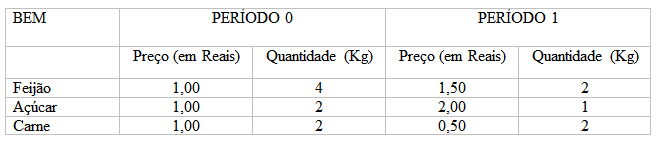
Podemos afirmar que:
Item 5: A variação percentual do nível de preços pelo índice de Laspeyres foi exatamente de 37,5% e pelo índice de Paasche foi inferior a 25%.
Provas
Provas
Sejam X1, X2, ... , Xm e Y1, Y2, ... , Yn variáveis aleatórias independentes tais que !$ Xi~N(μ, σ^2) !$ e !$ Y_j~N(v, t^2) !$. Podemos afirmar que:
Item 1:
Se dispomos de dois testes (T1 e T2, digamos) apropriados para testar a hipótese H0: !$ μ !$=!$ v !$ e precisamos escolher um deles, então se a potência (ou poder) de T1 é sempre superior à do teste T2 e ambos tem o mesmo nível de significância, é preferível usar o teste T2.
Provas
Provas
Tight Money
By
Robert Heilbroner and Lester Thurow. Economics Explained. Chapter 12, pp. 158-159. Touchstone Book. Simon and Schuster, 1994.
That bring us, of course, back to square one. If we cannot easily introduce deep institutional changes and if the use of controls promises quick relief but no permanent cure, how do we cope with the inflationary propensities that continue to lurk within modern capitalism?
The answer is very likely to be continued reliance on the one medicine that has brought inflationary fever down: tight money. As we have seen, if we are willing to tighten money ruthlessly, and to keep it tight until unions quit asking for higher wages and corporations are forced into price wars to win markets, then inflation will come to an end.
The problem with tight money is twofold. The first, obvious, problem is that the cure is so severe it threatens the health of the patient, even though it rids him of his immediate ailment. The recession that stopped inflation in the early 1980s was the worst economic catastrophe that afflicted the capitalist world since the Great Depression itself. No one wants to go through that experience again.
The second problem with tight money is certainly not an equitable, and likely not an effective anti-inflationary policy unless it is imposed with Draconian severity. Suppose a tight-money policy brings unemployment up to, say, 8 percent. That does not mean that every worker is laid off for 8 percent of the year. It means that some workers are unemployed for long periods of time. Over 50 percent of the total number of weeks of unemployment is typically borne by individuals who are unemployed for more than half of the year. Almost half of those who suffer long spells of unemployment end up not with a job, but by withdrawing from the work force.
Thus if a relatively mild recession is the way we decide to fight inflation, we should recognize that the honor of being designated as an inflation fighter is rather selectively awarded. It does not mainly go to those whose recruitment into the brigade of the unemployed would be most effective in bringing down wage rates, namely the group of prime-age white males. Rather, enlistment in the ranks of inflation fighters is predominantly that of younger workers, age 16-24, of women, of blacks and of Hispanics. These groups share two characteristics: they tend to be relatively unskilled, and they tend to lack political clout. Thus their impact on the trend of the national wage rate is small. The brigade is not only inequitably chosen, but is ineffective.
The authors points to two problems with tight money:
Item 1: It threatens the health of the economy and some workers will be unemployed for a long time.
Provas
Caderno Container